








Why Trump's Tariff Policy Could Be Good for Bitcoin
TechFlow Selected TechFlow Selected
Why Trump's Tariff Policy Could Be Good for Bitcoin
Economic uncertainty could prompt investors to turn to bitcoin, much like they have sought gold over the past few months.
 Navigating Web3 tides with focused insights
Author: Benjamin Schiller
Translation: TechFlow
As the Trump administration unveiled its tariff policy on Wednesday's "Liberation Day," many expressed pessimism about the overall economy and cryptocurrency prices. However, analysts say there are strong reasons to remain optimistic.
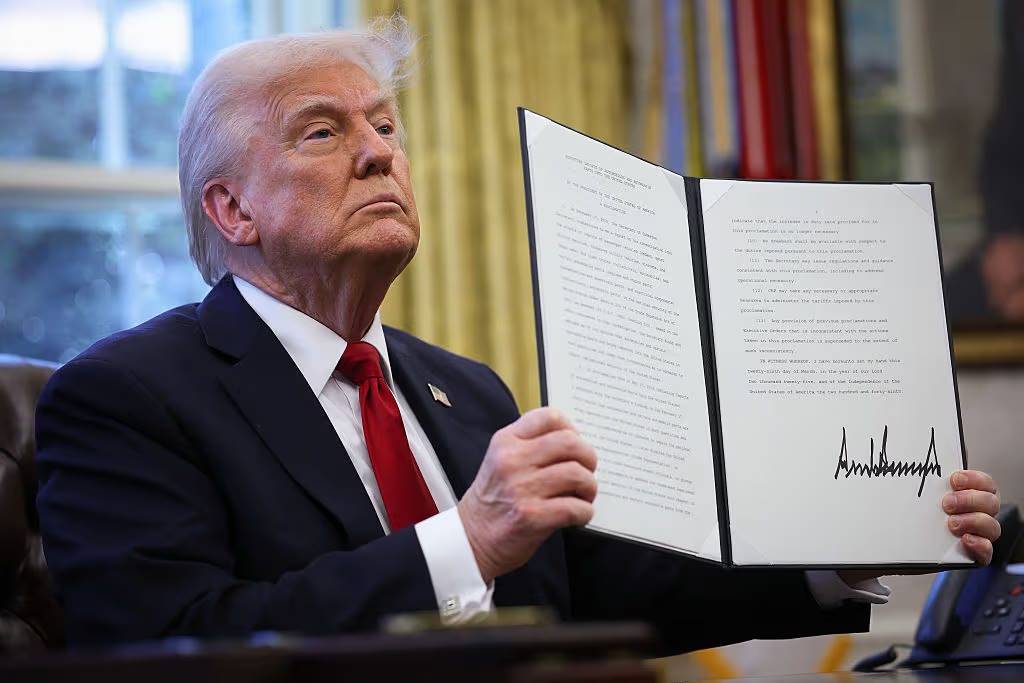
U.S. President Donald Trump signs an executive order in the Oval Office of the White House in Washington, D.C., on March 26, 2025, announcing a 25% tariff on all foreign-made automobiles
Image source: Win McNamee/Getty Images
Key Points:
-
Bitcoin price has significantly declined during the Trump administration, contrary to investor expectations.
-
Economic uncertainty and tariff policies have driven investors toward safer assets like gold, affecting the crypto market.
-
Analysts believe tariffs could weaken the dominance of the U.S. dollar, potentially benefiting Bitcoin in the long term.
So far, the cryptocurrency market’s performance under the Trump administration has diverged sharply from expectations. Investors had hoped that regulatory reforms and policies such as a Bitcoin strategic reserve would substantially boost prices—but the opposite has occurred. Early this year, Bitcoin soared past $100,000, but by March it had fallen to around $85,000.
Cryptocurrency prices have been weighed down by increased correlation with traditional assets like stocks and bonds, which are suffering due to macroeconomic uncertainty. Tariffs—additional fees imposed by the U.S. on imported goods from other countries—have raised concerns on Wall Street about a global economic downturn. Crypto investors are moving away from digital assets, which are now perceived as relatively high-risk.
"It all comes down to market 'risk appetite,' which is currently deteriorating, creating a divergence between crypto assets and gold. Gold continues to be the preferred 'safe-haven asset,'" said Marc Ostwald, chief economist and global strategist at ADM Investor Services.
"This shift is largely driven by central bank foreign reserve managers who are trying to reduce their exposure to the U.S. dollar—a long-standing concern for them."
As the global financial and trade system becomes increasingly fragmented, investors are seeking lower-risk alternatives to the dollar. For now, that means turning to gold, which has risen 18% year-to-date.
But this could change, according to Omid Malekan, adjunct professor at Columbia Business School and author of *The Story of Blockchain: A Beginner's Guide to the Technology Nobody Understands*. He believes Bitcoin may soon become the new gold.
"I think the future is full of uncertainty, even unpredictable in some ways, because there are so many intersecting factors—and both cryptocurrencies and tariffs are uncharted territories. Some view crypto purely as a risk-on tech asset that gets sold off during tariff turmoil. But Bitcoin is seen by some circles as 'digital gold,' and physical gold is rapidly rising on tariff news. So which narrative wins out?"
In other words, economic uncertainty might eventually drive investors to turn to Bitcoin much as they’ve recently flocked to gold.
Another positive signal: the impact of tariffs on cryptocurrencies may already be “priced in,” meaning the worst could be behind us, said Zach Pandl, head of research at Grayscale, a leading crypto asset management firm.
President Trump is expected to announce U.S. tariff policy on Wednesday, April 2, at 4 p.m. Eastern Time—an event dubbed “Liberation Day” (Liberation Day). Reports indicate he will unveil “reciprocal tariffs” targeting 15 countries that impose tariffs on the U.S., including China, Canada, and Mexico.
Pandl estimates tariffs have already reduced economic growth by 2% this year. But “Liberation Day” could alleviate the worst of the pain felt by financial markets. "If we see a tough but phased announcement on Wednesday, focused specifically on those 15 countries they appear to be targeting, I expect markets to rebound on the news," Pandl told CoinDesk.
"Once we get past this announcement, crypto markets may refocus on fundamentals—and those fundamentals are very positive."
Pandl pointed out that announcements like Circle’s IPO filing wouldn’t happen unless institutions had strong confidence in the digital asset sector and related policies.
Moreover, Pandl—the former Goldman Sachs macroeconomist—believes tariffs will increase demand for non-dollar currencies.
"I think tariffs will erode the dominance of the U.S. dollar and create space for competitors, including Bitcoin. Prices may fall in the short term, but the first few months of the Trump administration have further strengthened my long-term conviction in Bitcoin as a global monetary asset."
Despite current market pessimism about prices, Pandl still believes Bitcoin will reach new all-time highs this year. "If I didn’t believe Bitcoin would ultimately win in the long run, I wouldn’t have left my job on Wall Street," he said.
Join TechFlow official community to stay tuned
Telegram:https://t.me/TechFlowDaily
X (Twitter):https://x.com/TechFlowPost
X (Twitter) EN:https://x.com/BlockFlow_News
 CoinDesk






