GHIBLI Mania: From Cultural Symbol to the Fracture and Crisis of Crypto Frenzy
TechFlow Selected TechFlow Selected
GHIBLI Mania: From Cultural Symbol to the Fracture and Crisis of Crypto Frenzy
GHIBLI's rapid rise to fame in a short period cannot be attributed to luck alone—it was driven by three indispensable engines: technological revolution, celebrity effect, and the crypto market's hunger for narrative.
 Navigating Web3 tides with focused insights
By Daniel Li
In March 2025, a global wave of cultural symbol financialization, triggered by AI-generated images, swept across the internet. On March 25, OpenAI officially launched its multimodal model GPT-4o, whose built-in "Ghibli-style" image generation feature quickly ignited social media. Users could transform any image into the classic aesthetic style of Studio Ghibli animations with just an upload and a simple command. This technological breakthrough not only turned ordinary users into "digital artists," but also sparked a carnival spanning technology, art, and finance.
Within just 24 hours, over 5 million Ghibli-style-related posts flooded X (formerly Twitter), with participation from tech leaders like Elon Musk and Sam Altman pushing the frenzy to its peak. Meanwhile, the crypto market reacted swiftly: on the afternoon of March 26, the Solana-based meme token GHIBLI launched and achieved a market cap exceeding $40 million within 24 hours—a surge of more than 100x—with trading volume reaching $109 million. Behind this spectacle lies the erosion of artistic originality by AI and, even more so, the capture of emotional value by crypto capital.
01 The Rise of GHIBLI: An Experiment in Complicity Between Algorithms, Capital, and Cultural Symbols
The rapid explosion of GHIBLI was no mere stroke of luck—it was driven by three indispensable engines: technological revolution, celebrity influence, and the crypto market’s hunger for narrative. Remove any one, and the phenomenon would not have occurred.
Technological Revolution: GPT-4o's "Style Transfer" and the Illusion of Artistic Democratization
OpenAI’s GPT-4o multimodal model uses contrastive learning techniques to precisely decode the visual characteristics of Ghibli works—soft color gradients (like the forest greens in *Spirited Away*), rounded character outlines (such as the childlike designs in *My Neighbor Totoro*), and intricate natural scenes (like the primeval forests in *Princess Mononoke*). With just an uploaded image and the prompt “redraw in Ghibli style,” the model generates highly faithful imitations within five seconds. At the core of this breakthrough is multimodal integration: GPT-4o achieves joint training of text, image, and audio for the first time, eliminating reliance on external models like DALL-E and enabling direct cross-media content generation.
However, the essence of this "barrier-free creation" is the industrial downgrading of art. As early as 2016, Hayao Miyazaki condemned AI-generated content as “an insult to life itself,” arguing that it lacks the emotional warmth of hand-drawn animation. While democratization of technology appears to empower mass expression, it simultaneously erodes the uniqueness of artistic creation. When Musk used GPT-4o to generate a *Totoro*-style portrait of himself, public attention shifted from the narrative depth of animation to symbolic visual tags—artistic value reduced to a replicable template.
Celebrity Effect: Viral Social Capital and the Minting of Financial Symbols
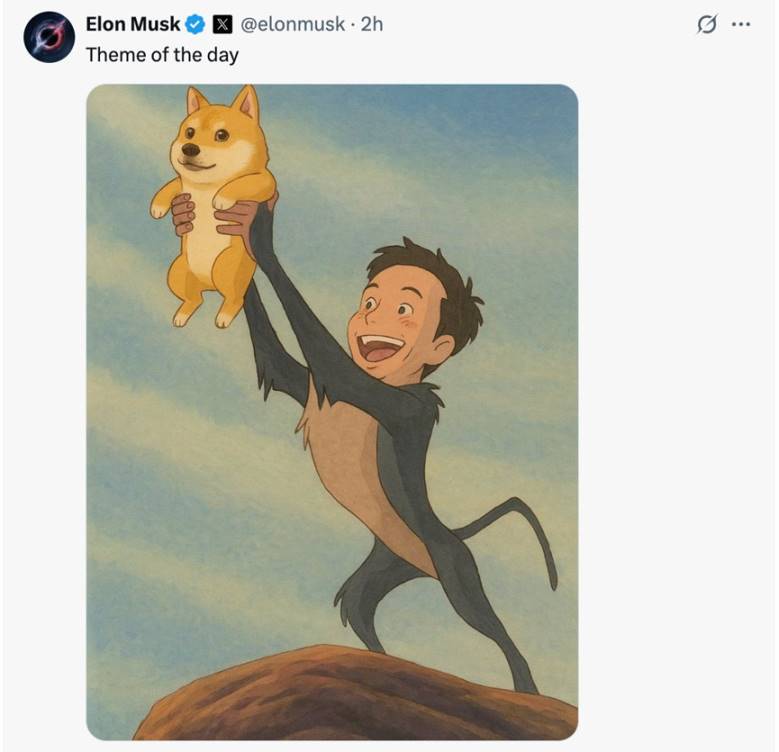
The deep involvement of tech elites served as the core catalyst behind the GHIBLI phenomenon—a strategy fundamentally about converting personal influence into social capital, then monetizing it through the crypto market. At 9:00 AM on March 26, OpenAI CEO Sam Altman changed his X profile picture to a Ghibli-style portrait, captioning it “This is today’s theme.” The post garnered 1.2 million retweets, directly propelling GHIBLI’s market cap from $5.3 million to $15 million within three hours. The next day, Musk posted a Ghibli-style portrait of himself wearing a kimono in a bamboo grove, with the same caption. It received 55.9 million views—the highest single-tweet engagement record of 2025—and triggered a 17-fold increase in GHIBLI trading volume over the following 24 hours, accounting for 23% of Solana’s total transaction volume.
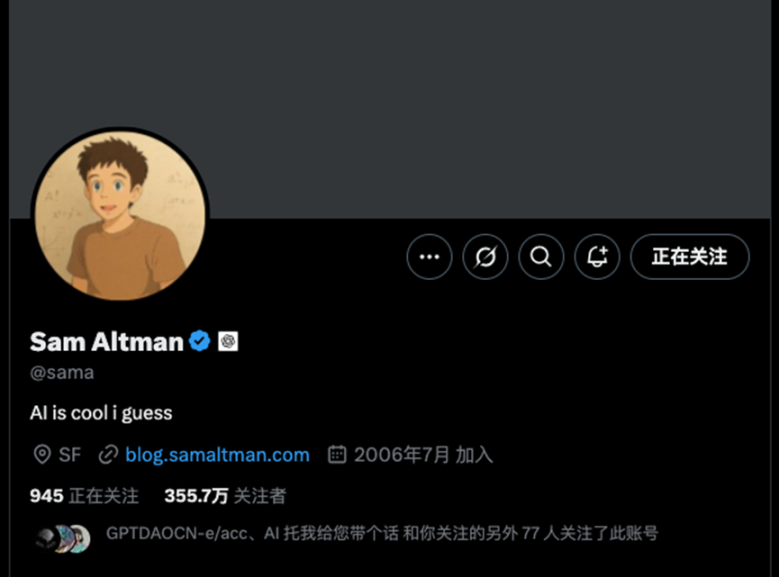
Crypto figures were quick to follow. Binance CEO Richard Teng and Ripple executive Brad Garlinghouse actively shared their own Ghibli-style avatars, creating a chain reaction. On-chain analysis revealed that an address linked to Garlinghouse held $870,000 worth of GHIBLI tokens, suggesting a possible “celebrity endorsement + covert holding” dual harvesting strategy. This act of “identity rebranding” not only satisfies the public’s desire for personalization but amplifies the token’s reach through celebrity credibility, forming a closed loop of “social heat → financial premium.”
Narrative Hunger in Crypto: From Liquidity Traps to Emotion-Driven Pricing
GHIBLI emerged at a time when the crypto market was mired in macroeconomic turmoil. In early March, the Trump administration announced 15% tariffs on imported goods, sparking inflation fears. Bitcoin plunged 40% from its late-2024 highs; Ethereum dropped 60%; total market capitalization shrank by 38%. Institutional funds rapidly exited, with Bitcoin ETF net inflows collapsing from a weekly peak of $1.2 billion to just $89 million. Against this backdrop, high-volatility meme coins became prime targets for speculative capital. On GHIBLI’s launch day, meme coin trading volume on Solana surged from 14% to 39% of the chain’s total, while DeFi protocol TVL fell 23%, signaling a clear shift of liquidity from technical projects to emotional assets.
The deeper logic lies in filling a narrative vacuum. Sectors like AI and RWA had fallen silent after valuation bubbles burst. GHIBLI seized the moment with its cross-genre narrative of “Ghibli aesthetics + AI generation,” rapidly capturing public imagination. Its market cap soared past $24 million within 24 hours, up 10,824%, revealing a new pricing paradigm in crypto: emotional value > technical value. This shift exposes the industry’s speculative nature—when innovation stalls, the financialization of cultural symbols becomes the only lifeline.
02 GHIBLI May Spark a Paradigm Shift in Meme Coins: From Cultural Symbols to Financial Instruments
The rise of GHIBLI is more than a fleeting trend—it signals a profound transformation in the meme coin market. Unlike the traditional “Dogecoin model,” which relied on grassroots community momentum, GHIBLI resembles a top-down precision marketing campaign. Its rapid spread and powerful market dynamics reveal three key evolutionary traits of meme coins:
1. Cross-Community Spread: Building a Cultural Capital Loop
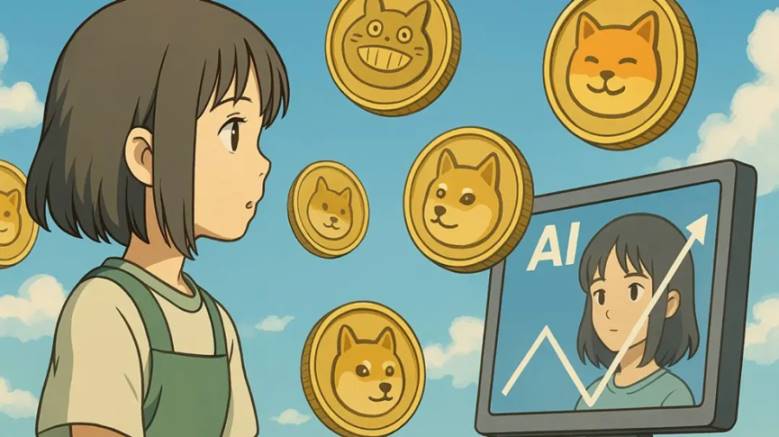
GHIBLI’s success was no accident—it was a masterclass in “cultural crossover.” The Ghibli IP already commands global recognition, and the GHIBLI token leveraged this to attract a massive influx of non-crypto users, expanding the crypto market’s reach unprecedentedly. Data shows that Musk’s GHIBLI-related tweet reached 55.9 million users, 70% of whom came from outside the crypto community. This indicates that meme coins are no longer dependent solely on traditional crypto circles. Instead, they now achieve broader market penetration through IP appeal, social media virality, and emotional hype. This model grants meme coins extraordinary growth potential—but also intensifies their speculative nature.
2. Instant Financialization: The Meme Coin “Industrial Assembly Line”
Traditional crypto projects typically require months of development, auditing, and community building. New-generation meme coins, however, bypass all of this entirely, achieving “instant listing.” Solana’s fast transaction speeds and low fees provide the technical foundation for such explosions. Take Pump.fun on Solana, for example: it reduces the token launch process to just five minutes, making meme coin creation and trading extremely efficient. The essence of this model is automated token issuance via smart contracts, allowing markets to instantly seize trends and complete a full cycle from emotional trigger to trading activity. This hyper-financialized pipeline transforms meme coins from mere community artifacts into “short-term financial instruments” designed for rapid capital博弈.
3. Standardized Harvesting: Precise Market Timing and Control
As meme coin trading matures, manipulation tactics grow increasingly sophisticated. Capital operators now use social media data analytics to precisely control token release timing. For instance, on-chain data shows that during GHIBLI’s most active trading period, one address added 7.28 million GHIBLI tokens in liquidity on Meteora, then withdrew them 24 hours later—causing the price to crash 43% instantly. Such maneuvers indicate that the meme coin market is evolving into a “data-driven financial game,” where whales leverage social sentiment monitoring and on-chain analytics to execute precise harvest strategies, leaving retail investors struggling to discern real market movements.
03 The Ultimate Question for Crypto: Speculative Frenzy or Value Rebuilding?
The Ghibli fever ignited by GHIBLI burned fast—and faded faster. Currently, GHIBLI trades at just $0.006964, down over 80% from its all-time high on March 28. Another coin, GhibliCZ, briefly surpassed a $14 million market cap within 24 hours of launch, only to fall back to $3.2 million within 48 hours—a volatility of 318%. A similar fate befell KawaiiCoin on the BNB Chain, which capitalized on “kawaii culture” and briefly accounted for 9% of BNB’s total trading volume on launch day. But lacking real-world utility, its price halved within two days, and interest evaporated rapidly.
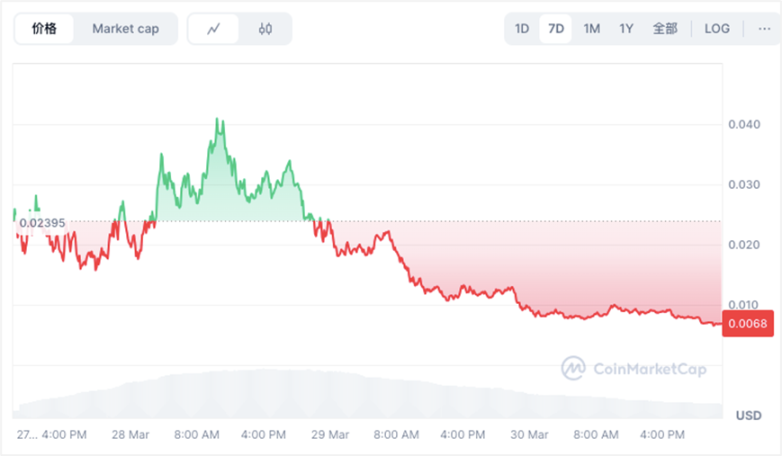
Such sharp rallies and crashes are not anomalies—they represent the cyclical fate of nearly all meme coins. Historical data shows that 99% of meme coins die within three months, experiencing extreme volatility before quickly collapsing to zero—becoming sacrificial victims of speculation. GHIBLI’s rollercoaster ride reaffirms this pattern: most meme coins are fundamentally emotion-driven financial games, devoid of long-term value or genuine technological innovation, operating instead within a short-term loop of “emotion → traffic → capital.”
But can this market logic truly last? If the industry remains addicted to the fast-food cycle of “trend → token → harvest,” crypto will ultimately devolve into a battlefield of scams and bubbles, stripped of any real value. Over the past few years, whether during the NFT craze or successive waves of meme coin mania, one central issue has persisted: when market drivers shift from technological innovation to emotional manipulation, the entire industry’s long-term viability is jeopardized.
GHIBLI’s collapse won’t be the last, nor the largest. In the future, regulatory crackdowns, legal actions, or shifts in market sentiment could all serve as triggers to burst the meme coin bubble. What the crypto industry truly needs isn’t more short-term gambling opportunities, but a redefinition of long-term value.
The Ghibli IP once stood as a symbol of warmth and healing. Now, it has become a tool for financial speculation. This is not only a profound challenge to the crypto market but also a critical reflection on the entire digital cultural ecosystem: Will we continue catering to short-term market emotions, or build a digital economy grounded in sustainable, long-term value? This is the question every participant in the crypto space must confront.
Join TechFlow official community to stay tuned
Telegram:https://t.me/TechFlowDaily
X (Twitter):https://x.com/TechFlowPost
X (Twitter) EN:https://x.com/BlockFlow_News