








Strategy stock has tripled since October last year—unraveling Saylor's Bitcoin financial magic
TechFlow Selected TechFlow Selected
Strategy stock has tripled since October last year—unraveling Saylor's Bitcoin financial magic
Market attention and feedback, in turn, drive the success of the strategy, and this "reflexivity" could bring longer-term growth potential to the Bitcoin reserve strategy.
 Navigating Web3 tides with focused insights
Author: JAY
Translation: TechFlow

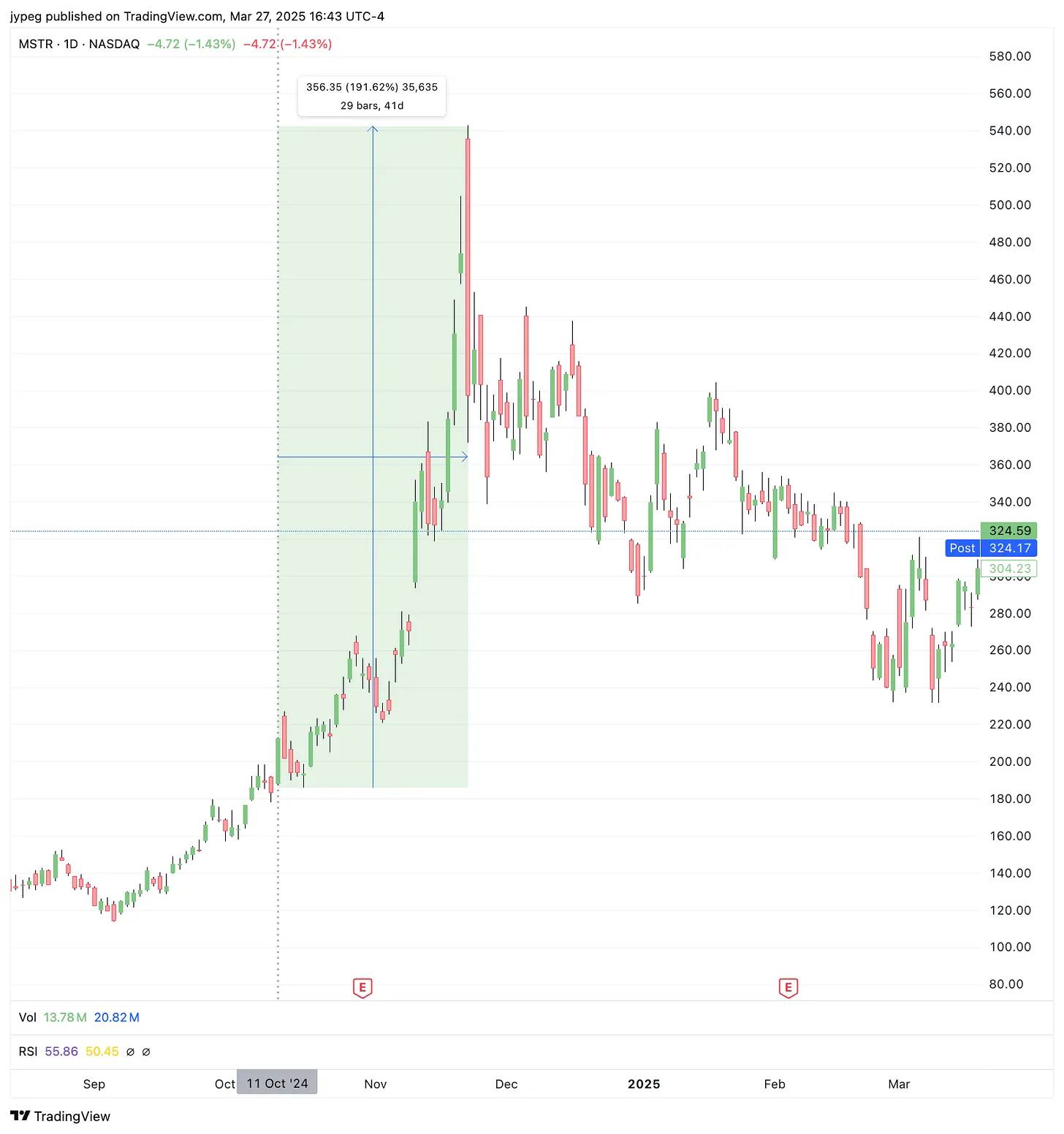
Since October 2024, Strategy (MSTR) has experienced dramatic stock price fluctuations. The share price surged from $188 to $540—an almost threefold increase—before pulling back and stabilizing in the lower $300 range.
(Note: In February this year, MicroStrategy announced its official name change to Strategy. For clarity, this article continues to refer to it as MicroStrategy.)
Behind this stock movement lies a series of strategic moves driven by company founder Michael Saylor, including renaming the company to Strategy, acquiring over 506,000 bitcoins (BTC), and issuing two new preferred shares, STRK and STRF.
However, there are many inaccurate interpretations in the market regarding how Strategy operates. To help investors better assess whether Saylor’s bitcoin reserve strategy is sustainable, we aim to simplify its core logic.
Saylor's Bitcoin Reserve Strategy: Two Key Elements
Saylor’s financial strategy can be summarized in two key points:
-
Selling stock options and collecting proceeds upfront
Strategy raises capital by selling purchase or conversion options for MSTR shares, setting strike prices between 30% and 300% above the current market price, and collecting all proceeds immediately through structured transactions. This is primarily achieved by issuing convertible bonds and preferred shares STRK and STRF.
-
Issuing additional common stock at opportune moments
Using the ATM (At-the-Market) mechanism, Strategy issues additional MSTR shares when market conditions are favorable to raise further funds.
It should be noted that Saylor does not have a clear plan to repay the principal on these options or bonds. His primary goal is to sustain the financing program long-term while paying interest, until MSTR’s share price reaches the relevant strike prices.
The main advantage of this strategy lies in its highly flexible funding approach. Using this framework, Saylor can select the optimal fundraising instrument based on market conditions:
-
When implied volatility is high, issue convertible bonds;
-
When MSTR’s net asset value (NAV) trades at a high premium, issue common stock via the ATM program;
-
When neither condition is met, issue more preferred shares (such as STRK or STRF).
While outsiders may express concerns about the high leverage risk of this strategy, data shows these fears are unfounded. Below are key financial metrics for MSTR:
-
Market cap: $85 billion;
-
Bitcoin holdings value: Approximately $44 billion (506,000 BTC);
-
Total debt: $8.2 billion, with an annual interest rate of only 0.421%, resulting in roughly $34 million in annual interest expenses;
-
Preferred dividend payments: $58.4 million annually for STRK, $85 million annually for STRF.
Ratio analysis of these figures reveals that Saylor’s use of leverage is actually very limited, and the cost of debt is extremely low.
Bitcoin Reserve Strategy vs. Traditional Banking Model
In some ways, Strategy’s bitcoin reserve strategy resembles the operational model of traditional banks. The core mechanics of each are as follows:
-
Traditional banking model
Banks amplify leverage through fractional reserve banking to boost returns, though this occasionally leads to bank failures.
-
Accept customer deposits;
-
Use deposited funds to purchase “safe” government-backed debt (e.g., Treasury securities, mortgage-backed securities);
-
Pay depositors interest rates lower than the yield earned on debt investments.
-
-
Bitcoin reserve strategy
Unlike traditional banks, Strategy’s bitcoin reserve strategy avoids excessive leverage, as there will be no government bailouts available if problems arise—as seen in the banking sector.
-
Raise capital (analogous to banks accepting deposits);
-
Use raised capital to purchase bitcoin (instead of government-backed debt);
-
Pay investors returns via MSTR stock appreciation plus regular interest or dividends.
-
Despite different operational methods, both models aim to generate profits through capital management. Banks rely on net interest margin—the difference between investment yields and deposit interest—to deliver returns to investors. In contrast, bitcoin reserve companies depend on capital appreciation of bitcoin, allowing investors to benefit from bitcoin price volatility (see this resource for a deeper explanation of how this trade works and why it benefits convertible bond buyers). This appreciation stems primarily from rising bitcoin prices or dollar depreciation against bitcoin.
Future Potential of the Bitcoin Reserve Strategy
Michael Saylor is one of the most committed advocates of the bitcoin reserve strategy. His asset management model has successfully attracted numerous companies to follow suit and prompted the U.S. government to begin exploring similar reserve strategies. The continued rise in both MSTR and bitcoin prices serves as the best “advertisement” for this strategy, further boosting market acceptance of the bitcoin reserve concept.
Although only a small minority currently fully understand and embrace Saylor’s strategy, its market influence and sustainability are growing alongside the development of bitcoin and MSTR. Market attention and feedback in turn reinforce the success of the strategy—this “reflexivity” could unlock even greater long-term potential for the bitcoin reserve model.
Join TechFlow official community to stay tuned
Telegram:https://t.me/TechFlowDaily
X (Twitter):https://x.com/TechFlowPost
X (Twitter) EN:https://x.com/BlockFlow_News
 @0xjaypeg


