Arcium Past and Present: Solana Enters Privacy 2.0
TechFlow Selected TechFlow Selected
Arcium Past and Present: Solana Enters Privacy 2.0
Arcium entering the TGE process marks the end of classical privacy projects.
 Navigating Web3 tides with focused insights
Author: Zuo Ye
Fashion is cyclical; crypto moves in cycles. Perhaps the era of pure cycles is over, but copycat projects will live forever.
Arcium, a cryptographic supercomputing project on Solana, chose CoinList for its community round—suddenly reminding me of the script wars for CoinList allocation during 2017–2021, the rookie village for scientists and yield farmers alike.
A new generation surpasses the old, yet Arcium has changed course three times, struggling to carve out a path to survival. It narrowly escaped the Solana meme season—whether it can fulfill its dreams in the BSC meme season remains to be seen.
Past Life: The Dark Pool Elusiv That Deleted Its Repository and Fled
Three sentences summarize why Elusiv transformed into Arcium:
-
You should know Arcium isn't my real name—Elusiv is my true lineage;
-
MPC-based encrypted data was a disguise; dark pools were always the core business;
-
Privacy 1.0 focused on individual private states; version 2.0 emphasizes shared collaboration.
Elusiv originated from a Solana hackathon, initially serving as a Solana clone of privacy-focused projects like Zcash, Monero, and Tornado Cash, concentrating on building dark pool (Dark Pool) services using ZK/FHE/MPC technologies.
Dark pool services aren’t complicated—they refer, much like the dark web, to activities beneath the surface, carrying an air of deep-state intrigue. In essence, they represent off-exchange anonymous transactions by traditional institutions or large individual traders aiming to avoid volatility in secondary markets.
On blockchains, however, transparent ledgers expose all transactions publicly—this transparency is precisely where MEV originates. Thus, there’s inherent demand for shifting certain activities into anonymity.
But as mentioned, Privacy 1.0 at that time had no fundamental difference from mixers or Monero. After Tornado Cash faced regulatory crackdowns, continuing down this path would amount to provoking U.S. authorities. As such, Elusiv ceased code updates two years ago.
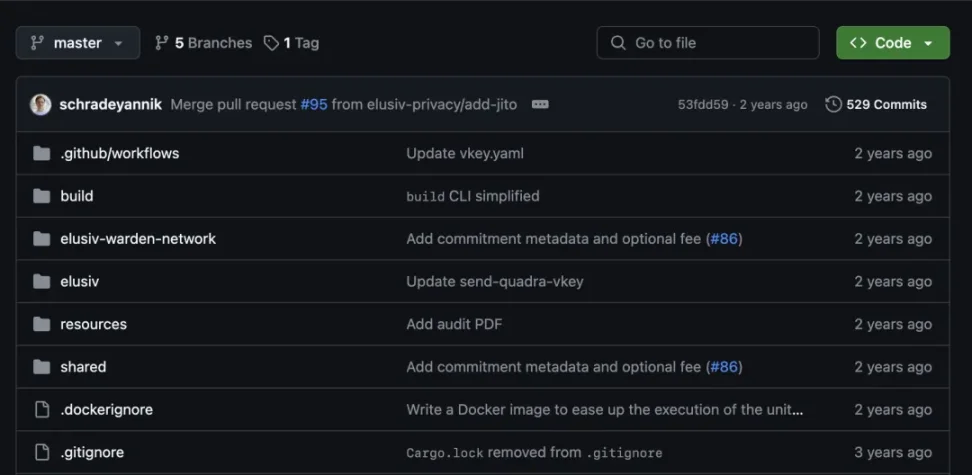
Image caption: Elusiv halted development. Source: @ArciumHQ
If you search for "Dark Pool" and "FHE" under @ArciumHQ, you’ll find they focus on two things: emphasizing MPC's advantages over FHE—mainly computational efficiency and cost—and expressing long-term optimism about dark pools, whether under the former name Elusiv or current branding Arcium.
In reality, technologies like MPC, FHE, ZK, and TEE don’t have absolute superiority; their value lies more in differing application scenarios. MPC centers on secure multi-party computation, FHE enables computation on encrypted data, while ZK ensures data validity before encryption.
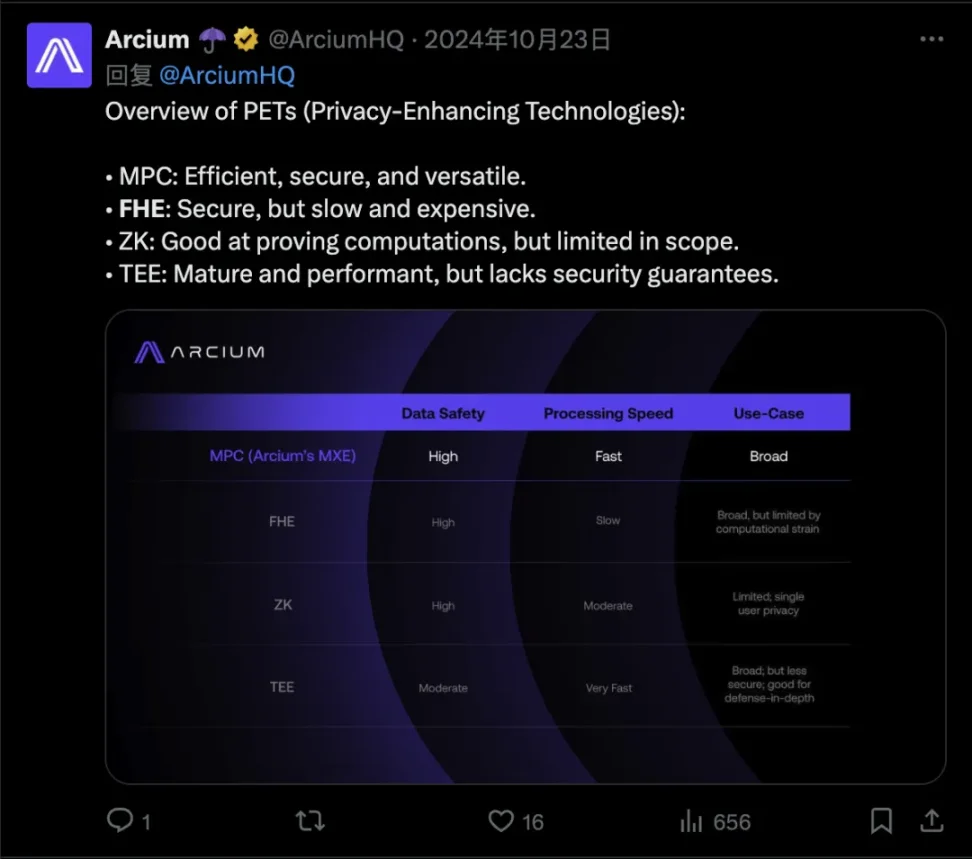
Image caption: Privacy tech comparison according to Arcium. Source: @ArciumHQ
To state confidently: today, most privacy technology-driven projects are struggling. Why attack each other when growing the market together would yield greater mutual benefit? But here’s the twist: just as Tornado Cash sees a glimmer of hope, Arcium begins promoting dark pools again.
Building a project is hard; building a successful one is harder—it must withstand relentless market scrutiny and still feel fresh. Being a retail investor is tough; being a profitable one is even tougher—you must decode meaning word by word amid “all wearing Bluetooth headsets along the Huanglong River.”
Present Life: From Parallelized FHE to Cryptographic Supercomputing
Arcium has its own vision regarding data-centric privacy.
In short, Arcium explores how to integrate blockchain characteristics with MPC. The answer seems straightforward: since MPC requires multi-party computation and blockchains rely on multi-node operations, combining them naturally leads to Multi-Party eXecution Environments (MXEs).
Basing on this foundation, adding parallel execution techniques and integrating features from FHE/ZK creates a fast and secure blockchain encryption system.
For those interested in parallelization, read our earlier article that hasn’t aged poorly: *Parallelism Isn’t Just for EVM: Can High-Performance L1s (Like Sui) Challenge Ethereum L2s?*
Still, these technical details aren’t crucial. Like Nillion, the central issue facing privacy tech today is lack of real-world use cases. Arcium targets AI, DePIN, and DeFi. The first two serve well as fundraising buzzwords, but only dark pools and private transactions (mixing) within DeFi currently have genuine market demand.
Arcium’s claim of being 10,000x faster than FHE architectures holds no practical significance—blockchain has zero demand for FHE, so multiplying zero by ten thousand still results in zero.
I’m not dismissing Arcium or MPC/FHE technology, but their long-term demand remains unclear. Under pressure to launch tokens, teams resort to fabricating non-existent needs—just as buying back garbage coins doesn’t turn them into valuable ones.
Future Life: Drifting Solana Privacy 2.0
Yet change is always possible. Helius once delivered the most accessible explanation of Solana 2.0 and is now redefining the concept of Solana Privacy 2.0. I remain skeptical, but it does sound plausible.
The core idea boils down to one point: Privacy 2.0 means multi-party privacy—specifically, shared private states. In other words, MPC. More concretely, it encapsulates Arcium’s conceptual framework:
-
arxOS is an encrypted operating system designed to aggregate computing power across Arcium nodes;
-
MXE is the execution environment enabling secure computations on Arcium;
-
Arcis is a programming language derived from Rust, similar to how Move relates to Rust.
Let me vent here: StarkNet, Move, and now Arcis—all are modified versions of Rust. While projects may believe this maximizes customization benefits, in practice, it merely increases developer burden without tangible gains.
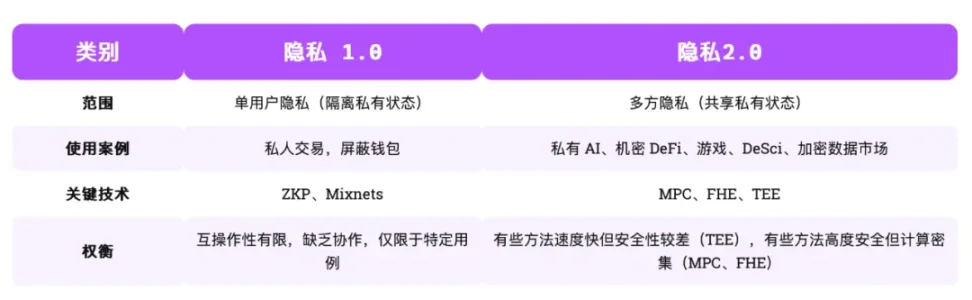
Image caption: Difference between Privacy 1.0 and 2.0. Source: Helius
In reality, privacy-preserving AI likely won’t require MPC/FHE-level technologies. If LLMs become small enough, MCP could become a de facto industry standard, meeting everyday personal user needs without excessive privacy exposure.
If "private AI" refers to companies, entities, or individuals deploying their own LLMs locally, then incorporating MPC/FHE introduces inefficient trade-offs—increased interaction latency and high computational costs. While MPC is cheaper than FHE, its own compute demands are far from inexpensive.
Moreover, dark pools and private transactions (anonymous micro-transfers, mixing) primarily face regulatory hurdles, followed by cost issues. Dark pools cater to whales—the battle between traditional financial dark pools and the SEC continues unabated, as does the struggle around mixers.
Even if Trump embodies a "profit-at-all-costs, let chaos follow" attitude, would the rise of on-chain dark pools really prompt another Railgun-style move toward regulator-approved privacy models? Such arrangements between big players leave only retail investors vulnerable.
The U.S. government has officially dropped its pursuit of Tornado Cash, but after this episode, purely classical true-privacy solutions will never regain mainstream status. TRM Labs and Railgun’s active/passive compliance models allow regulators to monitor on-chain behavior.
The only real market need lies in anonymous micro-transactions. Yet average users won’t pay extra for privacy. You can treat it as a service, but basing a full PMF (Product-Market Fit) strategy solely on this is extremely difficult.
Conclusion
Arcium entering TGE marks the end of classical privacy projects—an even more iconic conclusion than Tornado Cash’s rehabilitation. From now on, teams will proactively self-censor; boundaries have been firmly drawn.
Join TechFlow official community to stay tuned
Telegram:https://t.me/TechFlowDaily
X (Twitter):https://x.com/TechFlowPost
X (Twitter) EN:https://x.com/BlockFlow_News
 @zuoyeweb3