








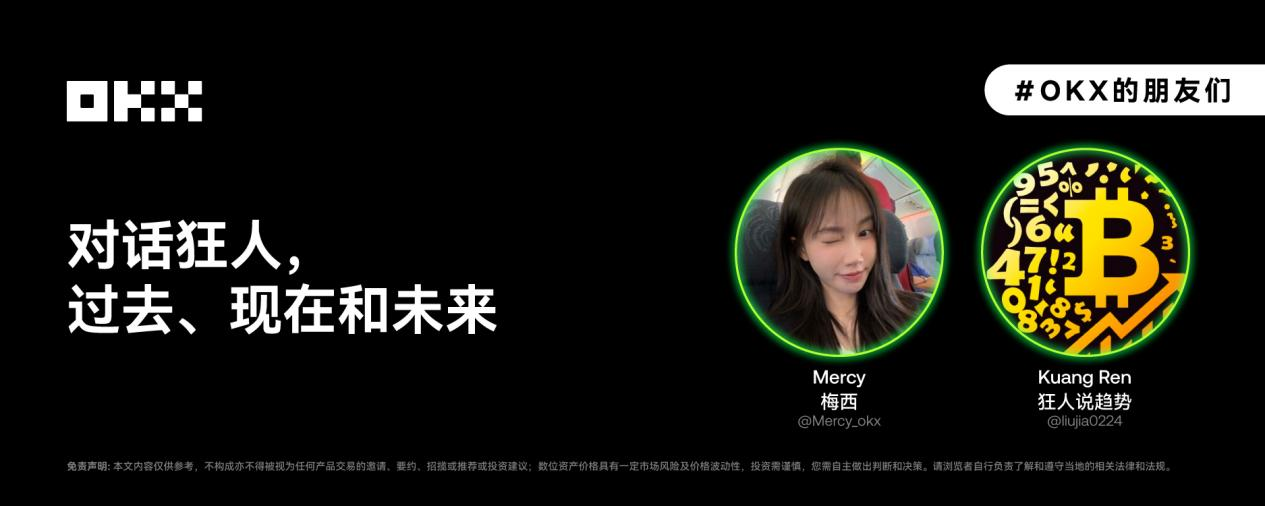
OKX Friends Episode 9 | Conversations with the Visionary: Past, Present, and Future
TechFlow Selected TechFlow Selected
OKX Friends Episode 9 | Conversations with the Visionary: Past, Present, and Future
The crypto world is stirring again—what is the once-dominant "madman" of the crypto scene doing now?
 Navigating Web3 tides with focused insights
The crypto world is stirring again—do you remember @liujia0224, the top influencer from the 2017 bull run?
The one who posted daily without fail, guiding countless traders with a "responsible, focused, and sincere" approach—the legendary "Crypto Trend Maniac."
This WeChat account was once a must-read for every Bitcoin trader. Articles would instantly rack up 100,000+ views, earning it the nickname of the "weather forecast" for crypto, accurately predicting price movements of Bitcoin, Litecoin, Ethereum, and other digital currencies.
On social media, he was a superstar—an icon known to all. His VIP group had an entry threshold so high it was almost absurd (rumors said at least 10 BTC), making membership a status symbol reserved only for the wealthy and well-connected.
Yet after several market cycles, the influencer landscape shifted toward YouTube and Twitter, and rumors about the "Maniac" retiring from the scene began to circulate. Now, as the crypto market heats up again, what has become of this once-dominant figure?
Welcome to "Friends of OKX," a series of in-depth interviews exploring the personal journeys, insights, and lessons learned from various KOLs across the industry, offering valuable guidance for new users. This episode features Mercy Messi @Mercy_okx—follow her for more!
Main Content
Article Overview:
Chapter One: The Maniac Speaks – The Past
Chapter Two: The Maniac Speaks – Present & Future
Chapter Three: The Maniac Speaks – Advice for Newcomers
Chapter One: The Maniac Speaks – The Past
1. What brought you into crypto? Did you first see BTC priced at just over 600 RMB?
Hi Mercy, hello everyone. I'm thrilled to join this space session with OKX's friends. Let me briefly introduce myself—I hold a master’s degree in finance and have worked at several major financial institutions, including securities firms, trust companies, and insurance firms. I'm deeply familiar with various financial products and derivatives.
I started trading stocks in 2008, which is when I fell in love with trading. Like many young traders, I went through all the classic pitfalls—leveraged positions blowing up, years of hard-earned gains multiplying tenfold, only to lose everything in just days during a market crash. That year featured the stock market circuit breaker event.
While trading stocks, I also enjoyed exploring new markets. Back in 2013, I dabbled in precious metals, philately, and even Bitcoin. Among them, Bitcoin left the deepest impression. There was a newly launched exchange aggressively advertising on Baidu, offering 0.1 BTC for signing up. I first saw Bitcoin priced around 600 RMB. Within a month of participating, it surged from 600 to 8,000 RMB—the accelerated bull run of 2013. I didn't invest heavily since my focus was still on A-shares, but I managed to make about 100,000 RMB. Later, I kept buying the dip during the decline, but ended up losing most of those profits through repeated trades.
Still, that experience planted a seed—a deep passion for Bitcoin trading. Compared to A-shares, Bitcoin offered three key advantages: zero trading fees, 24/7 trading, and unrestricted T+0 trading. For someone passionate about trading, it felt like paradise. But then Bitcoin entered its bear markets of 2014 and 2015, with low volatility. Meanwhile, A-shares entered a bull phase, so my attention drifted away from crypto.
In 2016, A-shares turned bearish again, and I remembered Bitcoin. I thought—if I keep thinking about it, why not try working at an exchange? So, leveraging my years of experience in both A-share trading and crypto, I successfully joined an exchange as an analyst.
That marked the beginning of my journey in virtual currencies—in today’s terms, entering the crypto industry.
2. Why did you start writing a WeChat public account? How did you become the #1 crypto influencer?
Starting the public account was serendipitous. At the time, WeChat public accounts were booming—the hallmark of a new era of self-media. I've always enjoyed trying new things. I initially wrote casually for Huobi, focusing on general finance topics rather than crypto. With zero followers, my second article hit 2.5 million reads, showing me the platform’s potential. I realized: if I applied my years of stock trading expertise to crypto, it would be like bringing a tank to a knife fight.
Sure enough, thanks to professional depth, I quickly surpassed the few existing analysts in the space and remained at the top of rankings for five years—until my account was eventually shut down.
I didn’t actively build a community. Because I poured so much effort into writing, all my interaction happened in the comment section. The positive feedback fueled me to maintain a daily update streak for over six years—five of which were on WeChat. Over time, a unique "Maniac-style" community naturally formed.
The content journey wasn’t smooth. 2017 saw the fastest growth in followers, driven by strong profit opportunities and numerous altcoins creating overnight millionaires. But by late 2018, the market froze—dead silent. My posts attracted little attention, users kept losing money, and all I received were angry comments. I began questioning my path. Around 90% of top influencers in the industry quit at that time, but I chose to persist. I believed in Bitcoin’s future. I believed blockchain was the technology of tomorrow. As the pioneer of blockchain, Bitcoin had a bright destiny ahead.
During that dark period, I kept reinforcing faith—telling people Bitcoin would replace gold, could become a national strategic reserve, evolve into a globally circulating currency, and ultimately be priced in satoshis, with 1 BTC = 100 million satoshis. To this day, I still believe that.
By 2021, the market finally showed signs of life. My followers celebrated—they said they were glad they held on because they made millions, changing their lives forever. Countless people told similar stories. That’s when I truly felt successful—not just transforming my own life, but also positively impacting those who believed in me. Looking back, though, it was simply riding the right wave. The same level of effort in A-shares likely wouldn’t have led to such life-changing results. So in the end, choice matters more than effort.
Chapter Two: The Maniac Speaks – Present & Future
1. What impact will the U.S. treating crypto as a national asset reserve have on the market in the short and long term?
Let’s start with the short-term impact. Trump’s policy falls under the category of “sell the news”—a positive expectation turning negative upon realization. The market had hoped the U.S. government would directly purchase Bitcoin with real funds as part of a strategic reserve. Instead, Trump’s plan relies on seized assets to form the reserve. Naturally, this fell short of expectations. The market reacted immediately—selling off sharply, literally washing its face with a waterfall.
Long-term, however, the significance of a U.S. strategic reserve is enormous. The U.S. dollar is the world’s most important currency. Until now, sovereign nations have only held dollars and gold as reserves. Adding Bitcoin to America’s strategic reserve signals that Bitcoin will gain global recognition. Even if the U.S. isn’t buying now, other countries wanting to add Bitcoin to their reserves will need to purchase it outright. The logic mirrors Grayscale’s Bitcoin Trust model—only buy, no selling allowed. But the scale could be hundreds or thousands of times larger than Grayscale. This clearly supports long-term price appreciation.
We should now watch for which country becomes the second to announce a strategic reserve. I believe it won’t be long before multiple nations follow suit.
Beyond store of value, Bitcoin’s inclusion in reserves has deeper implications regarding liquidity. Bitcoin is far easier to transport than gold—just memorizing your private key allows you to carry wealth anywhere,不受 any national currency restrictions. No existing currency or gold offers this feature. If such a currency becomes global, billions of people could hold small amounts of Bitcoin for daily transactions. A unified global monetary system would emerge, with Bitcoin as the value anchor, and all goods priced relative to it. That may be the ultimate form.
Until that point, we can say Bitcoin’s price will never be “too high.” Each step forward pushes prices higher. How many years will it take? I believe we’re still early. My view on Bitcoin: the long-term bull market is far from over, innovation has just begun—it’s a legacy to pass to the next generation.
2. All of Trump’s promised benefits have now been delivered. Is there any new catalyst that could drive further market gains? Or do you think the market has already entered a bear phase?
In the short term, yes—all positives are priced in. No significant new policies are expected. The only hope we have this year is that the Fed resumes QE in the second half, increasing market liquidity. Judging from Trump’s actions since taking office, he appears to be engineering an artificial economic crisis to force the Fed to loosen policy. So we’re currently living through this manufactured crisis, and feeling uneasy is completely normal. But we must understand the Chinese saying: “In crisis lies opportunity.” Every crisis wipes out weak hands, but the market always rebounds. Those brave enough to accumulate during the dip often reap massive rewards. Knowing this is a man-made crisis, we can expect the hole to eventually be filled. The question is: how deep will it go? That requires careful consideration.
Regarding bull vs bear: from a Bitcoin-only perspective, I believe we’re still in a bull market. Current on-chain data and funding conditions don’t support a bear thesis. More likely, we’re in a bull market correction cycle. Historically, such corrections range from 30% to 40%. From the recent high near $110K, that puts the bottom between $66K and $77K. The market has already reached this zone, but whether it’s the final bottom depends on broader context—especially U.S. equities. U.S. stocks have posted three consecutive weekly red candles, down over 10%. Such corrections rarely end quickly. In past crises, a 10% drop in equities is just the appetizer; 20% offers a decent chance to catch a bottom; 30% is nearly a sure win. So personally, I don’t think $77K is likely the final bottom.
Near term, $77K is a strong support. As U.S. stocks rebound from oversold levels, Bitcoin could easily test $90K+. For short-to-mid-term traders, trimming positions above $90K and buying dips may be a smart strategy.
Overall, Bitcoin doesn’t meet bear market criteria yet, but the correction likely isn’t over—this is a range-bound, buy-low-sell-high environment.
Looking ahead, here are several potential catalysts that could push Bitcoin to new highs:
First, the Fed restarting liquidity expansion—already mentioned.
Second, global adoption of Bitcoin as a strategic reserve. As more countries follow, demand will surge dramatically.
Third—and most impactful—legalization of crypto in mainland China. In terms of purchasing power, no nation compares to Chinese citizens. People have savings but lack attractive investment options. The stock market has stagnated around 3,000 points for over a decade despite constant IPO expansions, delivering clear losses. Real estate is also weakening. With demographic dividends ending, property may face a decade-long bear market.
If China opens up, trillions of yuan could flood into crypto—doubling Bitcoin’s price wouldn’t be difficult. But China’s approach likely won’t involve opening to existing offshore exchanges. Instead, they’ll launch a domestic ETF product—onshore capital, onshore trading, no withdrawals allowed, but price-pegged to global Bitcoin. Essentially, they’d create a local pool hedged externally. After all, the foreign exchange firewall cannot fall—it’s the foundation of the economy.
3. Which sectors should we watch? Where might new alpha opportunities emerge?
Here are some sectors I find promising—food for thought:
1. RWA (Real World Assets): Tokenization of real-world assets—a broad concept with vast potential. By integrating DeFi with traditional finance, we unlock immense possibilities. DeFi is mature in crypto. Applying blockchain to traditional markets can revolutionize finance. Examples include tokenized bonds for collateralized lending, tokenized equities to boost market liquidity, fractional ownership of real estate for income sharing, and tokenized art. These represent tangible use cases. However, getting real assets on-chain requires backing from major traditional institutions.
2. AI: No introduction needed—AI is the hottest topic and a continuous source of innovation. The fusion of AI and blockchain centers on algorithms. AI needs massive data for training, while blockchain protects data privacy and enables data as a value layer—pushing centralized AI toward safer, decentralized models. Currently, aside from simple AI agents, most projects are still in the hype phase, less practical than centralized AI. But bubbles are inevitable—markets crave dreams, so speculative expectations will emerge.
3. Layer 1s (Public Blockchains): A perennial favorite. Every bull cycle sees L1s heat up, with a few new chains capturing attention. Alpha typically comes from new chains, not old ones—building on the shoulders of giants. Until blockchain achieves internet-level speed and cost efficiency, L1s will keep evolving, striving to overcome the “impossible triangle.”
4. Payments: Cross-border payments play a vital role in globalization. Traditional finance suffers from slow settlement and high costs—blockchain solutions offer clear advantages. However, stablecoins like USDT and USDC already dominate this space. Going forward, watch for integration of payments with smart contracts—e.g., IoT devices earning value via data transfer. Also, blockchain projects replacing banking systems in underbanked regions (Latin America, Africa, Southeast Asia) show promise. For the poor, opening a bank account is prohibitively expensive. Example: My former Filipino maid received salary in fiat, but traditional transfers were slow, complex, and costly. After I taught her to use an exchange and settle in USDT before converting locally, it became faster and cheaper.
5. MEME Coins: The meme coin craze has cooled, but it won’t disappear. Low-cost, high-reward player-versus-player dynamics will always exist in gambling environments—perfectly aligned with human psychology. In the future, celebrities and brands may launch their own tokens. Imagine tokens redeemable for company products. Today’s speculation is just the beginning. Eventually, memes will gain utility—through brand value or strengthened consensus.
Overall, the theme remains “new over old.” The biggest opportunities lie in new projects. 90% of legacy projects are doomed to lower highs each cycle—because for most teams, launching a new project is easier than rescuing a diluted old one.
4. Traditional financial institutions are entering crypto. Which crypto assets do you think they’ll allocate to? Where will the capital flow?
To anticipate institutional moves, consider four reference points: strategic reserves, ETFs, Grayscale, and Trump’s fund.
Assets included in U.S. strategic reserves—BTC, ETH, SOL, XRP—are likely first choices for traditional institutions entering crypto. Most traditional funds don’t understand crypto. They manage others’ money and tend to invest blindly—“because it’s on the list.” Projects at risk of going to zero are off-limits. With strategic reserve endorsement, these funds avoid accountability.
Next, monitor approval progress of U.S. ETFs. Currently only BTC ETFs are approved. ETH, SOL, XRP, LTC are in the pipeline.
Grayscale’s holdings reflect early institutional sentiment in U.S. crypto. Their single-asset trusts include: BTC, ETH, BCH, ETC, LTC, SOL, LINK, MANA, FIL, BAT, LPT, XLM, ZEC, ZEN.
Finally, Trump’s crypto fund serves as another indicator. Holdings include: BTC, ETH, TRX, LINK, AAVE, ENA, MOVE, ONDO, SEI.
Chapter Three: The Maniac Speaks – Advice for Newcomers
1. What advice do you have for newcomers entering crypto? How should they begin learning and gaining experience?
The barrier to entry in crypto is much higher now than when I started. Back then, knowing how to buy and sell was enough. It was relatively simple. But over the years, crypto has spawned countless new mechanics—especially on-chain activities. Almost everything from traditional finance has been copied, plus native innovations. This means you now need deep financial knowledge, strong blockchain understanding, and internet fluency.
24/7 trading can also exhaust beginners. So my advice: first, understand the overall structure—spot trading, fundamental or macro analysis, exchange operations, on-chain treasure hunting, DeFi, etc. Focus on a niche. Master it completely. Gain hands-on experience. Talk to veterans. Learn from their mistakes—that’s the most valuable resource for beginners.
Finally, learn fast. Only by moving faster than others can you capture outsized returns.
2. What common pitfalls or traps should newcomers avoid in trading?
I’ve been trading for nearly 20 years—older than many in this space (though not *that* old—I started trading in school). I’ve made countless mistakes. The most important thing is mindset. I often say in my posts: trading is a marathon, not a 50-meter sprint. Don’t chase overnight riches. Aim for steady, sustainable growth. As long as you stay alive, opportunities will keep coming. I focus on asset allocation—how to achieve stable annual growth, how to classify risk assets, cash assets, and safe-haven assets, and how to allocate based on personal risk tolerance.
If your capital is still limited, focus on building skills and earning income—not on getting rich through trading. I’ve seen too many people gain wealth by luck, only to lose it all later—often losing through skill what they gained through luck.
Never trade with borrowed money or funds essential to your livelihood. Doing so destroys your most critical trading tool: mindset. Once your psychology warps, every decision becomes distorted. If you feel emotionally unstable, stop trading immediately. Take a break and return when calm.
If you trade with leverage, always set a stop-loss before opening any position. That’s the key to survival. If you can’t stick to this rule, don’t engage in futures or leveraged trading at all.
3. How should newcomers build their own analytical frameworks and models? Any tools or methods you recommend?
In trading, I believe theory comes after practice. Start small—use a tiny amount of money to experiment, make mistakes, accept losses, accept stop-outs. Acknowledge that you’re imperfect—even foolish. Learn to respect the market. My advice: begin with minimal capital, test strategies, identify your weaknesses, and fix them. Find a method that suits you.
Once you’ve accepted failure, start studying theory. Learn indicators. Study price action and candlestick patterns. Here are books I found helpful: Wyckoff Methodology, Japanese Candlestick Charting Techniques, Reminiscences of a Stock Operator, The Turtle Trading Rules, and Stop Loss.
Eventually, combine knowledge to improve prediction accuracy. Trading isn’t simple—it’s a system. Rarely can a single indicator provide reliable answers. I’m still refining my approach after all these years. Trading is a path of hardship. If you have a better way to make money, I suggest choosing that instead. This is a path where nine out of ten die. Stable profitability is extremely rare. Often, success depends on innate talent—or whether your personality suits trading. The key is finding the right way for *you* to earn.
Conclusion
Mercy: It’s an honor to host legendary trader The Maniac for this session. “Responsible, focused, sincere”—these are the qualities I deeply sensed from him. In this dull market phase, I hope everyone finds inspiration and renewed confidence from his honest and profound insights!
Finally, I’d like to share a quote from one of the Maniac’s recommended books, Reminiscences of a Stock Operator:
"There is nothing new on Wall Street. Speculation is older than the hills. What has happened in the stock market today has happened before and will happen again."
Risk Warning and Disclaimer
This article is for informational purposes only. The views expressed are those of the author and do not necessarily reflect the positions of OKX. This article does not constitute (i) investment advice or recommendations; (ii) an offer or solicitation to buy, sell, or hold digital assets; or (iii) financial, accounting, legal, or tax advice. We make no guarantees regarding the accuracy, completeness, or usefulness of the information provided. Holding digital assets—including stablecoins and NFTs—carries high risk and may result in significant price volatility. You should carefully consider whether trading or holding digital assets is suitable for you based on your financial situation. For specific advice, please consult your legal/tax/investment professionals. You are solely responsible for understanding and complying with applicable local laws and regulations.
Join TechFlow official community to stay tuned
Telegram:https://t.me/TechFlowDaily
X (Twitter):https://x.com/TechFlowPost
X (Twitter) EN:https://x.com/BlockFlow_News
 OKX
OKX






