The Trio of "AI + Lightning Network + Stablecoin": Ushering in a New Era of Comprehensive Payment Adoption in the BTC Ecosystem
TechFlow Selected TechFlow Selected
The Trio of "AI + Lightning Network + Stablecoin": Ushering in a New Era of Comprehensive Payment Adoption in the BTC Ecosystem
The crypto industry is likely to witness paradigm innovation driven by AI + PayFi + BTC infrastructure, which could in turn force Web2 to self-evolve toward Web3.
 Navigating Web3 tides with focused insights
Authors: Evan Lu, Waterdrip Capital; Leo, AISA
Introduction
For the past century, the fundamental unit of economic activity has always been human beings. Whether in production, transactions, payments, or financial services, everything has revolved around human needs. However, the rise of AI technology is reshaping this landscape, transforming machines from passive tools into "active economic agents"—AI Agents.
Additionally, at the beginning of 2025, Tether announced the integration of USDT into the Bitcoin (BTC) ecosystem, spanning its base layer and Lightning Network. Behind these converging trends lies a quiet revolution: payment infrastructure driven by AI Agents is breaking through, pushing the crypto industry into a new wave of innovation. From BTC’s consensus layer to smart contract execution layers, and now to AI-driven application layers, the crypto sector may soon witness a paradigm shift combining AI + PayFi + BTC Infra—spurring Web2 to self-evolve toward Web3. The future of mass adoption is gradually becoming reality.
1. Stablecoins: The Foundation of a New Global Payment Era—A Decade-Long Evolution from Cross-Border Revolution to Mainstream Currency
The programmability, cross-border utility, and increasingly clear regulatory frameworks of stablecoins position them as potential standard settlement currencies for global payments. With the election of Trump—a pro-crypto U.S. president—the American government is expected to progressively provide regulatory clarity for cryptocurrencies. As a result, stablecoin use cases will expand, allowing us to envision an ideal future for stablecoin-based payments over the next decade:
Short-term (1–3 years): Stablecoins will dominate cross-border remittances, offering faster and cheaper alternatives to SWIFT. Crypto-linked debit/credit cards (e.g., Visa/MasterCard) will simplify spending, bridging on-chain wealth with real-world transactions.
Mid-term (3–7 years): Enterprises will increasingly adopt stablecoin payments due to their low fees, instant settlement, and programmability. Companies will seamlessly convert between crypto and fiat, offering customers dual-payment options.
Long-term (7+ years): Stablecoins will become mainstream legal tender, widely accepted for payments and even tax payments, fundamentally disrupting traditional financial infrastructure.
Beyond transactional convenience, stablecoins also play significantly positive roles in other areas—for example, providing entrepreneurs with easier access to platforms for developing new payment products: no intermediaries, minimum balances, or proprietary SDKs required. Moreover, rough estimates suggest that medium-to-large enterprises could increase profits by 2% by adopting stablecoin solutions as service providers. In addition, sanctioned countries like Russia have already experimented with using stablecoins for intergovernmental trade to bypass the U.S. dollar settlement system. Growing evidence shows stablecoins are approaching optimal product-market fit. This is unsurprising—they represent the most cost-effective way to transact in dollars and enable the fastest global payments.
2. Next Level: AI Agents as the Future User Experience Layer of Apps
Today, we no longer rely solely on AI for single tasks such as image recognition, voice synthesis, or autonomous driving. Instead, we are entering an era where “AI Agents become independent market participants.” This transformation extends beyond AI-driven financial transactions and intelligent supply chain management, encompassing generative AI (AIGC) serving content creators, developers, and businesses. Further still, AI agents can “autonomously negotiate, trade, settle, and optimize their own resource utilization.”
By the end of last year, we witnessed AI Agents redefining DApp use cases. Pioneers like @truth_terminal—an AI Agent capable of self-promoting its issued token $Goat—led the way. Soon followed Luna and AIxbt, AI Agents able to autonomously trade tokens, generate content, and even manage their own crypto wallets and assets. This evolution has sparked narrative innovation within the crypto space—for instance, Virtual Protocol, a platform similar to Pump.fun, but where what gets “pumped” isn’t just tokens, but diverse AI Agents themselves.
The continuous advancement of AI Agent capabilities, combined with plug-and-play issuance platforms, opens up a multi-billion-dollar market opportunity for the AI + Crypto convergence. AI is becoming an active participant in the on-chain ecosystem, propelling blockchain applications from tool-based utilities toward full-fledged ecosystems.
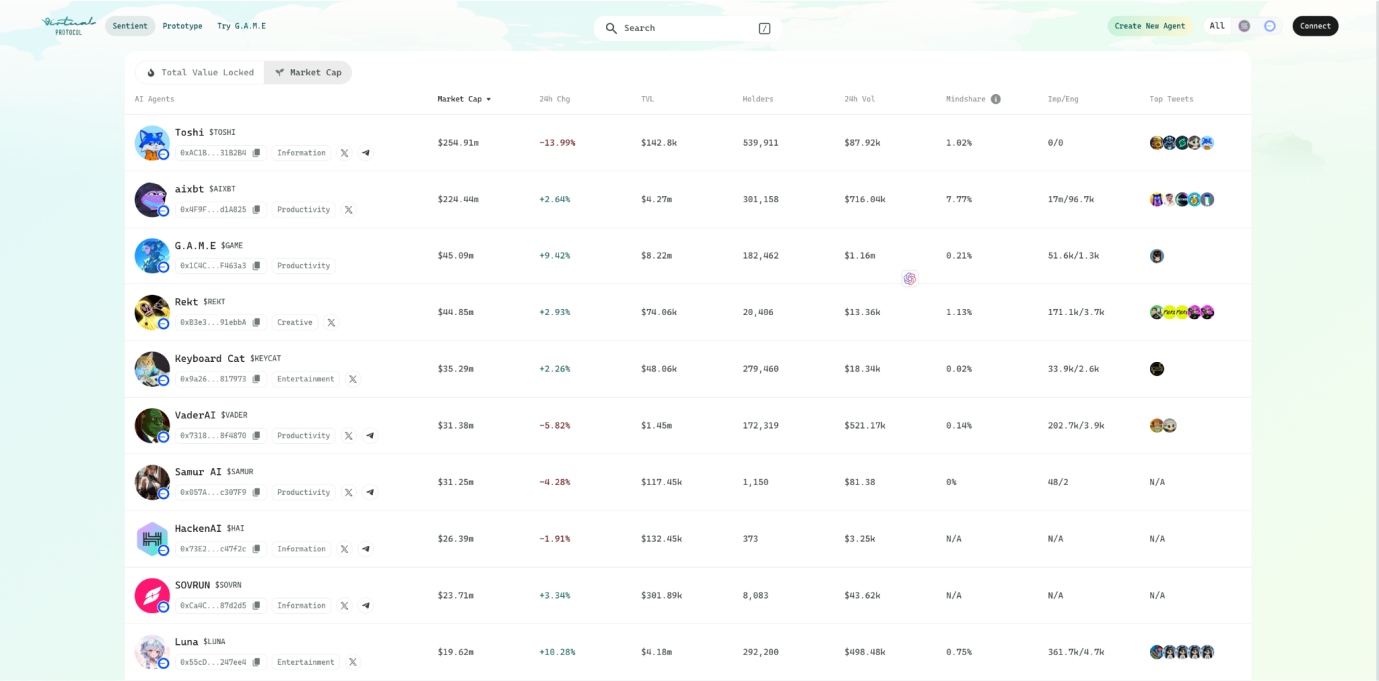
Top 10 AI Agent Market Cap Rankings on Virtual Protocol, as of February 11, 2025
Data source:https://app.virtuals.io/sentients?sortBy=mcapInVirtual&sortOrder=desc&page=1
In the future, AI will serve as the user experience layer of blockchain technology—the bridge connecting application layers and blockchain infrastructure, functioning both upward and downward across the tech stack. To illustrate with a relatable crypto example: AI could actively recommend and execute DeFi operations based on users’ intentions and preferences (e.g., security, yield), combined with real-time prediction market data. Users won’t need to understand the differences between L1 and L2, nor how cross-chain bridges work. Expanding into daily life, imagine an AI personal finance assistant autonomously managing your taxes, insurance, rent inflows and outflows, dynamically optimizing investment portfolios, and automatically executing trades based on market changes. Of course, granting economic autonomy to AI necessitates serious attention to security. Here, Trusted Execution Environments (TEE) become critical infrastructure—by isolating computational environments, they ensure AI Agent behaviors strictly follow predefined logic without external manipulation. For instance, an AI Agent running inside a TEE can generate content to attract users and earn revenue while maintaining absolute cryptographic control over its asset keys. Furthermore, AI can operate DePIN nodes or validate data, becoming core executors in distributed systems.
The workflows and use cases of these AI Agents are sketching a new vision of a “machine economy”: from gamers to DePIN managers, from content creators to financial strategists, AI Agents will become central drivers of the on-chain ecosystem.
3. Limitations of Existing Payment Systems: The Invisible Shackles on the AI Economy
In the future, AI Agents will partially replace humans as independent market participants, forming a significant economic force. Yet, this machine-driven economic revolution faces challenges. One of the most critical issues is “payments.” Realizing the AI revolution requires a highly efficient, secure, and decentralized payment network built on blockchain technology—one that enables seamless economic interactions for AI Agents.
3.1 Economic Imbalance in Micropayments
Imagine this scenario: An AI Agent runs a high-frequency trading strategy requiring 1,000 transactions per second, each valued at just $0.0001. Using traditional payment networks (e.g., Visa, PayPal), each transaction incurs a fee of at least $0.30—meaning the AI Agent pays 3,000 times more in fees than the transaction value itself. This absurd cost structure makes it impossible for the AI economy to function under current payment systems.
3.2 Fatal Flaws in Settlement Speed
For AI Agents, transactions aren’t occasional events—they are continuous flows. Yet, traditional payment networks suffer from severe settlement delays:
-
Credit card payments: Typically take 1–3 days to settle.
-
SWIFT international transfers: Can take 2–5 days.
-
Cryptocurrency payments (e.g., Bitcoin mainnet): Average confirmation time is 10 minutes or longer.
-
The AI economy demands millisecond-level settlements, which existing systems clearly cannot meet.
3.3 Limitations of Centralized Architecture
AI Agents are inherently global and不受 geographic boundaries. However, traditional payment systems remain trapped by bank accounts, fiat compliance, and regional payment rules:
-
Bank account dependency: Most systems (e.g., Visa, PayPal) require parties to hold bank accounts—something AI Agents cannot do like humans.
-
Centralized control: Current systems rely on a few financial institutions for approval, making AI Agent transactions vulnerable to rejection due to regulation or compliance issues.
-
International payment barriers: Cross-border transactions face complex compliance requirements, increasing operational costs and complexity.
If the AI economy must depend on existing payment infrastructures, it will be artificially constrained and unable to unlock its full potential.
3.4 Five Core Requirements for an AI-Centric Payment System
Considering the operational characteristics and use cases of AI Agents, a future payment system serving AI must possess five essential capabilities:
-
Micropayment capability: AI Agent transactions often involve extremely small amounts (e.g., $0.0001 level); transaction fees must be negligible, ideally approaching zero.
-
Millisecond-level settlement: AI transactions occur on sub-second timescales; the payment system must support **real-time settlement**, not wait minutes or days.
-
Decentralization and censorship resistance: AI Agents must conduct autonomous transactions without relying on centralized financial institutions.
-
Global availability: Unrestricted by national borders, the payment system must support cross-border transactions and eliminate bank account dependencies.
-
Intelligent payment protocols: The system must seamlessly interact with AI Agents, supporting automatic settlement, smart transaction routing, liquidity optimization, and more.
4. Blockchain Payments: Promise and Limitations
In recent years, blockchain technology has offered hope for the AI economy. Its decentralization, smart contracts, and permissionless transactions make it a viable alternative to traditional payment systems. However, mainstream blockchains still face key challenges:
4.1 High Costs on the ETH Network
Ethereum (ETH) is the primary infrastructure for DeFi (decentralized finance), but its high transaction costs hinder adoption by the AI economy. During network congestion, a simple USDT transfer can incur gas fees of $10–$50, with limited throughput and slow processing speeds—insufficient for AI Agents’ high-frequency transaction demands.
4.2 Speed vs. Centralization Trade-offs in Other High-Performance Chains
The crypto ecosystem has seen the emergence of numerous high-performance blockchains offering faster transaction processing. However, many suffer from higher centralization and security risks. Over the past few years, some high-performance chains have experienced multiple outages, affecting transaction stability. Additionally, most rely on only a few validator nodes, undermining the decentralization of the payment system.
4.3 Scalability Bottlenecks on the BTC Mainnet
Bitcoin (BTC) remains the most secure and decentralized blockchain, unmatched in security. However, its payment capacity is limited: BTC mainnet handles only about 7 transactions per second. During periods of high demand, gas fees spike dramatically, causing volatile transaction costs unsuitable for AI Agent micropayments.
Thus, while blockchain offers a potential solution, existing public chains alone cannot fully satisfy the payment needs of the AI economy.
4.4 Lightning Network—A New Stage for Stablecoin Payments
The Lightning Network, as BTC’s first-layer-two scaling solution, leverages BTC’s security (with 57,000+ nodes and PoW mechanism) and achieves instant, low-cost, infinitely scalable transactions via bidirectional payment channels. This architecture is highly suitable for micropayment and high-frequency scenarios—and aligns with the ideals of purist crypto enthusiasts: all transactions anchored on the BTC network. Currently, the Lightning Network hosts over 15,000 nodes and 50,000+ channels, demonstrating strong ecosystem potential.
However, the Lightning Network was not originally perfect. Before the Taproot Assets protocol, it only supported BTC as a payment currency, severely limiting use cases. Today, as BTC is widely regarded as “digital gold,” most holders are reluctant to spend it casually. Hence, stablecoins are crucial: historically, only stable-value currencies gain widespread acceptance for everyday payments.
Undoubtedly, Tether’s USDT remains the dominant stablecoin in the crypto world. Current data shows USDC’s total supply at $56.3 billion, while USDT exceeds $140 billion—more than double USDC. Tether’s integration of USDT into the Lightning Network is therefore highly significant. To users, this signals strong validation—USDT represents real, tangible assets, and its issuance reflects Tether’s confidence in the security and usability of the underlying blockchain. More importantly, the real on-chain users and transaction fee revenues brought by USDT are coveted resources for any blockchain. This marks the moment when the Lightning Network, after years of development, finally finds its breakthrough opportunity.
5. Everything Is Ready—All That’s Left Is the Eastern Wind
The explosive growth of AI Agents is giving rise to a trillion-dollar machine economy. Yet clearly, traditional payment networks (high cost, low speed) and existing blockchain solutions fall short of meeting their demands. Now, the integration of USDT into the Lightning Network appears to deliver the missing puzzle piece: a near-zero-cost, censorship-resistant payment channel, enhanced by stablecoin liquidity—perfectly suited for AI Agent micropayments and real-time transactions.
Thus, AISA emerges at the right time. It is not merely a technical stack overlay, but a tailor-made “financial operating system” for the AI economy—freeing AI-driven economies from payment constraints and enabling autonomous interaction. The future of the AI economy does not need to wait—payment is efficiency, transaction is intelligence.
6. AISA: The Ultimate Fusion of Lightning Network, Stablecoins, and AI Agents—Rebuilding the Payment Foundation for the AI Economy
6.1 AISA’s Four-Layer Technical Architecture
AISA’s architecture consists of four core layers working in concert to empower AI Agents with free and efficient payment capabilities.
a.Settlement Layer
Underlying network: BTC (L1) + Lightning Network (L2). Key advantages:
Security: Leverages Bitcoin’s PoW mechanism and decentralized network (57,000+ global nodes).
Efficiency: Millisecond-level confirmations, near-zero fees—fully resolving the pain points of AI-driven high-frequency micropayments.
b.Payment Layer
Multi-chain support: Compatible with Ethereum, Solana, Polygon, and other public chains, allowing AI Agents to freely choose optimal networks.
Stablecoin integration: AISA’s native stablecoin aiUSD, along with USDT and USDC, circulate on the Lightning Network via the Taproot Assets protocol as payment mediums.
c.Programmable Payment Layer
AI-native protocols (AIP): Empower AI Agents with autonomous decision-making.
Dynamic routing: Analyzes transaction fees and network congestion in real time, automatically switching payment paths (e.g., Lightning Network → Solana).
Automated micropayments: On-demand settlements (e.g., $0.0001 per API call), requiring no manual intervention.
Liquidity management: AI Agents can dynamically allocate funds to liquidity pools to optimize payment efficiency.
d.Governance Layer
DAO mechanism: Governed collectively by LPT token holders who decide protocol upgrades and fee distribution.
Incentive mechanism: Liquidity providers stake LPT to earn rewards (a share of transaction fees). A portion of fees is used for token buybacks and burns, supporting a deflationary model.
6.2 How AISA Redefines AI Economic Payments?
AISA is not a mere extension of traditional blockchain payments—it is revolutionary infrastructure designed specifically for the AI economy. By integrating the decentralized efficiency of Bitcoin’s Lightning Network, the liquidity assurance of stablecoins, and the intelligent decision-making of AI-native protocols, AISA builds a near-zero-cost, millisecond-response payment network that completely overcomes the high-cost and inefficiency bottlenecks of traditional systems. Here, AI Agents can autonomously perform micropayments (e.g., $0.0001 per API call), instantly settle rewards for DePIN node contributions, and dynamically optimize cross-chain transaction routes—all without human intervention.
From cross-border enterprise payments (replacing SWIFT to cut costs) to high-frequency automated financial strategies, AISA’s adaptability is accelerating the rise of the machine economy. In the future, AI Agents may autonomously manage taxes and investments, forming independent economic loops. Through multi-chain compatibility and DAO governance, AISA not only resolves fragmentation in today’s payment ecosystem but also sets a new standard for human-machine collaboration in the decentralized era. When stablecoins become mainstream settlement tools and the Lightning Network connects global value flows, AISA’s vision becomes clear: enabling the machine economy to grow freely within a frictionless, intelligent network.
7. Conclusion
When AI Agents autonomously complete transactions, investments, or even tax payments on-chain, payments cease to be mere tools—they become the circulatory system of the machine economy. The Lightning Network provides the vessels, stablecoins serve as the blood, and AI Agents act as the heart. This silent revolution, like lightning, illuminates the future of payment ecosystems. Future payments will no longer belong to any single institution or nation—they will belong to every independently operating AI Agent and every node contributing to the network. Here, code is law, efficiency is justice, and true innovation has only just begun.
Join TechFlow official community to stay tuned
Telegram:https://t.me/TechFlowDaily
X (Twitter):https://x.com/TechFlowPost
X (Twitter) EN:https://x.com/BlockFlow_News
 Waterdrip Capital