Trump Says "Dual Tariffs" to Launch on April 2; U.S. Economic Engines Risk Full Collapse
TechFlow Selected TechFlow Selected
Trump Says "Dual Tariffs" to Launch on April 2; U.S. Economic Engines Risk Full Collapse
Trump has once again issued warnings, prompting investors to pull out of U.S. stocks and shift into cash, bonds, gold, and overseas assets, as the pillars of the U.S. economy face severe challenges.
 Navigating Web3 tides with focused insights
By Xiao Yanyan
Trump said he will begin imposing broad-based reciprocal tariffs and additional sector-specific tariffs on April 2.
On Sunday, aboard Air Force One, Trump told reporters, "In some cases, foreign goods imported into the United States will be subject to 'two' taxes. They charge us, and we charge them. In addition, we will impose extra tariffs on automobiles, steel, and aluminum."
This indicates that despite initial moves disrupting financial markets and straining alliances, Trump still plans to push forward a more aggressive tariff regime.
Trump previously stated his administration is preparing so-called reciprocal tariffs—applying tariff rates on imports from various countries calculated based on their own tariff and non-tariff barriers. But he has also expressed a desire to protect key U.S. industries, including automobiles, steel, aluminum, microprocessors, and pharmaceuticals. It remains unclear whether these industry-specific tariffs will be incorporated into the reciprocal tariff system or imposed in addition to it.
"April 2 is our country's day of liberation," Trump said. "We're going to reclaim some of the wealth given away by very, very stupid presidents who had no idea what they were doing."
Trump has already imposed a 25% tariff on steel and aluminum. He also announced 25% tariffs on goods from Canada and Mexico, but later granted a one-month delay for products compliant with the USMCA—the North American trade agreement negotiated during his first term. Trump added that Canada’s energy and potash (a key fertilizer) would face only a 10% tariff.
For Many Americans, the Era of 'Buy-and-Hold' Investing Has Just Ended
The chaotic tariff policies and government spending cuts under the Trump administration have shocked many ordinary investors, prompting them to pull out of U.S. stocks and shift into cash, bonds, gold, and European defense-related equities. The S&P 500 had maintained an almost unbroken upward trajectory, but last week entered correction territory, as Wall Street grows concerned the economy is sliding toward recession.
Data from the American Association of Individual Investors shows investor optimism about the U.S. stock market is now at its lowest level since September 2022. Of course, many have not touched their portfolios, instead following standard financial advice to avoid making hasty decisions during market turbulence.
People's economic outlooks are also closely tied to their political leanings. Some Trump supporters say they aren't worried and are even looking for buying opportunities. Yet this marks a sudden shift, as in recent years it was easy to assume stocks would keep rising due to strong economic fundamentals.
According to data from the Investment Company Institute, individual investors injected a net $30.4 billion into money market funds over the seven days ending March 5—the largest weekly inflow in over a year.
Meanwhile, according to Morningstar, U.S. physical gold ETFs saw over $5 billion in net inflows in February. By last Tuesday, another $1 billion had flowed in during the current month. Gold prices surpassed $3,000 per ounce for the first time last week.
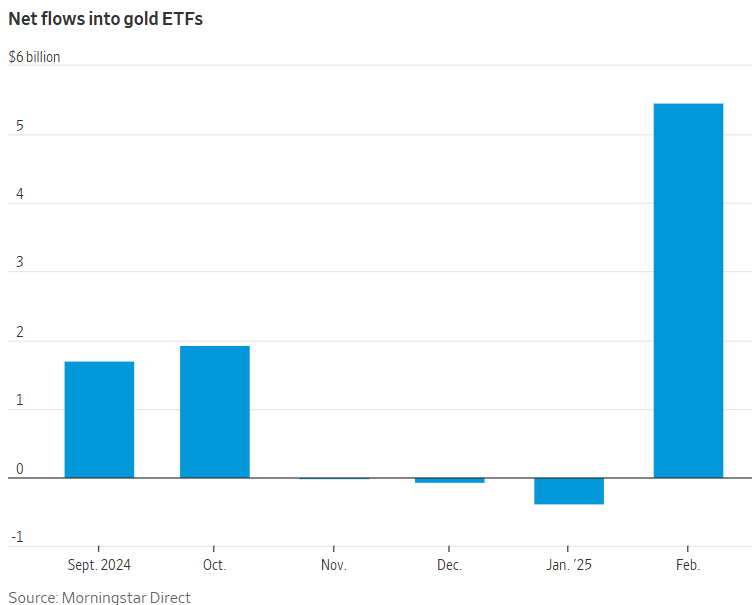
Gold ETF Net Inflows
Others are turning overseas. Data from London Stock Exchange Group shows investors put $1.8 billion into European equity ETFs registered in the U.S. last month.
In the first months of 2025, international markets have outperformed U.S. stocks. The STOXX Europe 600 Index is up 7.7% year-to-date, Germany’s DAX Index has risen over 15%, while the S&P 500 is down 4.1%. Some see warning signs in the U.S. market; others believe there’s nothing to worry about.
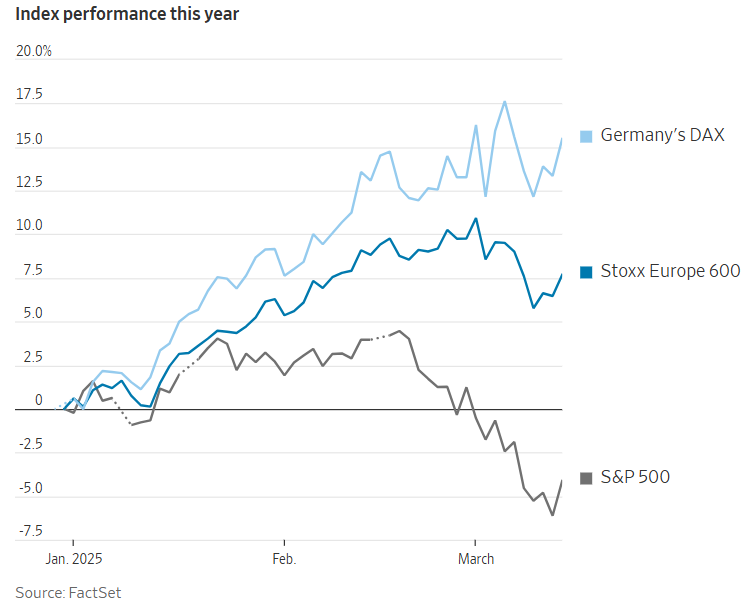
Year-to-Date Stock Index Performance
Stock Market Decline Threatens Pillars of U.S. Economy
U.S. consumer spending heavily relies on the wealthy, who in turn depend heavily on the stock market. Investors fear the White House’s aggressive and unpredictable tariff war could derail a soft economic landing. Sentiment has already darkened, and market contraction may only be the beginning of a chain reaction, causing further collateral damage.
Gabriel Chodorow-Reich, an economist at Harvard University, estimates that, all else being equal, a 20% drop in U.S. stock prices in 2025 could reduce economic growth by up to one percentage point this year. As of last Friday’s close, the S&P 500 was down 4.1% in 2025.
A decline in stock prices could drain two major engines behind America’s recent prosperity: strong household spending and corporate capital investment.
"In a hyper-financialized economy like the U.S., asset prices can lead the real economy. A downturn in asset markets raises the risk of weakening real economic conditions," said Alex Chartres of UK-based fund manager Ruffer.
Data from Moody’s shows the top 10% of U.S. income earners now account for nearly half of all consumer spending, compared to just 36% three decades ago.
A recent Federal Reserve survey found that, as of 2022, the top 10% of households held an average of about $2.1 million in stocks per person, accounting for roughly 32% of their net worth. In 2010, stocks made up about 26% of this group’s average net worth.
Over the past four years, spending by the top 10% of earners has increased by 58%. It’s not just the ultra-rich pouring money into equities. Reports from Vanguard and Fidelity show worker participation in and contributions to 401(k) plans have reached record highs.
Federal Reserve data shows that as of the end of last year, 43% of American household financial assets were in stocks—a historical high. While many low-income families still don’t own stocks, the share of those who do continues to rise.
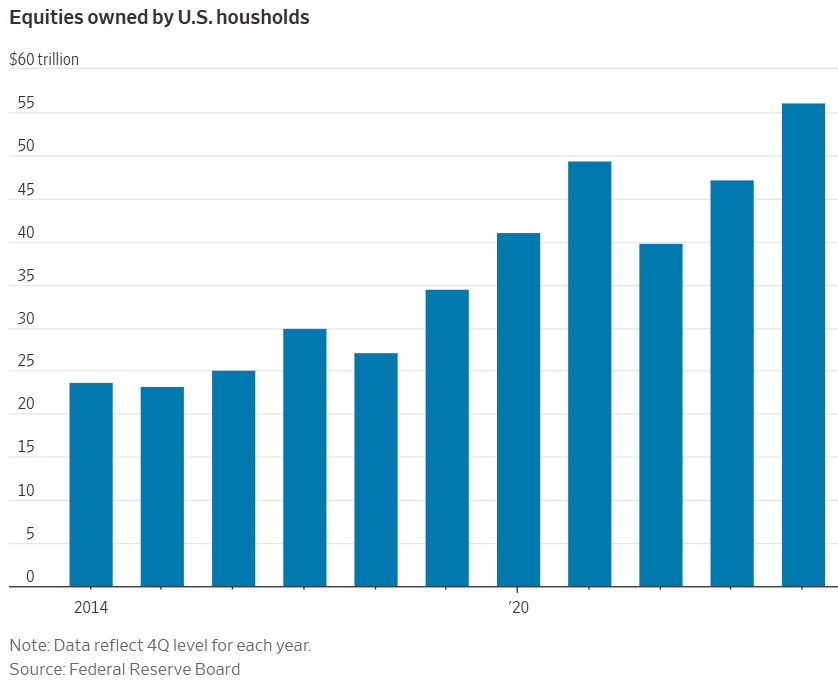
Value of Stocks Held by U.S. Households
Because of this, some economists worry a sharp market downturn could prompt Americans to cut back on everything from vacations to new clothing—a phenomenon known as the wealth effect. Deutsche Bank economists estimate that if the stock market had remained flat last year instead of rebounding, consumer spending would have grown by only about 2%, rather than the 3% partly driven by stock market wealth gains.
Some signs suggest consumer spending may already be weakening. Companies including Delta Air Lines, Foot Locker, and Brown-Forman, maker of Jack Daniel’s whiskey, have said consumers appear more cautious. Retail sales fell 0.9% in January—the largest monthly drop since 2023—though some economists blamed unusually cold weather. February figures will be released Monday.
Matthew Luzzetti, chief U.S. economist at Deutsche Bank, said that if nothing else changes, a 20% drop in stock prices could drag down consumer spending by 1.2 percentage points in 2025. Since consumption accounts for about 70% of GDP, this would reduce economic growth by approximately 0.8 percentage points.
Independent economist Phil Suttle worries that as the Nasdaq falls more than 10% from its peak, spooked executives might abandon plans to spend around $1 trillion on artificial intelligence-related investments over the coming years.
In a 2021 study, Chodorow-Reich and two colleagues found that for every $1 change in stock market wealth, household spending changes by about 3 cents on average. According to Federal Reserve data, as of the end of last year, U.S. households held over $56 trillion in stocks—either directly or through products like mutual funds—meaning fluctuations in the stock market have a massive impact on household spending.
Economists Sydney Ludvigson and Martin Lettau studied the wealth effect in the early 2000s. They concluded that stable stock gains over time do boost consumption, but people typically don’t overreact to short-term market volatility. The challenge for economists is that you can’t know which rallies or reversals will persist until they’ve become history.
Join TechFlow official community to stay tuned
Telegram:https://t.me/TechFlowDaily
X (Twitter):https://x.com/TechFlowPost
X (Twitter) EN:https://x.com/BlockFlow_News