Cryptocurrency, the Ongoing Collapse of a Cyber Religion?
TechFlow Selected TechFlow Selected
Cryptocurrency, the Ongoing Collapse of a Cyber Religion?
Belief doesn't make money, so only the belief in making money remains.
 Navigating Web3 tides with focused insights
Author: Cookie
Last year, during a dinner with a friend I’d met on the road, she asked me: “Is there anything interesting still happening in crypto?”
I mentioned the Bitcoin inscriptions craze of 2023, the approval of spot Bitcoin ETFs in the U.S., the meme coin speculation frenzy on Solana, and Bitcoin hitting new all-time highs.
After listening, my friend just smiled and shook her head. “All of it feels kind of… meh.”
This friend of mine had bought into various concept assets back when celebrities were rushing to buy or even launch their own NFTs, when Facebook rebranded to Meta and went all-in on the metaverse, and when DAOs aiming to purchase a copy of the U.S. Constitution, an NBA team, or an island to build a utopia were all the rage. She still holds those assets today and has never sold.
To the crypto world, those narratives are now yesterday’s news—or even seen as outright “scams.” So I was curious: as someone who briefly dipped into crypto—a so-called “outsider” by crypto standards—how did she view these perspectives? Did she think her investments had failed?
Her answer:
“Of course not. Before I bought in, I knew nothing about and had no interest in crypto. But NFTs, the metaverse, DAOs—they were the trend at the time. If I didn’t participate, I’d have felt outdated. I know my NFTs dropped significantly in value later, but I barely paid attention afterward, and I don’t see them as failed investments. It’s like that old Pentium computer my family bought for me as a kid—would anyone say buying that computer was a failure just because Pentium processors eventually became obsolete?”
I said this analogy wasn’t quite right—buying a computer is consumption, while buying NFTs or metaverse land is investing. She laughed and replied that, at least for her, NFTs and virtual land weren’t investments but consumption. Investments, she argued, are rational and driven by analysis, not by novelty or trendiness. And unlike consumption, investments don’t bring the excitement or cultural thrill that trends do.
Blockchain belongs to the young. Web3 belongs to the young. We can use it to change the world, or create a world of our own. Yet now, crypto is rapidly losing that appeal.
Belief Can’t Make Money, So Only the Belief in Making Money Remains
The current state of crypto is struggling under the myth of exhaustion and decline.
What can blockchain technology actually do? Throughout the history of cryptocurrency development, wave after wave of new narratives have fueled industry growth and sustained crypto’s “market dream ratio.” From the legendary tale of 10,000 bitcoins buying two pizzas—spontaneously establishing the value of a new digital currency—to Ethereum’s ICO boom turning blockchain into a new decentralized platform for asset issuance and fundraising, then DeFi (decentralized finance) transforming blockchain into a bank-like system capable of lending, leverage, and other financial operations, followed by the emergence of consumer-facing applications like NFTs, the metaverse, and blockchain gaming.
Blockchain can change the world. Cryptocurrency can change the world. As long as you hold this belief, stay curious about new technological innovations, and remain in the space, your opportunity will come, and you’ll reap your rewards. Once, many young people were drawn to the vibrant energy of crypto, diving into the wave as bold pioneers of a new era, changing their lives through this strange and wondrous journey.
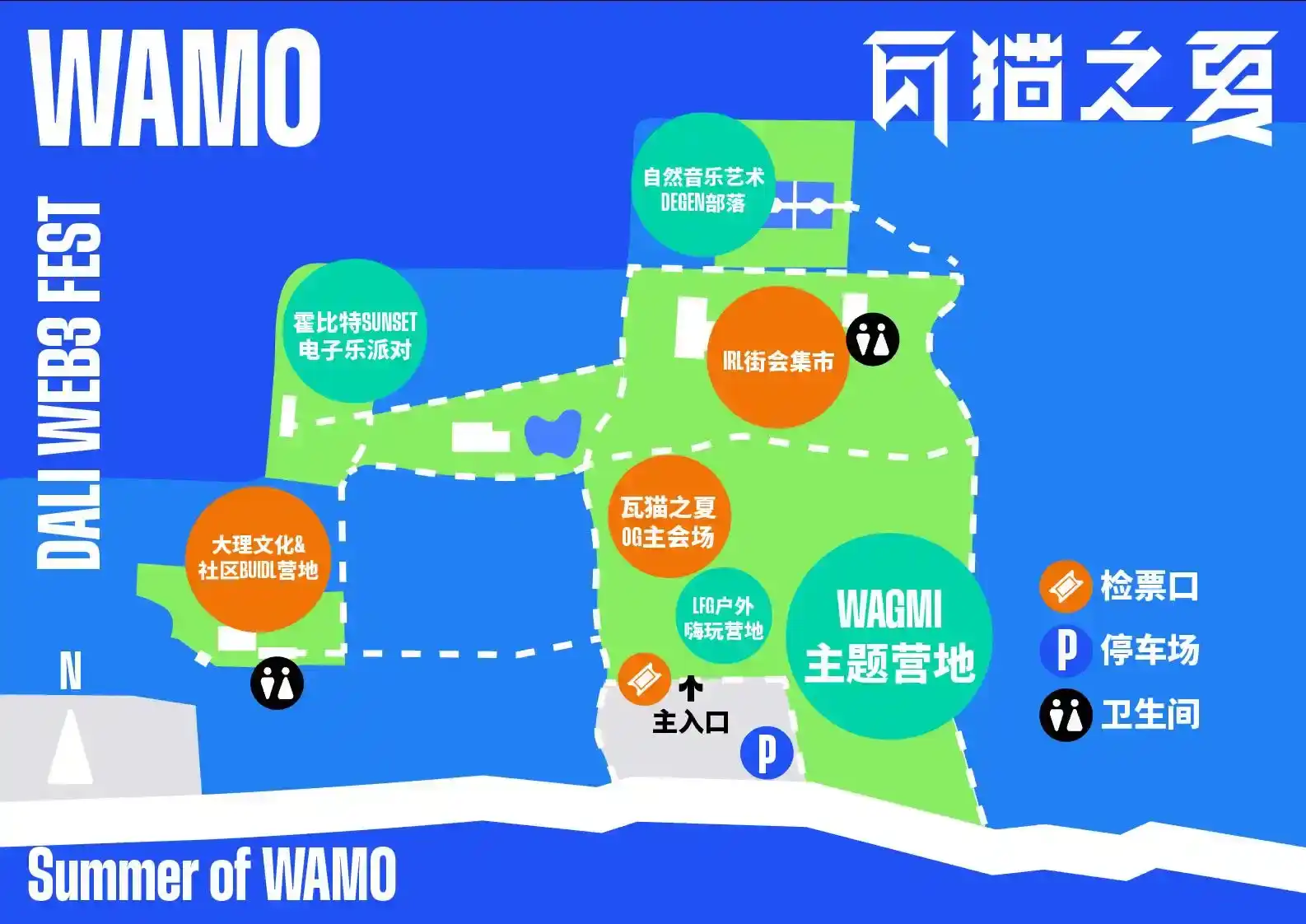
Toward the end of 2021 and into 2022, global celebrities rushed to buy—and even launch—their own NFTs. Facebook rebranded to Meta and bet big on the metaverse. DAOs (decentralized autonomous organizations) sprang up overnight, aiming to buy a copy of the U.S. Constitution, an NBA team, or an island to build a utopia. To me, this was the “golden age” of blockchain, or Web3. In 2022, in Dali, a lively and artsy Web3 street festival was organized. The planning team grew from two or three local youth to thirty or forty, eventually nearing a hundred people—all coordinating in a truly decentralized way, running purely on passion.
Also in 2022, “Tiao Hai” Bar, which later secured tens of millions in angel funding, gained greater attention due to its distinctive “Web3” character. The bar owner, Liang You, said in an interview at the time that he wasn’t part of the Web3 community, but that Tiao Hai adopted a DAO-style organizational structure inspired by Web3 and even launched China’s first Bored Ape co-branded beer.

Twitter is the most active social media platform in crypto. In the past, you could find diverse analyses, forecasts, debates, and discussions about different directions for the industry. Today, such content has lost its audience and become rare. Instead, trending topics include what CZ, founder of Binance, named his dog, motivational speeches from self-proclaimed “crypto gurus,” and even discussions about “female college students” and “hostess bars.”
This shift is a direct reflection of crypto’s “broken dao”—the collapse of its innovative spirit after falling into a crisis of value creation. While the crypto community welcomes increasing regulatory friendliness from the U.S. government, there's also widespread anxiety: “This is the last bull market.” Initially, when narrative-driven assets like NFTs (“digital luxury”) or metaverse land (“digital real estate speculation”) crashed, the blame fell on project teams for failing to deliver. Gradually, criticism faded into apathy and cynicism toward all new narratives.
In this disillusionment, exchanges, market makers, and KOLs have emerged as the most powerful forces in crypto. A token listing on a major exchange means access to a large user base—even if they’re not transacting directly on-chain. A token backed by market makers implies orchestrated liquidity, artificially inflating price action to create excitement. These coordinated efforts are often dubbed “cartels” within the community. A token promoted by a KOL means that influencer will actively cheerlead for it. The most influential KOLs are called “locomotives” (“cheadou”)—even without direct promotion, their on-chain activity is closely tracked and copied by followers.
Recently, Consensus 2025 concluded in Hong Kong. Many in crypto joked that despite being called the “Consensus Conference,” attendees seemed unable to find any actual consensus. During the event, project teams continued to spend lavishly—renting high-end venues, hosting elaborate events, and reportedly spending HK$600,000 on drinks in a single night.
Yet, the revelry cannot erase the underlying confusion and anxiety: “Where are we going?” Crypto has lost the fairy tale where belief creates returns. All that remains is the belief in making money.
The “Nasdaq-ification” of Crypto and the Original Sin of the “Second Crypto Religion”
When the crypto world subconsciously begins comparing itself to a decentralized “Nasdaq,” cracks start to appear in cryptocurrency—the world’s largest “cyber religion.”
Different people interpret crypto’s value in different ways—most commonly through a financial lens. But to me, crypto’s value has always been one of belief, of faith in a cyber religion.
From 10,000 bitcoins buying two pizzas, to becoming “darknet hard currency,” to legal tender in El Salvador, to the U.S. building a strategic Bitcoin reserve—each milestone was unplanned and unpredictable. It was the collective belief of people worldwide that carried this “cyber religion” through 16 turbulent years. Without genuine belief that Bitcoin could become a global currency, without trust that Satoshi Nakamoto would never move his ~1 million BTC, Bitcoin could never have reached its current standing.
The “Nasdaq-ification” of crypto began with Ethereum’s birth. This marked the first schism in the “cyber religion”—the formal emergence of the “second crypto religion.” Bitcoin purists uphold the “currency” narrative, refusing to let Bitcoin sacrifice even a sliver of security, stability, or decentralization in pursuit of doing more. They believe in Bitcoin’s intrinsic value. Ethereum believers, however, think they should—and can—create additional value.
“Bitcoin is gold, Ethereum is silver.” Through innovations like ICOs, DeFi, NFTs, the metaverse, and blockchain gaming, Ethereum rose to prominence and earned this status in the minds of the crypto community. Vitalik Buterin, Ethereum’s founder, became the second “god” of crypto—second only to Satoshi.
But the “second crypto religion” was fragile from the start. Gold and silver don’t need to prove their utility to justify their value. In this sense, Bitcoin can truly be compared to gold—but Ethereum cannot be equated with silver. From day one, Ethereum has been on a path requiring constant validation of value, much like our lives—forever needing to prove ourselves.
Rather than calling Vitalik a “god,” it might be more accurate to call him crypto’s Steve Jobs. Now, his situation seems to mirror Jobs’ early career. In 1985, amid declining performance and clashes with Apple’s management, Jobs was ousted from the board. Nearly 20 years later, as Ethereum faces competition from Solana and declining momentum, when Vitalik stated he wouldn’t proactively seek government approval as a bullish signal, he was swiftly downgraded from “V God” to “V Dog.”
On crowdfunding platforms like Kickstarter, many games take years to deliver—from funding to final release. Shenmue 3 took over four years; Star Citizen has been in alpha testing for over 12 years. But in the highly speculative crypto market, Vitalik cannot expect such patience from investors.
Yet, whether these novel blockchain experiments on Ethereum will succeed—and whether they matter at all—depends on timing, luck, and broader adoption. Take NFTs: from the birth of CryptoPunks to mainstream explosion, nearly four years passed. And if NFTs gave blockchain a role as a “new artistic medium,” algorithmic art (computer-generated visual art) dates back to the 1950s. It took around 70 years before blockchain provided this art form with uniqueness and traceability—and the perfect display format. After all, printing algorithmically generated images on paper drastically diminishes their magic.
So why has crypto lost its patience this time?
Real Bull Market or Fake One?
Because Bitcoin hit a new all-time high last year.
In crypto, the term “marking the boat to find the sword” (ke zhou qiu jian) refers to blindly relying on past patterns to predict future rallies. One ironclad rule of this approach is that every four years, following Bitcoin’s halving, a major bull run begins. Bitcoin rises to new highs and consolidates, then altcoins—led by Ethereum—take center stage in the second half of the bull market. New blockchain narratives emerge, each spawning wealth stories of 10x, 100x, or more.
When Bitcoin hit a new all-time high last year, the crypto community still believed in this rule. But unlike previous cycles, this time, anxiety ran deeper. This unease stems from eroded faith—the realization that even governments are now stepping in to “buy the dip.” What’s left for retail investors?
For most in crypto, Bitcoin’s new high doesn’t directly translate to profits. Bitcoin’s massive market cap makes it hard to achieve rapid financial freedom through investment alone. What people really want is the altcoin mania that traditionally follows Bitcoin’s peak.
This time, however, the conditions for replicating altcoin mania simply don’t exist. First, capital flowing into spot Bitcoin ETFs comes from traditional finance and doesn’t enter the blockchain ecosystem directly. Unlike before, these funds aren’t participating in DeFi, NFTs, or metaverse projects on-chain. Second, there’s no compelling new native crypto narrative emerging within the community—let alone one capable of attracting outsiders.
But after waiting three long years, is this really all we get? The crypto world refuses to accept it. This shared refusal formed a false bull market—a phenomenon insiders call “PvP” (player versus player). In the last bull cycle, people united around new narratives, spreading the vision of Web3 far beyond blockchain circles. This time, there’s no shared vision. Everyone just wants to be the “smart one,” profiting from others’ losses.
It’s reminiscent of the ending of *Alice in Borderland*—one survival game after another, revealed to be the final desperate dreams of people dying from an asteroid impact, collectively creating an illusion.
For the “cyber religion,” this is a dire situation—a dangerous sign: in confusion and loss, consumed by profit anxiety, crypto has stripped away its idealism and sacredness.
Pessimistic Honesty Is Actually Desperate Self-Diminishment
Crypto is now calling itself a “big casino.”
Last year, I met up offline with a longtime friend who specializes in trading meme coins. Meme coins were his entry point into crypto and remain almost the only area he cares about.
“I just think it’s fun—it’s our generation’s thing. Meme coins, or just drop the word ‘coin,’ this whole culture—it’s wild, imaginative, something that doesn’t make sense in the real world but is embraced here in crypto. When I realized my instinct, my taste, could actually make money, I thought meme coins were the coolest, most fun thing ever.”
After he said this, we clinked glasses hard. As alcohol spread through my body, my mind flashed back to the meme coins that once excited me—like $DOGE, born from the world-famous Shiba Inu meme and repeatedly endorsed by Elon Musk, or $PEOPLE, whose community raised millions to bid on a copy of the U.S. Constitution…
But now, even “fun”—once the golden key to meme coins—has largely stopped working. Strip everything away, close your eyes—only one word remains:
“Gambling”
Solana, the busiest “crypto casino” in this fake bull market, has seen over 640,000 meme coins created since April 1 of last year—according to data up to early July. That’s over 7,000 new meme coins per day across just three months.
The disappearance of “cyber religion believers” coincides with the rise of “crypto gamblers.” These gamblers flood chat apps daily with strings of alphanumeric “addresses”—shortened to “CA,” meaning contract address. Only with this address can you precisely locate and trade a specific token.
“Smart money” and “dev” are the two most critical success factors for “crypto gamblers.” “Smart money” functions like “gaming gods”—on-chain addresses known for high win rates, whose trades are followed by legions of gamblers. “Dev” is short for “developer,” the token creators. Gamblers need relatively trustworthy “game hosts,” trying to avoid tokens launched by devs with a history of dumping their holdings immediately after launch.
Objectively speaking, this fake bull market has produced the most wealth stories through the “crypto casino” narrative. But this was meant to be a reluctant, honest admission of reality—not a numb, defiant justification.
This is the most serious challenge crypto—the “cyber religion”—has ever faced. When an industry’s idealism and sacredness crack, no one knows when or how that crack might heal.
Can it even be repaired at all?
Crypto Consensus Isn’t Unbreakable—It Needs to Keep Growing
The greatest value of new narratives born from blockchain innovation is allowing the “cyber religion” to present itself in more diverse forms, drawing more people in through different entry points and encouraging deeper exploration. In the past, this created a virtuous cycle with price growth. Now, that connection has broken.
Rising crypto prices mainly reinforce existing believers’ faith. Meanwhile, astonishing wealth stories do little to advance the “evangelism” of crypto.
Does crypto need new narratives? Yes. Is it urgent? Not necessarily. The world keeps evolving. Technological progress will continuously generate new demands. The answer to “what else can blockchain do?” may surface next year—or even tomorrow. Even if it doesn’t, have existing narratives been fully realized? No. There’s still room to improve, still paths to explore.
If crypto is merely a “casino,” a playground for speculators, then its countdown to death has already begun. How the crypto world sees itself determines how it presents itself to the world.
This generation of young people might still find crypto cool. But what about the next generation? And the one after that? How will they see it?
I don’t know, my friend. The answer is blowing in the wind.
Join TechFlow official community to stay tuned
Telegram:https://t.me/TechFlowDaily
X (Twitter):https://x.com/TechFlowPost
X (Twitter) EN:https://x.com/BlockFlow_News
 BlockBeats