What does Manus' collaboration with Alibaba's Qwen mean?
TechFlow Selected TechFlow Selected
What does Manus' collaboration with Alibaba's Qwen mean?
Consensus on open source.
 Navigating Web3 tides with focused insights
Author: Lian Ran
The two most watched AI companies in China have quietly come together.
On the evening of March 11, Manus officially announced a strategic partnership with Alibaba's Tongyi Qianwen team. In its announcement, Manus stated that both parties will leverage the open-source models from the Qianwen series to deliver all of Manus’s functionalities on domestic models and computing platforms.
According to Geek Park, the two sides had only recently begun communicating but quickly reached a cooperation agreement. In fact, just last Friday, Geek Park recommended that the Manus team connect with relevant personnel at Alibaba Group—based on the belief that Alibaba Cloud could provide critical support to this startup. Indeed, Alibaba has long placed great importance on innovative projects; “they clearly understand their capabilities can empower entrepreneurs.”
Alibaba acted swiftly this time. Based on posts shared by the Manus team on social media, even Eddie Wu, CEO of Alibaba Group, may have been personally involved. Now, both sides already have clear next steps. This move also reflects Alibaba’s consistently open mindset and its growing influence within the open-source community.
A Timely Collaboration
Since Manus launched, while users marvel at its ability to independently solve complex tasks, speculation has swirled around the foundational models it uses.
Previously, Ji Yichao, co-founder of Manus, revealed on social media that the product utilizes Claude as well as various fine-tuned models based on Qwen.
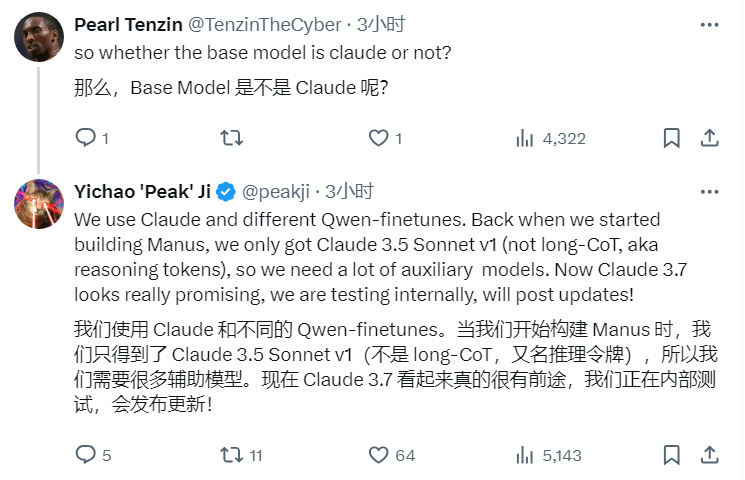
Image Source: X
Tongyi Qianwen's reasoning model, QwQ-32B, is indeed one of the most talked-about large AI models recently.
On the same day Manus was released, Alibaba open-sourced its new reasoning model QwQ-32B. According to an official technical report, through large-scale reinforcement learning, QwQ-32B achieved a qualitative leap in mathematics, coding, and general capabilities, matching the performance of DeepSeek-R1:
In a series of authoritative benchmark tests, QwQ-32B performed exceptionally well, nearly surpassing OpenAI-o1-mini and rivaling the strongest open-source reasoning model, DeepSeek-R1. On AIME24, which evaluates mathematical ability, and LiveCodeBench, which assesses coding skills, QwQ-32B matched DeepSeek-R1 and significantly outperformed o1-mini and similarly sized distilled versions of R1. On LiveBench—the so-called “hardest LLM leaderboard” led by Meta Chief Scientist Yann LeCun—IFEval (a Google-proposed benchmark for instruction-following), and BFCL (developed by UC Berkeley and others to evaluate accurate function or tool calling)—QwQ-32B scored higher than DeepSeek-R1.
There were reports suggesting each Manus call costs up to $2, and resolving a single complex task might consume millions of tokens. As user numbers grow, task queuing delays have already started emerging—even under an invite-only system with limited access.
Manus’s multi-agent architecture and full-chain autonomous execution require handling more complex tasks and larger data volumes, naturally increasing computational demands. Moreover, since each task runs in an independent cloud virtual machine—ensuring isolation and security—each VM must be allocated sufficient computing resources, further exacerbating overall consumption.
Under these circumstances, the collaboration between Manus and the Tongyi Qianwen team becomes particularly significant. With its outstanding reasoning and execution capabilities, QwQ-32B can provide strong technical backing for Manus. Meanwhile, its efficiency helps reduce Manus’s computing burden, improving response speed and processing efficiency to meet rising user demand.
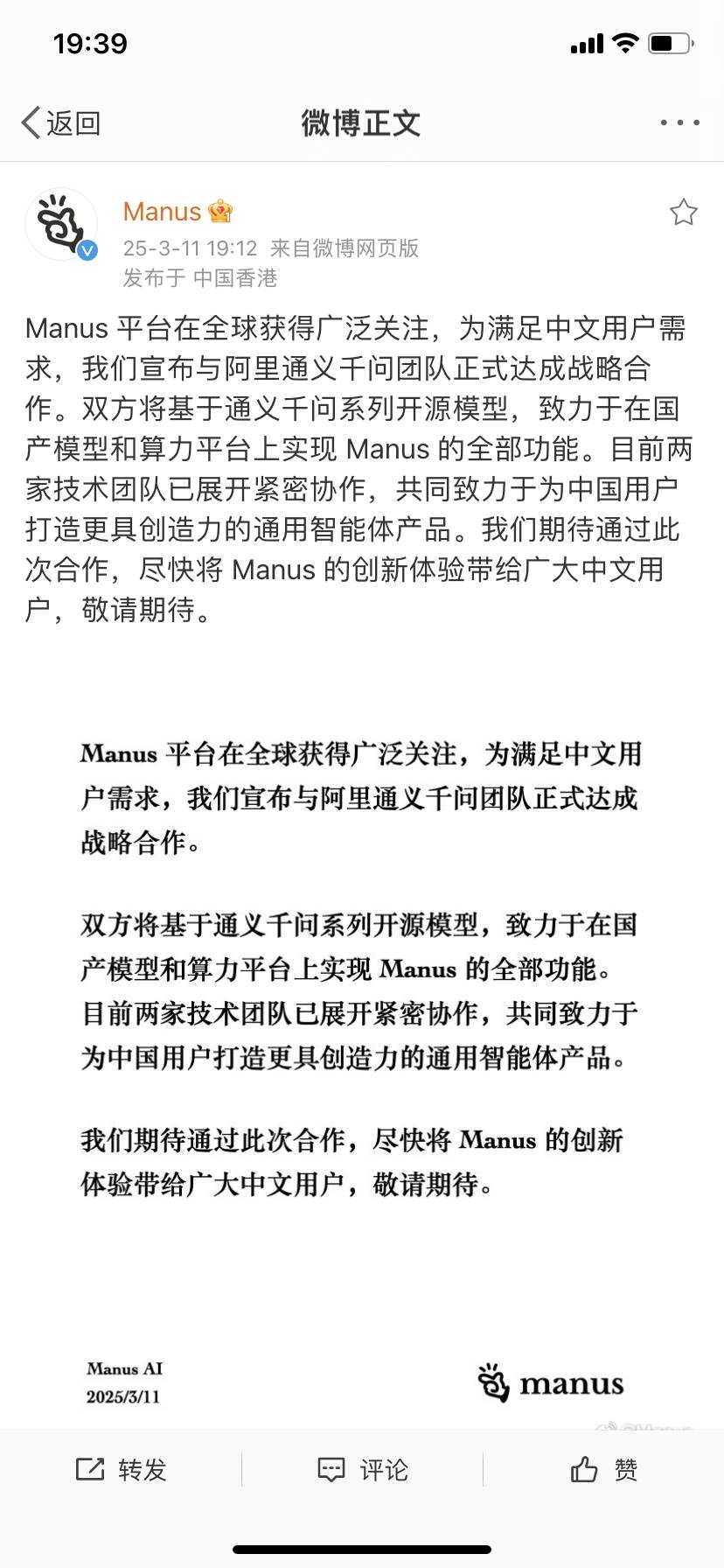
Image Source: Weibo
The joint statement highlights several key aspects of the collaboration: leveraging the open-source Qianwen series models, implementing Manus functionality on domestic models and computing platforms, and serving Chinese users.
"Leveraging the open-source Qianwen series models to implement Manus functionality on domestic models and computing platforms" indicates deep technological integration at the core of this partnership.
In particular, the "domestic computing platform" likely refers to Alibaba Cloud’s infrastructure. While Manus’s existing isolated virtual machine architecture ensures task separation and security, it comes at a high computational cost.
Alibaba Cloud can offer distributed computing resources and improved computational efficiency, helping Manus maintain full functionality while reducing costs. Additionally, using domestically based computing power meets compliance requirements in the Chinese market, such as data localization.
Considering that each Manus invocation may consume millions of tokens, achieving comparable performance on domestic models and hardware while controlling costs will be one of the key challenges facing both teams.
Although many details remain undisclosed, the collaboration between Manus and Alibaba has already generated excitement. It not only demonstrates the potential for cooperation beyond competition in the AI industry but also offers new ideas and momentum for driving sector-wide progress.
After Partnering with Qianwen, Will Manus Go Open-Source?
Last Wednesday, shortly after its launch, Manus went viral across Chinese tech media and social networks, becoming a nationwide talking point. The development team showcased use cases in resume screening, real estate research, and stock analysis, demonstrating strong potential in handling complex tasks—very close to the ideal AI agent.
By the weekend, Manus’s influence had spread overseas, drawing reviews and discussions from international media and tech influencers. Hugging Face’s product lead called it an impressive AI tool, while tech entrepreneur Jack Dorsey praised it on Twitter.
Manus is developed by Monica.im, founded by serial entrepreneur Xiao Hong. In an interview, Xiao mentioned the “New Era Andy-Bill’s Law,” where surplus model capabilities create opportunities for application-layer companies.
Regarding the division between model and application companies, Xiao believes vertical domains, niche areas, and labor-intensive tasks are often neglected by foundational model providers—creating a window of opportunity for app companies to deliver specialized solutions. As for Manus, he positions it as a consumer-grade, mass-market product, with pricing aligned accordingly. For comparison, Devin—an AI agent targeting programmers—is priced at $500 per month, while ChatGPT Operator costs $200 monthly.
From this perspective, the collaboration between Manus and Tongyi Qianwen essentially fills the gap in those “labor-intensive” segments. Tongyi Qianwen’s models provide robust technical support, enabling Manus to transform sophisticated technology into user-friendly consumer products, while simultaneously addressing diverse industry needs and delivering precise, domain-specific solutions.
This partnership with the Qianwen team may help Manus better achieve this positioning.
Moreover, Alibaba has consistently strengthened its AI capabilities and driven industry advancement through open-source initiatives. Since 2023, the Tongyi team has open-sourced over 200 models, including major series like the large language model Qwen and the visual generation model Wanxiang (Wan). Covering full scales—from 0.5B to 110B parameters—and supporting multimodal, mathematical, and coding tasks, these models have repeatedly topped authoritative global and domestic leaderboards, establishing themselves as one of the most important model families in the global open-source community.
On March 6—the same day Manus launched—Tongyi Qianwen released and open-sourced its reasoning model QwQ-32B. Then on March 10, after Manus was unexpectedly exposed online, co-founder @peakji (Ji Yichao) responded that open-sourcing is part of the team’s tradition: “We’ll be open-sourcing quite a few good things soon.”
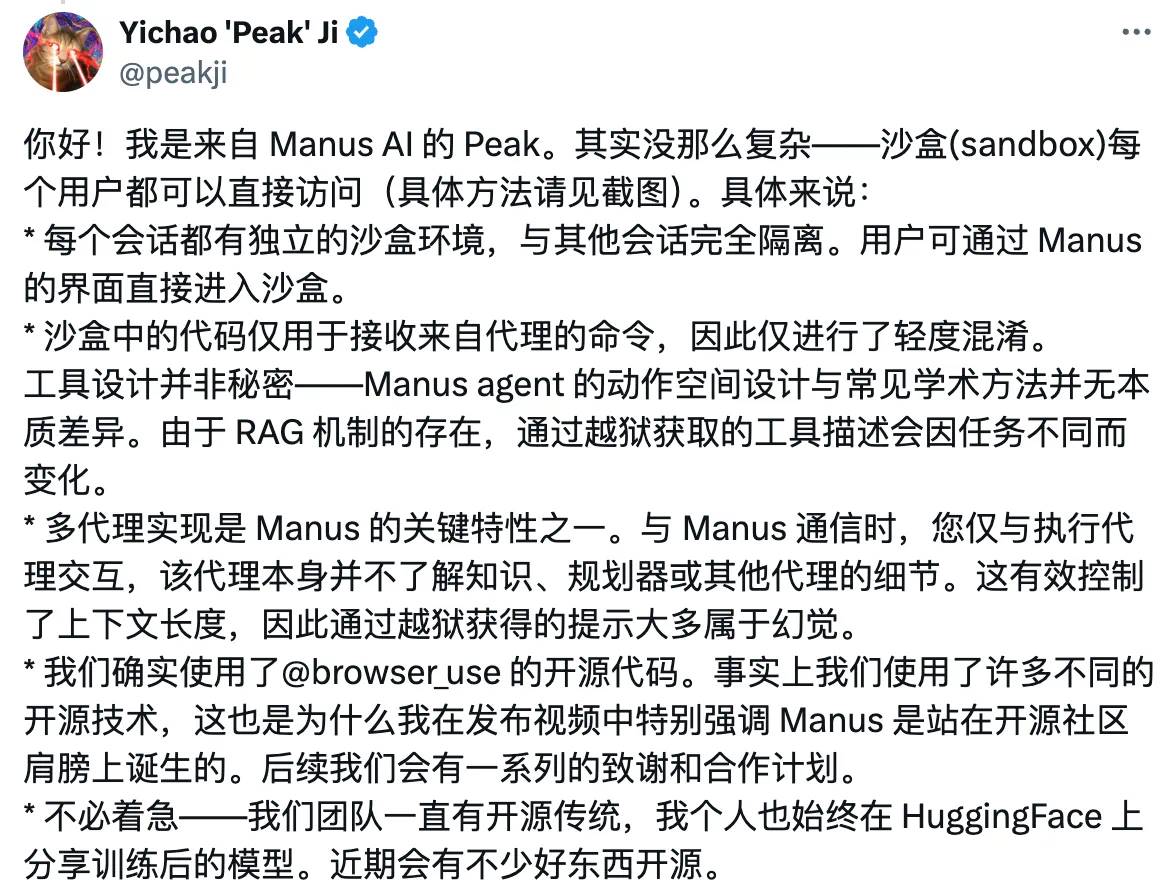
With both partners committed to open-source principles, we may look forward to more open-source developments from Manus in the future.
Join TechFlow official community to stay tuned
Telegram:https://t.me/TechFlowDaily
X (Twitter):https://x.com/TechFlowPost
X (Twitter) EN:https://x.com/BlockFlow_News