Analyst: Uniswap Foundation Launches $165.5 Million Mega Investment Plan, but Why Do I Think It's Only a Quick Fix?
TechFlow Selected TechFlow Selected
Analyst: Uniswap Foundation Launches $165.5 Million Mega Investment Plan, but Why Do I Think It's Only a Quick Fix?
UNI holders are like "cows" being milked dry, with their token value never captured.
 Navigating Web3 tides with focused insights
Author: Ignas
Translation: Tim, PANews
Why did the Uniswap Foundation vote to approve a massive $165.5 million investment plan?
Because the performance of Uniswap v4 and Unichain after launch has fallen far short of market expectations.
Over the past month:
-
Uni v4's total value locked (TVL) was only $85 million
-
Unichain's TVL was merely $8.2 million
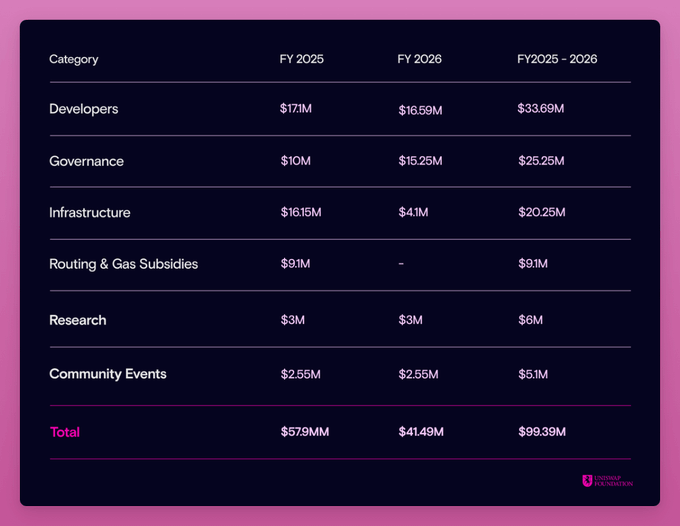
To drive growth, the Uniswap Foundation proposed allocating $165.5 million toward the following areas:
-
$95.4 million for grants (developer programs, core contributors, validators);
-
$25.1 million for operations (team expansion, governance tool development);
-
$45 million for liquidity incentives.
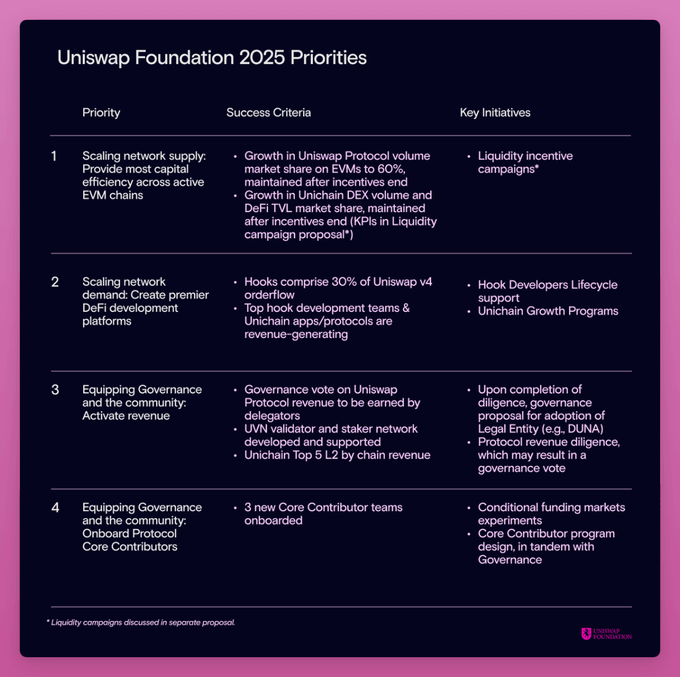
As you can see, Uni v4 is not just a DEX—it's a liquidity platform, with Hooks serving as applications built on top of it.
Hooks are expected to drive ecosystem growth for Uni v4, hence the need to accelerate this process through grant programs.
Detailed breakdown of the grant budget allocation:
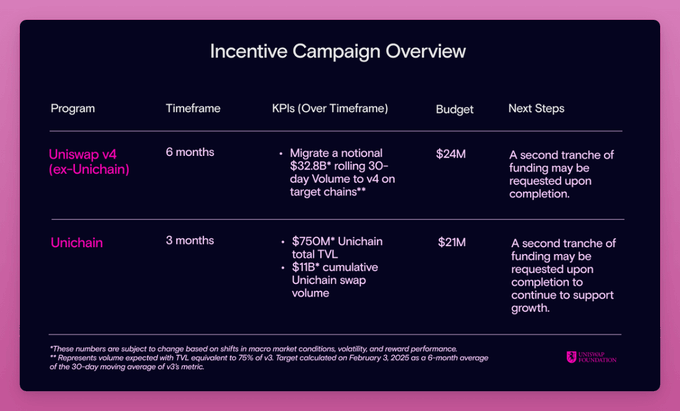
The $45 million in liquidity provider (LP) incentives will be used for:
-
$24 million (disbursed over 6 months): to incentivize liquidity migration from other platforms to Uni v4;
-
$21 million (disbursed over 3 months): to grow Unichain's TVL from its current $8.2 million to $750 million.
In comparison, Aerodrome mints approximately $40–50 million worth of AERO tokens each month for LP incentives.
The proposal has passed the temperature check phase but still faces criticism:
At a time when industry dynamics are shifting, Aave has proposed repurchasing $1 million worth of AAVE tokens weekly, and Maker plans to buy back $30 million monthly—yet UNI holders are treated like "cash cows" being drained of value, with no mechanism capturing value for their token.
The UNI token lacks a fee-sharing mechanism, while Uniswap Labs has earned $171 million in frontend fees over two years.
The crux lies in Uniswap's organizational structure:
-
Uniswap Labs: focused on protocol technology development;
-
Uniswap Foundation: drives ecosystem growth, governance, and funding initiatives (such as grants and liquidity incentives).
What a clever legal team.
Aave and Maker have established tighter alignment between their protocols and token holders. I don’t understand why Uniswap's frontend revenue cannot be shared with UNI holders.
In summary, other criticisms mainly focus on three aspects: high salaries for the core team, Gauntlet's role in executing liquidity incentives, and the establishment of a new centralized DAO legal structure (DUNA).
As a small governance participant in Uniswap, I voted in favor of this proposal—but I remain deeply concerned about the future of UNI holders: the incentive mechanisms are misaligned with token holder interests.
Nevertheless, I'm a strong supporter of Uniswap and highly recognize its role in advancing DeFi. The current growth trajectory of Uni v4 and Unichain is extremely weak, and they need incentives to foster development.
The next Uniswap DAO vote should focus on implementing value capture mechanisms for the UNI token.
Join TechFlow official community to stay tuned
Telegram:https://t.me/TechFlowDaily
X (Twitter):https://x.com/TechFlowPost
X (Twitter) EN:https://x.com/BlockFlow_News
 Ignas | DeFi Research