Analysis of SIMD-0228: Solana's Monetary Policy Transition and Multi-Party Dynamics
TechFlow Selected TechFlow Selected
Analysis of SIMD-0228: Solana's Monetary Policy Transition and Multi-Party Dynamics
This article provides a detailed analysis of how the SIMD-0228 proposal changes Solana's inflation mechanism.
 Navigating Web3 tides with focused insights
Author: @lvxuan147

Key Takeaways | TL;DR
-
Proposal essence: SIMD-0228 drastically reduces Solana's inflation rate (from 4.779% to 0.87%), cuts token issuance, ensures network security, and releases capital into DeFi.
-
Core mechanism: Current fixed decline model (inflation drops annually from 8% by 15%, targeting 1.5%) criticized as "dumb emissions"; new model is market-driven—low inflation when stake rate >65%, high inflation when <33.3%, with 33.3% as the equilibrium point.
-
Divergent positions: Large investors and non-stakers support it (less dilution, stable price); small-to-mid validators and stakers oppose it (lower income); large validators support it (stronger MEV). Big fish thrive, small fish struggle—like supermarket pricing where big chains survive, small shops close.
-
Validator impact: Stake rate may drop from 65.7% to 45–55%; 3–4% of validators (40–55 nodes) might exit. Revenue shifts from inflation to MEV. DeFi locked SOL could rise 5–10%. Like factory layoffs—efficient stay, inefficient leave.
-
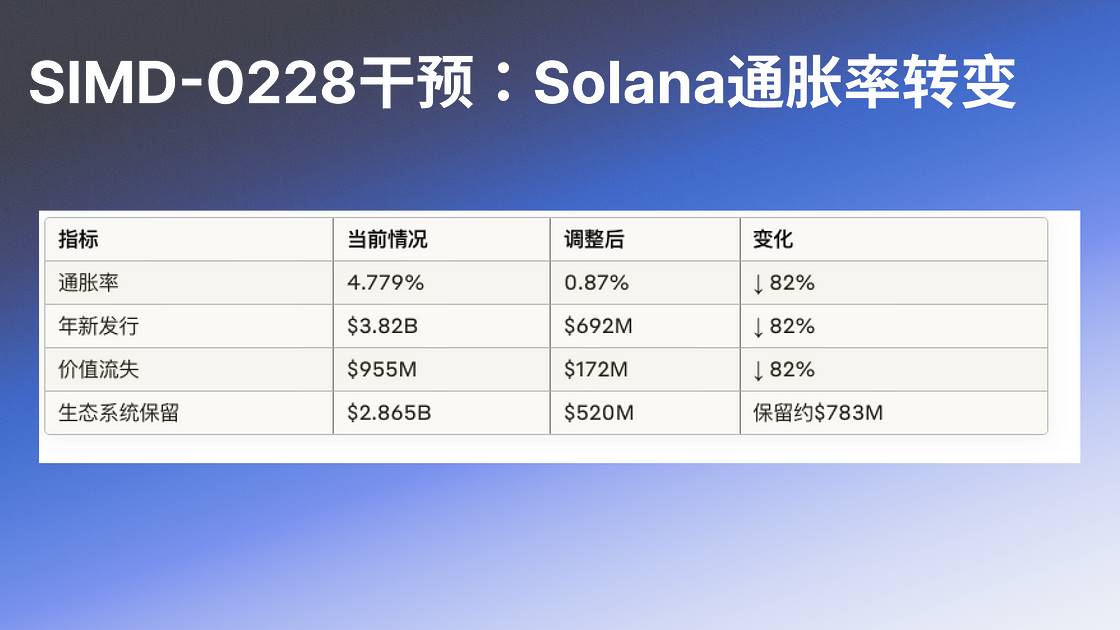
Ecosystem impact: Annual issuance of 382 million SOL, with 25% (955 million USD) leaking out. SIMD-0228 plugs this "leaky bucket," retaining ~783 million USD annually, boosting DeFi growth, optimizing resources, reducing dilution.
-
MEV vs Inflation: Validator income shifts from a “fixed salary” to relying on “tips” (MEV). In 2024, MEV reached $675M, accounting for 14% of issuance—high but volatile.
-
Security risks: Low stake rate → higher inflation → price drop → validator exits, creating a vicious cycle. Increased reliance on MEV raises centralization risk. Stability under extreme conditions remains unproven—like an economic recession with safeguards, but not foolproof.
-
Proposal significance: SIMD-0228 isn't just technical change—it marks Solana’s shift from “overpaying for security” to “finding the minimum necessary payment,” moving from artificial rules to market balance. It resembles a transition from planned economy to market economy, giving Solana the potential to evolve into a more mature, market-oriented economic model.
-
Actionable advice: Depends on whether the proposal passes. If so, holders should adjust staking strategies, validators must optimize MEV, and developers should seize new DeFi opportunities.
Key Terms Explained
Before diving in, understand these core concepts:
-
Stake Rate (s): Percentage of total SOL supply locked for network validation. Currently ~65.7%.
-
Inflation Rate (i): Annual percentage of newly minted SOL relative to total supply. Currently ~4.779%.
-
Validators: Node operators on the Solana network responsible for transaction validation and network security.
-
MEV (Maximal Extractable Value): Extra revenue validators earn through transaction ordering, akin to “transaction tips.”
-
Leaky Bucket Effect: Refers to value created by inflation that leaks out of the ecosystem via taxes or other channels.
Beginner-friendly guide: This article analyzes how the SIMD-0228 proposal changes Solana’s inflation mechanism. Even if you’re unfamiliar with blockchain or crypto, check the “💡 For Beginners” sections—I’ll explain complex ideas in simple terms. Let’s begin👇🏻.
0. Introduction: Five Key Questions About Solana’s Inflation Policy Turning Point
Solana stands at a historic crossroads—SIMD-228 could completely transform its inflation model, shifting from a fixed schedule to a market-driven dynamic system. This isn’t just a technical update; it’s a deep restructuring of Solana’s entire economic foundation.
The core problem SIMD-228 aims to solve: How can we ensure network security while minimizing unnecessary token issuance?
With that in mind, here are five key questions that help explain why this proposal has sparked such intense debate:
-
What underlying power struggles exist behind the proposal? How will value be redistributed?
-
What shocks will hit validator economics? How will they adapt?
-
Will lower staking rates threaten network security? Is there a critical threshold?
-
How will the relationship between MEV and inflation change? What impact will shifting income sources have?
-
How does the “leaky bucket effect” quietly erode Solana’s ecosystem? Are hundreds of millions in value leaking out each year?
-
Could low staking rates trigger systemic risk? Could a negative feedback loop destabilize the network?
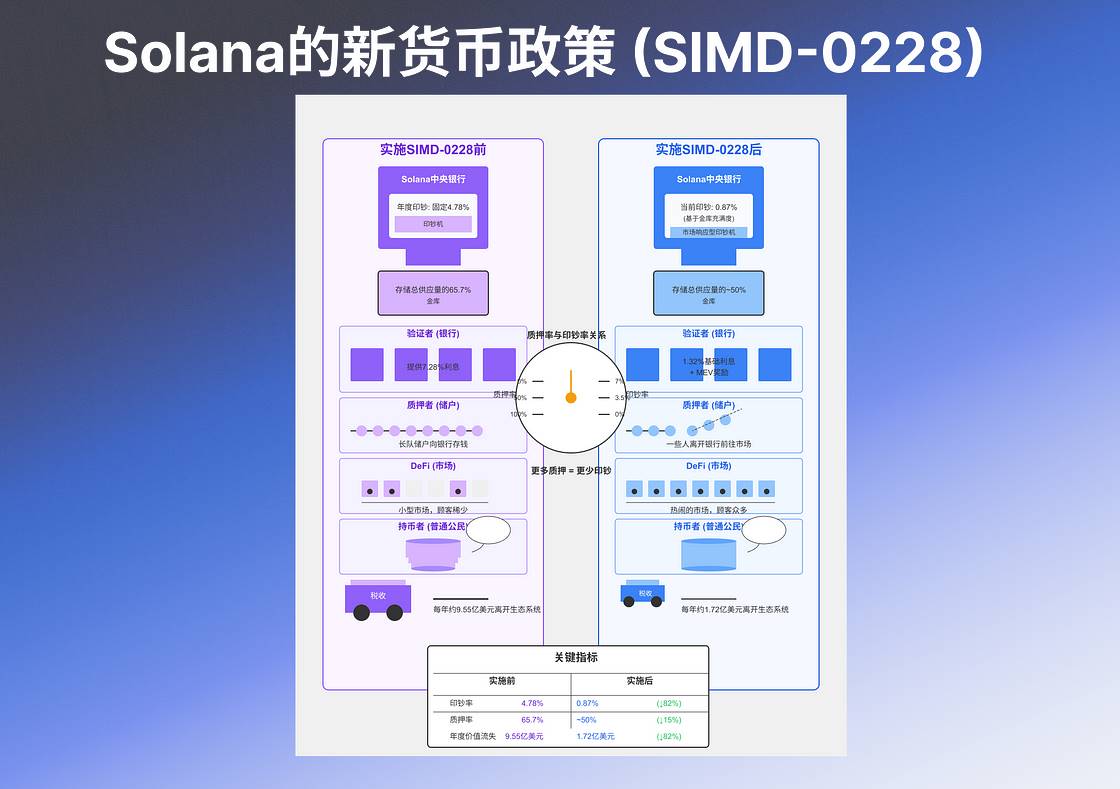
💡 For Beginners: Imagine Solana as a country reconsidering its “money printing” policy. Right now, it prints new money every year on a fixed schedule. The new proposal suggests adjusting the amount printed based on how many people deposit money in banks (stake). Print less if many people stake; print more if few do. This change affects everyone: banks (validators), depositors (stakers), consumers (app users), and regular token holders.
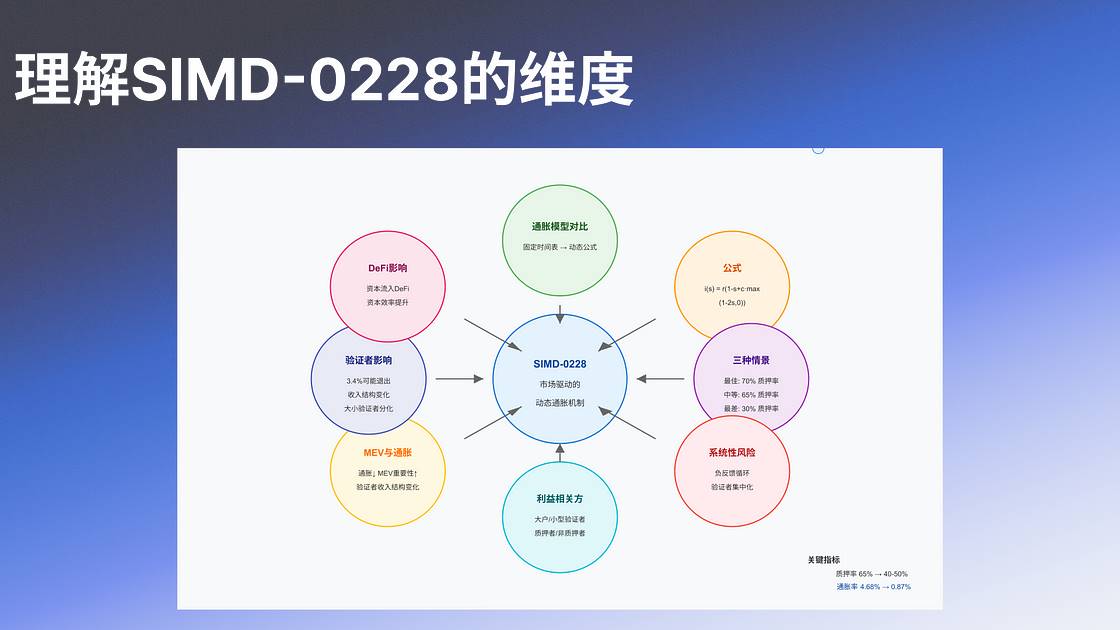
1. Deep Dive into SIMD-0228: Authors, Timing, Core Changes & Interests
Proposal Authors: Heavyweights
SIMD-0228 was jointly proposed by three influential figures in the Solana ecosystem:
-
Tushar Jain — Co-founder of Multicoin Capital, one of Solana’s earliest and largest institutional backers. Tushar has repeatedly expressed long-term bullish views on Solana and frequently discusses blockchain monetary policy.
-
Vishal Kankani — Investment Partner at Multicoin Capital, focusing on crypto economics and market structure. He’s published multiple analyses on Solana’s ecosystem and value capture mechanisms.
-
Max Resnick — Engineer at Anza and member of Solana’s core development team, bringing deep technical expertise and intimate knowledge of Solana’s codebase. He contributed key technical insights for implementation.
Notably, two authors come from Multicoin Capital, one of the largest institutional players in Solana, holding substantial amounts of SOL. This background is crucial for understanding certain motivations behind the proposal.
💡 For Beginners: The authors aren’t ordinary users—they’re “whales” in the Solana world. Two are executives at a major investment fund holding large amounts of SOL; the third is a core developer. Knowing who drives this change matters because it influences how they design the system.
Timing: January 2025
-
MEV Growth — In Q4 2024, Solana’s MEV revenue surged to $430M, over ten times higher than Q1. This supports the case for lowering inflation (Solana Floor), showing validators already have alternative income streams.
-
High Staking Rate — The current 65.7% staking rate is historically high, creating favorable conditions for reducing inflation.
-
Ecosystem Maturity — Solana’s DeFi ecosystem is now robust enough to absorb capital released from staking.
-
Market Environment — Broader crypto markets are increasingly focused on monetary policy and inflation control.
Core Change: Current State vs. Proposal Goal (Idealized)
The table below compares Solana’s current state (as of 2025–01–18) with the expected outcomes under SIMD-0228:
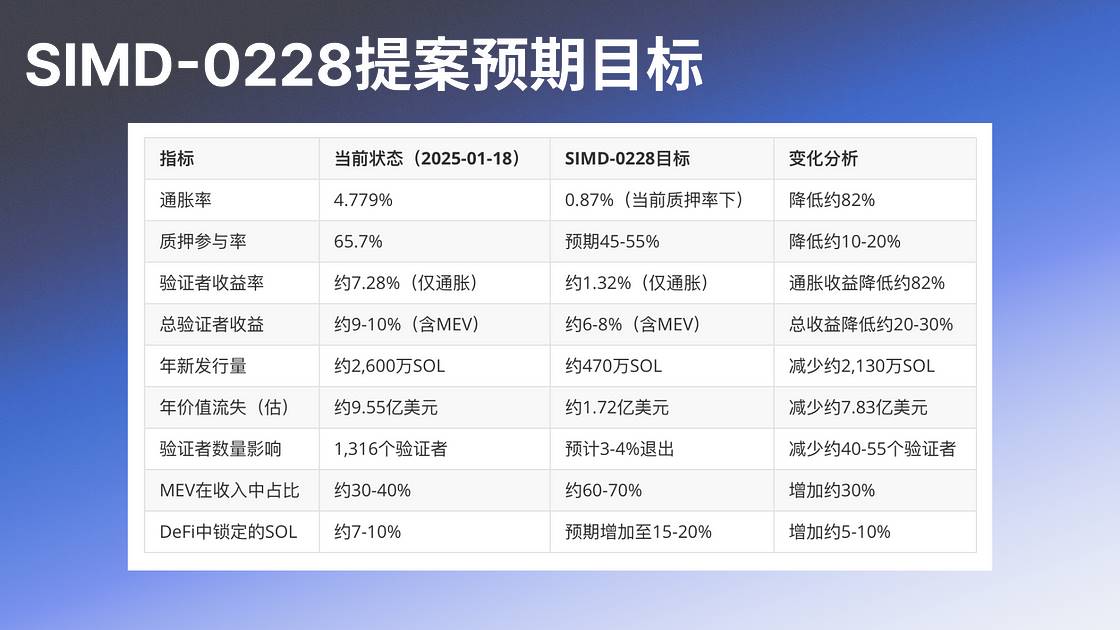
This data clearly shows the core goals of SIMD-0228:
-
Drastically reduce inflation
-
Cut unnecessary token issuance
-
Maintain sufficient network security while freeing up more capital for DeFi.
💡 For Beginners: This comparison shows how dramatic the change is. Simply put: currently, Solana “prints money” at 4.78% per year. The new proposal wants to bring that down to ~0.9%—an 82% reduction! That means validators (network maintainers) will get far less base pay, but they can make up for it through other income like MEV (“tips” from transaction ordering). Around 40–55 smaller validators might exit due to lower earnings.
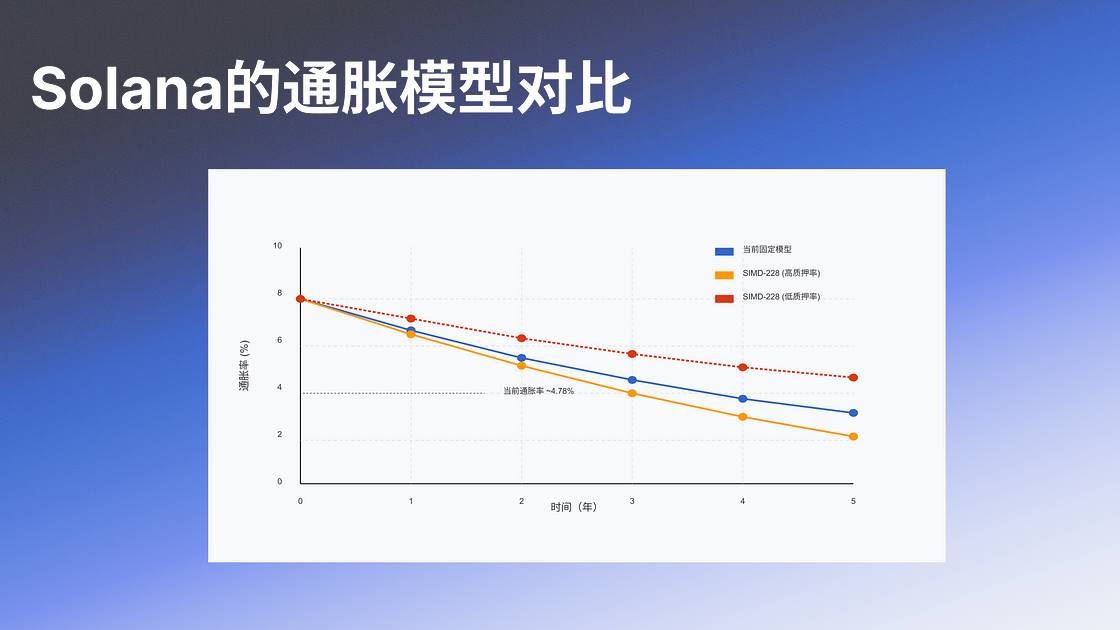
Original Formula & Design Logic
The core of the SIMD-0228 proposal is a dynamic inflation formula based on staking rate:
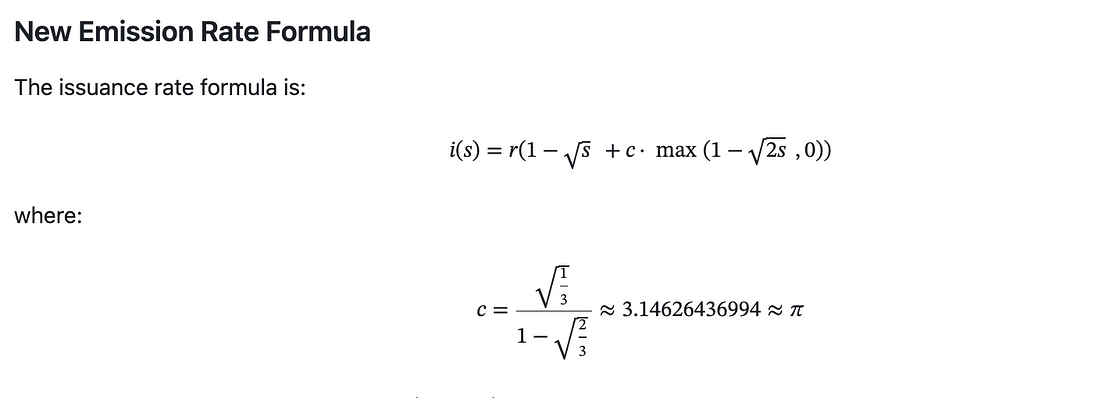
The formula looks complex, but its design is elegant:
-
Uses square root function instead of linear, making inflation decrease more gently at high staking rates and increase more aggressively at low ones
-
Defines a tipping point: when staking rate is 33.3%, inflation equals current fixed rate
-
Coefficient c (~π) ensures smooth transitions across different staking ranges
💡 For Beginners: Don’t worry about the math! Think of it simply: when many people stake SOL (>65%), the “printing press” slows dramatically. When fewer stake (<50%), it speeds up moderately. If staking falls below 33.3%, “printing” accelerates sharply to attract more participants. It’s like an automatic regulator maintaining network balance.
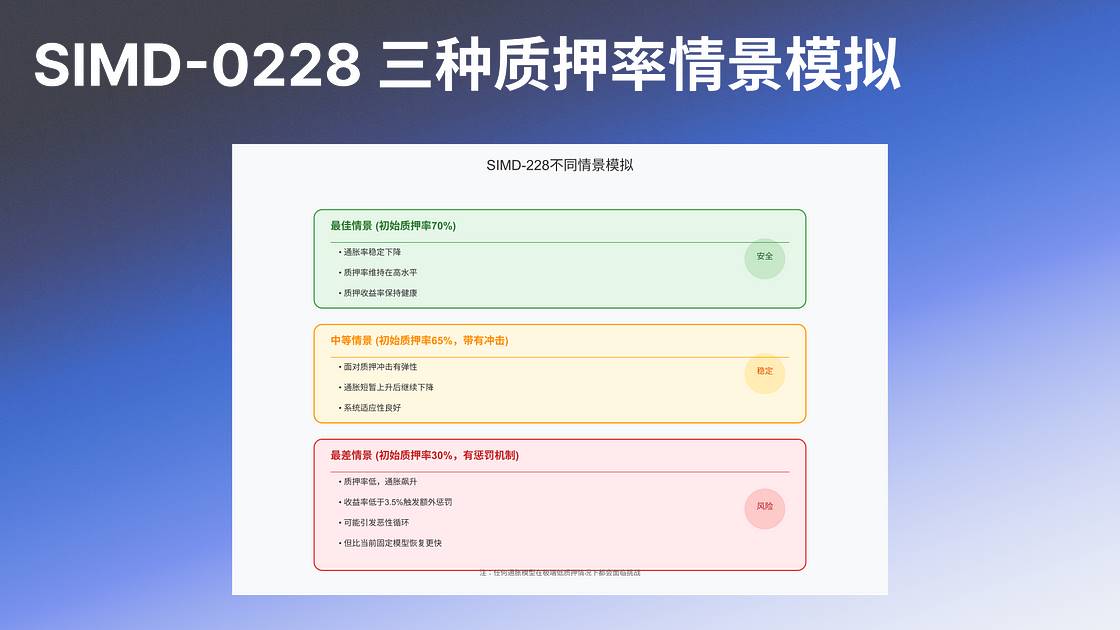
SIMD-0228 simulation under various scenarios—high, medium, and low staking—shows the formula is designed to use market mechanisms to auto-adjust inflation to exactly meet security needs, no more, no less.
Stakeholder Interests
By analyzing the proposal content, author backgrounds, and timing, we identify several key interests:
-
Reduce Holdings Dilution — Multicoin Capital holds large amounts of SOL; lower inflation reduces annual dilution by ~4.56%.
-
Support SOL Price — Reducing new supply may boost prices (Cryptotimes).
-
Free Capital for DeFi — The proposal repeatedly highlights how high staking suppresses DeFi activity, aiming to redirect capital into DeFi—benefiting Multicoin-backed projects.
-
Shape Market-Driven Narrative — Emphasizes “markets are the best price discovery mechanism,” reinforcing Solana’s image as an “efficient network.”
-
Optimize Validator Ecosystem — Max Resnick focuses on long-term sustainability, reducing dependency on inflation.
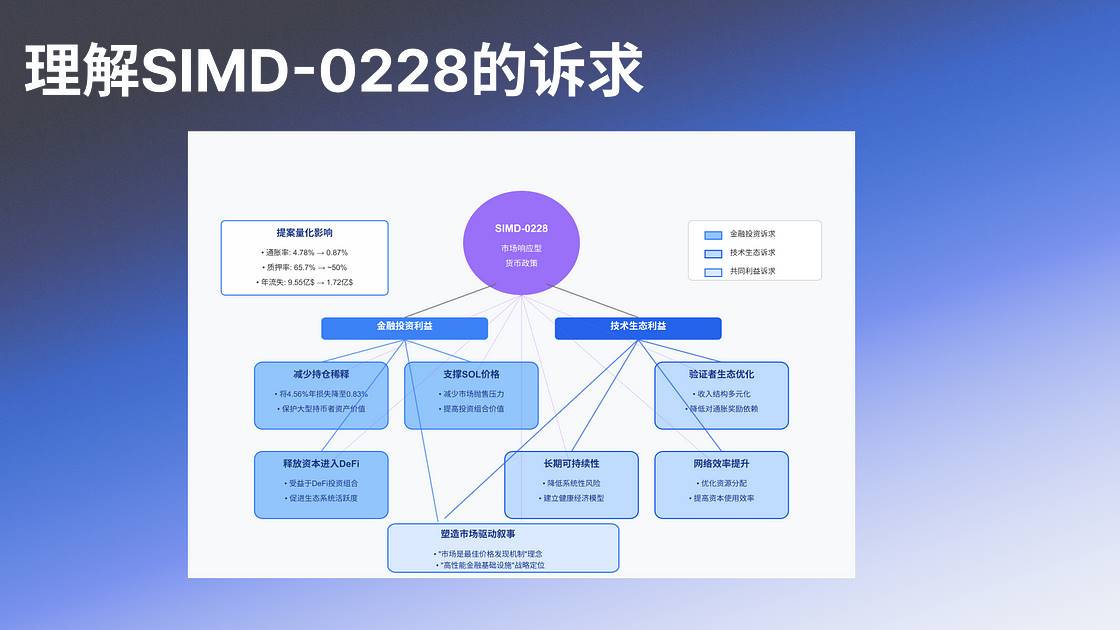
💡 For Beginners: There are multiple motives behind the proposal. Imagine you own 10% of a company. If the company issues 5% new shares annually to employees and you don’t receive any, your ownership gets diluted over time. Large investor Multicoin wants to reduce this dilution and also hopes for a rising SOL price (reduced supply growth typically benefits price). Additionally, they want more SOL flowing into DeFi apps—many of which they’ve invested in.
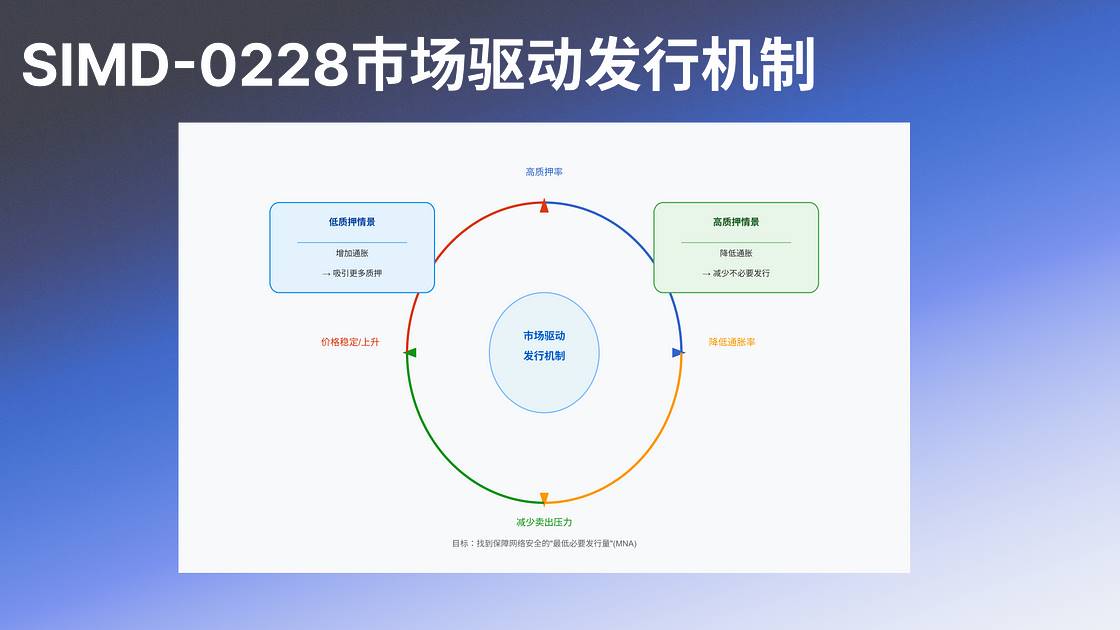
Notably, as shown in the diagram below, while the proposal likely aligns with large investors’ interests, its design also considers overall ecosystem health. Features like the safety threshold and a 50-round smoothing period suggest efforts to balance competing interests.
Strategic Timing
The January 2025 timing carries strategic importance:
-
MEV Surge — Q4 2024 MEV revenue hit $430M, over ten times Q1 levels. This strongly supports reducing inflation, proving validators have viable alternative income.
-
Historically High Staking — At 65.7%, current staking provides ideal conditions for lowering inflation.
-
Ecosystem Readiness — Solana’s DeFi ecosystem is now mature enough to utilize capital freed from staking.
-
Broader Market Trends — Cryptocurrency markets are increasingly debating monetary policy and inflation control, making this proposal timely.
💡 For Beginners: The timing is deliberate. Just like reforming during strong economic times, proposers chose a moment of “perfect alignment”: MEV (extra validator income) is booming, staking is high (65.7%), and Solana’s app ecosystem is mature. All factors make this an ideal time to slow down “money printing.”
2. From Fixed Schedule to Market-Driven: More Staking, Less Minting
Currently, Solana uses a fixed declining inflation model: starting from 8%, decreasing 15% annually until reaching a floor of 1.5%. The proposal calls this “dumb emissions” because it ignores actual network conditions.
The new model introduced by SIMD-0228 incorporates market dynamics, linking inflation rate dynamically to staking rate. This design lets the market determine inflation rather than following a preset calendar. When staking reaches 33.3%, inflation matches the current fixed rate—a crucial equilibrium point.
The key feature of this formula: higher staking leads to lower inflation; lower staking triggers higher inflation. This allows the network to self-adjust inflation to maintain optimal participation, ensuring security without excessive issuance.
💡 For Beginners: Currently, Solana’s “money printing” follows a fixed plan: cut issuance by 15% yearly until hitting 1.5%. It’s like a country printing money regardless of economic conditions. The new proposal works more like a modern central bank: dynamically adjusting money supply based on economic indicators (staking rate). If the economy is active (high staking), print less; if sluggish (low staking), print more to stimulate activity.
3. How Will Solana’s Monetary Policy Be Reshaped?
3.1 Large/Institutional Investors
-
Core interest: Reduce dilution, support price, improve DeFi capital efficiency.
-
Representative view: Tushar Jain and Vishal Kankani argue lower inflation stimulates DeFi (SIMD-228 and Solana DeFi).
-
Sol Strategies’ Max Kaplan promotes “roughly right over precisely wrong,” emphasizing flexibility of market-driven systems.
-
Kamino co-founder Marius states “staking encourages hoarding and reduces financial activity,” supporting reduced inflation to enhance liquidity.
-
Potential motive: Promote narrative of a “market-driven efficient network” to attract institutional capital, possibly benefiting diversified portfolio holdings.
-
Position: Support. Lower inflation reduces new supply, protects holdings, and boosts ecosystem appeal via DeFi activity.
3.2 Validators
Large Professional Validators
-
Core interest: Maintain network influence, optimize MEV extraction to offset lower inflation rewards.
-
Characteristics: Advanced MEV tech, significant voting power, strong governance influence, highly adaptable to inflation changes.
-
Examples: Exchange-run validators like Binance and Kraken; institutional validators with average inflation commission rate of 2.75%.
-
Position: Support. Can compensate for lower inflation via MEV and transaction fees, maintaining profitability.
Small-to-Mid Validators
-
Core interest: Maintain economic viability, sensitive to voting costs (~2 SOL per round).
-
Concerns: Helius data suggests 3–4% of validators may exit due to the proposal; fear of worsening “zero-commission race.” 49% of validators charge 0% commission, indicating lower sensitivity to inflation changes.
-
Examples: Validators like Chainflow reliant on Solana Foundation Delegation Program (SFDP).
-
Position: Oppose, may exit (David Grider on X).
3.3 Developers & Ecosystem Builders
-
Core interest: Increase network activity, channel capital into DeFi and apps, preserve decentralization.
-
Diverging views:
-
Supporters: Believe the proposal frees capital for app layers. Anza’s Max Resnick (co-author) emphasizes the “leaky bucket” effect, advocating reduced tax leakage (Solana’s SIMD-0228 Proposal Could Slash SOL Inflation to 0.87%).
-
Concerned: Worry that validator contraction could harm decentralization. Leapfrog raised concerns about potential inflation spirals in community discussions (Six Questions and Answers: A Comprehensive Analysis of Solana’s Latest Proposal SIMD-0228 and Its Impact on the Industry).
-
Representative: Helius (node provider) offers neutral data analysis, emphasizing network health.
-
Position: Mixed—some see DeFi growth potential, others fear decentralization risks.
3.4 Regular Token Holders
Active Stakers
-
Core interest: Stable staking returns, sensitive to tax implications.
-
Impact: Yields slightly decrease but become more sustainable in high-staking scenarios (e.g., dropping from 7.03% to 1.41%). Must reassess staking strategy, potentially concentrating on MEV-capable validators.
-
Position: Oppose—lower returns hurt investment performance.
Non-Staking Holders
-
Core interest: Avoid dilution, benefit from SOL price appreciation.
-
Impact: Directly benefit from lower inflation. Reduced “leaky bucket” effect may support price.
-
Position: Support—lower inflation protects their holdings.
2.5 Hidden Power Struggles
MEV Infrastructure Controllers
-
Core interest: As inflation rewards shrink, MEV becomes more valuable. Controlling MEV extraction technology increases power.
-
Examples: Jito and other MEV optimization providers, entities controlling block-building algorithms.
-
Position: Support—inflation reduction makes MEV more critical, strengthening their market position.
Governance Influencers
-
Core interest: Shape future protocol upgrades, maintain ecosystem influence.
-
Potential outcome: Increased validator concentration may centralize governance decisions; closer ties between core devs and large capital.
-
Position: Support (if large validators)—higher concentration eases network control.
Community Debate:
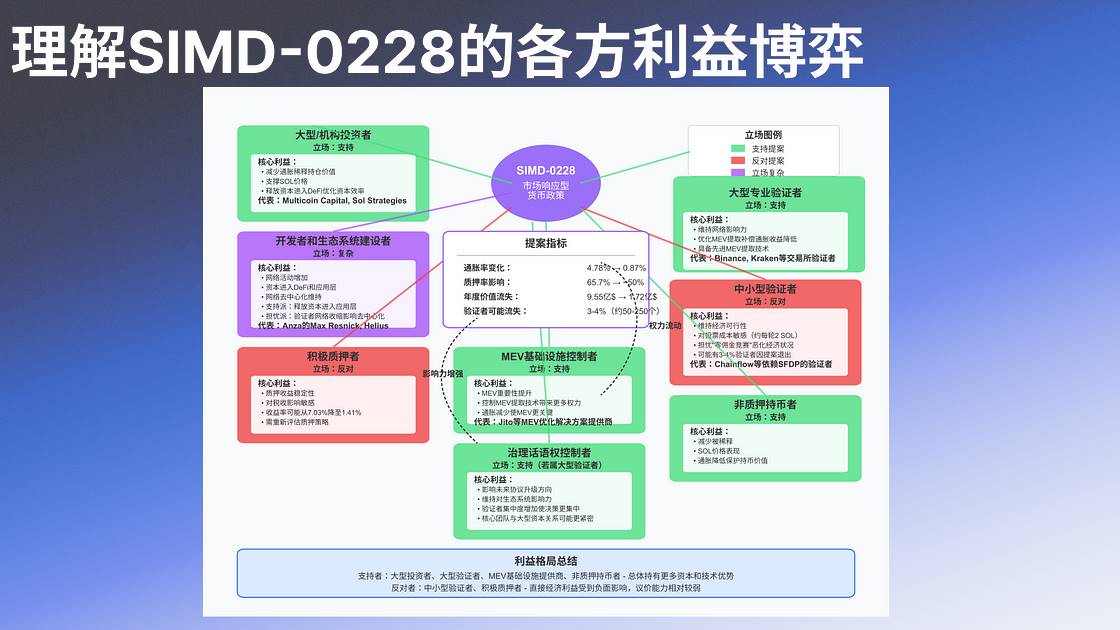
There’s controversy around IMD-0228, especially regarding its impact on small validators. David Grider’s thread estimates 50–250 validators could be lost under various scenarios, raising concerns about decentralization. A hidden detail: small validator exits could trigger a “zero-commission race,” worsening their economics, while large validators strengthen influence via MEV.
Helius Blog’s Latest Analysis: Validator Economics Under Pressure
Large Professional Validators: Potential winners in survival-of-the-fittest, typically possessing:
-
Advanced MEV extraction capabilities to offset reduced inflation income
-
Sufficient capital and technical resources to adapt
-
Greater influence in network governance
For this group, SIMD-0228 presents an opportunity to gain larger market share within the validator ecosystem. By optimizing MEV capture and cutting costs, they can maintain or even improve profitability.
Small-to-Mid Validators: Facing existential challenges:
-
Lack efficient MEV extraction tools
-
More sensitive to voting costs (~2 SOL per round)
-
Disadvantaged in “zero-commission races”
Smaller validators like Chainflow have voiced concern, stating “despite our best efforts to attract stakes, we still heavily depend on SFDP delegation to remain operational.”
According to validator economic models:
-
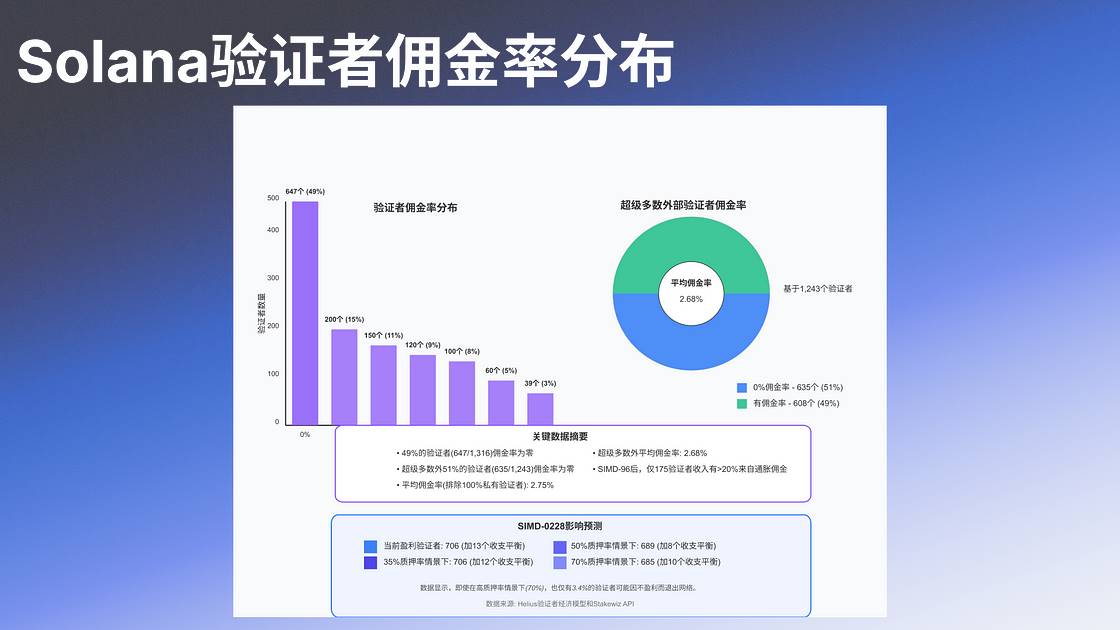
Of 1,316 validators, 647 (49%) have zero commission on staking rewards—making them less affected by inflation changes
-
Under high staking scenario (70%), ~3.4% of validators may exit due to unprofitability
-
David Grider’s model suggests 50–250 validators might exit under different scenarios
In Summary
The stakeholder dynamics of IMD-0228 reflect ecosystem complexity. Institutional investors support it; validators split (large support, small oppose); developers hold mixed views; regular holders divide (stakers oppose, non-stakers support); hidden powers like MEV controllers and governance influencers likely back it.
💡 For Beginners: This is like retail transformation—large chain stores (large validators) have resources to invest in advanced tech and survive margin compression through scale and efficiency. Small independent shops (small validators) face greater pressure and may shut down or get acquired. SIMD-0228 could cause ~40–55 small validators to exit, unable to profit in the new environment.
4. Impact of SIMD-0228 on Validator Landscape
SIMD-0228 may affect different validator types very differently. According to Helius’ validator economic model:
-
Of 1,316 validators, 647 (49%) charge zero commission on staking rewards—so inflation changes affect them less
-
Under high staking scenario (70%), ~3.4% of validators may exit due to unprofitability
-
David Grider’s model estimates 50–250 validators may exit under various scenarios
This shift affects not only individual validator viability but could reshape the entire validator ecosystem’s structure and competition. Key question: Are we willing to accept fewer validators for a more efficient economic model?
💡 For Beginners: Validators’ “Survival Game”
Imagine the Solana network as a large factory, with validators as quality inspectors. Now, management (network governance) adjusts the reward system:
Before: Every inspector received a fixed salary
Now: Only the most efficient inspectors earn higher rewards
Result? Some less-efficient inspectors may be phased out; the inspection process may become more precise, though the total number of inspectors slightly decreases.
Key question: Are we willing to trade a slightly smaller number of “inspectors” for a more efficient, accurate system?
5. Will Lower Staking Rates Threaten Security? Finding Balance Between Safety and Efficiency
Staking rate is a key metric for PoS network security. Solana’s current staking rate (~65.7%) exceeds many other PoS networks. SIMD-0228 may lower this figure, raising security concerns.
Staking Rate Forecast & Security Threshold
Simulation data shows:
-
At market equilibrium, staking rate may fall from 65.7% to 45–55%
-
When staking hits 33.3%, inflation equals current fixed rate
-
In worst-case scenarios, further decline could trigger negative feedback loops
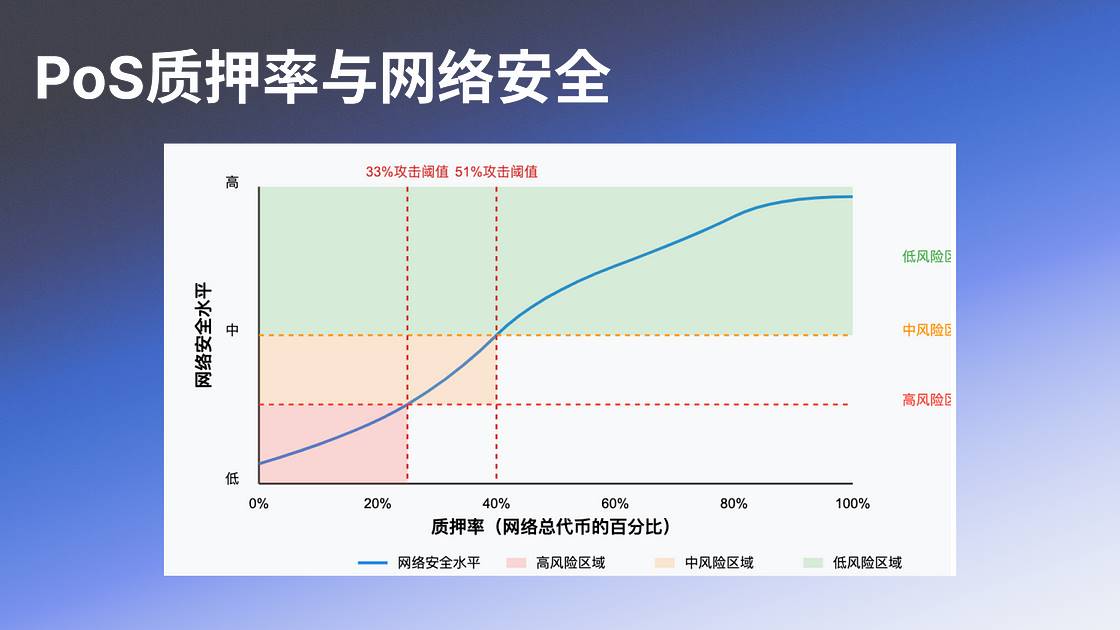
The key issue: What is the “sufficient” security threshold? 33%? 40%? Higher? No consensus exists yet.
On the Other Hand: Shift in Security Model
SIMD-0228 represents a fundamental shift in security philosophy:
-
From “overpaying for security” to “finding the minimum necessary payment”
-
From “fixed incentives” to “market-determined incentives”
-
From “inflation-driven security” to “usage-value-paid security”
This reflects Solana’s transition from startup phase to maturity. As network activity and MEV grow, high inflation may no longer be needed.
The diagram below illustrates the relationship between staking rate and security. Higher staking increases attack cost and improves security—but with clear diminishing returns.
SIMD-0228 balances security and capital efficiency: It moves Solana’s staking rate from a “possibly over-secured” zone to a more balanced range, while preserving adequate safety margins.
💡 For Beginners: Imagine a country’s military: currently 65.7% of the population serves, far beyond what’s needed. The new proposal might reduce this to 45–55%—still enough for defense, while freeing more people for economic work. But if it drops too low (<33.3%), national security could be threatened. The real question: Where is the security tipping point?
6. How Will the MEV-Inflation Relationship Change? Impacts of Shifting Income Sources
As blockchain matures, MEV’s role will continue evolving. The challenge lies in balancing MEV’s economic incentives while preserving decentralization and efficiency.
With SIMD-0228 potentially cutting inflation rewards, MEV (Maximal Extractable Value) will become even more critical for validator income. This shift could deeply reshape validator revenue models and Solana’s network dynamics.
Revenue Model Transformation
-
Shift in income focus: Traditionally, validators relied mainly on inflation rewards. With SIMD-0228, MEV will become a key income source. This reflects deeper evolution in blockchain economic models.
-
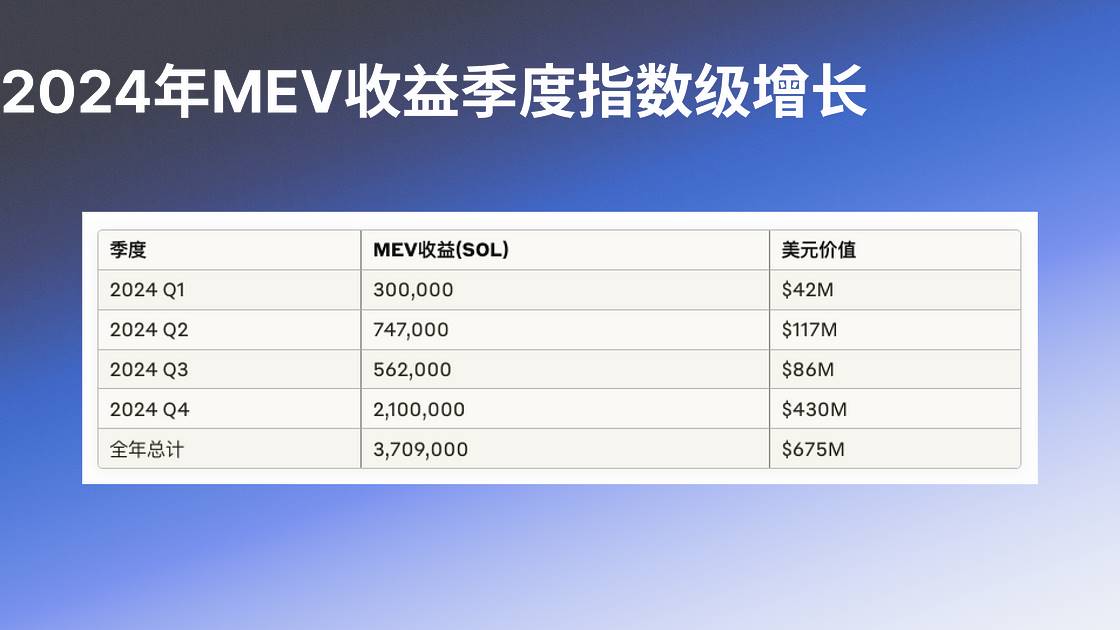
Rapid MEV growth: Data shows explosive growth—Q4 2024 MEV hit $430M, over 10x Q1. In 2024, MEV totaled ~3.7M SOL ($675M), growing exponentially and sometimes exceeding inflation rewards in certain quarters.
Impact Analysis
-
Inflation Compression: SIMD-0228 aims to cut inflation rewards, directly reducing validator income from this source. MEV offers a fast-growing alternative.
-
Income Diversification: Rapid MEV growth fundamentally shifts validator income: under traditional models, income is stable and predictable; under MEV, it becomes dynamic and volatile.
-
Network Dynamics: MEV growth brings profound impacts: validator behavior becomes more market-driven, competition over block building and transaction order intensifies, and incentive structures grow more complex.
Potential Risks & Challenges
-
Income Uncertainty: MEV volatility may increase financial uncertainty for validators, encourage aggressive strategies, and raise new centralization risks.
-
Redefining Blockchain Incentives: 2024 MEV (~$675M) accounted for ~14% of new issuance under current inflation—meaning MEV is becoming comparable to inflation rewards. Long-term, this could redefine blockchain incentive models.
Chain Reactions & New Risks Among Validators
This shift will lead to:
-
Validators focusing more on optimizing MEV extraction
-
MEV capability becoming a key competitive differentiator
-
Network security shifting from inflation dependence to greater reliance on MEV
But it also introduces new risks:
-
MEV’s volatility may destabilize validator income
-
Validators may prioritize MEV over security
-
Dependence on MEV infrastructure may create new centralization points
This shift is not just an economic model update—it’s a deep reconfiguration of security incentives.
💡 For Beginners: Imagine a busy restaurant where transactions are customers. In the old model, servers (validators) earned a fixed wage (inflation). Now, they can earn extra “tips” (MEV) by providing better service.
In 2024, these “tips” exploded—from $42M per quarter early in the year to $430M in Q4! This means validators are shifting from passively waiting for a “salary” to actively creating value.
7. How Does the “Leaky Bucket Effect” Quietly Drain Solana’s Ecosystem?
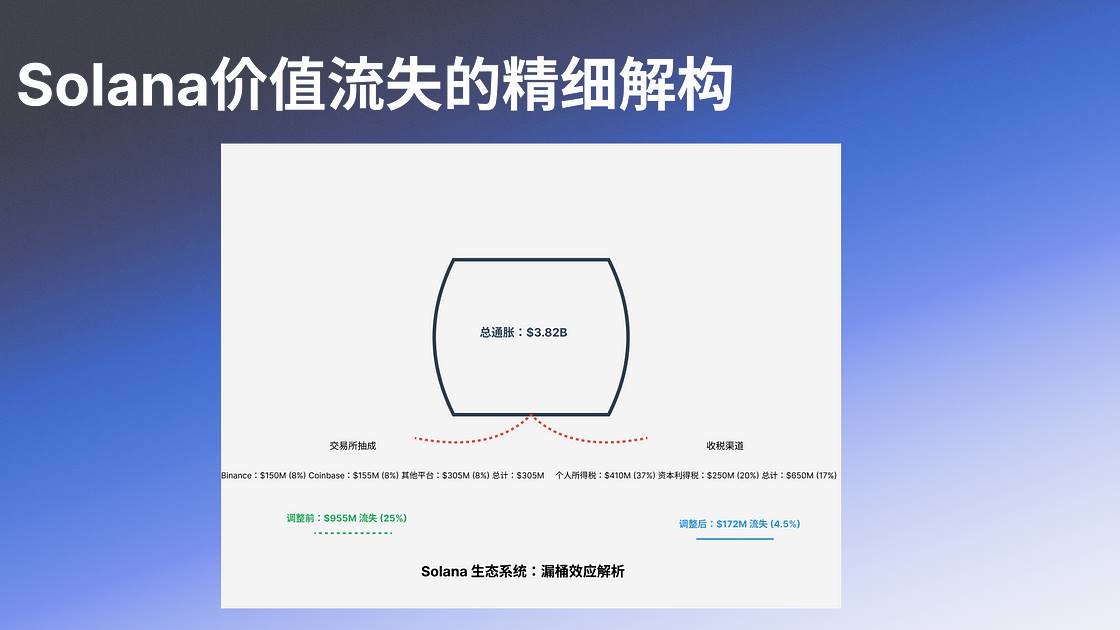
Proposal authors highlight the “leaky bucket effect”—value escaping the ecosystem through taxes and other channels. This concept is a key justification for SIMD-0228.
Inflation Baseline Data:
-
Market Cap: $80B
-
Annual Inflation Rate: 4.779%
-
Annual Newly Issued Value: $3.82B
Channels of Value Leakage
1. Tax Channels: Compliance costs
2. Centralized Exchange Fees
3. Overall Value Loss Structure
-
Tax Channel: $650M (68%)
-
Exchange Fees: $305M (32%)
-
Total Leakage: $955M (25%)
Intervention Effect of SIMD-0228
Deep Economic Impacts
-
Ecosystem Capital Retention
-
Reduces external value extraction
-
Strengthens internal capital circulation
-
Enhances ecosystem autonomy
2. Investor Incentive Restructuring
-
Reduces selling pressure
-
Attracts long-term investors
-
Improves market expectations
3. Capital Flow Dynamics
-
Increased DeFi activity
-
Larger innovation funding pools
-
Reinvestment of value within the ecosystem
As Kamino co-founder Marius said: “Staking encourages hoarding and reduces financial activity… similar to the Fed raising rates and tightening financial conditions.” From this view, reducing inflation may boost overall ecosystem vitality.
The leaky bucket effect reveals a truth: an economic system’s resilience depends not just on total capital, but on the efficiency and direction of capital flow.
SIMD-0228 represents a precise, systematic economic intervention, marking a major evolution in Solana’s governance model.
💡 For Beginners: The “leaky bucket effect” is Solana’s water conservation project. Imagine Solana as a giant reservoir:
Previously: Nearly $1B leaked out annually
Now: Through smarter management, leakage drops to under $200M
Result: ~$800M in “water” retained within the ecosystem
8. Could Low Staking Trigger Systemic Risk? Understanding Potential Negative Feedback Loops
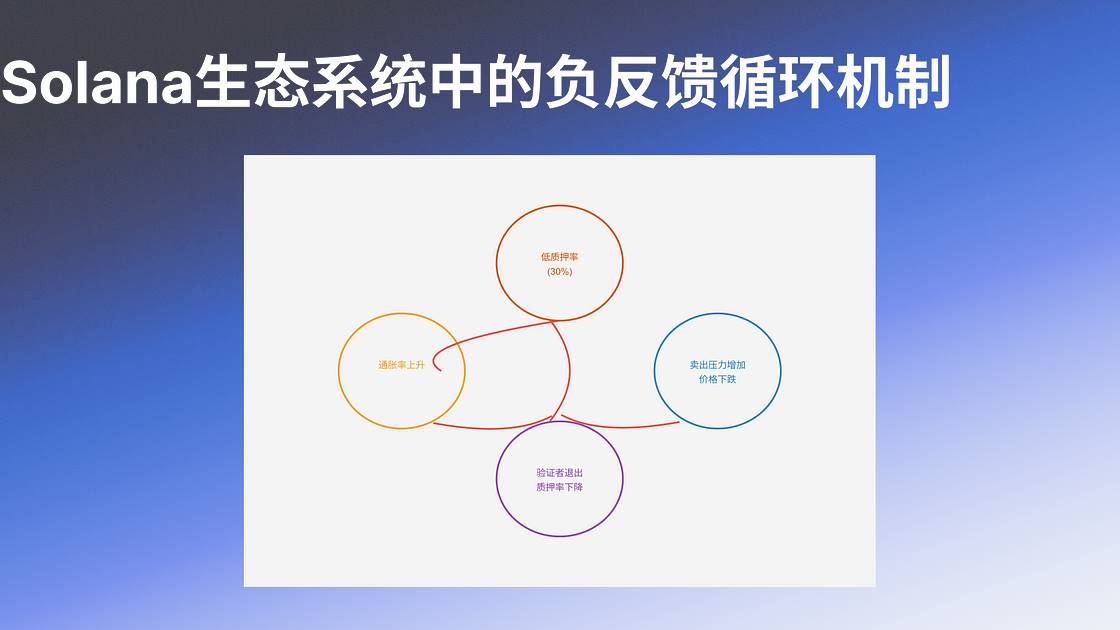
Another major concern with SIMD-0228 is the potential negative feedback loop under low staking conditions, especially if staking falls far below current levels.
Potential Negative Feedback Mechanism
In worst-case scenarios, the following cycle could occur:
-
Low staking (e.g., 30%) → triggers higher inflation
-
Higher inflation → increased selling pressure → price drops
-
Price drop → lower validator yields → some validators exit
-
Validator exits → staking rate declines further
-
When yield drops below 3.5%, a “punishment mechanism” may trigger, accelerating unstaking
Key Considerations for System Stability
This negative loop isn’t just theoretical—it poses a real threat to Solana’s security and stability. Key challenges include:
-
Maintaining security in low-staking environments
-
Designing self-regulating economic incentives
-
Preventing minor fluctuations from escalating into systemic crises
Mitigation Strategies
To address this risk, consider:
-
Implementing smoother inflation adjustment mechanisms
-
Introducing dynamic staking reward systems
-
Creating emergency buffers to protect network stability in extreme cases
-
Improving community communication to boost investor confidence
Resilience Comparison
While this risk exists, SIMD-0228 is designed to be more resilient than the current fixed model:
-
Offers higher yields when staking is low, incentivizing stake return
-
Automatically reduces inflation as staking recovers—self-balancing mechanism
-
Coefficient c (~π) makes the curve more incentive-rich at low staking rates
This adaptive mechanism is a key advantage of SIMD-0228 over fixed models—though risks remain under extreme conditions.
💡 For Beginners: This resembles a recessionary death spiral:
When too many withdraw from banks (low staking)
Banks raise interest (inflation) to attract deposits;
But high rates hurt the economy, prompting more withdrawals;
Banks collapse under strain; panic spreads, more withdrawals…
This cycle is hard to break. SIMD-0228 includes mechanisms to prevent it, but risks remain under extreme stress.
8. Future Outlook: How Will SIMD-0228 Transform Solana’s Ecosystem?
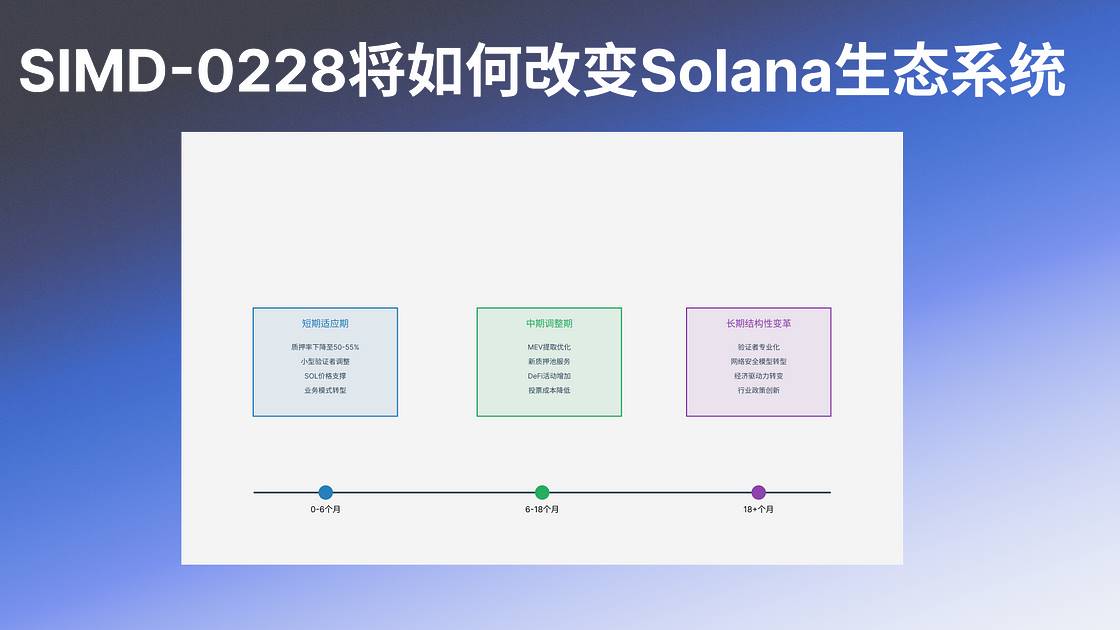
If SIMD-0228 passes and is implemented, it could profoundly reshape Solana—from short-term adaptation to long-term structural transformation.
Short-Term Adaptation (0–6 months)
-
Staking rate gradually drops from 65.7% to 50–55%
-
Some small validators exit or get acquired
-
SOL price may gain support, drawing increased attention
-
Validators begin adjusting business models for the new reality
Medium-Term Adjustment (6–18 months)
-
Validators focus on optimizing MEV extraction
-
New staking pools/services emerge to help stakers access MEV
-
DeFi activity grows, apps using non-staked SOL expand
-
Initiatives to reduce voting costs help small validators survive
Long-Term Structural Shift (18+ months)
-
Validator industry restructured, professionalism increases
-
Security model shifts from inflation-reliant to market-driven hybrid
-
Solana’s economy transitions from “inflation-driven” to “usage-value-driven”
-
Potentially becomes a blueprint for monetary innovation in other PoS networks
💡 For Beginners: Imagine a country transitioning from a planned economy to a market economy: short-term pain as some firms fail; mid-term emergence of new business models; long-term structural efficiency gains. SIMD-0228 may transform Solana from a network primarily incentivized by “money printing” to one sustained by real usage value—a sign of maturity.
These changes affect not just tech and economics, but may reshape the ecosystem’s power structure and developmental path.
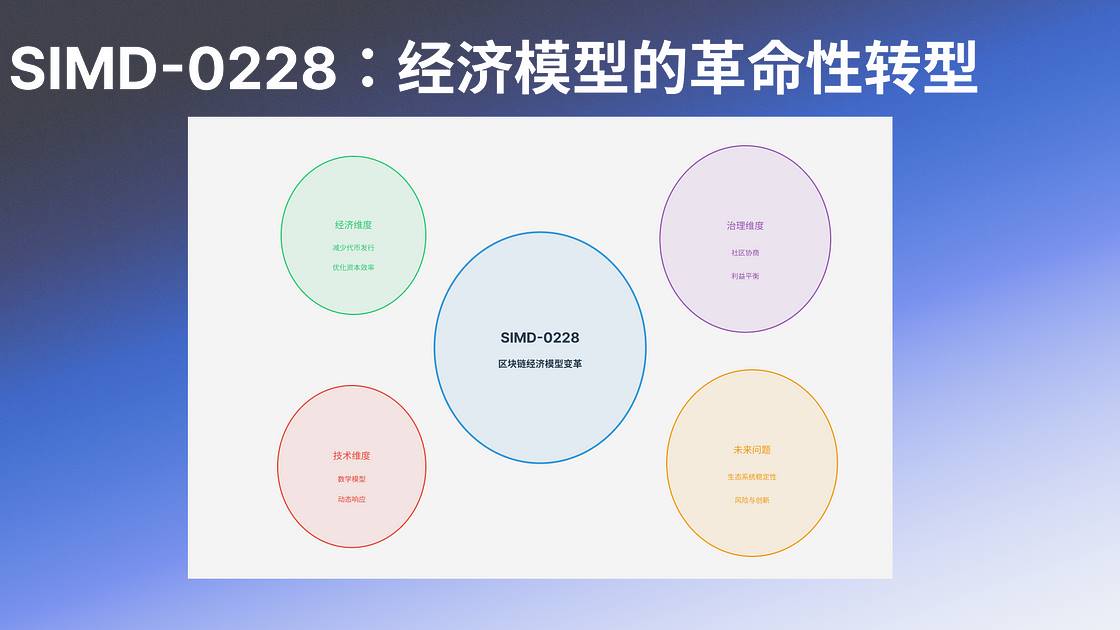
9. Conclusion: Evaluating SIMD-0228 Across Three Dimensions
SIMD-0228 is more than a technical proposal—it’s a profound transformation across economics, governance, and technology for Solana. It marks a leap from simple inflation models to sophisticated market mechanisms in the blockchain world.
Economic Dimension:
-
Reduces unnecessary token issuance and prevents value leakage
-
Uses market mechanisms to adjust inflation, optimizing security costs
-
Releases capital into DeFi, improving overall capital efficiency
Governance Dimension:
-
Reflects the Solana community’s ability to debate complex economic models
-
Seeks balance between resource optimization and network health
-
Allows diverse stakeholders to voice positions and influence outcomes
Technical Dimension:
-
Applies mathematical modeling to tune core economic parameters
-
Designs dynamic response systems to adapt to network changes
-
Offers new thinking for blockchain monetary policy
Key Questions Ahead
As discussion and potential implementation of SIMD-0228 unfolds, keep watching:
-
Can validator ecosystem diversity be preserved?
-
What new risks arise from increased MEV dependence?
-
Can market-driven mechanisms remain stable under extreme conditions?
-
Can other blockchains adopt this model?
💡 For Beginners: SIMD-0228 represents blockchain’s evolution from “simple inflation rules” to “complex market mechanisms,” akin to modern central banks replacing the gold standard. It’s both revolutionary (fundamentally changing rules) and evolutionary (reflecting actual network maturity). Regardless of outcome, it’s a pivotal experiment in blockchain economics.
In a way, SIMD-0228 is both revolution and evolution—it signifies a revolutionary shift in thinking, while reflecting Solana’s natural progression from startup blockchain to mature financial infrastructure. Whatever the result, the proposal and its wide-ranging discussion demonstrate the growing sophistication of blockchain communities in economic design and governance.
10. Actionable Advice (If Proposal Passes)
Regular SOL Holders:
-
If you mainly hold SOL without staking, SIMD-0228 likely benefits you—lower inflation helps protect your holdings
-
If you’re staking, reconsider your strategy—consider switching to validators skilled in MEV extraction
-
Monitor proposal progress closely, especially staking rate and price trends
Validators:
-
Large validators: Invest in MEV optimization tech, prepare for new revenue structures
-
Small validators: Assess economic viability, consider specialization or differentiated services
-
All validators: Track progress on voting cost reductions—they could significantly impact economics
Developers:
-
Prepare to leverage newly freed capital liquidity
-
Build tools helping stakers participate in MEV revenue sharing
-
Explore new, efficient ways to use SOL in DeFi applications
💡 For Beginners: Whether you're a holder, validator, or developer, prepare for changes SIMD-0228 may bring. Regular holders should track developments; validators need to adapt business models; developers can find new opportunities. As with any economic policy shift, those who prepare early often benefit most.

Final Thoughts
SIMD-0228 marks a pivotal turning point, signaling Solana’s move toward a more mature, market-oriented economic model.
By introducing a dynamic inflation mechanism, it aims to build a more efficient, sustainable ecosystem—balancing network security with maximum capital efficiency.
Like any major change, it brings both opportunities and challenges, supporters and opponents. By understanding the motivations, mechanics, and potential impacts behind the proposal, we can better prepare for this transformation and find our place in the new economic landscape.
Regardless of the final outcome, the discussion around SIMD-0228 itself demonstrates the blockchain community’s collective intelligence in solving complex economic problems—an arguably revolutionary aspect of blockchain technology.
Join TechFlow official community to stay tuned
Telegram:https://t.me/TechFlowDaily
X (Twitter):https://x.com/TechFlowPost
X (Twitter) EN:https://x.com/BlockFlow_News
 @lvxuan147