AI "fortune-telling": humanity's cyber placebo
TechFlow Selected TechFlow Selected
AI "fortune-telling": humanity's cyber placebo
Using the most scientific tools to do the most mystical things.
 Navigating Web3 tides with focused insights
By Bingdian
At a family dinner shortly after the start of the new semester, fifth-grader Lin Duo overheard adults discussing using DeepSeek to "tell fortunes." She didn't understand fortune-telling, nor did she catch that "DeepSeek" was made up of two English words. Still, she immediately asked her father for his phone and earnestly posed a question to the app with the whale logo: "Hello, please predict my score on the next exam."
Soon, an answer appeared in the chat box: "Predicting exam results requires considering multiple factors such as your study habits, review efficiency, and mastery of knowledge—information I currently don’t have access to. However, I can offer some scientifically backed study suggestions." This was followed by a series of recommendations like "efficient planning," "Pomodoro Technique," and "Feynman Learning Method."
Lin Duo was deeply disappointed—she hadn’t received a specific score. Her father complained that she didn’t know how to write proper fortune-telling prompts and tried to give her a lesson, but others at the table quickly stopped him. Meanwhile, Lin Duo’s mother applauded the response, urging her daughter to follow the study methods recommended by “Teacher D.”
This wasn’t a fictional scene. As Lin Duo’s aunt, I sat right across from her, observing this fifth-grader’s first experience with a large AI model. In the Year of the Snake, AI mysticism has sparked a craze—regardless of whether people believe in mysticism or understand AI, all it takes is a “spell” (a prompt) to ask DeepSeek about one’s fate, which plants to place in the office, or what color scheme to use for a thesis defense PPT.
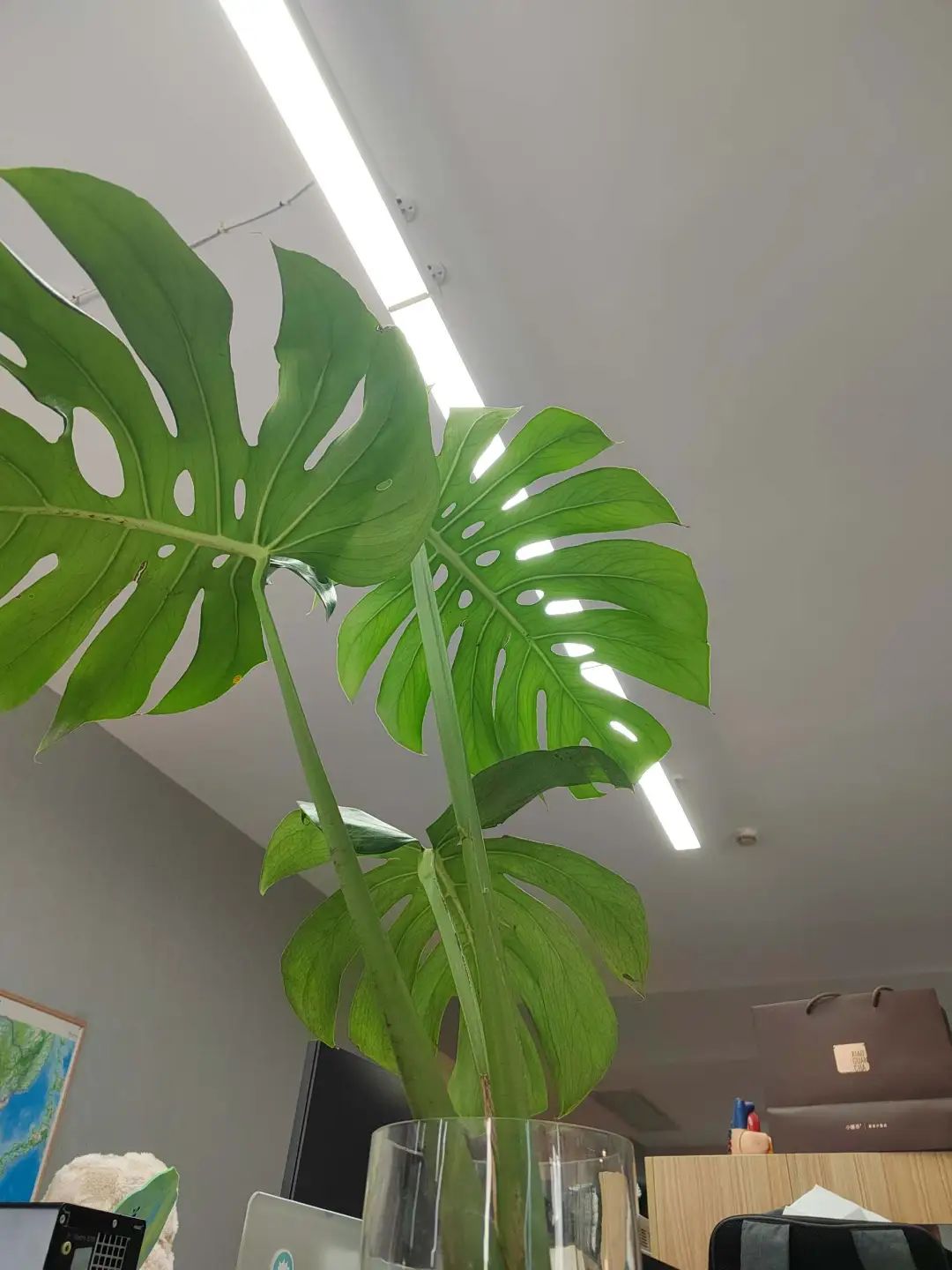
The hydroponic monstera placed according to DeepSeek's suggestion—it looks vibrant, except for slightly blocking the light
Seeking vague answers (though some users insist they’re “very accurate”) from AI seems mysteriously appealing across all age groups.
Why do we always use the most scientific algorithms to do the most mystical things? And when we turn to AI for life guidance, what are we really seeking?
Accuracy doesn’t matter—emotional value is enough
It’s been two years since ChatGPT burst onto the scene. During this time, AI large models have continuously evolved and broken through barriers. Amid the fierce “battle of hundreds of models,” DeepSeek has stood out with its eloquent writing and logical reasoning, becoming the social darling of the Year of the Snake.
No one knows who first started using DeepSeek for fortune-telling, but this AI product—“better suited to Chinese netizens’ constitution” and more attuned to Chinese language and culture—is clearly more in line with Chinese users’ preferences than ChatGPT. Suddenly, Xiaohongshu was flooded with posts about using DeepSeek to calculate BaZi (Chinese eight characters), many thoughtfully including ready-to-use prompts so even those unfamiliar with BaZi could jump right in. In real life, a well-crafted prompt can even become a workplace “social password,” instantly sparking conversation with new colleagues.
Some said, “I wasn’t interested in DeepSeek at all until I heard it could calculate BaZi—I downloaded it immediately.” Others woke up in the middle of the night because the server was too busy during the day, only stopping their fortune-telling spree at dawn.
Gao Jinjin, who works in the large model industry, uses AI for everything. After stumbling upon a post about using DeepSeek for BaZi, she decided to try it out for fun. She sent the same prompt to both DeepSeek and DouBao, receiving two completely opposite answers. Excited, she took each AI’s response and challenged the other—one side eventually conceded. DouBao admitted DeepSeek was correct and advised her not to take it seriously. Gao found this both amusing and ironic.
She didn’t ask about major life issues like disasters, destined relationships, or career choices. Instead, she treated the results as lighthearted references—only “believing what makes me happy.” Since she enjoys wearing jewelry, she asked DeepSeek what kind would suit her best. If the answer wasn’t satisfying, she’d keep asking until DeepSeek logically combined her destiny profile and personal preferences to recommend a type of jewelry she actually liked—then she’d end the conversation contentedly.
Zhou Siyuan shares a similar mindset. She uses AI for Tarot readings; since it’s free, she keeps drawing cards until she gets an interpretation she likes. But she treats it purely as entertainment, not truly caring about the outcome.
Zhou has her own understanding of the algorithm’s data-driven responses. For example, if AI says there will be arguments during home renovation recently, she thinks: whose renovation doesn’t involve quarrels and stress? It’s rare for anyone to go through it smoothly. If the prediction is negative, it just reflects common life struggles everyone faces; if it’s positive, it highlights small joys present in most people’s lives—and feeling happy about that is perfectly fine.
Bai Ou feels DeepSeek is like a friend who knows a bit about mysticism—someone who shares pleasant things and won’t push you to spend money. While it might suggest buying lucky bracelets or gold accessories, skipping them is no problem—you can keep consulting anyway. When DeepSeek advised him to spend more time outdoors and get more sunlight, Bai Ou—a longtime outdoor enthusiast—was thrilled.
When it comes to catering to preferences, big data really does deliver.
And when it comes to selective belief, humans excel equally well.
Can AI replace human fortune tellers in the mysticism arena?
Using a domestic AI to perform traditional Chinese mysticism sounds plausible. But scroll through the comments on Xiaohongshu, and you’ll find half the people saying AI is “scarily accurate,” while the other half call it “complete nonsense.”
The large AI models that have advanced rapidly in recent years fundamentally rely on massive datasets to learn patterns and predict the next token in a sequence. DeepSeek enhances this process with a “reasoning” step, making its predictions appear more logical.
However, general-purpose large models still face significant limitations. Their training data mostly comes from public sources—while some theoretical knowledge of mysticism may be publicly available, it’s unclear whether there are enough open records of actual divination cases. After all, many people’s “mystical practices” happen offline and aren’t shared online.
Another major issue is AI “hallucination”—AI confidently fabricates information that isn’t true. By design, large models must generate an output regardless of whether they know the correct answer, leading them to “fill in the gaps” in ways humans struggle to detect.
DeepSeek’s hallucinations may even be worse than other models. Some speculate that the DeepSeek-R1 model places higher “rewards” on creative text generation, enabling more surprising and imaginative outputs—but also increasing the likelihood of straying from facts. Additionally, its “reasoning” process sometimes overcomplicates simple questions, causing deviations in output due to excessive effort, resulting in hallucinations.
Theoretically speaking, setting aside philosophical debates about whether “mysticism” itself exists, if an AI were fed sufficient esoteric knowledge and real-world calculation examples, it could potentially become a specialized model capable of performing tasks like those of a “fortune teller” or “Tarot reader.”
But deeper concerns remain.
For Han Yang, who has consulted both online and offline fortune tellers, using free online tools raises privacy concerns.
On one hand, registration often requires a phone number linked to a full set of real-name authentication details—the consequences of a data breach are terrifying. On the other hand, fortune-telling often involves sharing private information like birth dates and times. If malicious actors obtain this data, “what if they curse you?”
She believes trust is at the heart of fortune-telling.
This is somewhat similar to psychological counseling. If you're talking to someone trustworthy, you can freely share personal information and life experiences, allowing the fortune teller or counselor to provide personalized advice and connect past details—unlike AI models, which tend to be “forgetful” and lose context after several conversational turns. Users must constantly re-enter information and guide the AI back on track based on their own judgment to maintain a coherent dialogue.
Unlike AI boyfriends or AI counselors, which mainly serve listening and conversational roles, AI fortune tellers actively give advice. Some suggestions are harmless and whether to follow them is entirely up to mood. But when it comes to major life decisions or large financial expenditures, few would likely trust a cold algorithm.
Han Yang feels DeepSeek, with its vast knowledge base and ability to “speak human language,” is best used for learning mystical knowledge and understanding obscure technical terms.
As for predicting fate and fortune, caution is warranted.
In an uncertain world, we need a little “certainty”
Why are young people so drawn to mysticism?
Whether it’s the once hard-to-get prayer beads from Yonghe Temple or today’s trending “cyber fortune-telling,” these phenomena perhaps reflect the emotional seesaw between “lying flat” and “hustling” that many experience.
Some people have capitalized on this mindset, quickly cashing in during the cyber fortune-telling wave. First to benefit were bracelet sellers—DeepSeek recommended items like obsidian, aquamarine, green sandalwood, and gold. After users shared their experiences online, countless jewelry merchants seized the opportunity to promote their products.
Meanwhile, many are monetizing AI + mysticism directly. Blogger “Tatara” claims to have fine-tuned a highly accurate AI fortune-telling prompt. For 2,888 yuan, users can submit personal information and ask five life questions—a steep price that has sparked controversy.
Most people who turn to DeepSeek for fortune-telling probably aren’t seeking definitive answers. Rather, they’re looking for a tiny bit of guidance or comfort in an otherwise unstable life. And DeepSeek always adds a line or two of “inspirational鸡汤 (chicken soup)” after its predictions—delivering ample emotional value.
Many users know nothing about mysticism—they’re just following trends and unsure how seriously to take it. DeepSeek might say: “BaZi is like a paper lantern—the point isn’t the bamboo frame or the written hexagram, but your determination to carry it forward.” Or: “Acknowledge patterns, but don’t be trapped by fate; recognize tendencies, yet never forget your freedom.”—words that sound profoundly wise.
Some input personal labels like zodiac signs, blood types, or MBTI types for DeepSeek to analyze. DeepSeek often ends such responses with: “Remember, you are more vivid than any label.”
Others deliberately ask DeepSeek to respond in the harshest tone possible—and indeed receive brutally harsh predictions, sending them into深夜 emo spirals. Sometimes DeepSeek even appears to get “fed up,” eventually replying after repeated questioning: “Fortune teller has passed away…”—as if behind the computer isn’t a soulless algorithm, but a living, thinking, emotional being.
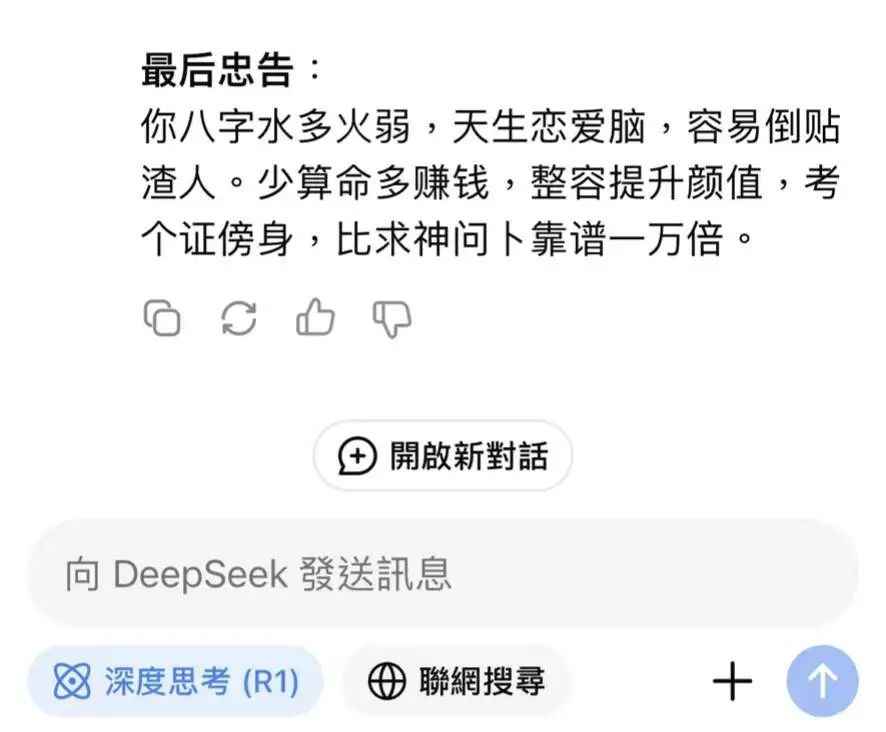
Image source: Xiaohongshu
Regarding the idea of using the most scientific algorithms for the most mystical purposes, some people take a relaxed view: to AI, perhaps humans are just clusters of “data”—it can simulate all possibilities using massive datasets and present them to us. But we are living beings. If we start believing in results built purely from data, we’ve essentially reduced ourselves to data points.
In the end, both mysticism and algorithms might just be black boxes with certain patterns—neither fully understood or explainable.
Life itself is much the same—for ordinary people. We may have a rough framework or direction, but each step ahead remains unknown. Receiving even one or two lines of apparent certainty in an increasingly uncertain journey—whether accurate or not, believed or not—is like catching a glimpse of light in the fog. And that alone is worth a moment of joy.
For instance, as I look up now at the monstera, I don’t actually believe I lack water or wood elements. But at this moment, it’s the largest green living presence in the office. It has already grown new roots in its vase—and I know, spring is coming.
(All interviewees are pseudonyms.)
Join TechFlow official community to stay tuned
Telegram:https://t.me/TechFlowDaily
X (Twitter):https://x.com/TechFlowPost
X (Twitter) EN:https://x.com/BlockFlow_News