
In disputes over virtual currency investments, how is liability determined among the involved parties?
TechFlow Selected TechFlow Selected
In disputes over virtual currency investments, how is liability determined among the involved parties?
Currently, civil and commercial cases involving cryptocurrencies exhibit the characteristics of small numbers and limited variety in judicial practice.
 Navigating Web3 tides with focused insights
Author: Attorney Liu Zhengyao
In civil disputes related to cryptocurrency investments, recent rulings from a court in Shanghai and the Yancheng Intermediate Court in Jiangsu Province have shown starkly different judicial approaches. Given the current state of judicial practice in China regarding cryptocurrency investment disputes, it is necessary to examine issues such as the acceptance and adjudication of civil and commercial cases involving cryptocurrencies. Based on personal practical experience and existing domestic regulations concerning cryptocurrency-related civil and commercial disputes, the author presents this brief article for discussion and feedback.
I. Current Status of Cryptocurrency Investment in China
Recently, Bitcoin prices have experienced significant volatility, dropping rapidly from a high of over $100,000 per coin to a low of $78,000. Investors who purchased cryptocurrency derivative contracts suffered margin calls and total losses, while even spot holders felt disheartened. The declines of many other altcoins were even more staggering.
Some people believe that purchasing cryptocurrencies is illegal or even criminal, and even some legal professionals display disdain toward cryptocurrency investments. This reflects widespread misunderstanding about China’s current policies on cryptocurrencies. In fact, mainland China has not banned citizens, legal entities, or other organizations from investing in cryptocurrencies. However, Chinese law does not provide legal protection for such investments (this will be further analyzed in Section III). Therefore, investing in cryptocurrencies in China is neither illegal nor criminal.
Common methods used by domestic entities (individuals, corporations, unincorporated organizations, etc.) to invest in cryptocurrencies and related industries include: directly purchasing cryptocurrencies with fiat currency; entrusting others to invest in cryptocurrencies and their derivatives; using stablecoins (such as USDT) to invest in exchange-based cryptocurrency derivative products; and participating in cryptocurrency mining activities. It is difficult to accurately estimate the number of individuals involved in cryptocurrency investment in China, but one relatively reliable indicator reflects the scale: there are at least hundreds of thousands of individuals and businesses engaged in facilitating fiat-to-cryptocurrency exchanges (commonly known as "on-ramping" and "off-ramping," referred to in the industry as "U merchants").

II. Significant Divergence in Civil Rulings Involving Cryptocurrencies
Since September 24, 2021, when ten national regulatory agencies—including the Supreme People's Court, Supreme People's Procuratorate, Ministry of Public Security, the People's Bank of China, and State Administration of Foreign Exchange—jointly issued the "Notice on Further Preventing and Responding to Risks Associated with Cryptocurrency Trading and Speculation" (hereinafter referred to as the "September 24 Notice"), civil and commercial courts across China have increasingly tightened their standards for accepting cases involving cryptocurrencies. Currently, successfully filing a case involving cryptocurrencies can already be considered half a victory.
Despite these challenges, isolated civil cases involving cryptocurrencies continue to be accepted, heard, and decided across the country. Recently, a court in Shanghai and the Yancheng Intermediate Court in Jiangsu Province each ruled on a civil dispute concerning cryptocurrency investment, but reached dramatically different conclusions.
(A) A Shanghai Court Invalidates a Cryptocurrency Investment Contract but Orders Refund of Investment Amount
In a cryptocurrency investment dispute handled by a Shanghai court, plaintiff Zhang transferred RMB to defendant Shen to purchase cryptocurrency and entrusted Shen to manage the investment. Later, withdrawals from the investment platform became impossible. Zhang then sued Shen, demanding repayment of the invested RMB. The court, citing the September 24 Notice, held that cryptocurrency investment activities violate public order and good customs in China, rendering the investment act invalid. Consequently, the contract between Zhang and Shen for purchasing cryptocurrency was deemed void, and the court ordered Shen to return the RMB paid by Zhang for the cryptocurrency purchase.
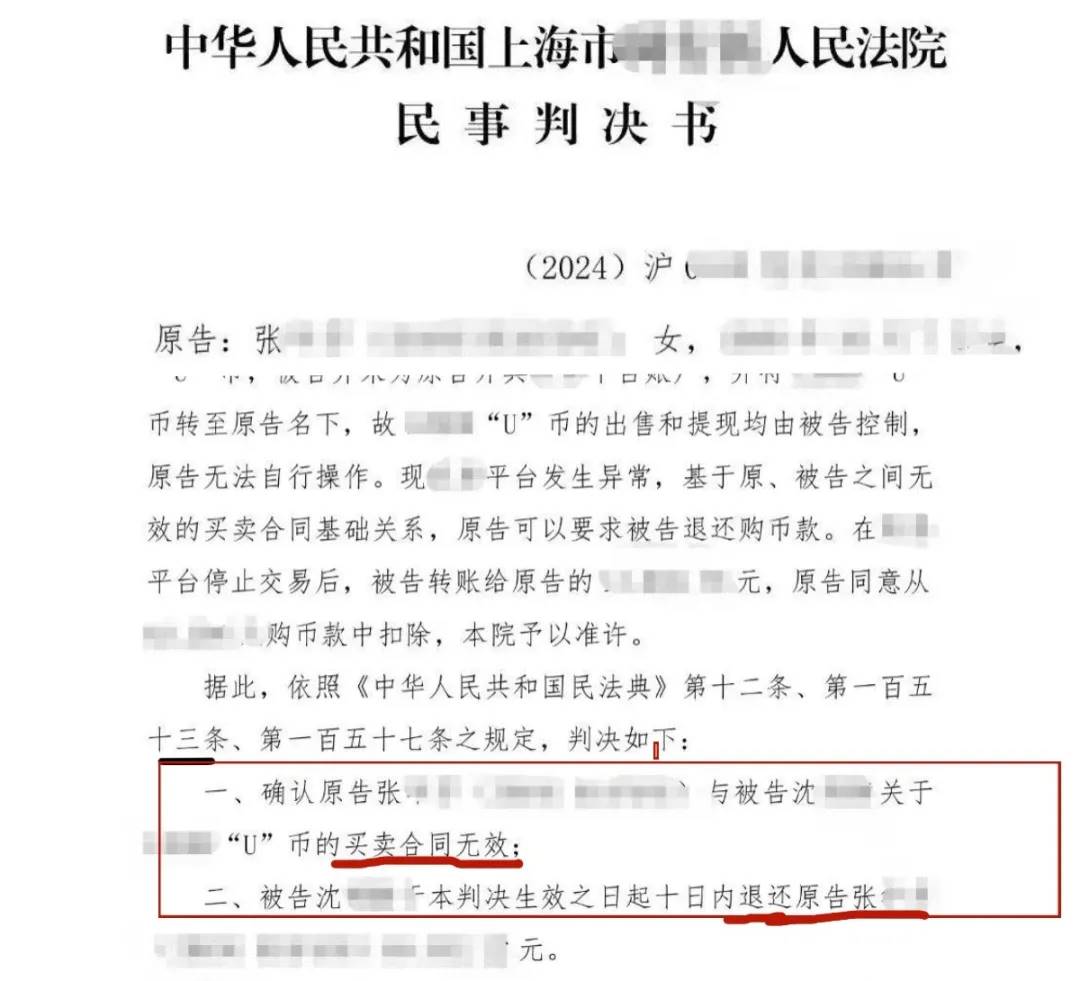
The author previously provided detailed analysis of this case in an article titled “Cryptocurrency Purchase (Investment) Dispute: Shanghai Court Rules Contract Invalid!” Interested readers may refer to that piece.
(B) Yancheng Intermediate Court Declares Cryptocurrency Investment Contract Void and Denies Refund, Holding Losses Be Borne by Investor
An article published on the official WeChat account of Yancheng Intermediate Court, titled “
Pan (a Singaporean national) partnered with Tian to jointly invest in a cryptocurrency project, with Tian responsible for technical development and operations, and Pan covering initial development costs and capital management. Pan transferred 15.74 million RMB to Tian for purchasing cryptocurrency. Due to poor platform performance, Pan demanded the return of his investment. Tian returned 1.06 million RMB in installments but withheld the remainder. Pan subsequently filed a lawsuit seeking recovery of the outstanding amount.
The case went through both first and second instance trials. Both courts held that China does not recognize the legal validity of cryptocurrency investment contracts. Investing in overseas cryptocurrencies and related derivatives violates mandatory provisions of Chinese laws and regulations and runs counter to public order and good customs. Thus, the cooperation agreement was declared invalid, and any resulting losses must be borne by the parties themselves.
Compared to the Shanghai court ruling, the Yancheng Intermediate Court’s application of the principle that “losses arising therefrom shall be borne by the parties” aligns more closely with the spirit of the September 24 Notice. However, the author disagrees with Yancheng Court’s assertion that “investing in offshore cryptocurrencies and their derivatives violates mandatory provisions of Chinese laws and regulations.”
III. Legal Basis for Adjudicating Cryptocurrency-Related Cases
To date, China has not enacted specific laws or regulations governing cryptocurrencies. Judicial practice regarding cryptocurrency disputes relies primarily on guidance from regulatory authorities and industry associations. After the National Court Financial Trial Work Conference was held in April 2023, the draft “Minutes of the National Court Financial Trial Work Conference” (hereinafter referred to as the “Minutes”) was released, which includes rules for adjudicating cryptocurrency-related civil and commercial disputes. Although the Minutes have not yet formally taken effect, they carry certain guiding weight for courts nationwide.
The current legal basis for adjudicating cryptocurrency-related civil and commercial cases can be summarized as follows:
(A) Relevant Provisions of the September 24 Notice
Prohibited Activities: Converting cryptocurrencies into fiat currency; exchanging one cryptocurrency for another; providing pricing services or intermediary information for cryptocurrency transactions; token issuance financing (ICO); and operating cryptocurrency exchanges.
Discouraged Activities: Participating in cryptocurrency investment and trading. Any investment in cryptocurrencies or related derivatives (e.g., common futures products offered by cryptocurrency exchanges) by Chinese legal entities, unincorporated organizations, or individuals is deemed contrary to public order and good customs. Related civil acts are invalid, and losses arising therefrom must be borne by the investor.
Therefore, China does not outright ban cryptocurrency investment and trading. However, from a practical standpoint, there are virtually no fully compliant channels for cryptocurrency investment within China today. For example, major banks, as well as payment platforms like WeChat Pay and Alipay, have explicitly stated that users must not use their systems for cryptocurrency transactions. As such, using bank transfers, WeChat Pay, or Alipay for cryptocurrency transactions constitutes at least a breach of contract under civil law.
(B) Relevant Provisions of the Minutes
1. Disputes Involving Virtual Currency as Payment Consideration. The Minutes acknowledge the property attributes of virtual currencies. Where parties agree to settle debts arising from barter, labor, or similar basic relationships through small amounts of virtual currency, and no other grounds for invalidity exist, courts should recognize the contract as valid. Courts may support claims requiring delivery of virtual currency (author’s note: practically very difficult to enforce). However, if parties use fictitious underlying transaction agreements to exchange virtual currency for legal tender or physical goods, the court should deem the contract invalid.
2. Disputes Over Entrusted Cryptocurrency Investment Management. If a wealth management委托 contract was signed after the issuance of the “Announcement on Preventing Risks Associated with Token Issuance Financing” (the “September 4 Announcement”), the委托 matter is considered unlawful, and the委托 contract should be deemed invalid. For losses incurred by the委托or, courts may consider the cause of the委托activity as a key factor in determining fault levels, allowing losses to be shared between the parties. This provision aligns with the core principles of the September 24 Notice. The author agrees that when adjudicating cryptocurrency-related disputes, courts should not simply declare contracts void solely because they violate domestic regulatory rules, but should also assess the respective fault of each party.
3. Disputes Related to Cryptocurrency Mining. Mining-related disputes typically involve contracts concerning the sale, lease, or custody of mining equipment (“miners”), or additional services such as operational management and technical development. The Minutes set September 3, 2021—the date of the joint notice banning mining—as a dividing line: mining contracts entered before this date are generally considered valid; those entered afterward are generally invalid. Courts should handle such cases based on the degree of fault of each party.

IV. Final Thoughts
Currently, cryptocurrency-related civil and commercial cases remain few in number and limited in variety within judicial practice. The author believes this situation is unlikely to change significantly in the short term. Nevertheless, as noted above, some local courts may occasionally accept such cases. Due to the scarcity of precedents and the lack of deep understanding among many judges regarding the cryptocurrency industry and market mechanisms, outcomes in these civil cases vary widely (in contrast, criminal proceedings involving cryptocurrencies have seen relatively consistent judicial standards).
The judiciary always serves reality. Should China eventually allow regulated cryptocurrency investment and trading, the author believes that the quality of judicial adjudication in cryptocurrency-related civil and commercial matters would undoubtedly improve significantly.
Join TechFlow official community to stay tuned
Telegram:https://t.me/TechFlowDaily
X (Twitter):https://x.com/TechFlowPost
X (Twitter) EN:https://x.com/BlockFlow_News