Where are the future opportunities and potential in AI?
TechFlow Selected TechFlow Selected
Where are the future opportunities and potential in AI?
World Economic Forum jointly releases authoritative report with Accenture and KPMG.
 Navigating Web3 tides with focused insights
Author: Xin Zhiyuan

Image source: Generated by Wujie AI
As the tide of technology surges forward, artificial intelligence (AI) has evolved from a cutting-edge concept into a deeply integrated force across all aspects of socioeconomic life, becoming a core driver of industrial transformation and innovative development.
Against this backdrop, the World Economic Forum (WEF), in collaboration with Accenture and KPMG, released reports that provide authoritative insights into the future trajectory of AI.
These reports consolidate diverse expertise through in-depth industry research, advanced technical analysis, and precise understanding of global trends, offering a comprehensive view of AI's future opportunities and potential.
Whether you're a tech innovator, a financial professional seeking investment directions, or a member of the public concerned about societal progress, this report offers valuable insights to help you prepare and embrace the boundless possibilities of the AI era.
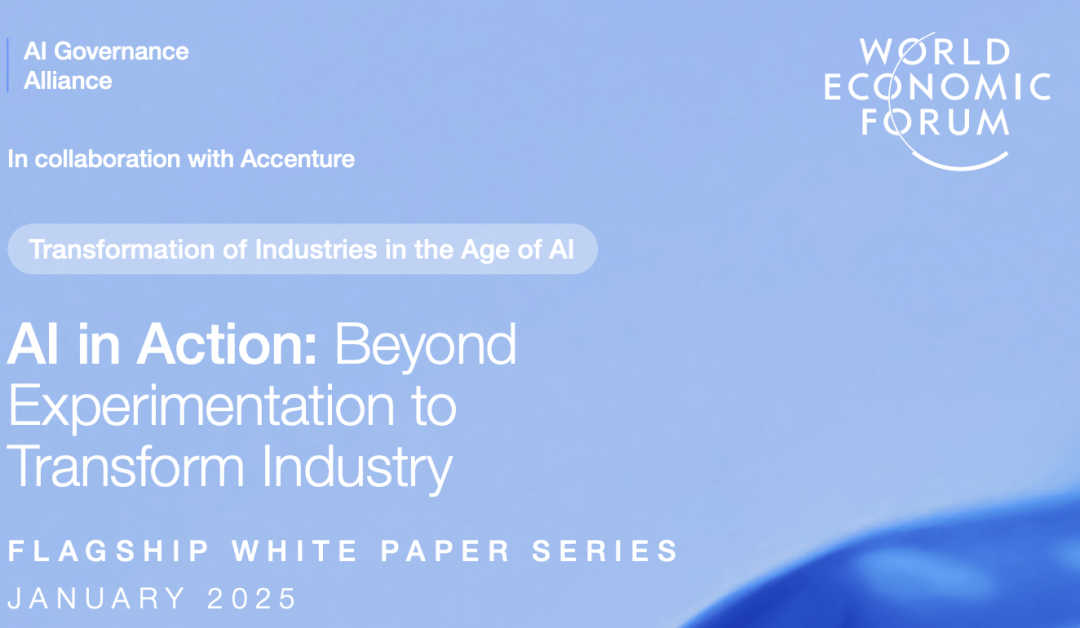
Report 1: "AI in Action: Beyond Experimentation to Transform Industry 2025"
Artificial intelligence is advancing at an unprecedented pace, particularly in natural language processing (NLP), computer vision, and generative AI.
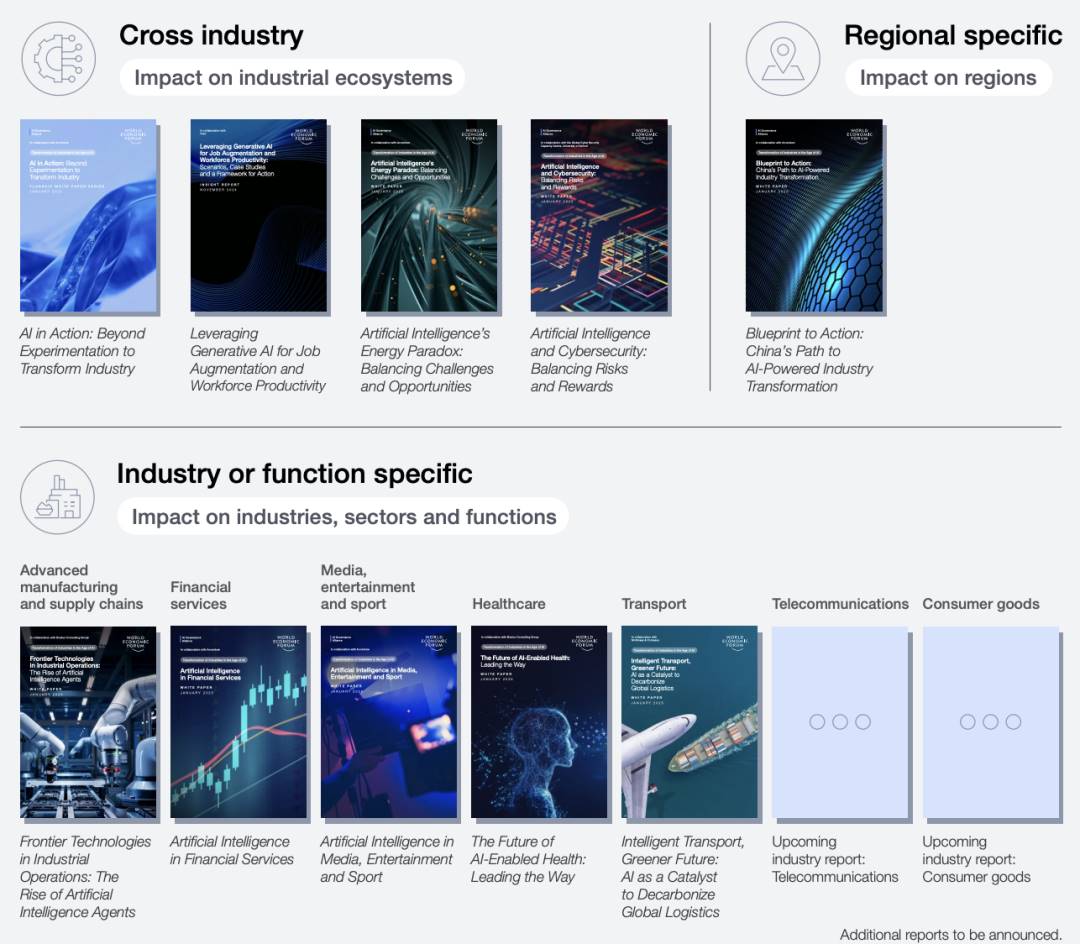
The report "AI in Action: Beyond Experimentation to Transform Industry 2025", jointly authored by the World Economic Forum (WEF) and Accenture, explores AI’s opportunities, current adoption status, and future potential in 2025. It aims to provide organizations with a responsible and transformative framework for AI adoption.
Report link: https://www.weforum.org/publications/industries-in-the-intelligent-age-white-paper-series/cross-industry/
Below are the key highlights of the report:
Opportunities of AI
-
Efficiency and Cost Savings: Generative AI not only optimizes workflows and costs but also significantly boosts productivity. For example, a virtual engineer developed by a technology provider uses real-time data to optimize building management, reducing HVAC energy costs by 25% and cutting maintenance scheduling time by 90%.
-
Revenue Growth: Early adopters of AI are already outperforming their peers in revenue by 15%, a gap expected to double by 2026. Generative AI drives sales and revenue growth by enabling designers to rapidly generate diverse design patterns via personalized tools.
-
Enhanced Customer Experience: AI has transitioned from a unique differentiator to a fundamental requirement for competitiveness across businesses. For instance, the London Stock Exchange Group reduced customer query resolution time by 50% using an AI-powered Question Answering Service (QAS).
Current State of AI Adoption
-
Industry Adoption: Telecommunications, financial services, and consumer goods industries lead in AI adoption. Generative AI is especially prominent in human-capital-intensive sectors such as healthcare, finance, and media & entertainment.
-
Functional Adoption: Marketing and sales, product and service development, service operations, and risk management show the highest rates of AI adoption. These functions typically generate or digitize large volumes of structured and unstructured data, allowing AI models to be trained and scaled more effectively.
-
Organizational Adoption: Despite a surge in AI investment and usage, most organizations remain in the early stages of AI adoption. 74% of companies report challenges in scaling AI, and only 16% are ready for full-scale AI-driven transformation.
Future Potential of AI
-
Full Automation of Complex Tasks: AI agents can work collaboratively to fully automate complex, repetitive tasks, freeing humans to focus on higher-level responsibilities. By 2028, significant benefits are expected in manufacturing and financial services, where AI agents will manage production lines, optimize supply chain operations, and handle customer support.
-
More Contextual and Personalized Decision-Making: Integrating advanced reasoning capabilities into generative AI applications will make AI systems more effective in helping humans navigate complex environments and make context-aware decisions. In healthcare, for example, AI will support personalized treatment plans.
-
Enhanced Individual Efficiency and Capability: Handheld devices integrated with AI, advanced edge AI, and compact language models have the potential to revolutionize work by automating tasks, managing schedules, and delivering real-time information.

Foundations for Successful AI Implementation
-
Ecosystem Collaboration: Companies are increasingly partnering with cloud providers, AI tech firms, startups, and public institutions to access resources and expertise.
-
Stakeholder Trust in AI: Trust is critical to AI success. 61% of people hesitate to rely on AI systems, primarily due to concerns over data security and third-party involvement.
-
Industry Self-Governance: Organizations are creating self-governance frameworks to complement regulations, ensuring AI deployment aligns with corporate values and regional laws.
-
Talent and Organization: Organizations must prioritize employee development to equip workers to adapt to technological changes and lead AI-driven value creation.
-
Cybersecurity: AI-powered cyber threats—such as deepfakes, targeted phishing, and data breaches—are emerging risks. Organizations need to integrate AI-related cyber risks into enterprise-wide risk management.
-
Digital Core: Deploying scalable AI strategies depends on building a robust digital core, including AI applications and digital platforms, data and AI “backbone,” and physical and digital infrastructure.
Report 2: "Blueprint for Intelligent Economies"
Artificial intelligence is driving the Fourth Industrial Revolution, fostering economic growth and innovation across industries and societies.
However, many countries may fail to benefit economically and socially from the intelligent era due to insufficient energy-intensive AI infrastructure, limited access to advanced computing power, lack of high-quality data, and shortage of AI skills. Without intervention, technological advancements could exacerbate existing digital divides rather than distribute benefits equitably.
Report link: https://www.weforum.org/publications/blueprint-for-intelligent-economies/
The "Blueprint for Intelligent Economies", co-authored by the World Economic Forum (WEF) and KPMG, aims to foster inclusive growth through comprehensive collaboration.
The blueprint consists of three interconnected layers:
-
Building the Foundation: Includes sustainable AI infrastructure, high-quality datasets, responsible AI models, and effective channels for capital investment.
-
Developing New Intelligent Economies: Reimagining core activities across industries by embedding intelligence into applications, workflows, devices, and robotics.
-
Putting People First: Unlocking human potential through quality education, skills development, and workforce training, while establishing ethical, safe, and secure safeguards.
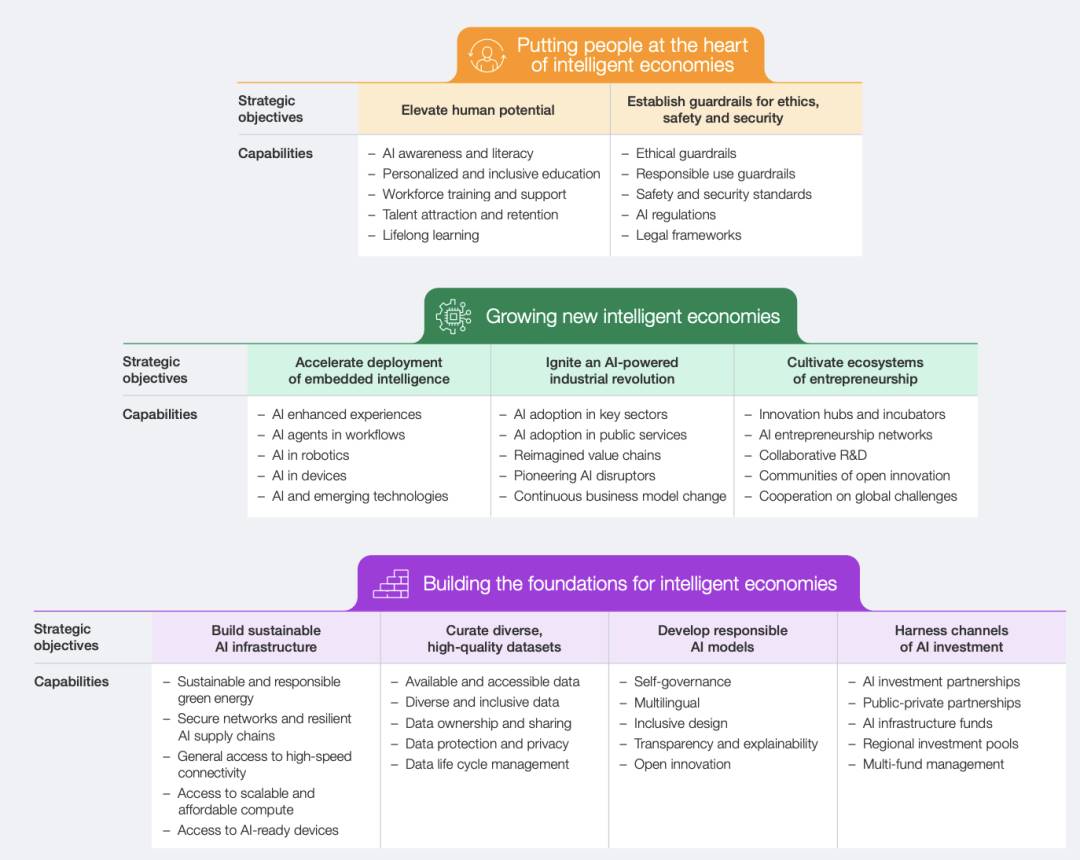
The blueprint outlines three strategic goals:
-
Build Sustainable AI Infrastructure
-
Challenges: High energy consumption, massive investment requirements, insecure AI supply chains, digital divide, high-cost internet-enabled devices.
-
Success Cases: Microsoft signed an agreement with the U.S. to purchase carbon-free energy and reopen the Three Mile Island nuclear plant to power its data centers with green energy. The World Bank launched a $10 billion renewable energy program aiming to add 15 gigawatts of renewable capacity.
-
Key Capabilities: Sustainable and responsible green energy, secure networks and resilient AI supply chains, high-speed connectivity, scalable and affordable computing power, AI-ready devices.
-
-
Curate Diverse and High-Quality Datasets
-
Challenges: Access to high-quality data, data inequality, data ownership, AI technological advancement, trust in AI.
-
Success Cases: Fugaku LLM in Japan is an open-source large language model trained with at least 60% Japanese-language data. The UAE government partnered with G42 to develop Jais, an LLM based on Modern Standard Arabic.
-
Key Capabilities: Available and accessible data, diverse and inclusive datasets, data ownership and sharing mechanisms, data protection and privacy, data lifecycle management.
-
-
Establish Ethical, Safe, and Secure Safeguards
-
Challenges: Mitigating bias, adapting to evolving regulatory landscapes, ensuring AI safety, implementing responsible AI practices, AI intellectual property, and legal uncertainties.
-
Success Cases: The EU’s Artificial Intelligence Act classifies AI applications by risk level and sets requirements for high-risk domains. The U.S. and UK collaborate through AI Safety Institutes to develop shared AI model testing frameworks.
-
Key Capabilities: Ethical safeguards, responsible use frameworks, safety and security standards, AI regulations, legal frameworks.
-
WEF
The World Economic Forum (WEF) is an international non-governmental organization headquartered in Davos, Switzerland. Also known as the "Davos Forum" because its first meeting was held there, the WEF is dedicated to advancing sustainable development in the global economy, society, and environment through public-private cooperation.
As its influence grows and participation expands among global leaders, the WEF has become regarded as an "unofficial highest-level international economic forum," serving as one of the most important unofficial venues where world political leaders, business executives, and civil society leaders discuss pressing global economic issues. Its corporate membership includes over 1,000 major companies and enterprises from more than 70 countries and regions worldwide.
Join TechFlow official community to stay tuned
Telegram:https://t.me/TechFlowDaily
X (Twitter):https://x.com/TechFlowPost
X (Twitter) EN:https://x.com/BlockFlow_News