









First batch of "AI civil servants" based on DeepSeek begins work
TechFlow Selected TechFlow Selected
First batch of "AI civil servants" based on DeepSeek begins work
The daily data processing volume is equivalent to the total workload of all civil servants in the city over 10 years.
 Navigating Web3 tides with focused insights
Author: Mu Feng

Image source: Generated by Wujie AI
Recently, Zhenjiang Municipal Data Bureau held a press conference, where officials stated that after locally deploying DeepSeek, the "daily data processing volume is equivalent to the total workload of all civil servants in the city over 10 years."
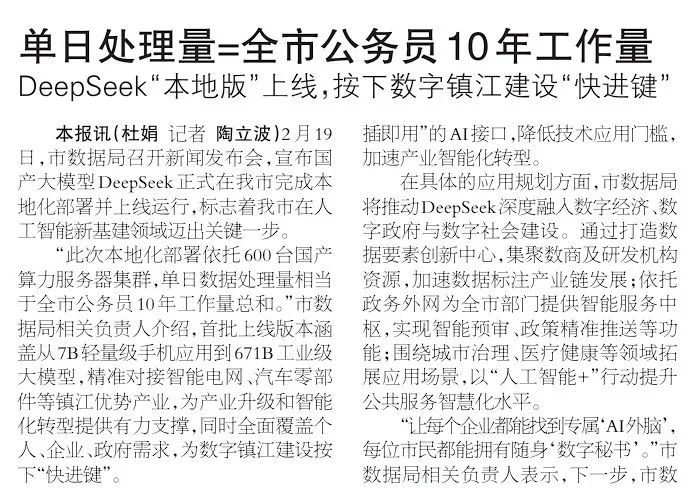
Although the description lacks precision, the information quickly went viral, sparking widespread attention on the topic of "AI in government services."
"AI civil servants" are gradually being deployed across the country.
Just days before Zhenjiang's press conference, Futian District in Shenzhen launched AI employees based on DeepSeek, with 70 deployed in the first batch.
These AI employees are distributed across 35 government agencies in the district, covering 240 government work scenarios including document processing, public welfare services, emergency management, and investment promotion.
In terms of office efficiency, personalized custom generation time has been reduced from five days to minutes, document formatting correction accuracy exceeds 95%, review time has been shortened by 90%, and error rates remain below 5%.
Gao Zeng, member of the Party Leadership Group and Deputy Director of Futian District Administration of Government Services and Data Management in Shenzhen, explained that AI digital employees serve as assistants to civil servants and cannot make independent decisions—"they are not AI civil servants."
To support this, Futian District also introduced the "Management Measures for Intelligent Robots in Government Assistance," establishing institutional boundaries for AI in government services through three core principles:
First, an ethical framework: AI is defined as an "assistant role," with each digital employee required to have a human supervisor, ensuring clear accountability;
Second, safety thresholds: maintaining human intervention mechanisms at critical decision points;
Third, scenario limitations: clearly defining applicable domains for AI to prevent controversies arising from technological overreach.
Besides Futian, Bao'an District in Shenzhen has also integrated the DeepSeek + Tencent Hunyuan large model into its government system to enhance administrative efficiency using AI.
The broader context is Shenzhen’s unprecedented emphasis on AI.
On February 13, Shenzhen conducted citywide AI operational training; on February 16, it officially rolled out DeepSeek model application services to all districts and departments via its government cloud environment.
While Hangzhou has recently dominated headlines regarding large AI models, is Shenzhen positioning itself to set the benchmark in real-world AI applications?
Beyond Shenzhen, the integration of "AI + civil servants" has already taken root in government systems across multiple regions.
For example, Guangzhou has launched the DeepSeek-R1 and V3 671B large models, applying them in areas such as policy interpretation systems for public welfare and work order assignment for the 12345 hotline.
Chongqing's Dazuqiao District introduced a "Digital Grid Officer" system that collects public inquiries to enable rapid responses to common issues.
Other cities include Ganzhou in Jiangxi, Wuxi in Jiangsu, Urumqi in Xinjiang, Linyi in Shandong, and Hohhot in Inner Mongolia.
The use of AI in government services is not unique to China.
Singapore, for instance, developed a dedicated "Pair" system to help civil servants improve work efficiency, which has received wide acclaim.
The United States and the United Kingdom have also applied AI technology in public services, significantly contributing to crime trend prediction, traffic flow optimization, and fraud detection.
As Gao Zeng of Shenzhen’s Futian District Administration of Government Services and Data Management noted, in the short term, "AI civil servants" will remain in an assistant role and cannot fully replace human workers.
In the long run, however, AI-driven government systems are an inevitable trend.
This is primarily due to the nature of government services, which are highly standardized, regulated, and process-oriented—precisely the types of tasks AI excels at.
Compared to humans, AI holds advantages in efficiency and error rates.
Taking Zhejiang Province's "Zheli Ban" app as an example, its "instant intelligent processing" service uses AI to automatically verify documents, reducing processing time for matters like business deregistration and social security transfers from an average of three working days to just 10 minutes, with an accuracy rate of 98.3%.
According to Beijing Municipal Administration of Government Services' annual report, its "intelligent customer service" system handled 120 million inquiries in 2023, with 85% of common questions answered instantly.
Contrary to common perception, "AI civil servants" are not devoid of empathy or emotional awareness.
A report from Hangzhou Municipal Bureau of Data Resources showed that the city’s "Qinqing Online" platform uses AI emotion recognition technology to detect anxiety in citizens during consultations and automatically transfers such cases to human agents, reducing complaint rates by 45%.
Meanwhile, broader adoption of "AI civil servants" could accelerate interoperability of government information, further improving public service standards.
Additionally, potential optimizations in government service philosophies and systems driven by these advancements are also worth anticipating.
Join TechFlow official community to stay tuned
Telegram:https://t.me/TechFlowDaily
X (Twitter):https://x.com/TechFlowPost
X (Twitter) EN:https://x.com/BlockFlow_News










