Hong Kong SFC Releases Virtual Asset Regulation Roadmap: What Are the Key Points?
TechFlow Selected TechFlow Selected
Hong Kong SFC Releases Virtual Asset Regulation Roadmap: What Are the Key Points?
门槛变低?监管加强!
 Navigating Web3 tides with focused insights
Authors: Bai Zhen, Huang Wenying
On February 19, 2025, the Hong Kong Securities and Futures Commission (SFC) released a new regulatory roadmap for the virtual asset market titled "A-S-P-I-Re," aiming to further refine the regulation of virtual assets, introduce more types of virtual asset products and services, and balance innovation with risk management in Hong Kong's Web3 industry.
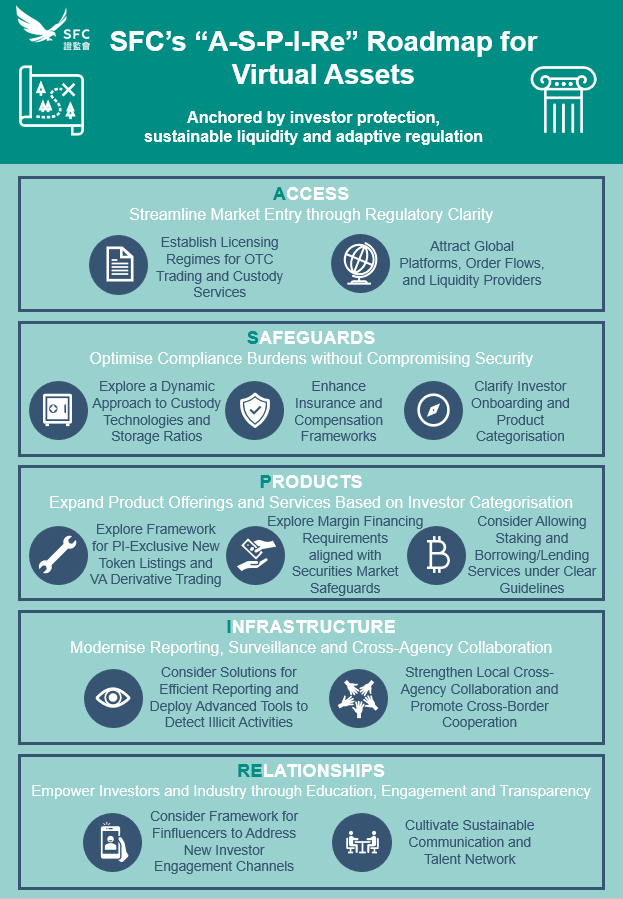
The roadmap outlines five key pillars—Access, Safeguards, Products, Infrastructure, and Relationships—along with 12 action items, including optimizing the licensing regime, advancing regulation of OTC and custody services, exploring the allowance of derivative and staking trading for professional investors, and positioning Hong Kong as a compliant and trusted hub for virtual asset flows.
For ManQin Law, the release of this regulatory roadmap indicates that the compliance pathway for Web3 startups in Hong Kong is becoming increasingly clear. This article summarizes the roadmap, distills key regulatory directions, and highlights compliance considerations for Web3 projects looking to establish in Hong Kong.
Pillar A: Expanding Access
In 2024, the SFC officially implemented the Virtual Asset Trading Platform (VATP) licensing regime, under which several virtual asset trading platforms in Hong Kong have been approved to operate.
However, barriers to market entry remain, particularly in the areas of over-the-counter (OTC) trading and custody services, which are not yet included in the regulatory framework. This not only affects the integrity of market structure but also limits investor choice. To address this, the SFC proposes establishing an independent licensing system for OTC trading and custody services under Pillar A, allowing non-VATP businesses to operate within a compliant framework. OTC trading is crucial for large-volume transactions, while custodians play a vital role in asset security. The new licensing regime will fill existing market gaps and enhance the safety and transparency of Hong Kong’s market.
Moreover, Hong Kong’s virtual asset market cannot rely solely on local VATPs. Liquidity providers (LPs) and global virtual asset trading platforms can also bring fresh momentum. Therefore, the SFC plans to moderately lower entry barriers in 2025 to bring in compliant international providers, enabling local investors to access broader global order books, reduce trading costs, and improve market liquidity.
For Web3 enterprises, the rollout of Pillar A signifies changes in market access requirements. Companies planning to offer OTC or custody services in Hong Kong must closely monitor new licensing requirements, while licensed platforms will face increased competition from international players. At the same time, the opening of global liquidity will make Hong Kong a more attractive virtual asset hub, but it will also place higher demands on firms’ compliance capabilities.
Pillar S: Optimizing Compliance Requirements
Toward the end of 2024, the SFC reviewed its licensing process and outcomes, concluding that compliance procedures should be optimized to improve licensing efficiency without compromising market safety. Meanwhile, as the global regulatory landscape evolves, overly stringent compliance requirements could diminish Hong Kong’s appeal and hinder the inflow of global capital.
Under Pillar S, the SFC has proposed a series of adjustments to optimize custody arrangements, cold storage ratios, insurance compensation mechanisms, and investor access rules, ensuring market safety while reducing unnecessary compliance burdens and enhancing competitiveness.
For example, current custody and cold storage ratio requirements in Hong Kong are too rigid, potentially causing liquidity management challenges for VASPs during periods of high trading volume. The SFC plans to allow trading platforms greater flexibility in choosing custody models and optimizing hot-to-cold storage ratios based on their own risk management strategies, supported by independent audits and real-time monitoring to ensure fund security and operational efficiency. Additionally, mandatory insurance and compensation mechanisms will become more flexible, allowing VASPs to adopt tailored insurance solutions based on their business models rather than a one-size-fits-all standard.
Regarding investor access, the SFC intends to introduce a clearer product classification framework, enabling Web3 companies to better understand their compliance pathways when launching products and entering the market. For instance, different types of virtual assets—such as security tokens, stablecoins, and RWA (real-world asset tokenization)—may be subject to distinct regulatory requirements, reducing compliance uncertainty and improving market transparency for investors.
For Web3 enterprises, the adjustments under Pillar S mean reduced compliance costs, but also higher expectations for technical infrastructure and risk controls. Trading platforms and custodians will need to adapt their storage and security strategies to the updated regulatory framework, while project teams planning to enter Hong Kong must clearly define the regulatory nature of their products to ensure compliance.
Pillar P: Expanding Product Offerings
Currently, Hong Kong’s virtual asset trading market primarily focuses on spot trading. For example, HashKey Exchange, Hong Kong’s largest licensed exchange, offers only a limited number of major cryptocurrencies like BTC and ETH, resulting in relatively low product diversity. Compared to global markets, Hong Kong’s trading ecosystem has significant room for expansion, especially in financial instruments such as derivatives, staking, lending, and structured products.
Therefore, Pillar P signals the SFC’s intention to expand the range of tradable products under a compliant framework, meeting professional investors’ needs for risk management tools and deeper markets. The regulator’s core approach is not blanket liberalization, but rather introducing certain high-risk products to professional investors (PI) first, under the Investor Suitability Principle, while strengthening transparency and oversight.
First, the SFC plans to permit professional investors to trade new tokens and virtual asset derivatives. New token listings will require stricter due diligence and enhanced disclosure, ensuring only qualified tokens enter the market. Meanwhile, the SFC will study the regulatory framework for virtual asset derivatives to support hedging, arbitrage, and risk management activities by professional investors.
Beyond expanding trading products, the SFC also proposes exploring compliant frameworks for staking and lending services under Pillar P. While staking and lending have become mainstream investment strategies globally, these services remain in a regulatory gray area in Hong Kong. Going forward, regulated platforms may be allowed to offer staking and lending, likely subject to specific requirements around custody, risk management, and disclosure.
The implementation of these measures will align Hong Kong’s product offerings more closely with international standards, but will also require Web3 firms to invest more in compliance and risk control. For projects planning to offer staking or lending in Hong Kong, establishing secure asset custody and transparent yield distribution models may become key compliance components.
Pillar I: Enhancing Regulatory Capabilities
From airdrop phishing scams to presidents promoting suspected insider-trading MEME coins, the Web3 market has never been short of market manipulation, fraudulent trades, and money laundering. Yet currently, the SFC—and most regulators worldwide—primarily rely on event-triggered supervision, intervening only after incidents occur. This reactive regulatory model is inherently lagging and ineffective at preventing manipulation or fraud.
Under Pillar I, the SFC plans to leverage new technological tools and infrastructure to enhance reporting mechanisms and introduce data-driven monitoring tools, strengthening its oversight across the market. The SFC proposes studying direct digital asset data reporting methods and exploring data-driven tools such as transaction monitoring, blockchain intelligence, and wallet tracking to detect fraud, financial crime, and market misconduct earlier.
At the same time, the SFC intends to strengthen inter-agency collaboration, including with the Hong Kong Police Force, the Hong Kong Monetary Authority (HKMA), and international securities regulators such as IOSCO, to jointly combat market manipulation and illegal trading.
For Web3 enterprises, especially virtual asset trading platforms, the regulatory upgrades under Pillar I imply stricter data reporting obligations and higher demands for transaction transparency. Firms must therefore strengthen their compliance and risk management systems to meet future regulatory standards, particularly in areas such as transaction data submission, asset flow monitoring, and anti-money laundering compliance.
Pillar Re: Market Education and Outreach
The complexity and high risks of the virtual asset market make investor education and industry transparency critical issues. Pillar Re in the roadmap focuses on market education, industry engagement, and regulatory transparency, aiming to help investors better understand the market and foster dialogue between Web3 firms and regulators.
A notable initiative is the SFC’s plan to establish a regulatory framework for Finfluencers (financial influencers). In recent years, social media has been flooded with virtual asset investment advice, with some KOLs (key opinion leaders) misleading investors through deceptive promotions, and a few even participating in scams. The SFC aims to promote responsible behavior and accountability among financial influencers, helping investors make informed decisions and protect their interests. Once implemented, this could mean stricter marketing compliance requirements in Hong Kong, with KOLs and social media promotions facing higher regulatory scrutiny.
Besides regulating KOLs, the SFC also plans to launch investor education programs to improve public understanding and reduce investment risks. Additionally, Pillar Re emphasizes the need to establish industry dialogue platforms to increase policy transparency. The SFC intends to use the Virtual Asset Consultation Panel (VACP) to enhance communication with Web3 firms, allowing market participants to better understand regulatory policies and provide feedback during the policymaking process. This will enable Web3 enterprises to leverage official industry engagement channels to build closer relationships with regulators and ensure compliant, sustainable operations.
ManQin Law Summary
The SFC’s “A-S-P-I-Re” roadmap marks a significant milestone in the evolution of Hong Kong’s virtual asset regulatory framework. With its five pillars and 12 action items, the SFC is striving to strike a balance between risk control and market development. For Web3 enterprises, these new regulations clarify the compliance landscape in Hong Kong, but also signal rising compliance costs, intensified competition, and heightened regulatory expectations.
As Web3 legal advisors deeply engaged in Hong Kong’s regulatory environment, ManQin Law maintains close communication with Hong Kong regulators and actively supports Web3 firms in license applications, business compliance, and regulatory alignment. In light of the upcoming SFC regulatory enhancements, ManQin Law will continue to monitor developments closely and develop tailored compliance strategies to help virtual asset trading platforms, crypto funds, Web3 startups, and cross-border teams optimize their business structures and enhance market readiness.
As Web3 legal advisors focused on Hong Kong’s virtual asset regulation, ManQin Law maintains close engagement with the SFC and plays an active role in supporting Hong Kong-based Web3 firms with licensing and commercial compliance. Facing this regulatory upgrade, ManQin Law is closely tracking policy changes to assist trading platforms, crypto funds, startups, and cross-border teams in optimizing their operations within the compliant framework and improving market adaptability.
Join TechFlow official community to stay tuned
Telegram:https://t.me/TechFlowDaily
X (Twitter):https://x.com/TechFlowPost
X (Twitter) EN:https://x.com/BlockFlow_News