Vitalik's Chinese community dialogue: Ethereum needs new narratives and new users, internal reforms underway at EF
TechFlow Selected TechFlow Selected
Vitalik's Chinese community dialogue: Ethereum needs new narratives and new users, internal reforms underway at EF
If the foundation disappeared, could the chain survive? Only Bitcoin and Ethereum can clearly answer: of course.
 Navigating Web3 tides with focused insights
Compilation: BlockBeats
On the evening of February 19, invited by FSL's Chief Revenue Officer Mable Jiang, Ethereum founder Vitalik Buterin participated in a special flash text AMA within Tako App's "Flash Interview Circle." This interview collected anonymous questions from the community in advance, aiming to address community concerns and confusion about Ethereum's future development.
The discussion covered ETH's future adoption and ultimate narrative, perspectives on the relationship between L2 and Ethereum mainnet, and MegaETH's centralized sequencer proposal. Notably, Vitalik even responded to a community question asking whether he is a communist. It's worth noting that this marks one of the first times in recent years that Vitalik has conducted an AMA entirely in Chinese.
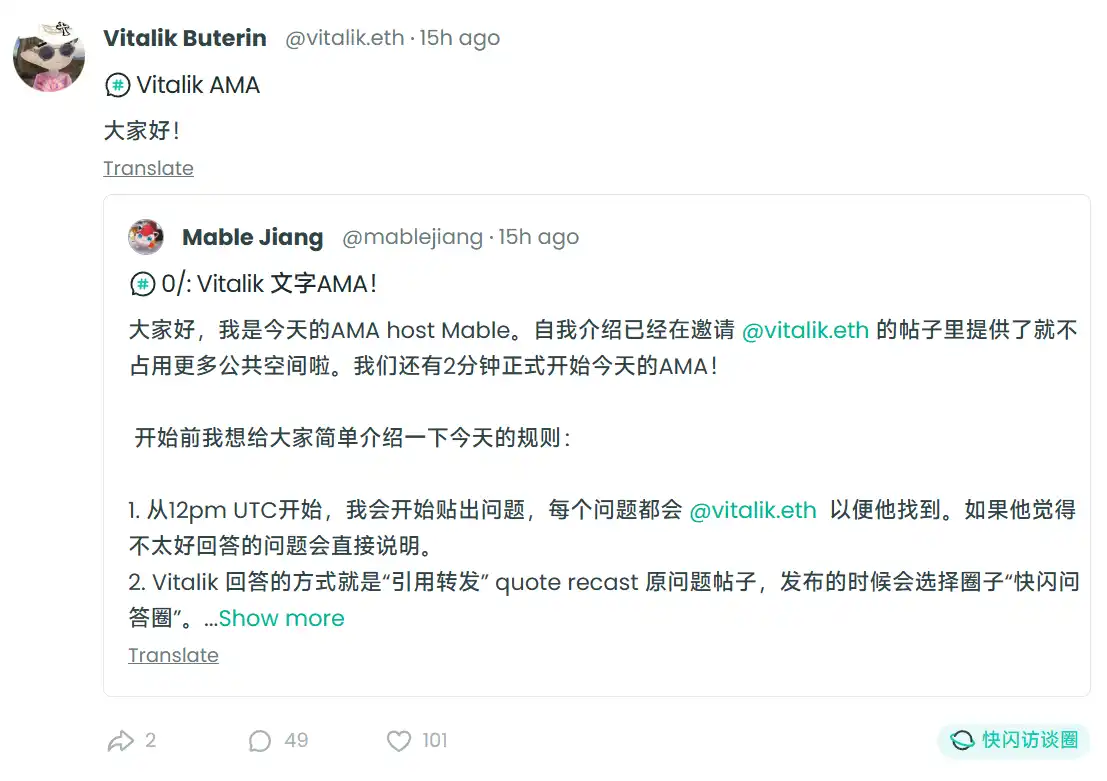
Below is the compiled content of this AMA:
Q1: In your view, should today’s Ethereum be closer to Bitcoin or to the world computer? In a previous X post, you mentioned that many people holding negative views toward ETH are actually short-term speculators whose frustration brings almost no constructive value to the ETH community. However, among OG ETH-Maxis, many actively promote the idea of "ETH is money" (e.g., Bankless, arguably the largest ETH Maxi media), equating ETH with BTC as another competitive digital currency form (possibly even better). What is your envisioned ultimate narrative for ETH's future adoption?
Vitalik:
Is Ethereum a world computer or a currency? I believe these two perspectives are compatible.
If you want to test which blockchains are "truly decentralized," there's a simple way: if its foundation disappeared, could the chain survive? I feel only Bitcoin and Ethereum can clearly answer: of course. Most Ethereum development happens outside the foundation; client teams have independent business models, many researchers aren't affiliated with the foundation, and nearly all events are independent except Devcon. Reaching this stage is difficult—five years ago, Ethereum wasn’t like this.
Sacrificing these advantages to pursue higher TPS is a big mistake because new chains can always emerge with even higher TPS. But decentralization and resilience are precious qualities few blockchains possess.
These characteristics benefit both long-term valuable digital currencies and powerful world computers. But the world computer also needs scalability solutions. "World computer" doesn't mean "a single machine supporting every global application simultaneously," but rather "a place where world applications can interoperate." High-performance computing can happen on L2—that's fine. But this role still requires sufficient L1 scale. For details, see my recent article: "Vitalik: Expanding L1 Significantly Still Has Value, Making Application Development Simpler and Safer"
ETH is the digital asset suitable for use across world applications (including finance and others like ENS). ETH doesn't need every transaction on L1, but it needs enough throughput so anyone wanting to use L1 can occasionally do so. Thus, these two directions align: features helping Ethereum become a better world computer also help ETH become a better digital currency.
Q2: Today we already see many L2s, primarily OP Stack-based, along with some zkRollup attempts. We'd love to hear your evaluation of the rollup path over the past few years—a relatively objective review: what aspects worked well, what differed from initial expectations; overall, are rollups beneficial for Ethereum or vampiric (I recently saw your call for L2s to give back to Ethereum)? Does ETH really need these L2s?
Vitalik:
Ethereum needs hybrid L1 + L2. Our current scaling approach can be understood as hybrid L1 + L2, though I think no one has clearly defined yet which transactions should go on L1 versus L2.
The answer "everything on L2" is hard to accept because:
* This risks losing ETH's position as medium of exchange, store of value, etc. If you worry about L2s stealing L1 users without giving anything back, this problem becomes worse when "L1 does almost nothing."
* Cross-L2 operations still require L1. If an L2 fails, users need ways to move themselves to another L2. So some L1 use cases are unavoidable. I've written about this: "Vitalik: Expanding L1 Significantly Still Has Value, Making Application Development Simpler and Safer"
The answer "everything on L1" is also hard to accept because:
* Supporting many transactions on L1 easily leads to centralization, even with technologies like ZK-EVM.
* Demand for on-chain transactions is infinite—no matter how high L1's TPS, we can always find an application needing 10x more (e.g., AI, micropayments, micro prediction markets).
* L2s don't just scale—they also offer faster confirmations via preconfirmations and mitigate MEV through sequencers.
So we need hybrid L1 + L2. I think L2 roles will continue evolving. Currently, EVM-equivalent L2s seem sufficient, but we may see more privacy-focused L2s (Aztec, Intmax, etc.) or more application-specific L2s (if apps want control over their MEV, there are benefits). In the short term, we should keep improving L1 capabilities, increase blobs for more L2 space, push cross-L2 interoperability, and let the market decide which scaling method suits which application.
Q3: The rollup roadmap has existed for quite some time. Do you see Arbitrum/Base/OP's current centralized sequencers as a major challenge for future regulation due to insufficient censorship resistance? Do you think they'll move toward decentralized sequencer solutions? And if your answer to the previous question is yes, what's your take on MegaETH's centralized sequencer proposal?
Vitalik:
About centralized sequencers—they actually have many advantages:
* Centralized sequencers ensure they won't steal user funds via frontrunning, etc.
* Instant preconfirmations
* Makes it easy to turn traditional apps into blockchain apps since servers directly become sequencers
We can leverage blockchain's decentralization to mitigate centralized sequencer risks: forced inclusion mechanisms prevent censorship, while optimistic or zk-proof mechanisms prevent sequencers from altering or violating app rules (e.g., suddenly inflating a token or NFT collection).
But centralized sequencers still carry risks, so we can't rely solely on them. Having based rollup options or direct L1 transaction capabilities remains important. I support a two-part ecosystem advancing both approaches, letting us see which works best for different applications. Maintaining ordinary users' ability to send censorship-resistant transactions is certainly critical.
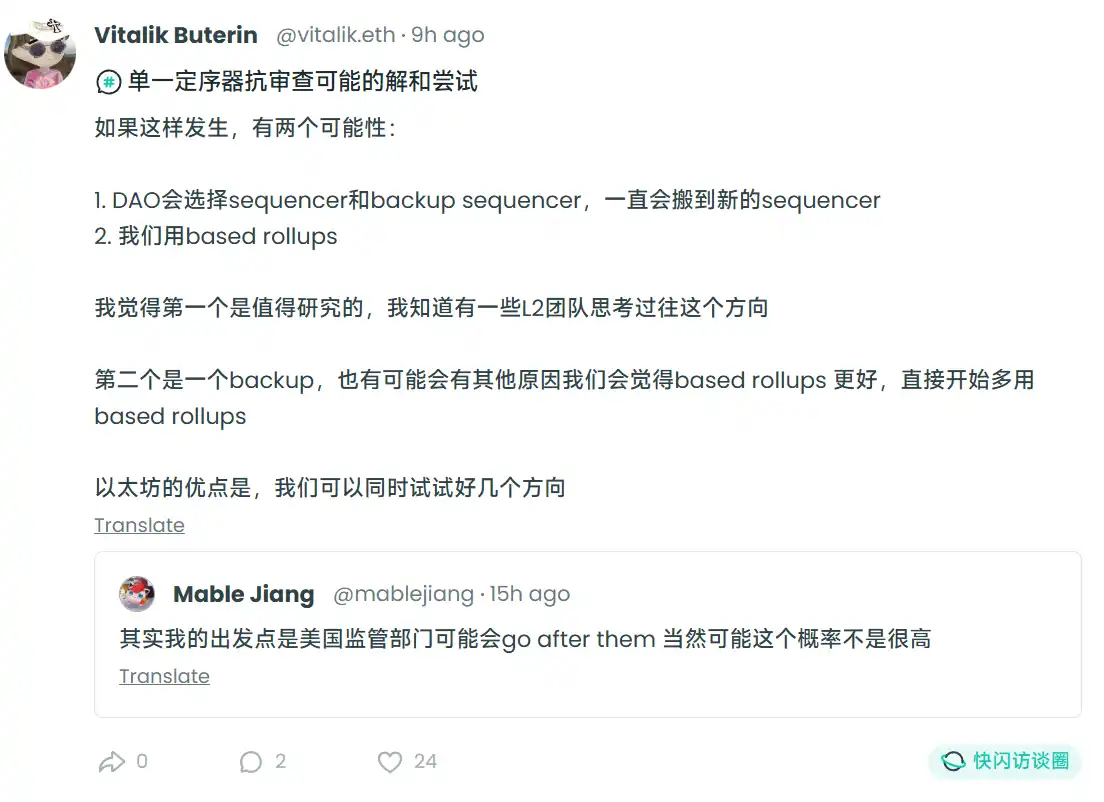
Vitalik replies to comment "Actually my concern is US regulators might go after them, though probability may not be high": Possible solutions and experiments for single sequencer censorship resistance. If this happens, two possibilities:
1. DAO selects sequencer and backup sequencer, continuously rotating to new ones
2. We use based rollups
I think the first is worth researching—I know some L2 teams have considered this direction. The second serves as a backup; there might be other reasons we prefer based rollups, prompting earlier adoption. Ethereum's advantage is we can experiment with multiple directions simultaneously.
Q4: What distinguishes the goals of the ETH 3.0 technical roadmap from those of the rollup era? Did the ETH 3.0 design revealed at last November's Devcon consider the current reality that rollups aren't providing real value back to Ethereum mainnet?
Vitalik:
Value capture between L2 and L1. There's currently no official thing called ETH 3.0. Some refer to Justin Drake's 5-year plan, but that focuses only on consensus layer, not execution layer—thus only part of Ethereum's future.
L1-L2 relationship and balance is an execution-layer issue. Another roadmap exists: enhance L1 capabilities (raise gas limit, add stateless verification like Verkle and other features), improve cross-L2 interoperability, increase blobs, etc. I also believe we shouldn't view whether L2 pays sufficient fees to L1 purely from a short-term perspective. For example:
* Before EIP-4844, complaints were opposite: Was L1 draining L2?
* Now, blob fees over the last 30 days totaled 500 ETH
* If blob target increases from 3 to 128, under our plan and assuming same blob gas price, monthly burn would reach 21,333 ETH, annually 256,000
Narratives change quickly. Now we need to strengthen L1 so things meant for L1 can happen there, increase blobs, and maintain our community's adaptability.
Q5: You decided to step up again leading EF—I believe this followed deep consideration, a courageous leap into the abyss, and I deeply admire it. Would you mind sharing your entire thought process today? Also, do you recognize China's socialist system with Chinese characteristics? My question stems from your discussion with Ameen about "proper board": before following the right developmental path, do you think organizations need strong leaders to guide and correct direction?
Vitalik:
"Decentralization" doesn't mean "doing nothing."
I feel blockchain communities and the world are currently in a dangerous state. Many activities lacking long-term value—or even malicious—are gaining attention. But we can't merely oppose these—we must propose better alternatives. Our goal should be building and demonstrating stable, brighter futures are possible.
This applies both within blockchain circles ("If a memecoin crashing 97% in a day isn't our future, then what is?") and societally: many now believe democracy is impossible, requiring strongman leadership. But at Devcon, a political scientist told me he deeply respects Ethereum precisely because we represent a truly open, decentralized ecosystem that succeeded at scale—giving him hope. If we succeed this way, our positive impact could be immense, offering a bright, successful example others can follow.
But "decentralization" ≠ "doing nothing." The Ethereum Foundation's philosophy of subtraction doesn't mean "reduce foundation to zero," but maintaining ecological balance. Where imbalance occurs (e.g., excessive centralization in one area, or vital public goods neglected by others), we can help counterbalance. Once resolved, the foundation retreats. When new imbalances emerge, we redirect resources accordingly.
In Chinese culture, our approach resembles Daoist philosophy, but walking this path requires wisdom—Foundation capabilities must actively enhance certain areas, not assume "success comes from doing nothing." Short-term, significant effort is needed for key pivots.
Q6: I'm not part of core Ethereum circles, so unclear about some detailed political issues. From your perspective, why did certain ETH Maxi OGs leave the Ethereum community? When recording a podcast with Shuyao, she raised an interesting point: Ethereum needs to hit zero before rebuilding (half-joking). Does current Ethereum indeed face a major reshuffle of existing holders and community members to forge its own path?
Vitalik:
Ethereum needs new stories and new users.
Different people have different narratives. For instance, ten years ago, many in blockchain said the goal was creating a globally neutral system protecting individual freedom and countering government hegemony. Now, if a president launches a memecoin, they say, "Wow, real-world adoption!" Great—but why does this happen on other chains? If we're friendlier to politicians, next time it'll happen on our chain! Personally, I think such people are misguided. Of course, they'll say I'm too idealistic, unrealistic, etc. Each side has its own story.
Others argue Ethereum's ecosystem is overly controlled by OGs, leaving insufficient space for newcomers. But this criticism comes from different groups with distinct viewpoints.
I believe only one path leads out of these dilemmas: we need updated narratives explaining Ethereum's purpose, ETH's function, L1/L2 roles, etc.? We're no longer in the infrastructure era—it's now the application era. So these narratives can't be abstract ideals like "freedom, openness, censorship resistance, solarpunk public goods"—we need concrete application-layer answers. I plan to focus more on info finance (also an AI + crypto direction), privacy protection, high-quality public goods funding, and continuing as an open financial platform—including real-world assets. These simultaneously serve broad user value and align with our enduring values. We must re-embrace these directions, creating more opportunities for newcomers.
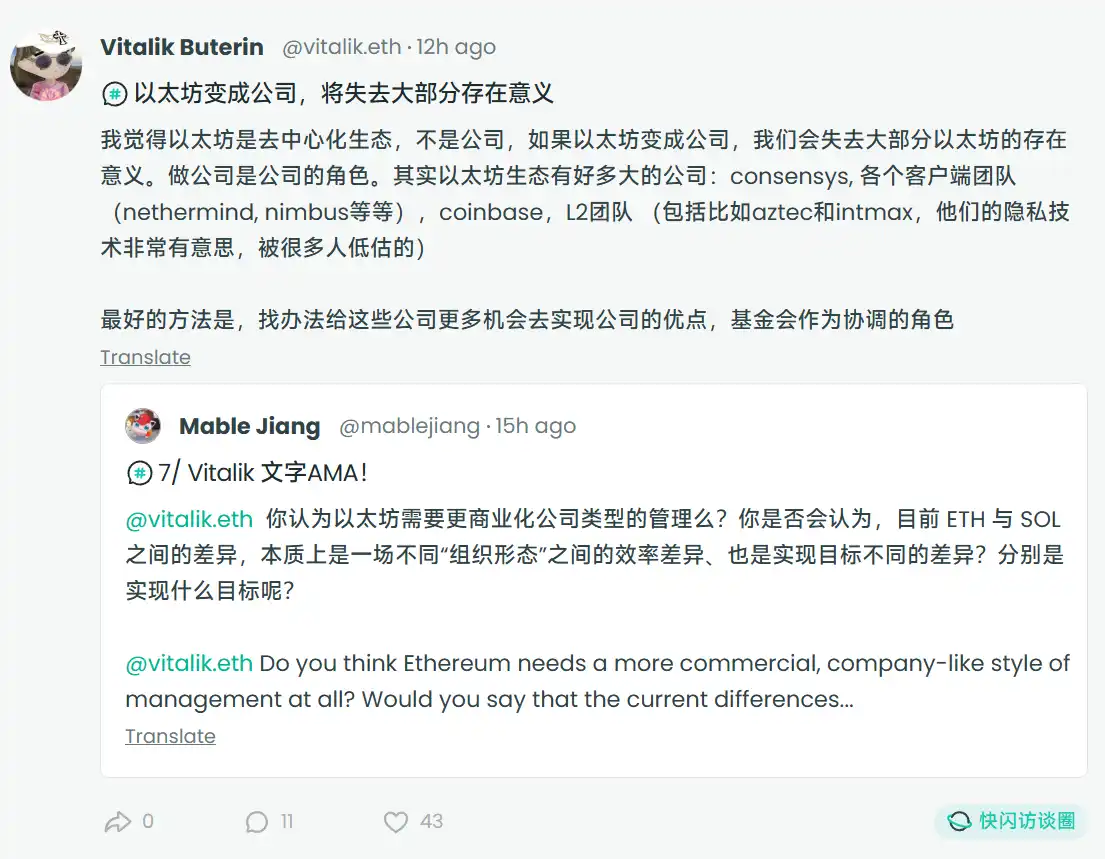
Q7: Do you think Ethereum needs more corporate-style management? Could the current difference between ETH and SOL essentially reflect efficiency differences between organizational forms—and differing objectives? What specific goals are involved?
Vitalik:
If Ethereum became a company, it would lose most of its reason for existence.
Ethereum is a decentralized ecosystem, not a company. Becoming a company would sacrifice most of Ethereum's purpose. That's what companies are for. Actually, Ethereum's ecosystem already hosts many large companies: ConsenSys, various client teams (Nethermind, Nimbus, etc.), Coinbase, L2 teams (including Aztec and Intmax—their privacy tech is fascinating and underappreciated).
The best approach is finding ways to give these companies more opportunities to realize corporate advantages, with the Foundation playing a coordinating role.
Q8: You've consistently shown interest in ZK technology applications in web3. Beyond asset trading scenarios, what social media network use cases could leverage ZK for privacy protection?
Vitalik:
I'm very interested in many non-financial ZK use cases, such as:
* Anti-sybil verification. Many services requiring KYC login don't necessarily want to know who you are—they just want to ensure you're not a bot, or that if banned, you can't return 100,000 times. This use case only requires ZK proof of personhood, proof of reputation, or sometimes even proof of tokens suffices (e.g., AnonWorld).
* Cryptographic methods for privacy-preserving AI applications. Here, ZK may not be optimal—FHE might be better. FHE has advanced significantly recently; if we further reduce FHE overhead, promising opportunities may emerge.
* Wrapping any Web2 account with ZK-snarks for Web3 use. Examples include zkEmail, anon Aadhaar, zkPassport, zkTLS, etc.
I believe this technology offers vast potential to solve security, governance, and other societal issues by protecting individual freedom and privacy.
Q9: Encouraging more developers to join Ethereum and incentivizing/retaining existing ones (compared to generous incentives offered by newer L1s or even L2s, Ethereum faces more complex challenges)—is this currently a priority? Among accelerating network decentralization, improving scalability, and exploring more application scenarios, which is Ethereum's highest priority today?
Vitalik:
Ethereum community alignment isn't a social game but a technical game. We actually need to simultaneously address three issues:
1. Attract more developers
2. Encourage developers to build applications that are open-source, secure, compliant with open standards, and have long-term value
3. While solving (2), avoid the ecosystem becoming an insular clique ("We're aligned because we're friends with developers")
That's why I recently emphasized Ethereum alignment should be a technical game, not a social game. I stress this because I believe the most urgent centralization issues today often aren't at L1, but at L2, wallets, or applications. The entire ecosystem must collectively expand, attract new developers, and advance decentralization and trustlessness.
We can facilitate this through several approaches:
1. Education—help developers easily understand blockchain's purpose, what belongs on-chain vs off-chain, and key considerations in blockchain development
2. If certain blockchain-specific technical components are too difficult for application developers, the Foundation can develop them to lower barriers—e.g., ZK programming languages, a16z's Helios, etc.
3. Provide clear standards for developers. For example, Ethereum clients have numerous tests developers can run independently. L2s have frameworks like L2Beat's Stage 1, Stage 2. Similar standards should exist for ZK applications, wallets, etc.
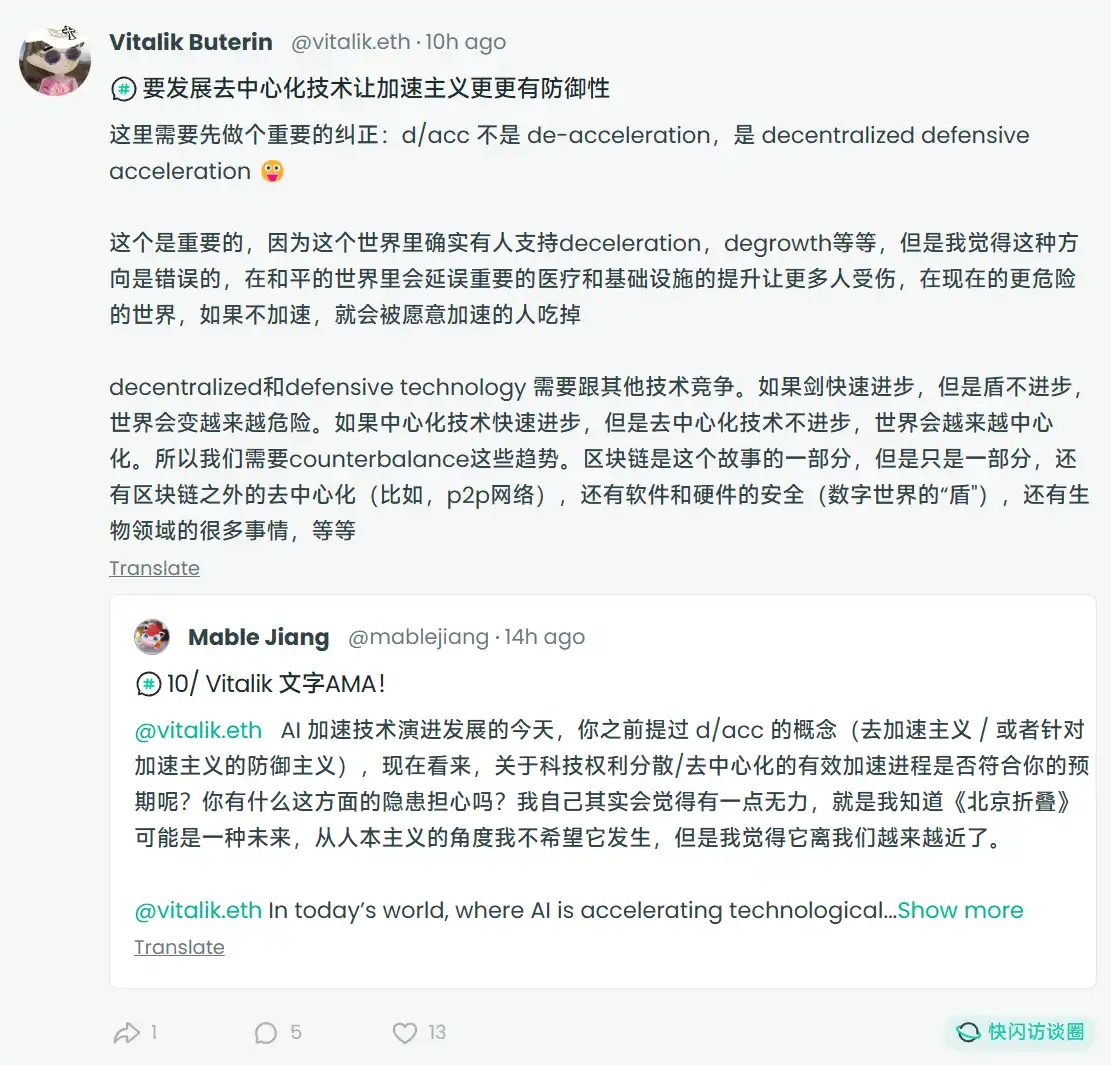
Q10: With AI accelerating technological evolution today, you previously mentioned d/acc (decentralized defensive acceleration). Looking now, does the effective accelerated progress of decentralized/defensive technology meet your expectations? Do you have any concerns here? Personally, I feel somewhat helpless—I know "Beijing Fold" might be one future. From a humanistic perspective, I don't want it to happen, but it feels increasingly near.
Vitalik:
An important clarification first: d/acc isn't de-acceleration, but decentralized defensive acceleration. This matters because some genuinely support deceleration, degrowth, etc.—but I believe such directions are wrong. In peaceful worlds, they delay crucial medical and infrastructure advances harming more people; in today's more dangerous world, failure to accelerate means being consumed by those who do.
Decentralized and defensive technologies must compete with others. If swords advance rapidly but shields don't, the world becomes increasingly dangerous. If centralized technologies advance rapidly but decentralized ones don't, the world grows more centralized. We need to counterbalance these trends. Blockchain is part of this story—but only part. Other elements include non-blockchain decentralization (e.g., P2P networks), software/hardware security ("shields" for digital worlds), biotechnology, and more.
Q11: Do all Ethereum Foundation employees, including the leadership team, have KPIs/OKRs or similar performance evaluations? Non-profits often suffer inefficiency—do you think EF has this problem? If so, how to solve it? Can you systematically explain from various angles how to accelerate Ethereum development? Ethereum is ten years old, updating once a year—it feels slow and needs massive acceleration.
Vitalik:
The Ethereum Foundation has recently initiated many internal reforms, so any answer I give now will quickly become outdated. This question might be better asked again in six months.
Q12: How do you view crypto as anti-establishment infrastructure contributing to degenerate communism? Do you think current memecoins (referring mainly to rapidly launched ones on Solana) represent "beneficial chaos" (a term from your blog)? Unable to find anonymous function, posting directly. Also strongly recommend you play "Disco Elysium"—I believe you'll enjoy it.
Vitalik:
At the core of degenerate communism is creating better "rules of the game." Chaos isn't inherently beneficial or harmful—it depends on context. The interesting question is: how can we design "rules of the game" so naturally occurring community chaos produces positive outcomes?
For example, civil wars usually have negative effects unless overthrowing malicious tyranny. Market chaos often brings benefits—eliminating outdated inefficient companies, creating opportunities for new ones—but sometimes markets create problems we see in blockchain circles. So it's complex.
How can we create better rules? I think current memecoins are far from ideal. Last year I wrote an article exploring better directions: "Vitalik on Memes Again: What Space Remains for Meme Coins?"
Q13: You likely know Simon de la Rouviere's Harberger tax experiment "This Art is Always on Sale" (patronage as an asset class). Do you think such experiments could yield new progress in future decentralized social networks? Are there any mechanisms you hope to see tested in decentralized social contexts?
Vitalik:
Yes, I believe decentralized social media offers great opportunities to test new mechanisms. Harberger tax is one example. Others include:
* Mechanisms similar to Community Notes: https://vitalik.eth.limo/general/2023/08/16/communitynotes.html
* Creator payouts—similar to Twitter and YouTube but fairer and more transparent. Try retro funding, deep funding, quadratic funding, etc.
* Integrating social media with DAO governance
Q14: How do you view our current situation—crypto natives still highly dependent on centralized platforms like Telegram and Twitter for communication and collaboration? Building decentralized social media and genuine encrypted communication tools seems insufficiently prioritized. Do their developments meet your expectations? Any advice for teams exploring this space?
Vitalik:
This is also a concern of mine. Personally, I've spent the last two years migrating most conversations from Telegram to Signal. But Signal isn't perfect—though private, it's still centralized, lacks interoperability, requires phone number registration, and servers see much of your metadata.
Building a higher-quality messenger is difficult. I try Status every year—they strive for full decentralization and do well—but still face reliability issues. Various small teams build messengers, but they don't unite, making each individually subpar.
Recently I started using Fileverse for documents and found its UX sufficiently good—now many in the Foundation use it. If a decentralized, encrypted messenger reached similar quality, I'd actively help migrate the community there.
Q15: I heard Milady community members say you chose Milady for certain reasons, but I'm still curious—how would you personally explain your connection to Milady?
Vitalik:
I think Milady attracts many people because this internet community achieves two things simultaneously:
1. It's not boring
2. It's not malicious
Looking at mainstream circles today, achieving both is rare—Milady is among the most successful examples.
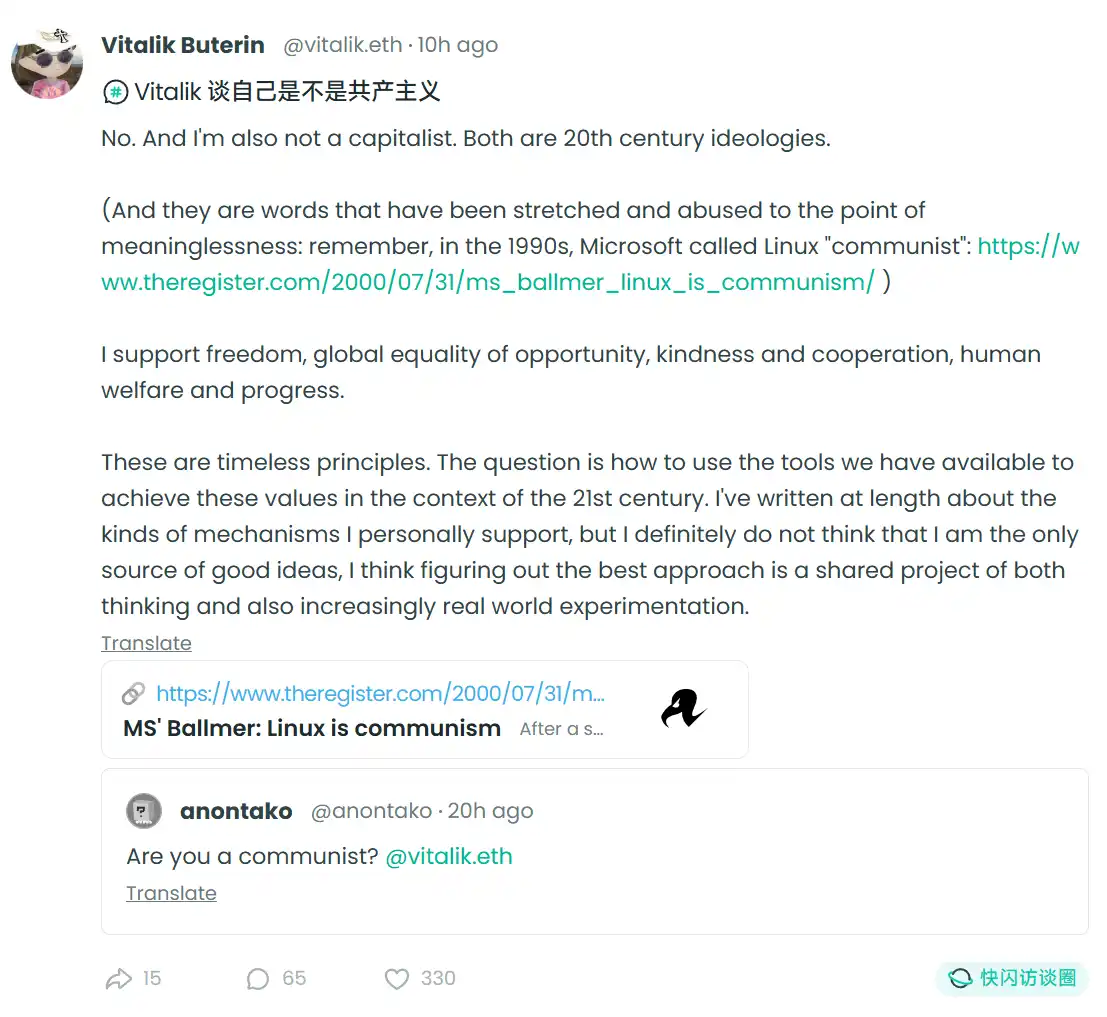
Q16: Are you a communist?
Vitalik:
No, nor am I a capitalist. Both are 20th-century ideologies.
(These terms have been stretched and abused to meaninglessness: remember, in the 1990s Microsoft called Linux "communist": https://www.theregister.com/2000/07/31/ms_ballmer_linux_is_communism/)
I support freedom, global equal opportunity, kindness and cooperation, human well-being and progress. These are timeless principles. The question is how to implement them using available tools in 21st-century contexts. I've detailed mechanisms I personally support, but I absolutely don't claim exclusive ownership of good ideas. Finding the best paths is a shared project requiring both thinking and increasingly practical real-world experiments.
Q17: Can you systematically explain from various angles how to accelerate Ethereum development? Ethereum is ten years old, updating once a year—it feels slow and needs massive acceleration. eth/acc
Vitalik:
Ethereum development currently focuses on increasing blob capacity. Key goals include:
* Pectra: Increase blob target from 3 to 6
* Fusaka: Add peerdas, further raising blob target
* 2026–2027: Continue optimizing peerdas
* Add 2D data availability sampling, further increasing blob target
There's also a roadmap to raise L1 gas limits, though more complex—requiring delayed execution, statelessness, etc.
Q18: Today's Vitalik has grown golden claws and silver scales, transforming from dragon-slayer to dragon. During Ethereum mining, it felt democratic and consensus-driven, but now v's management style seems dictatorial. After transitioning to PoS, it shifted from democracy to a "People's Congress System"—suspected of secretly joining the party behind everyone's back?
Vitalik:
PoS on Ethereum isn't a governance model. PoW can only be briefly democratic. Due to economies of scale, larger miners operate more efficiently, leading to increasing centralization over time.
I suspect we avoided ASIC dominance pre-PoS precisely because everyone knew we planned to transition, so no one invested in ASICs. Had we declared eternal PoW from day one, ASICs likely would've emerged between 2016–2019—unless we kept annually forking to change algorithms, which itself causes centralization.
Thus, our 7-year approach—using PoW for distribution, then moving to PoS—was optimal. PoS has its own fairness: 10x more stake produces 10x more blocks. In ASIC PoW, economies of scale might make 10x capital = 11x blocks. Also: PoS on Ethereum isn't a governance mechanism. Ether holders don't get to choose which EIPs go into the next fork, etc. If we used PoS for such decisions, it would indeed become excessively plutocratic.

Join TechFlow official community to stay tuned
Telegram:https://t.me/TechFlowDaily
X (Twitter):https://x.com/TechFlowPost
X (Twitter) EN:https://x.com/BlockFlow_News
 @VitalikButerin