








Deep Dive into Metaplex: Solana's Ecosystem Index?
TechFlow Selected TechFlow Selected
Deep Dive into Metaplex: Solana's Ecosystem Index?
Metaplex has developed nearly every major innovation in digital assets on Solana, including compressed NFTs, on-chain copyright protection enforcement, core plugins, and Aura.
 Navigating Web3 tides with focused insights
Authored by: Messari, Matt Kreiser, Tehsin Amlani
Translated by: 1912212.eth, Foresight News
Key Takeaways
-
Metaplex is a digital asset protocol for Solana and the Solana Virtual Machine (SVM). It provides tools and standards for creating, managing, and scaling digital assets, including NFTs, fungible tokens, RWAs, gaming assets, and DePIN assets. Over 800 million assets have been minted via Metaplex across 9 million wallets.
-
Metaplex's digital asset standard has become foundational to the Solana ecosystem, offering standardized architecture and behavior that ensures interoperability and liquidity across applications.
-
In December last year, Metaplex launched public beta access to the Metaplex Aura network—a data network designed for Solana and SVM.
-
Metaplex has pioneered nearly every major innovation in digital assets on Solana, including compressed NFTs, on-chain copyright enforcement, Core plugins (programmable assets), and Aura—the first data network optimized for digital assets. Integrations with major Solana applications such as Phantom, Magic Eden, Tensor, and Pump.fun, as well as emerging apps, have driven adoption and expanded functionality of digital assets within the ecosystem.
Introduction
The rapid rise of digital assets has created demand for more efficient and scalable solutions. This demand brings significant challenges, particularly around high costs related to on-chain storage and transaction processing across networks. Enter Metaplex, which supports all types of assets on Solana and the Solana Virtual Machine (SVM). With its suite of innovative solutions and developer experience, it has become the recognized digital asset protocol and critical infrastructure on Solana and SVM. Metaplex provides the standard for tokens and NFTs on Solana—similar to ERC-20 or ERC-721—and accounts for over 99% of NFT issuance on Solana and the majority of fungible token issuance on the network.
As a fully vertically integrated digital asset protocol, Metaplex is one of the most widely used protocols on Solana. Its on-chain program libraries drive substantial on-chain activity, and its developer tools enable developers and applications to read data associated with digital assets. Additionally, Metaplex’s Aura is the first data network on Solana and SVM optimized for digital assets, unlocking new capabilities for Metaplex’s on-chain programs—such as enabling asset data to flow in and out of Solana account space as needed, supporting composability and security.
Together, these solutions deliver an end-to-end developer experience unmatched by Solana’s competitors like Ethereum, where different projects dominate NFT issuance and management, blockchain indexing, and data availability. In contrast, Metaplex offers a comprehensive suite covering all these functions.
Aura also introduces new utility for the Metaplex token MPLX, as running Aura nodes and paying for data access requires MPLX tokens. New features and innovations like Aura will continue to be added as the protocol aims to maintain and further expand its dominant position in digital asset issuance and management on Solana and SVM, while launching new services such as indexing and data availability.
The Metaplex protocol is governed by Metaplex DAO, composed of MPLX token holders, and managed by the Metaplex Foundation—an independent nonprofit dedicated to supporting and growing the Metaplex ecosystem.
Background
Metaplex was founded internally at Solana Labs in June 2021 and co-founded by Stephen Hess, former Head of Product at Solana Labs. In August 2021, it was transferred to the Metaplex Foundation, a nonprofit organization committed to the long-term development of the Metaplex ecosystem.
Metaplex was established within Solana Labs in June 2021 and co-founded by Stephen Hess, former Head of Product at Solana Labs. In August 2021, Metaplex was transferred to the Metaplex Foundation, a nonprofit dedicated to the long-term development of the Metaplex ecosystem. Other key events in the protocol’s history include:
-
January 2022: Metaplex raised $46 million in strategic funding from investors including Multicoin Capital, Solana Ventures, Animoca Brands, Cultur3 Capital, and Blue Pool Capital.
-
July 2022: Metaplex launched its Digital Asset Standard (DAS) and DAS API for interacting with digital assets on Solana.
-
September 2022: The MPLX token launched, with an airdrop period for eligible community members and early protocol builders.
-
November 2022: The Metaplex Foundation launched the compressed NFT program (Bubblegum).
-
January 2023: Programmable NFTs with copyright protection enforcement were launched.
-
April 2024: The protocol’s latest NFT standard, Core, was launched. Core uses a single-account design to reduce minting costs and improve Solana network load. Additionally, several prominent crypto funds, including Pantera Capital and ParaFi Capital, acquired MPLX tokens previously held by the FTX estate.
-
September 2024: Metaplex launched Aura, a data network expanding Solana and the Solana Virtual Machine (SVM).
The Metaplex protocol is governed by Metaplex DAO, composed of MPLX token holders, and managed by the Metaplex Foundation. Half of all protocol fees are used to repurchase MPLX tokens, which are then contributed to the DAO treasury. The DAO may allocate treasury tokens at its discretion to incentivize ecosystem growth.
Technology
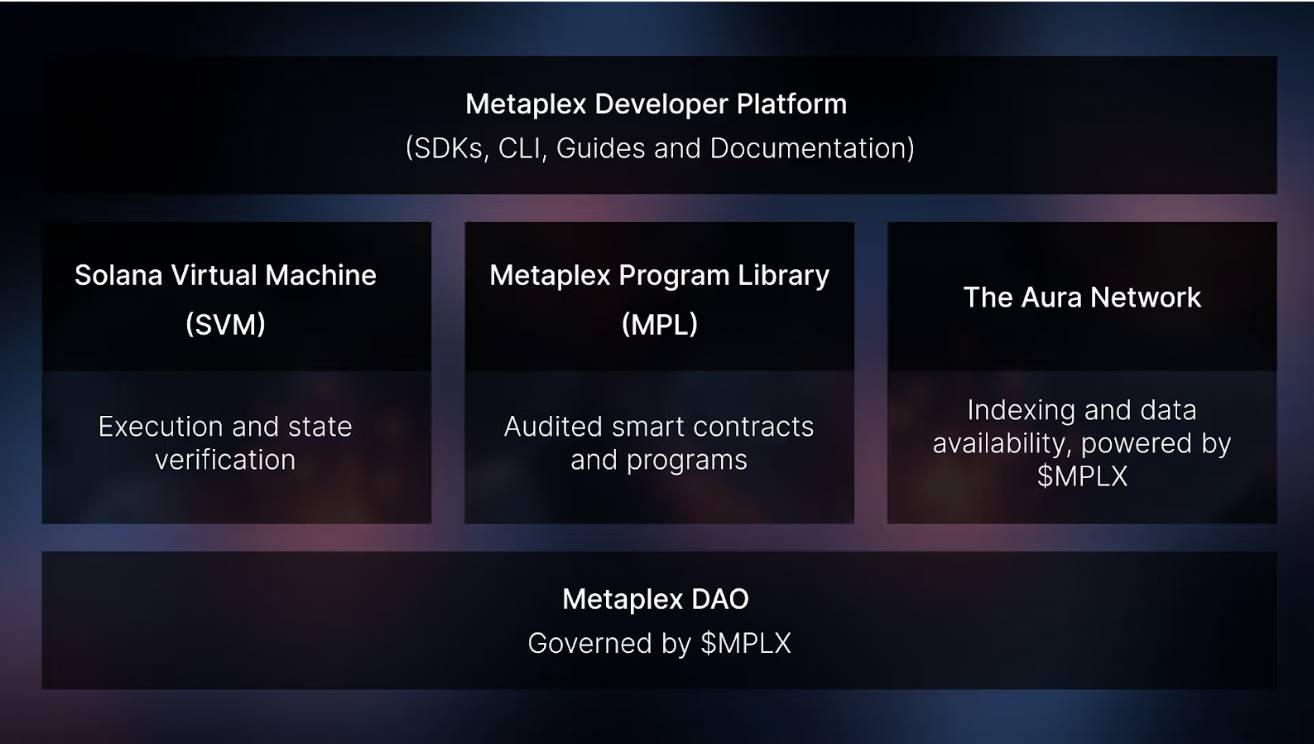
The Metaplex protocol consists of five main components:
-
Digital Asset Standard (DAS)
-
Metaplex Program Library (MPL)
-
Metaplex Developer Platform
-
Metaplex Aura Network
-
MPLX Token
Digital Asset Standard (DAS)
Just as the Ethereum ecosystem relies on standards like ERC-20, ERC-721, and ERC-1155, the Solana ecosystem relies on the Metaplex Digital Asset Standard (DAS). As a result, nearly all digital assets on Solana are Metaplex digital assets.
DAS is a standardized framework ensuring consistency and interoperability between different digital assets and applications on Solana. DAS establishes the necessary architecture, behavior, and system design for various types of digital assets, including but not limited to NFTs, compressed NFTs, fungible tokens (including meme coins), RWAs, DePIN assets, gaming assets, digital art, and token extensions.
Metaplex’s DAS provides a significant competitive advantage compared to rival ecosystems by offering a dedicated protocol and community focused on continuous innovation at the standard layer. This ensures ongoing improvements and support for developers, creators, and collectors.
Key Features of DAS
DAS provides a structured and composable framework for defining components of digital assets—such as images, configurable royalty percentages, and collections—facilitating their integration and interoperability within the Solana ecosystem. The flexible behaviors of digital assets under DAS—like metadata mutability, transfer semantics, and permission management—ensure assets can be easily updated, transferred, or restructured as needed.
DAS supports both on-chain and off-chain storage options, offering diversity in unit economics and scalability. On-chain storage ensures immutability and security, while off-chain storage provides a cost-effective and scalable solution for large volumes of metadata. Chain-off indexing and query standards established through reference implementations make data retrieval more efficient and performant, enhancing user experience.
Additionally, DAS maintains compatibility with Ethereum standards via two-way bridging through the Wormhole network, ensuring interoperability between Metaplex digital assets and Ethereum-based assets. This compatibility enables broader reach and higher liquidity for digital assets, benefiting the entire Solana ecosystem.
Metaplex Program Library (MPL)
The Metaplex Program Library (MPL) is the second component of the Metaplex protocol. It provides the on-chain implementation of DAS on Solana, enabling applications to create and manage digital assets.
MPL offers on-chain tools for developers building decentralized applications leveraging digital assets—such as marketplaces and launchpads, DeFi apps, games, DePIN, RWA platforms, on-chain subscriptions, ticketing solutions, etc. It includes products covering the entire digital asset supply chain—from creation and initial sales to utility. All components of MPL are open-source and available on GitHub. Below are some key Solana programs within MPL:
Metaplex Core
Metaplex Core is Metaplex’s latest standard for Solana NFTs. Metaplex Core introduces a cleaner, more efficient specification for digital assets than previous standards, improving cost efficiency and network performance. Core consumes minimal compute units (CU), allowing more transactions per block. Specifically, Core uses 17k CU to mint an NFT, compared to 205k CU under other standards. Core offers several key features:
Single-Account Design
A key feature of Metaplex Core is its single-account design. Unlike traditional fungible token standards—such as the Solana Program Library (SPL) token or token extensions—that rely on multiple accounts, Metaplex Core focuses on the needs of NFTs. This single-account design tracks ownership and encapsulates all necessary data within one Solana account without relying on a token program. This architecture significantly reduces minting costs and improves overall load on the Solana network. For example, minting an NFT using Metaplex Core costs approximately 0.0029 SOL, versus 0.022 SOL using the token metadata standard.
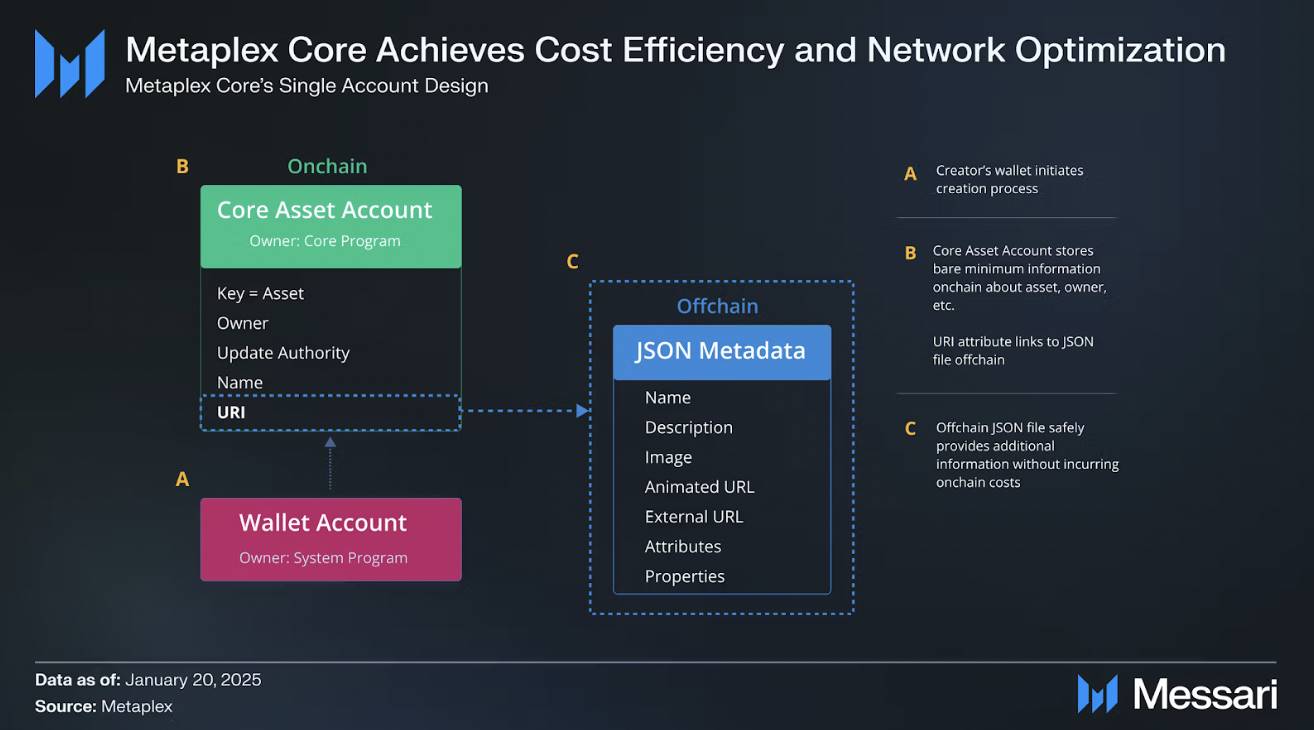
Metaplex Core employs a hybrid data storage approach combining on-chain and off-chain data. Core asset and collection accounts contain essential on-chain data, along with a URI attribute pointing to an off-chain JSON file. This off-chain file provides additional information without incurring the high cost of storing large amounts of data on-chain.
Flexible Plugin System
Metaplex Core includes a plugin system that makes Core assets more dynamic, efficient, and flexible for developers. This flexible plugin system allows developers to customize the behavior and functionality of digital assets by hooking into any asset lifecycle event—such as creation, transfer, and destruction. Plugins can offer a wide range of utilities—from built-in staking and asset-based point systems—to advanced features like delegated authority and on-chain attributes, all automatically indexed by the Metaplex DAS API. Developers can also write their own external plugins, extending Core with external data or logic to add behaviors to assets. Unlike standard plugins that only use asset data, external plugins can interact with data from other accounts or programs, making Core assets highly customizable.
Enhanced Collection Management
Metaplex Core allows assets to be grouped and managed at the collection level. This enables collection-level operations—such as freezing all assets in a collection or changing royalty details within a transaction. Furthermore, Core collections can have unique properties and plugins that override defaults, providing greater customization and control. For instance, developers can add a royalty plugin to a collection so all assets share the same royalty settings, or override those settings for individual assets as needed.
Native Metaplex DAS API Support
Core assets are automatically indexed and made available to application developers via the Metaplex DAS API—a public interface for all Solana NFTs. Moreover, all plugins are automatically indexed, including those enabling common on-chain data like attribute or AppData plugins. A notable historical example is users of Phantom and Backpack wallets being able to view their Core assets even before the apps’ developers completed full integration with Core.
Bubblegum
Metaplex’s Bubblegum program enables compressed NFTs (cNFTs) on Solana. Scalability of NFTs has historically been constrained by linear growth in on-chain rent costs on Solana (0.012 SOL per Token Metadata NFT, 0.0014 SOL per Core asset). Bubblegum addresses this challenge by drastically reducing on-chain storage costs for NFTs, enabling wider applicability of the technology.
For example, minting 1 billion NFTs would cost 12 million SOL, making large-scale NFT applications economically unfeasible. In contrast, directly transacting to mint 1 billion cNFTs costs only 5,000 SOL. With batch minting supported by Aura (Metaplex’s data network)—currently in development—this cost could be reduced by another 99%.
Bubblegum achieves scale and cost-efficiency using Merkle trees. This method ensures data remains verifiable without consuming excessive storage, thereby lowering costs. Through these strategies, Bubblegum makes large-scale NFT applications far more viable and practical than traditional methods.

Bubblegum achieves Merkle tree efficiency by strategically splitting on-chain and off-chain data storage. The core idea is to store only essential data on-chain while keeping most data off-chain, yet still allowing verification of off-chain data via the Merkle root.
Only the Merkle root and essential metadata are stored on-chain. This on-chain data provides necessary integrity checks, ensuring any off-chain data can be verified against the immutable Merkle root stored on-chain.
Detailed data and metadata of NFTs are stored off-chain, enabling greater scalability. This data remains secure and verifiable because any change to the off-chain data would alter the Merkle root, which is stored on-chain. This linkage between on-chain and off-chain data ensures off-chain data remains tamper-proof and consistent with on-chain state.
Although Bubblegum does not store NFT data directly in accounts, it still supports various cNFT operations:
-
Minting: cNFTs can be minted either unlinked to a collection or linked to one.
-
Transfer: cNFTs can be transferred between accounts.
-
Update: Metadata of cNFTs can be updated.
-
Destroy: cNFTs can be destroyed, removing them from the Merkle tree.
-
Decompress: cNFTs can be decompressed into regular NFTs, enabling interoperability with existing smart contracts, though subject to on-chain account rent fees.
-
Delegate: Ownership and management rights of cNFTs can be delegated.
-
Verify: Collections and creators of cNFTs can be verified or unverified.
Practical Applications & Efficiency
Casting cNFTs involves creating a collection and setting Merkle tree parameters. Metaplex’s Bubblegum SDK and Umi tools simplify this process, enabling developers to mint and manage NFTs at scale. Once minted, NFTs are stored in compressed format, greatly reducing storage costs while maintaining the same metadata schema as uncompressed NFTs.
Bubblegum strikes a delicate balance between cost-efficiency and security through state compression and parallel Merkle tree data management. By keeping most data off-chain and storing only essential proofs on-chain, the system significantly reduces storage costs. At the same time, cryptographic hashing ensures data remains secure and verifiable. This combination makes NFT management both scalable and cost-effective—an attractive solution for developers and creators.
Token Metadata
The Token Metadata program is a foundational program built atop Solana’s Token program, used to attach additional data to both fungible and non-fungible tokens. Metaplex’s Token Metadata program implements this by deriving a metadata account via Program Derived Addresses (PDAs) from the mint account address. On Solana, the mint account stores global information about the token, while token accounts store the relationship between a wallet and the mint account.
Although Solana’s mint accounts contain some data attributes (e.g., current supply), they do not allow injection of standardized data that applications can understand. Thus, the Token Metadata program provides a metadata account attached to the mint account via PDA. Each metadata account contains a "URI" attribute pointing to an off-chain JSON file, providing additional data without being limited by on-chain storage fees. Notably, this JSON file can be configured to be immutable after initial setup—particularly appealing to NFT developers. For NFTs, the metadata account holds the data that makes the NFT a useful digital asset (i.e., describing its unique characteristics).
Another account specifically provided for NFTs is the master edition account—a PDA also derived from the mint account. When created, the Token Metadata program transfers minting and freeze authorities to this account instead of disabling them. Thus, the master edition account serves as proof of the non-fungibility of the mint account. Notably, the master edition account can also enable minting one or more copies of the NFT. A token’s fungibility status is tracked in the token standard attribute within the metadata account.
Prior to 2024, NFTs were the primary use case for the Token Metadata (TM) program. However, since then, the TM program’s main usage has come from fungible tokens. Semi-fungible tokens (also known as “fungible assets”) can also be implemented via the TM program. Semi-fungible tokens have a supply greater than 1 and possess typical NFT-like attributes such as image and array of attributes in JSON metadata.
Moreover, it’s important to note that since the Token Metadata program is built atop Solana’s Token program, it cannot enforce rules related to the attached token. Therefore, programmable use cases like secondary market royalties or transfer restrictions cannot be enforced. However, Metaplex has developed programmable NFTs as a solution to this issue. Programmable NFTs are a new opt-in token standard that keeps the underlying token account permanently frozen, so no operation (e.g., transfer, lock, burn) can occur without authorization from the Token Metadata program. This allows creators to define operation-specific authorization rules (rule sets) and create and update them via Metaplex’s Token Authorization Rules meta-programming tool.
Candy Machine (V3) and Core Candy Machine
Candy Machine (V3) is Metaplex’s program for fair minting and distribution of NFT collections on Solana, while Core Candy Machine offers the same functionality but for issuing Core assets.
Candy Machine enables fair NFT distribution by allowing creators to configure various launch parameters—such as validation processes, minting limits, start and end dates. It helps creators efficiently handle large-scale NFT launches by supporting sequential or random minting of NFTs. Additionally, the program offers extensive customization options defining NFT attributes and metadata management, ensuring each NFT launch can be tailored to specific needs.
The Candy Machine lifecycle involves multiple stages. First, creators configure the Candy Machine, setting parameters including seller fee basis points, symbol for minted NFTs, maximum supply, mutability options, and list of creators with respective royalty shares. Then, items are loaded into the Candy Machine, each defining a name and URI pointing to off-chain JSON metadata. After configuration and fulfillment of all prerequisites, users can begin minting NFTs. Some users may need to complete additional verification steps—such as solving CAPTCHAs or providing Merkle proofs—before minting begins. After all NFTs are minted, the Candy Machine can be deleted to free up on-chain storage and reclaim rent fees.
Since its launch, Candy Machine has been a vital part of the Solana NFT ecosystem. Not only have most top-tier collections (e.g., DeGods, Claynosaurz, SMB Gen3) launched via Candy Machine V3, but most Solana launch platforms also use Candy Machine or its derivatives (e.g., Magic Eden uses a derivative version). Programs like Candy Machine and its variants streamline the asset creation process, driving volume through Metaplex standards such as Token Metadata and Core. Moreover, Metaplex’s decision to offer its utilities (like Candy Machine) for free has been a key value proposition attracting developers over competitors.
Metaplex Developer Platform
The Metaplex Developer Platform is a core component for effectively utilizing DAS and MPL, designed to facilitate Solana-based application development by providing a comprehensive suite of tools, software development kits (SDKs), and reference interfaces. Metaplex’s existing programs and developer tools provide customers with convenient pathways to integrate new Metaplex features. An example is the Aura network, accessible via SDKs compatible with all the same frameworks and tools in the Metaplex developer ecosystem. The Metaplex Developer Platform includes the following key tools:
Umi
Umi is a modular framework for building and using JavaScript clients for Solana programs. It features a zero-dependency library defining core interfaces along with default implementations and bundles for developers to use.
Sugar
Sugar is a command-line tool for interacting with and managing the entire lifecycle of Candy Machine. Its main advantages include a configuration file containing all Candy Machine settings and a multithreaded system accelerating media/metadata upload and computational processes during deployment.
DAS API
The DAS API provides a unified interface for interacting with digital assets on Solana, supporting standard (Token Metadata), compressed (Bubblegum), and Core assets. The DAS API defines methods for delivering asset data, with the vast majority indexed through Metaplex’s digital asset RPC infrastructure. This approach balances scalability and cost-efficiency, making it easier for developers to manage and interact with large volumes of digital assets. However, reliance on off-chain data storage means dependence on external RPC providers, which may affect reliability and consistency.
Metaplex Aura Network
Aura is Metaplex’s data network optimized for Solana and the Solana Virtual Machine (SVM), secured by the MPLX token. Aura provides developers with efficient access to on-chain data—including optimized indexing and querying of digital asset data—which is crucial for building decentralized applications capable of competing with centralized alternatives. With the launch of Aura, Metaplex now offers developers a complete framework for building applications on Solana: using the Metaplex Program Library (MPL) to write data on-chain paid in SOL, and reading that data via Metaplex Aura in a decentralized, high-performance way using MPLX.
Aura first launched on Solana mainnet and devnet in September 2024, followed by beta access for developers via Google Form applications in November 2024, and public beta in December 2024. Aura’s Eclipse Ethereum Layer-2 also entered beta in November 2024, followed by public testing in December 2024.
The Aura network operates via Aura nodes, which index both compressed and uncompressed states while providing critical data availability for compressed states. Aura has three main features:
-
Read Solana and SVM Data: Aura provides developers with decentralized access to on-chain data, paid in MPLX.
-
Manage Compressed and Uncompressed States: Aura implements the Digital Asset Standard (DAS) API, providing indexing capabilities for any digital asset on Solana and SVM. Additionally, in the future, developers and applications will be able to transition assets between SVM account space and varying levels of state compression based on demand.
-
Batch Mint NFTs: Batch minting generates offline JSON objects/files, with transactions indexed by Aura nodes. This feature is currently under development.
Aura introduces the term “elastic state” to describe the network’s ability to transition assets between SVM account space and varying levels of state compression based on demand. Elastic state management enables rollup-style minting transactions, allowing millions of assets to be created in bulk into compressed state with 99% fewer transactions, with Aura nodes providing data availability (DA) to manage state transitions.
Aura is currently accessible directly via public gateways and already integrated into Metaplex SDKs and developer tools, offering developers a complete solution for digital asset creation and management. Alternatively, projects can choose to run nodes directly to access the network.
The Metaplex Foundation’s Aura repository is open-source, allowing the global developer community to contribute code. Additionally, over 25 projects—including top NFT marketplaces, infrastructure providers, game developers, and SVM L2s—participated in Aura’s launch and provided feedback to improve and optimize the network.
MPLX Token Economics and Governance
MPLX Token
The MPLX token launched in September 2022 as the governance token of the Metaplex protocol, rewarding community members and early protocol builders through airdrops to incentivize protocol activity. In November 2024, the launch of the Aura network added further utility to MPLX: the token is not only required to operate Aura nodes but also serves as payment for accessing the Aura network. Additionally, half of Metaplex protocol fees are used to repurchase MPLX tokens, which are then contributed to the Metaplex DAO treasury.
Governance Rights
MPLX token holders have voting rights and can participate in key decision-making processes regarding:
-
Protocol Development & Roadmap: Deciding the future direction and improvements of the protocol, as well as the utility of MPLX.
-
Treasury Fund Allocation: Voting on how to allocate funds in the treasury.
-
Protocol Ownership, Upgrades & Deployment: Decisions involving protocol ownership, upgrades, and new deployments.
-
Responding to Emergencies & Unexpected Issues: Providing solutions for unexpected technical or compliance issues.
MPLX Grant Proposals
The Metaplex DAO treasury holds MPLX tokens that can be used to incentivize growth in the Metaplex ecosystem. Contributors to the Metaplex ecosystem can submit grant proposals to the DAO requesting MPLX or other available assets to promote adoption of the Metaplex protocol and deeper integration of MPLX functionality. Notably, all MPLX tokens funded through the DAO are locked for one year. The grant proposal process is as follows:
-
Proposal: Anyone holding at least 200 MPLX can submit a grant proposal, and proposers must complete KYC verification.
-
Preliminary Review: The Metaplex Foundation conducts an initial review of proposals, requesting additional information and filtering out “spam proposals” or those violating relevant laws and regulations.
-
Community Feedback & Voting Period: Proposals passing the foundation’s preliminary review are posted on the Metaplex Foundation’s GitHub, initiating a voting period. Each MPLX token equals one vote. A proposal must receive at least 66% support, and total votes must exceed the valid threshold (i.e., 1 million votes, 0.10% of total token supply).
-
Execution: If approved, the DAO committee releases MPLX to the grant recipient via direct transfer or smart contract.
Metaplex Improvement Proposals (MIP)
MIP is the proposal process for changes to the protocol (i.e., Metaplex Program Library). The MIP process is as follows:
-
Proposal: Anyone holding at least 1,000 MPLX and paying a 10 USDC spam reduction fee can submit an MIP. Notably, the Metaplex Foundation refunds USDC for “good faith submissions.”
-
Community Feedback & Preliminary Review: The community provides feedback on the Metaplex Foundation’s MIP discussion forum. During this phase, the Metaplex Foundation may filter out spam proposals, those lacking necessary details, or those violating hard requirements—such as breaking backward compatibility, compromising security, or violating relevant laws and regulations.
-
Implementation Assignment: If a proposal passes, the Metaplex Foundation decides whether the foundation or the community will implement it.
-
Voting Period: If the foundation opts for a vote, an MIP voting period begins. Each MPLX token equals one vote. A proposal must receive at least 66% support, and total votes must exceed the threshold set by the foundation.
-
MIP Implementation: If approved, the Metaplex Foundation publishes a development timeline indicating when the approved proposal will be implemented by the foundation. If implemented by the community, the Metaplex Foundation solicits bids and selects a winner.
Additionally, the Metaplex Foundation may independently make changes to the Metaplex Program Library as long as they do not violate the program library’s hard requirements. Finally, the Metaplex Foundation may decide to terminate the MIP process at any time if a proposal conflicts with applicable laws or regulations.
Aura
On the Aura network, the MPLX token has two primary uses:
-
Node Operation: To date, the Metaplex Foundation has released limited documentation explaining how MPLX is used to operate nodes on the Aura network. Both Metaplex’s developer documentation and the original blog post announcing Aura state that “Aura nodes are secured by MPLX tokens.”
-
Payment: Metaplex offers a free tier for API testing and early project development, but accessing the Aura network at larger scale requires payment in MPLX tokens. Under a pay-per-use model, each request has a designated price, and there are also two unlimited plans priced at 500 MPLX/month and 1,500 MPLX/month.
Buyback Mechanism
Half of Metaplex protocol fees are used to buy back MPLX tokens and contribute them to the Metaplex DAO treasury. Specifically, each month, “50% of Metaplex protocol fees from the prior month plus historical fees” are used to repurchase MPLX. For example, in December 2024, Metaplex used 12,000 SOL to repurchase MPLX—50% from November’s protocol fees (7,816 SOL), with the remainder from historical fees (4,184 SOL). The DAO may also choose to distribute tokens from the treasury to incentivize growth in the Metaplex ecosystem. From June to October 2024, Metaplex used 10,000 SOL monthly for buybacks, increasing to 12,000 SOL in November and December 2024, and January 2025. To date, buybacks amount to approximately 44.47 million MPLX (4.45% of total supply), with the largest single-month buyback occurring in January 2025 at 9.2 million MPLX (0.92% of total supply).
Earn Rewards
Approved by the Metaplex DAO, MPLX tokens are used to reward community members and incentivize activity. In December 2024, the Metaplex DAO approved Season One of Metaplex Earn, allocating 1 million MPLX (~0.10% of total supply) to reward liquidity providers supplying MPLX liquidity on major Solana DEXs. The program began in January 2025, with unused MPLX tokens returned to the DAO treasury after the program ends. Since launch, on-chain liquidity for MPLX has grown to $7.7 million—tripling in size.
MPLX Token Distribution
The total supply of MPLX tokens is 1 billion, fully unlocked as of September 19, 2024, distributed as follows:
(Specific allocation details such as team, investors, community, ecosystem, etc. can continue here)
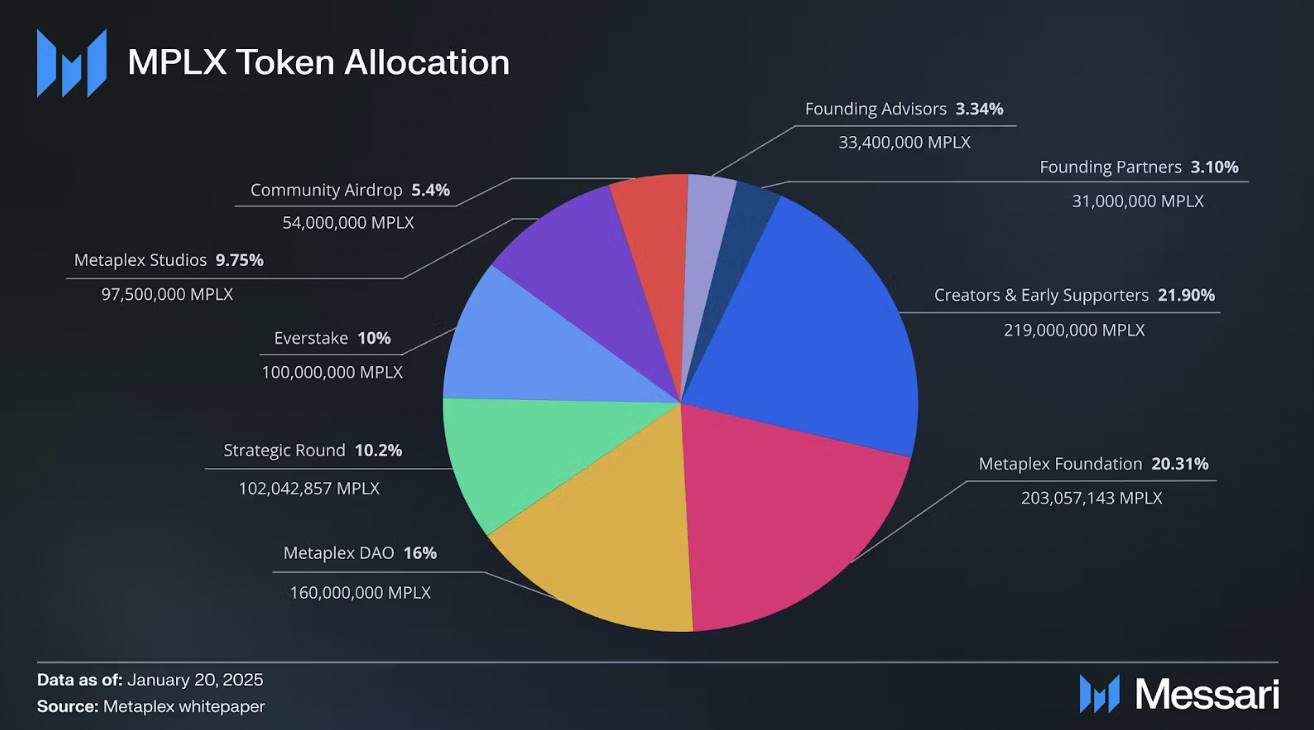
Creators & Early Supporters — 219 million MPLX (21.90%)
-
These tokens were allocated to key early supporters and contributors who purchased tokens during the initial funding round and played important roles in ecosystem development.
-
Each participant received 50% of their tokens one year after the initial airdrop (September 19, 2022), with the remaining 50% distributed monthly over 12 months.
Metaplex Foundation — 203 million MPLX (20.31%)
-
The Metaplex Foundation is a nonprofit organization dedicated to advancing research, development, and promotion of the Metaplex ecosystem.
-
These tokens were allocated to the Metaplex Foundation to reward and support the Metaplex community and advance the development, security, governance, and management of the Metaplex protocol and DAO.
-
These tokens are not subject to vesting and can be used immediately.
Metaplex DAO — 160 million MPLX (16.00%)
-
These tokens are held by the Metaplex DAO for protocol changes, ecosystem grants, and strategic initiatives.
-
Tokens held by the DAO are governed by Metaplex and can be gradually allocated through community proposals.
-
These tokens are not subject to vesting.
Strategic Round — 102 million MPLX (10.20%)
-
This allocation was announced in January 2022 and distributed to strategic capital providers and notable figures in pop culture, entertainment, sports, etc., to promote the role of Metaplex and NFTs.
-
The unlock schedule matches that of Creators & Early Supporters, with a one-year cliff followed by monthly distribution over one year.
Everstake — 100 million MPLX (10.00%)
-
Everstake is a development company and Solana staking provider, serving as one of the founding development teams of the Metaplex Foundation.
-
These tokens have a two-year cliff, followed by linear distribution over one year.
Metaplex Studios — 97.5 million MPLX (9.75%)
-
Metaplex Studios is the core development team providing services to the Metaplex Foundation, focusing on MPL and DAS development—including protocol development, developer tools, commercial partnerships, community support, and app development.
-
These tokens have a one-year cliff, followed by linear distribution over two years.
Community Airdrop — 54 million MPLX (5.40%)
-
On April 29, 2022, the Metaplex Foundation issued Genesis Developer NFTs to developers who contributed to the Metaplex protocol and distributed 800,000 MPLX tokens to Genesis Developer NFT holders (developer airdrop).
-
In addition, creator airdrops distributed 13.2 million tokens to creators who launched NFT projects using the Metaplex program library.
-
Furthermore, heavy minter or early NFT adopters (collector airdrop) received 40 million MPLX tokens.
-
Airdropped tokens are not subject to vesting and can be used immediately.
Founding Advisors — 33.4 million MPLX (3.34%)
-
Founding advisors contributed to promoting Metaplex among creators and developers in the Web3 space.
-
These tokens have a one-year cliff, followed by linear distribution over one year, with a one-year lock-up period after the initial airdrop.
Founding Partners — 31 million MPLX (3.10%)
-
Founding partners were early supporters and collaborators of the Metaplex protocol who launched some of the earliest NFT storefronts and continuously provided input on new features for the program library, NFT standards, and developer tools.
-
These tokens have a one-year cliff, followed by linear distribution over one year, with a one-year lock-up period after the initial airdrop.
Protocol Activity
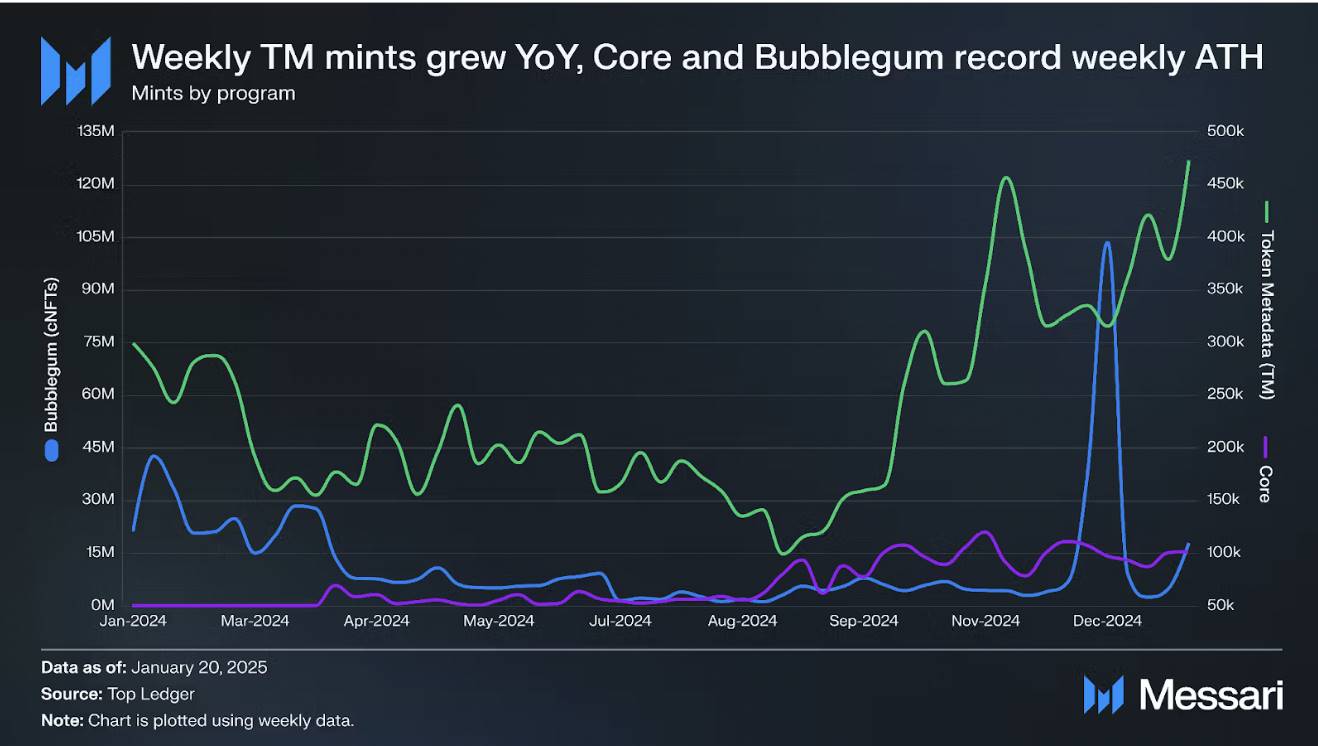
In 2024, weekly mint volume from the Token Metadata program increased 58% year-over-year—from 300,000 to 473,000—setting a new 52-week high. Similarly, weekly mint volume from the Core program, launched in March 2024, surged in September 2024—from 20,000–50,000 weekly mints to 50,000–120,000 weekly mints—and peaked at 121,000 mints in the week of November 11, 2024. Weekly mint volume from the Bubblegum program, launched in 2023, also hit a record high of 103.5 million in 2024—over 20 times higher than the previous record in 2023.
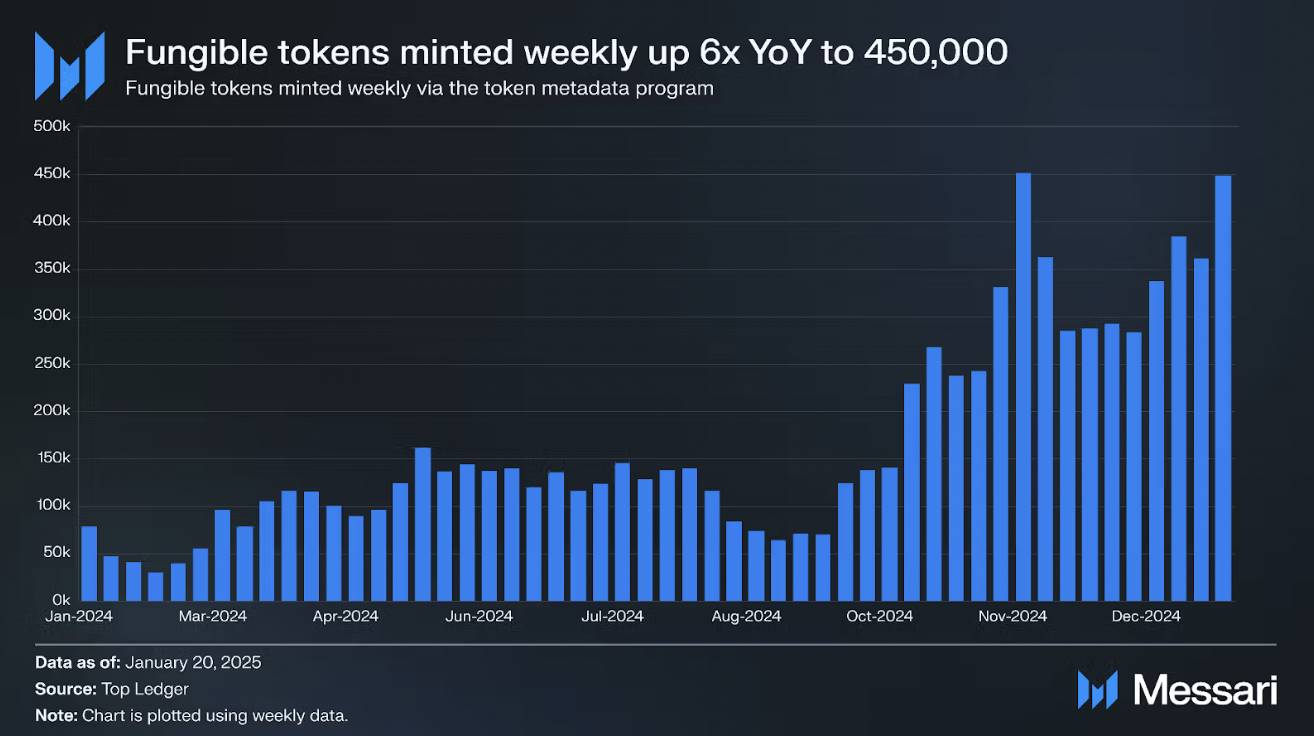
The number of weekly fungible tokens minted via the Token Metadata program grew sixfold year-over-year—from 78,000 to 450,000—reflecting rising trends in memecoin and AI token activity. Token launch platforms like Pump.fun and Meteora’s Mint, along with AI agent toolkits like Griffain and SendAI, leverage the Token Metadata program to create fungible tokens. AI agent toolkits and other agent platforms (like ElizaOS) also use Token Metadata and Core programs to create and manage NFTs as part of full access to the Metaplex Program Library (MPL).
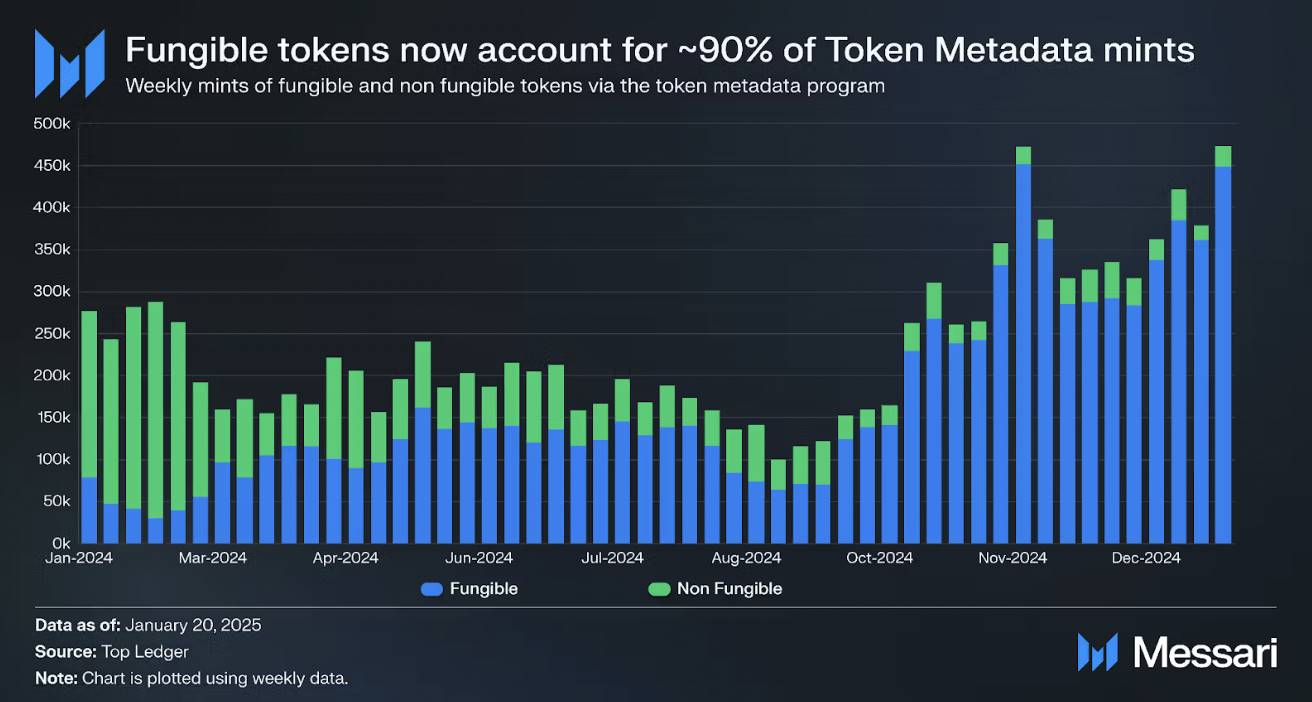
In March 2024, fungible tokens surpassed non-fungible tokens to become the majority of weekly mints via the Token Metadata program. This trend strengthened from April 2024 onward, with over 95% of Token Metadata mints being fungible tokens in the week of January 20, 2025. The dominance of fungible assets via the Token Metadata program can be attributed to memecoin and AI activity on Solana, which drove additional asset creation in these categories.
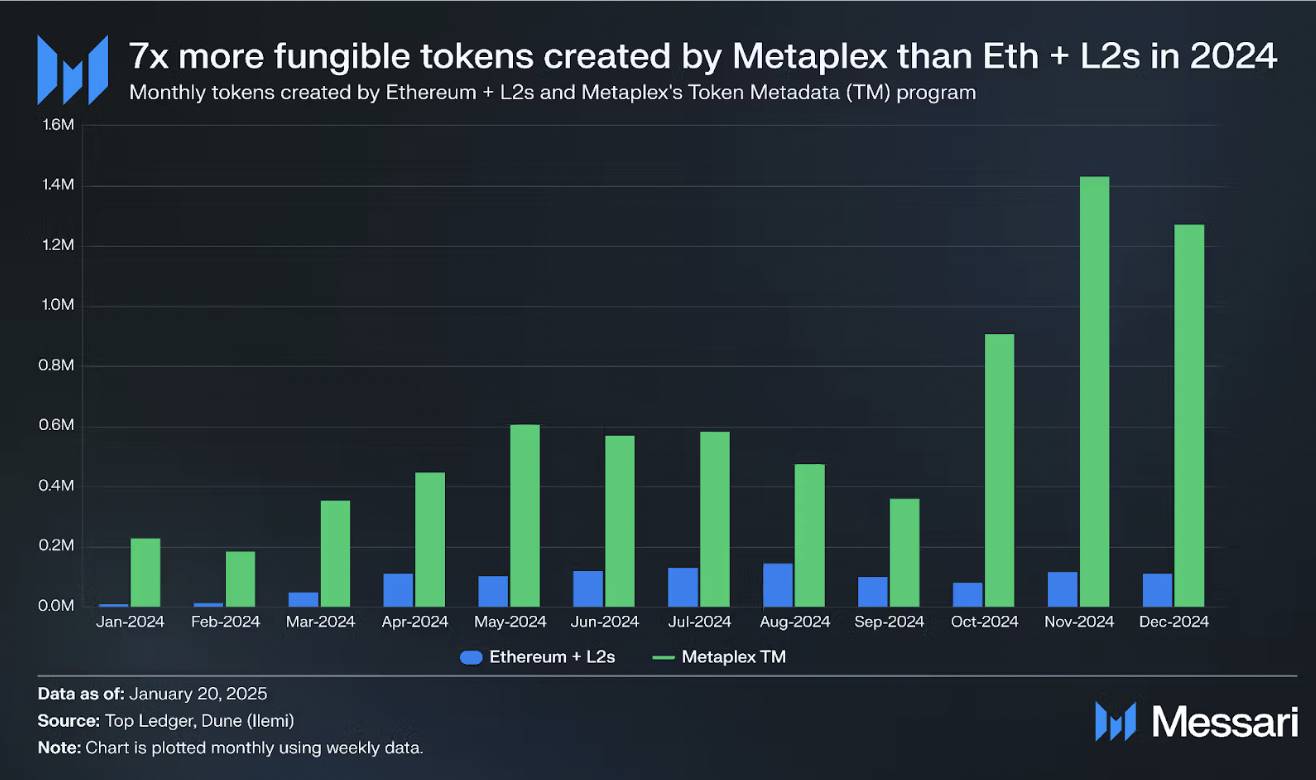
Fungible tokens minted via the Token Metadata program not only grew sixfold in absolute numbers (year-over-year) but also reached ~90% in relative proportion (i.e., most tokens minted via Token Metadata are fungible). They also show stronger dominance compared to token minting on Ethereum and its Layer 2s. In 2024, over 7.4 million fungible tokens were minted via Token Metadata—seven times the 1.06 million minted on Ethereum and its Layer 2s. Additionally, in Q4 2024, Token Metadata minted 12 times more fungible tokens than Ethereum and its Layer 2s, showing an accelerating trend. Ultimately, Metaplex’s dominance in fungible token minting reflects Solana’s leadership in on-chain transaction activity and Metaplex’s role as the creation protocol for nearly all tokens on the network.
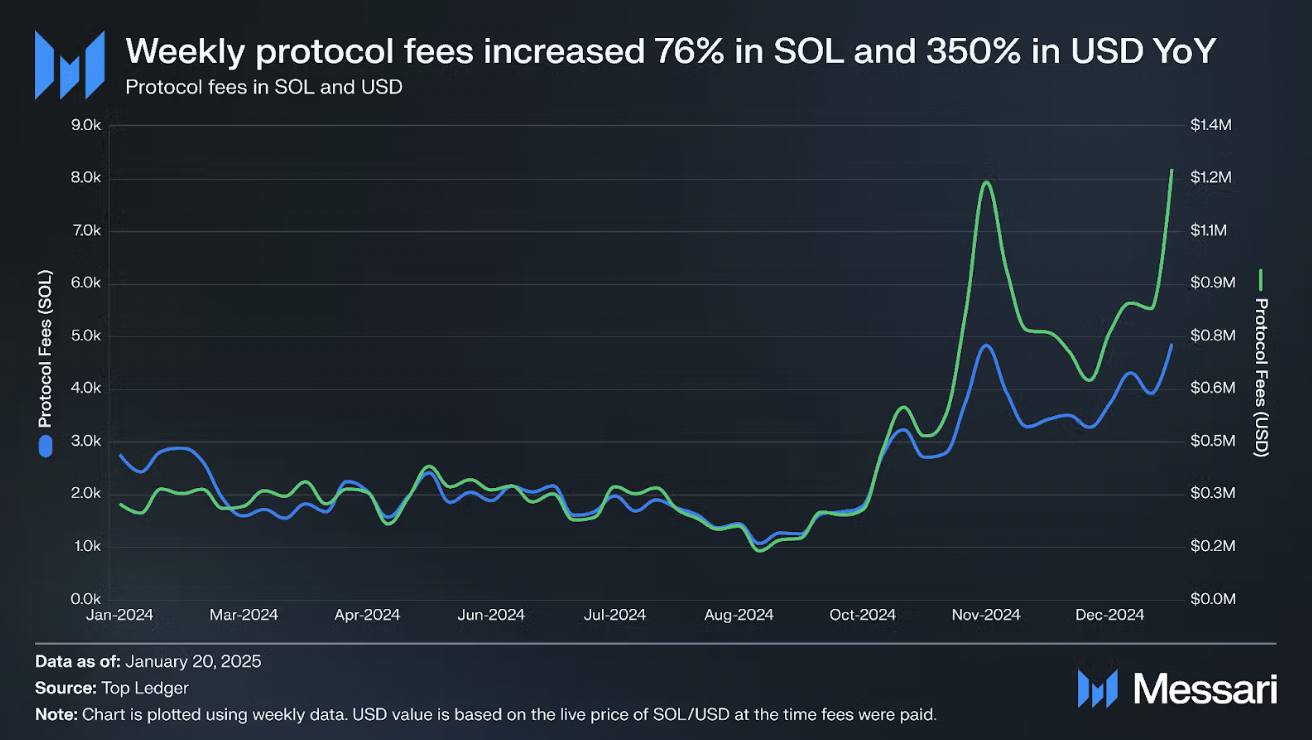
Year-over-year, weekly Metaplex protocol fees grew 76% in SOL terms—approaching 5,000 SOL—and 350% in USD terms—exceeding $1.2 million. Although Metaplex’s highest revenue week in December 2023 (11,343 SOL) generated $840,000 in fees, rising SOL prices enabled Metaplex to surpass $1.2 million in fee revenue (4,864 SOL) in the week of January 20, 2025—setting a new all-time high. These outlier weeks are crucial for calculating total fees. In comparison, Metaplex’s average weekly fee was 1,768 SOL in 2023 (median: 895 SOL), versus 2,306 SOL in 2024 (median: 2,050 SOL). The median weekly fee in 2024 was 130% higher than in 2023, while the average weekly fee only grew 30%.
Half of all Metaplex protocol fees are used to buy back MPLX and subsequently contributed to the Metaplex DAO treasury. This contrasts sharply with many other protocols that must pay most fees to third parties—such as liquidity providers, lenders, or validators—and thus cannot afford to allocate such a high percentage of fees to token buybacks.
From June to October 2024, Metaplex used 10,000 SOL monthly in fees to buy back MPLX, increasing to 12,000 SOL in November and December 2024, and January 2025. To date, this has resulted in approximately 44.47 million MPLX (~4.45% of total supply) being bought back, with ~9.2 million MPLX (0.92%) repurchased in January 2025—the largest monthly buyback to date.
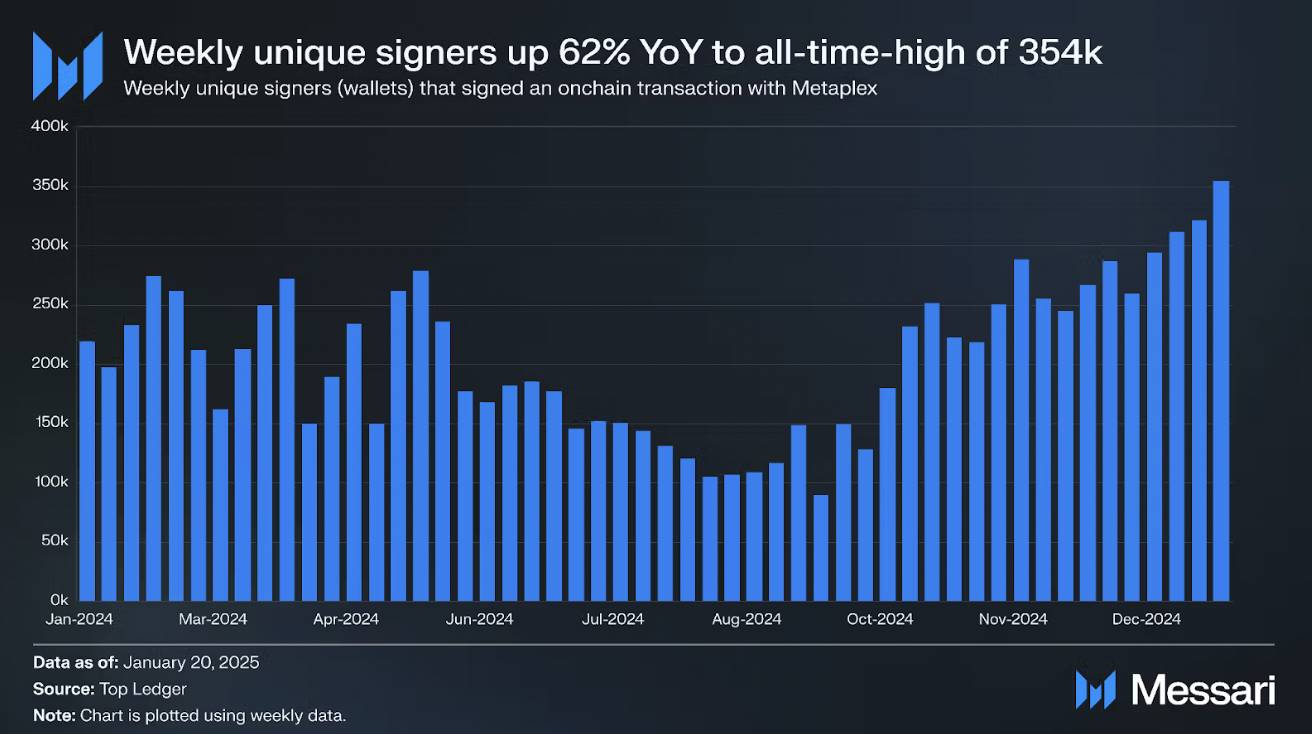
Weekly unique signers (wallets signing on-chain transactions via Metaplex) grew 62% year-over-year—from 219,000 to a record 354,000. Additionally, Metaplex averaged 196,000 unique signers per week in 2024—up 160% from the 76,000 average in 2023. Like other metrics, this growth is largely attributed to increased memecoin activity. Another contributing factor is the rise in Core mints, as each Core mint requires a signing wallet. Since August 2024, monthly Core mints have grown from 57,000 to over 400,000 by December.
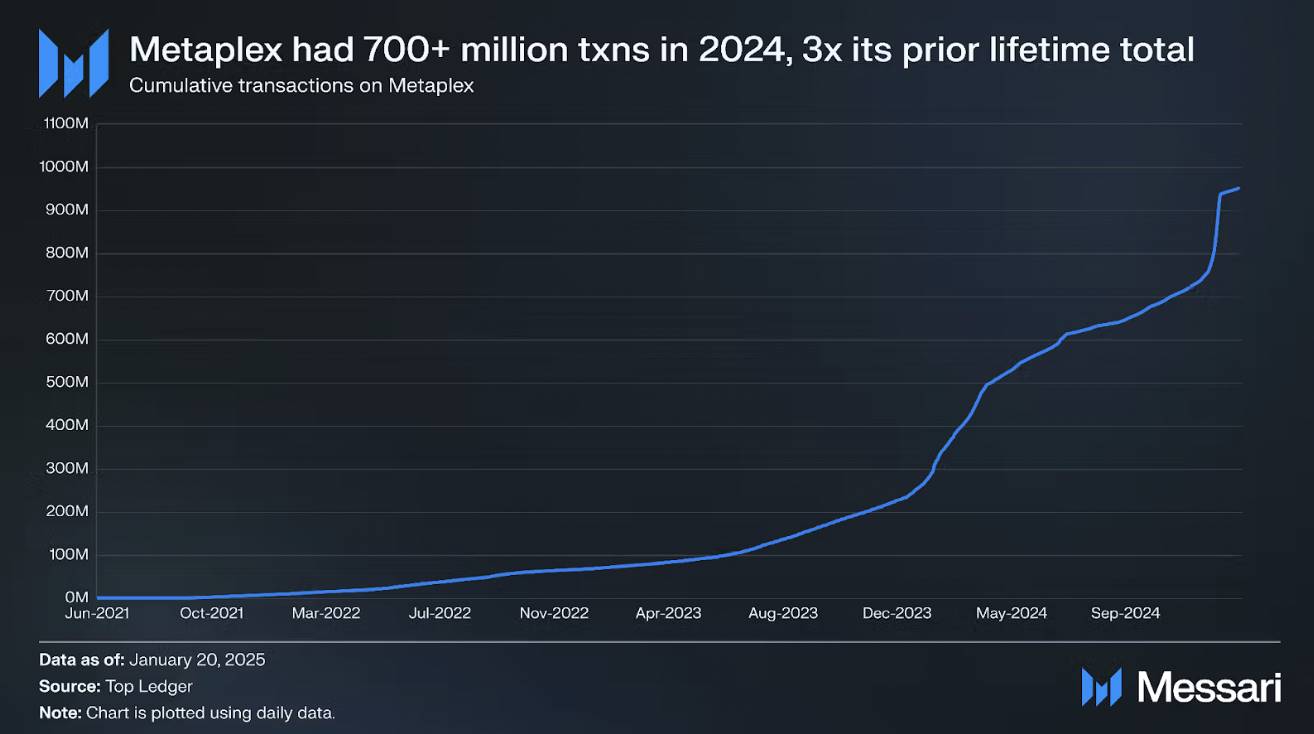
In 2024, Metaplex exceeded 705 million total transactions—more than triple the previous 233 million transactions since June 2021. Additionally, on December 23, 2024, Metaplex set a new record of over 23 million daily transactions—marking the sixth consecutive day of record highs following the previous all-time high on February 3, 2024. This surge in transaction volume was almost entirely driven by Bubblegum, which processed over 103 million transactions in the week of December 23, 2024.
Ecosystem
Metaplex is a critical infrastructure protocol for building digital
Join TechFlow official community to stay tuned
Telegram:https://t.me/TechFlowDaily
X (Twitter):https://x.com/TechFlowPost
X (Twitter) EN:https://x.com/BlockFlow_News
 Messari


