








The Two Sides of the Cryptoeconomy: Coexistence of "Useless Speculation" and "Practical Innovation"
TechFlow Selected TechFlow Selected
The Two Sides of the Cryptoeconomy: Coexistence of "Useless Speculation" and "Practical Innovation"
Skillfully leveraging the dual nature of crypto-economics, while harnessing speculative energy to drive financial transformation, increasingly serves non-speculative use cases.
 Navigating Web3 tides with focused insights
Author: Ryan Watkins, Co-Founder of Syncracy Capital and Former Analyst at Messari
Translation: Yangz, Techub News
Critics often point to the pervasive financial nihilism in crypto-economics as evidence that this economic system will ultimately collapse under the weight of its own excess. Yet beneath the speculative frenzy fueling such skepticism, we are also witnessing the emergence of new "winners" that continue to grow over time. In this article, we explore the tension between "uselessness" and "utility" in crypto-economics, and clarify how they are in fact two sides of the same coin.
"It was the best of times, it was the worst of times; it was the age of wisdom, it was the age of foolishness; it was the epoch of belief, it was the epoch of incredulity; it was the season of Light, it was the season of Darkness; it was the spring of hope, it was the winter of despair; we had everything before us, we had nothing before us; we were all going direct to Heaven, we were all going direct the other way." — A Tale of Two Cities, Charles Dickens
Critics frequently cite the widespread financial nihilism in crypto-economics as proof of its futility. Despite Bitcoin having existed for 16 years and Ethereum for 9, there remain few mainstream use cases demonstrating undeniable utility.
Every time we hear stories of emerging market users protecting their savings from domestic inflation via stablecoins, there seem to be just as many users in developed markets risking their life savings on high-stakes bets with various Memecoins.
Stablecoins are liberation and destruction; blockchains are great equalizers and massive disruptors; crypto-economics is both the future of global finance and humanity’s largest collective delusion.
These opposing views highlight the high stakes involved—this technology could either transform the world or self-destruct due to its own radical excess. For many, this contradiction breeds skepticism, prompting questions like “What is all this really about?” and whether holding long-term fundamental views on any crypto asset beyond Bitcoin even makes sense.
However, this tension between “uselessness” and “utility” is not a flaw—it is a feature, reflecting the growing pains of blockchain's revolutionary potential.
Wealth Democratization in the Digital Age
In an increasingly unequal world, blockchain technology holds the potential to democratize wealth for billions. To understand this, one must first grasp the idea that “blockchain is a new type of institution,” enabling users to transact and enforce contractual relationships without intermediaries. Blockchain achieves this through a supranational property rights system secured by cryptography and open to public verification—a subtle yet powerful tool for creating a fairer economic playing field.
Operating in the cloud, blockchain has no physical form other than thousands of computers distributed worldwide, collectively maintaining network integrity. Together, these machines build internet-native infrastructure—the closest mechanism yet to achieving the “perfect information” required for efficient resource allocation.
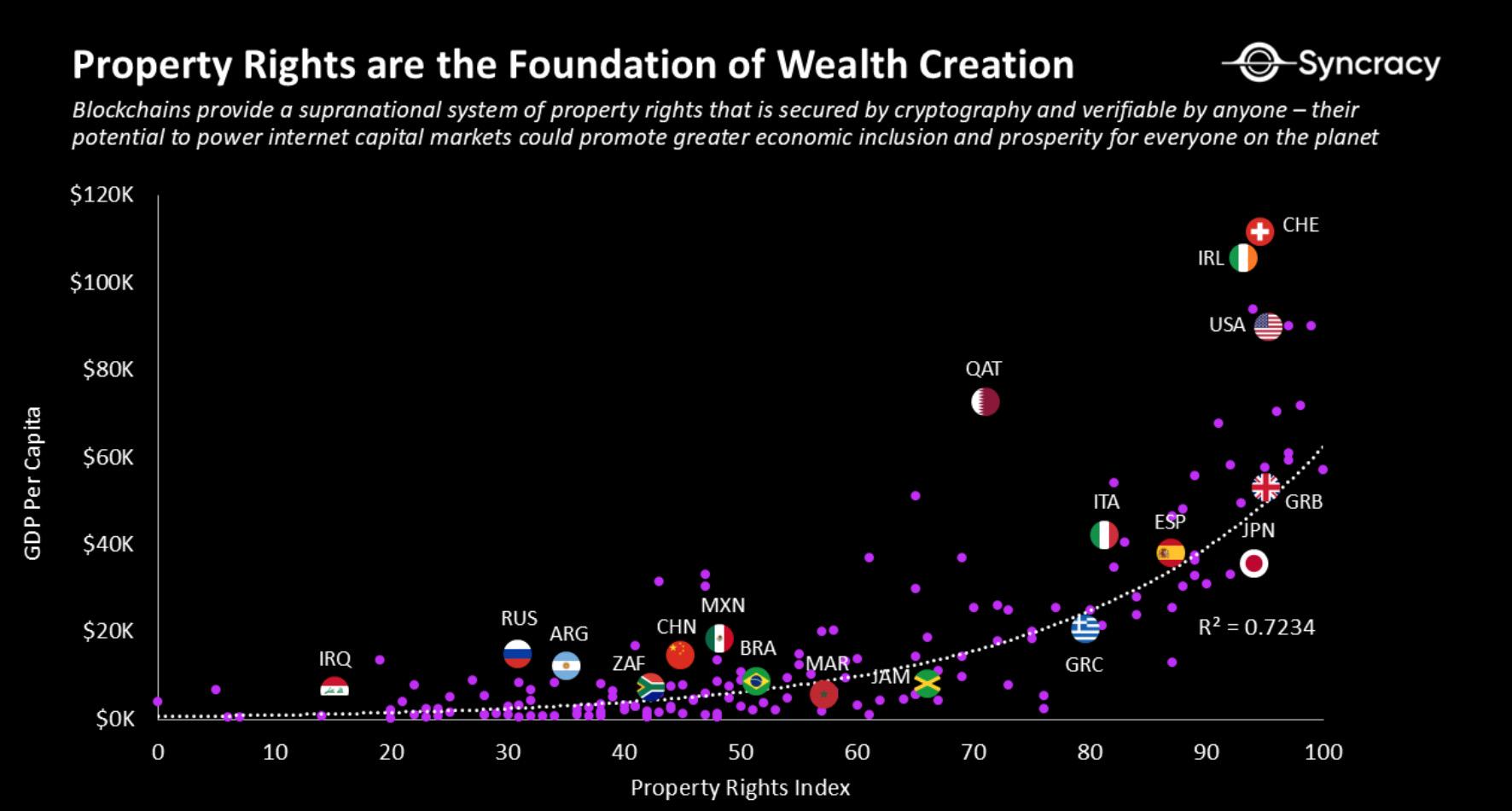
Property rights index; Data source: The Global Economy, IMF
Ronald Coase’s seminal 1937 paper, *The Nature of the Firm*, best illustrates the significance of this shift. Coase argued that firms exist because the costs of finding information, negotiating agreements, and enforcing contracts in the market exceed the efficiency gains of outsourcing.
Blockchain fundamentally changes this equation. By enabling automated execution through cryptography, making information universally accessible, and reducing reliance on intermediaries, blockchain drastically lowers transaction costs—especially when combined with internet-era tools like search engines and gig economy platforms. As transaction costs fall, the need for large hierarchical corporations diminishes, paving the way for blockchain-based global market structures. Such systems can maximize economic output, improve market efficiency, and lay the foundation for entirely new markets.
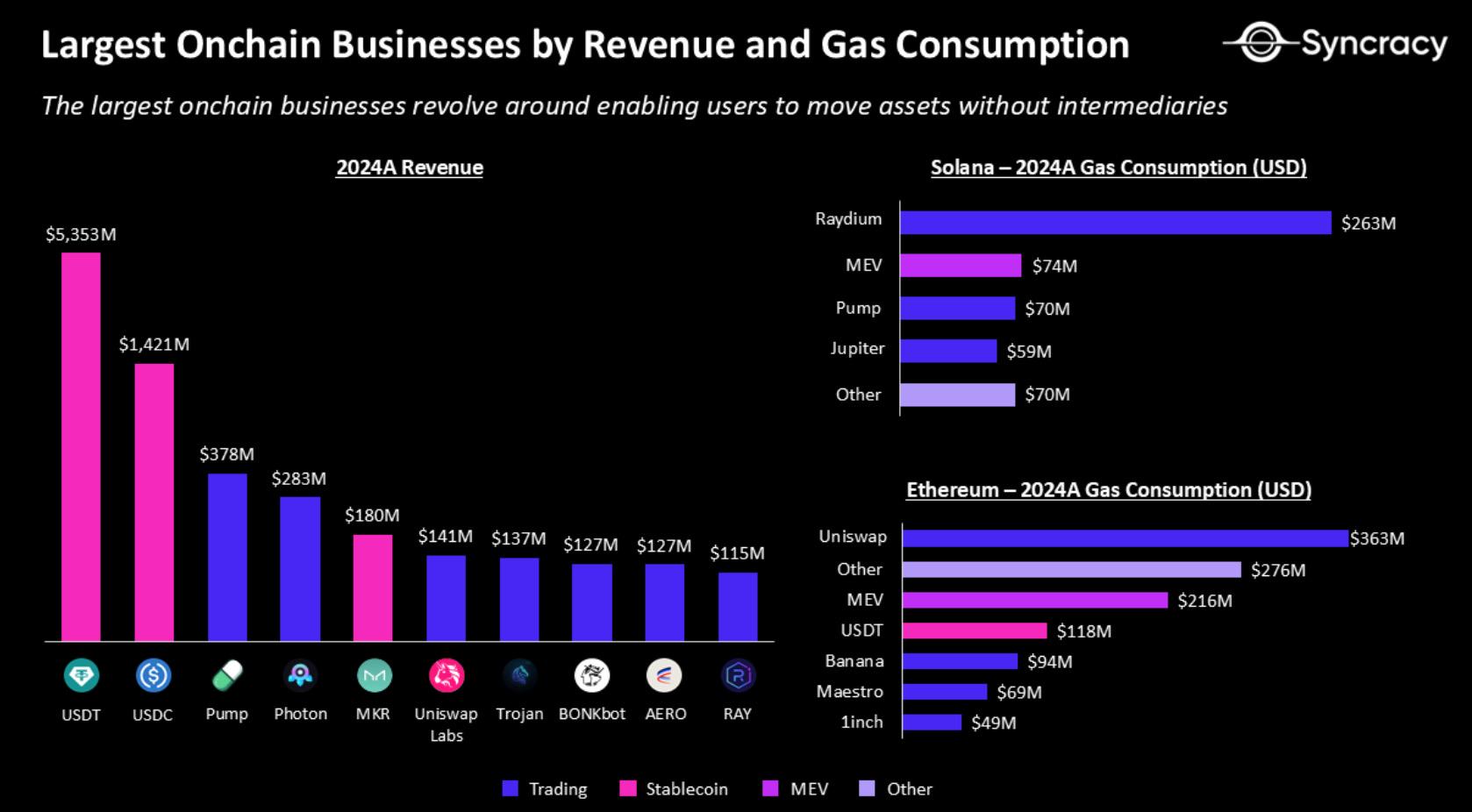
Largest on-chain "businesses" in 2024 by revenue and gas consumption; Data source: DeFiLlama, Artemis, Top Ledger
Crypto-economics has already demonstrated these advantages. Stablecoins promote economic growth and financial inclusion by providing users worldwide with cheap, reliable money; global exchanges and lending platforms create more efficient markets and democratize access to capital markets; DePIN creates entirely new markets, allowing users to coordinate and monetize diverse physical and digital resources. All these use cases operate with exceptional efficiency and software-like profit margins, as blockchain automatically handles most backend infrastructure and settlement processes. Major financial institutions and corporations are slowly recognizing this potential, with many launching products directly on blockchains or integrating blockchain-based projects into existing products as backend infrastructure.
So why does skepticism around crypto-economics persist?
The Overlap of Utility and Uselessness
Creating decentralized infrastructure for transactions and contract execution inevitably triggers unrestricted experimentation. Given that blockchain’s potential user base spans billions of internet users globally, the momentum behind such experimentation is exceptionally strong. Even national leaders are issuing their own currencies. The lure of opportunity causes new assets and financial protocols to proliferate rapidly—some transformative innovations, others outright scams.
While these efforts may appear reckless, they are not so different from the dot-com bubble era, when many companies went public with little more than a domain name. In contrast, crypto-economics amplifies this dynamic to an extreme, offering internet-scale capital markets to anyone. This creates an unprecedented stage for both innovation and speculation, ultimately accelerating discovery and adoption. After all, before trillions of dollars in future value enter blockchain ecosystems, speculation draws in new users and provides much-needed stress testing for the system.
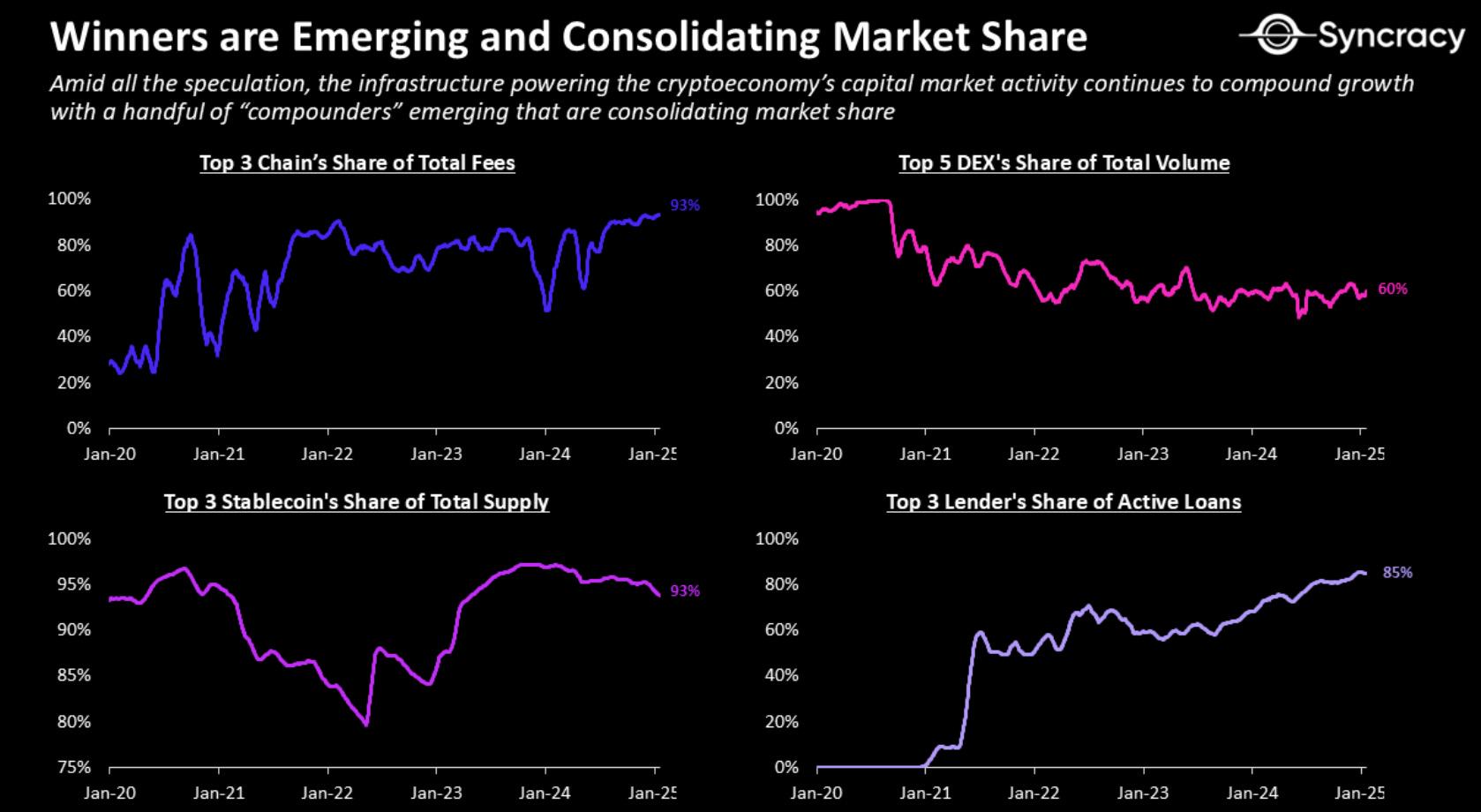
"Winners" are emerging and consolidating market share; Data source: DeFiLlama, Artemis, Token Terminal
Yet amid all the speculation, a few “winners” have begun to stand out. Many projects drive speculative activity in capital markets, topping headlines while achieving compound growth behind the scenes. These “winners” are rare “compounders” that consolidate market share, expand capabilities, and increasingly serve non-speculative use cases over time. Ultimately, these projects will become pillars supporting crypto-economics’ maturation and scaling on a global level.
Will Parallel Paths Converge?
In the foreseeable future, Syncracy believes the best way to articulate the fundamental case for crypto-economics is to identify assets that are both robust and capable of capturing the inherent speculative momentum of internet capital markets. This isn’t esoteric—in practice, it simply means embracing fast-growing projects that people actually use. For now, it also means being long on volume—either directly monetizing on-chain speculation through asset issuers or market platforms (such as exchanges), or investing in underlying infrastructure like L1s. These L1s not only monetize speculation but also offer flexible valuation frameworks, as they are often priced like monetary assets.
In fact, being long on speculation via infrastructure—fast-growing projects that people actually use—has been a common trait among many of the biggest winners in this cycle. Solana delivers top-tier performance, making on-chain trading feel similar to traditional retail trading platforms (like Robinhood); Phantom offers an Apple-like user experience with a mobile-first focus, enabling users to speculate anytime, anywhere like never before; Pump.fun drastically reduces the cost, effort, and resources needed to launch new tokens; Hyperliquid gives on-chain traders a centralized-exchange-like experience at lower cost, with fewer barriers and restrictions; Virtuals and ai16z (Eliza) allow anyone to launch AI agents with associated tokens and wallets; Telegram bots and token discovery tools (like Photon and DexScreener) bring visibility to on-chain economies and make them easily accessible from familiar apps. The list goes on.
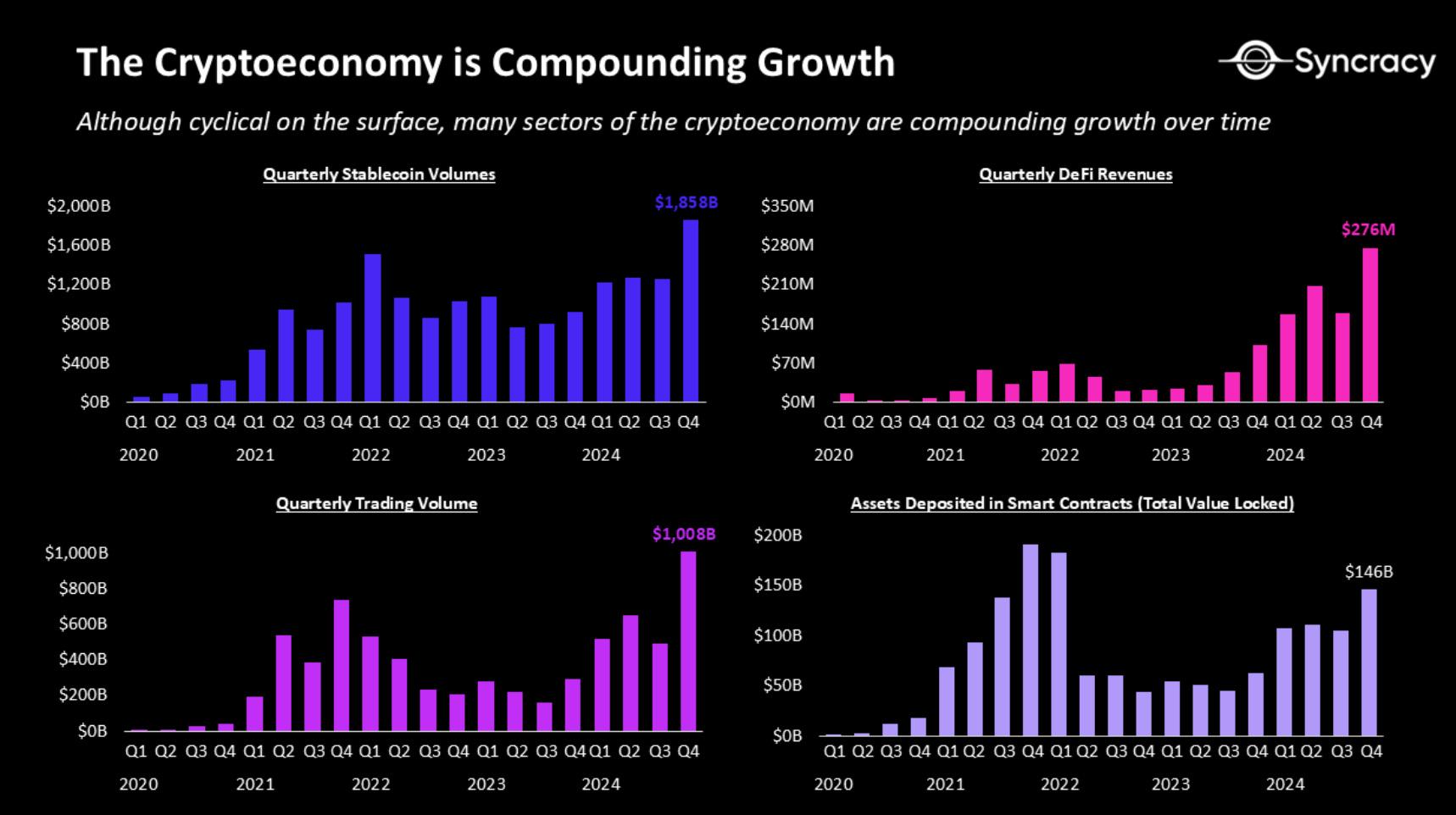
Crypto-economics is experiencing compound growth; Data source: DeFiLlama, Artemis
Eventually, we will move beyond the current model where speculative projects attract disproportionate attention and traffic—especially as more institutional investors enter the space. Meanwhile, many promising projects in DeFi and DePIN that are less speculative are steadily climbing the "slope of enlightenment" (the fourth phase of Gartner’s Hype Cycle, where technological advantages begin to emerge and gain broader understanding). These projects are already showing early signs of product-market fit and improving fundamentals. While these assets may take time to see valuation growth, they urgently require a clear regulatory framework to achieve mainstream adoption. Although certain sectors (like stablecoins) have already charted a path forward and confidently entered the deployment phase of their lifecycle, given the sheer complexity of current crypto-economic activity, observers can still find numerous counterexamples to support their biases.
Nevertheless, from an investment perspective, our current goal is to nurture long-term participants and leverage the dual nature of crypto-economics—harnessing speculative energy to drive financial transformation while increasingly serving real, non-speculative use cases. These assets can generate compounding returns over time, rather than getting caught in the “rotation game” that plagues many more narrative-driven assets in crypto. Ultimately, they will lead the world toward an on-chain future, as the speculation they drive will attract new users and provide critical stress testing before trillions of dollars in value migrate onto blockchains in the coming years.
In truth, uselessness and utility are, like two sides of a coin.
Join TechFlow official community to stay tuned
Telegram:https://t.me/TechFlowDaily
X (Twitter):https://x.com/TechFlowPost
X (Twitter) EN:https://x.com/BlockFlow_News
 @SyncracyCapital











