Lightspark co-founder: Should the U.S. establish a Bitcoin strategic reserve?
TechFlow Selected TechFlow Selected
Lightspark co-founder: Should the U.S. establish a Bitcoin strategic reserve?
Supporters of Bitcoin reserves are not wrong in their view of Bitcoin's potential long-term strategic role; the timing is simply not yet right.
 Navigating Web3 tides with focused insights
Author: Christian Catalini, Co-founder of Lightspark
Translation: Luffy, Foresight News
The United States benefits from what economists call "exorbitant privilege." As the issuer of the world’s reserve currency, the U.S. can borrow in its own currency and support new spending. However, this does not mean the U.S. can print money at will—Treasury debt must still attract buyers in open markets. Fortunately, U.S. Treasuries are widely seen as the safest asset in the world, with strong demand, especially during crises, making them a common safe-haven choice for investors.
Who benefits from this "exorbitant privilege"? First, U.S. policymakers gain extra flexibility in fiscal and monetary decisions. Second, banks at the core of global capital flows earn fees and influence. But the real winners are American companies and multinationals, which operate in their home currency and can issue bonds and borrow more cheaply than foreign competitors. Consumers also benefit, enjoying greater purchasing power, lower borrowing costs, and more affordable loans.
The result? The U.S. can borrow at lower costs, sustain higher deficits over the long term, and withstand economic shocks that might cripple other nations. Yet this "exorbitant privilege" is not guaranteed—it must be earned. It depends on America's economic, financial, and geopolitical strength. Ultimately, the entire system rests on one critical factor: trust. Trust in U.S. institutions, governance, and military power. Most importantly, the belief that the dollar remains the safest place to store global savings.
All of this has direct implications for the Trump administration’s proposed Bitcoin reserve. Supporters of a Bitcoin reserve are not wrong about Bitcoin’s long-term strategic role—they’re just early. The real opportunity today isn’t simply stockpiling Bitcoin, but actively shaping its integration into the global financial system to strengthen, not weaken, U.S. economic leadership. This means leveraging both dollar stablecoins and Bitcoin to ensure the U.S. leads the next era of financial infrastructure.
Before exploring this further, let’s first examine the role of reserve currencies and their issuing nations.
The Rise and Fall of Reserve Currencies
History shows that reserve currencies belong to dominant economic and geopolitical powers. At their peak, these nations set the rules for trade, finance, and military power, giving their currency global credibility and trust. From the 15th-century Portuguese real to the 20th-century dollar, reserve currency issuers have shaped markets and institutions, prompting others to follow.
But no currency dominates forever. Overextension—through war, costly expansion, or unsustainable social commitments—eventually erodes credibility. The Spanish silver dollar, once strong due to vast silver reserves from Latin America, declined as Spain accumulated debt and mismanaged its economy. The Dutch guilder faded as endless wars drained Dutch resources. The French franc, dominant in the 18th and early 19th centuries, weakened under revolution, Napoleonic wars, and financial mismanagement. And the British pound, once the cornerstone of global finance, unraveled under postwar debt burdens and the rise of American industry.
The historical lesson is clear: economic and military power may create a reserve currency, but financial stability and institutional leadership secure its position. Lose those foundations, and the privilege disappears.
Is the Dollar’s Dominance Ending?
The answer depends on your starting point. Whether through the Bretton Woods agreement after WWII—or earlier, when the U.S. became the world’s primary creditor after WWI—the dollar has dominated the global economy for over 80 years. By historical standards, that’s a long time, though not unprecedented; the pound ruled for roughly a century before its decline.
Today, some argue American hegemony is unraveling. China’s rapid advances in AI, robotics, electric vehicles, and advanced manufacturing signal a shift in power. Moreover, China holds significant control over critical minerals essential to shaping the future. Other warning signs emerge. Marc Andreessen, co-founder of a16z, called DeepSeek’s R1 launch a “Sputnik moment for AI” for the U.S.—a wake-up call that American leadership in emerging technologies is no longer assured. Meanwhile, China’s expanding military reach in air, sea, and cyberspace, along with growing economic influence, raises an urgent question: Is the dollar’s dominance under threat?
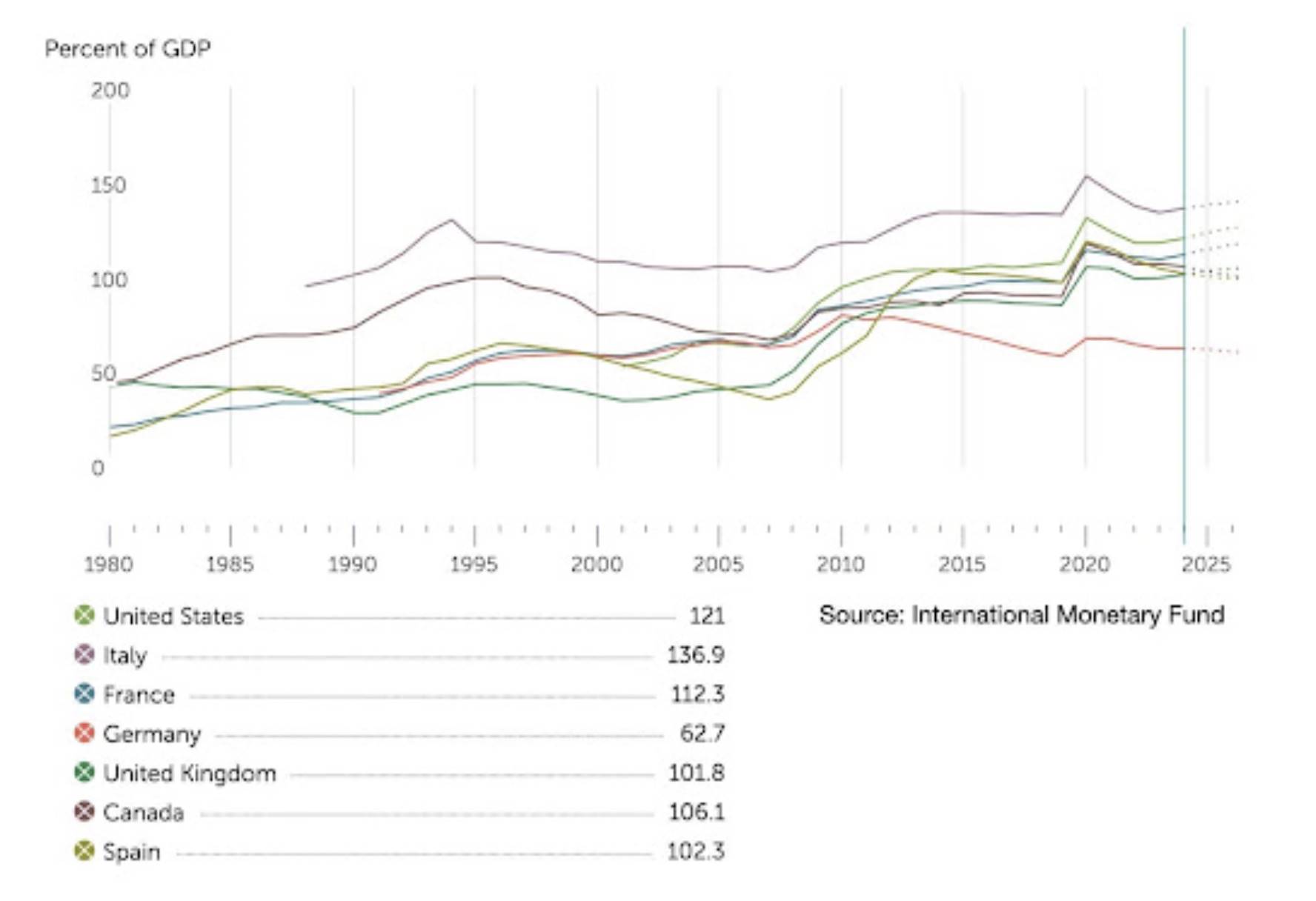
Debt-to-GDP ratio of major economies. Source: International Monetary Fund
The short answer: Not yet. Despite rising debt and misinformation campaigns predicting dollar collapse, the U.S. is not on the brink of fiscal crisis. Yes, debt-to-GDP is high, especially after pandemic-era spending, but it remains comparable to other major economies. More importantly, the vast majority of global trade still occurs in dollars. The yuan is narrowing the gap with the euro in some international settlements, but it’s far from replacing the dollar.
The real issue isn’t whether the dollar will collapse—it won’t. The real concern is whether the U.S. can maintain its lead in innovation and economic strength. If trust in U.S. institutions erodes, or if the U.S. loses competitive edge in key industries, cracks in dollar dominance could begin to show. Those betting against the dollar aren’t just market speculators—they include America’s geopolitical rivals.
This doesn’t mean fiscal discipline is irrelevant. It’s critically important. Reducing spending and improving government efficiency—whether through DOGE or other means—would be a welcome change. Streamlining outdated bureaucracies, removing barriers to entrepreneurship, and promoting innovation and competition would not only cut wasteful public spending but also strengthen the U.S. economy and reinforce the dollar’s position.
Combined with continued breakthroughs in AI, crypto, robotics, biotech, and defense technology, this approach could mirror America’s regulatory and commercialization model for the internet, fueling a new wave of economic growth and ensuring the dollar remains the world’s undisputed reserve currency.
Can a Bitcoin Reserve Strengthen U.S. Financial Leadership?
This brings us to the idea of a strategic Bitcoin reserve. Unlike traditional reserve assets, Bitcoin lacks historical backing from state institutions or geopolitical power—but that’s precisely the point. It represents a new paradigm: no national backing, no single point of failure, fully global and politically neutral. Bitcoin offers an alternative that operates outside the constraints of traditional financial systems.
While many see Bitcoin as a computer science breakthrough, its true innovation runs deeper: it redefines how economic activity is coordinated and how value is transferred across borders. As a decentralized, trustless system (with its anonymous creator exerting no control), the Bitcoin blockchain serves as a neutral, universal ledger—a standalone framework for recording global credit and debt without relying on central banks, financial institutions, political alliances, or intermediaries. This makes it not just a technological advancement, but a structural shift in global financial coordination.
This neutrality gives Bitcoin unique resilience against debt crises and political entanglements that have historically undermined fiat systems. Unlike traditional monetary systems deeply tied to national policies and geopolitical shifts, Bitcoin operates independently of any single government. This also gives it potential as a common economic language between nations that resist financial integration or reject unified ledger systems. For example, the U.S. and China are unlikely to trust each other’s payment channels, especially as financial sanctions become potent tools of economic warfare.
So how will these fragmented systems interact? Bitcoin could become the bridge: a globally accessible settlement layer requiring minimal trust, connecting otherwise competing economic spheres. When this vision materializes, a U.S. strategic Bitcoin reserve would clearly make sense.
But we’re not there yet. For Bitcoin to move beyond being an investment asset, critical infrastructure must be developed—to ensure scalability, establish modern compliance frameworks, and provide seamless fiat on-ramps for mainstream adoption.
Supporters of a Bitcoin reserve aren’t wrong about its potential long-term strategic role—they’re just early. Let’s explain why.
Why Do Nations Hold Strategic Reserves?
Nations hold strategic reserves for a simple reason: during crises, access matters more than price. Oil is a classic example—while futures markets allow price hedging, no financial instrument can replace physical oil when supply chains are disrupted by war, geopolitics, or other shocks.
The same logic applies to other essentials like natural gas, food, medical supplies, and increasingly, critical raw materials. As the world transitions to battery-driven technologies, governments are already stockpiling lithium, nickel, cobalt, and manganese to prepare for future shortages.
Currency works similarly. Nations with large foreign debts hold dollar reserves to roll over debt and guard against currency crises. But here’s the key difference: no country currently carries significant Bitcoin-denominated debt—at least not yet.
Bitcoin advocates argue that its long-term price trajectory clearly marks it as a reserve asset. If the U.S. buys now, the investment could multiply in value as adoption grows. But this approach aligns more with sovereign wealth fund strategies focused on capital returns, rather than reserve strategies vital to national security. It suits resource-rich but economically imbalanced nations seeking asymmetric financial gains, or countries with weak central banks hoping Bitcoin stabilizes their balance sheets.
What about the U.S.? It doesn’t currently need Bitcoin to keep its economy running. And although President Trump recently announced a sovereign wealth fund, crypto investments may be better left to private markets for efficient allocation. The strongest case for holding a Bitcoin reserve isn’t economic necessity, but strategic positioning. Owning reserves signals that the U.S. is decisively betting on leading the crypto space, establishing clear regulation, and positioning itself as the global hub for decentralized finance (DeFi)—just as it has dominated traditional finance for decades. Yet at this stage, the costs may outweigh the benefits.
Why a Bitcoin Reserve Could Backfire
Beyond logistical challenges of acquiring and securing Bitcoin reserves, the bigger issue is perception—and the cost could be high. In the worst case, it could signal a lack of confidence in the U.S. government’s ability to manage its debt, a strategic blunder that would give geopolitical rivals like Russia and China an advantage—both of which have long sought to undermine the dollar.
Russia promotes de-dollarization abroad while its official media for years has spread narratives questioning dollar stability and predicting its imminent collapse. Meanwhile, China takes a more direct approach, expanding the yuan’s influence and digital payment infrastructure—including the domestic-focused digital yuan—to challenge the U.S.-led financial system, especially in cross-border trade and payments. In global finance, perception is crucial. Expectations don’t just reflect reality—they shape it.
If the U.S. government begins accumulating Bitcoin at scale, markets might interpret it as a hedge against the dollar itself. That perception alone could prompt investors to sell dollars or reconfigure capital, weakening the dollar’s status. In global finance, beliefs drive behavior. If enough investors start doubting dollar stability, their collective actions could turn that doubt into reality.
U.S. monetary policy relies on the Federal Reserve’s ability to manage interest rates and inflation. Holding a Bitcoin reserve could send mixed signals: if the government is confident in its own economic tools, why hold an asset outside the Fed’s control?
Would a Bitcoin reserve alone trigger a dollar crisis? Extremely unlikely. But it also might not strengthen the existing system. In geopolitics and finance, unnecessary mistakes often carry the highest cost.
Strategic Leadership, Not Speculation
The best way for the U.S. to reduce its debt-to-GDP ratio isn’t speculation, but fiscal discipline and economic growth. History shows: reserve currencies don’t last forever, and those that decline often do so due to poor economic management and overreach. To avoid repeating the fates of the Spanish silver dollar, Dutch guilder, French livre, and British pound, the U.S. must focus on sustainable economic strength—not risky financial gambles.
If Bitcoin becomes the global reserve currency, the U.S. stands to lose the most. There would be no smooth transition from dollar dominance to a Bitcoin-based system. Some argue Bitcoin’s appreciation could help the U.S. “pay off” its debt, but reality would be far harsher. Such a shift would make it harder for the U.S. to finance its debt and maintain economic influence.
While many believe Bitcoin will never become a true medium of exchange or unit of account, history suggests otherwise. Gold and silver were valuable not just because they were scarce, but because they were divisible, durable, and portable—making them effective money, much like Bitcoin today. Similarly, China’s early paper money didn’t emerge as a government-mandated medium of exchange. It evolved from commercial bills and deposit receipts representing trusted stores of value, only later gaining broader acceptance as a medium of exchange.
Fiat currency is often seen as an exception—declared legal tender by government, it immediately functions as a medium of exchange, then later as a store of value. But this oversimplifies reality. What gives fiat its power isn’t just law, but the government’s ability to enforce tax collection and use that power to fulfill debt obligations. Currencies backed by states with strong tax bases have intrinsic demand, as businesses and individuals need them to settle debts. This taxing power allows fiat to hold value even without direct commodity backing.
Yet even fiat systems aren’t built from nothing. Historically, their credibility stemmed from commodities people already trusted—most notably gold. Paper money was accepted because it was once redeemable for gold or silver. The shift to pure fiat came only after decades of reinforced trust.
Bitcoin is following a similar trajectory. Today, it’s largely seen as a store of value—volatile, but increasingly viewed as “digital gold.” But as adoption grows and financial infrastructure matures, its role as a medium of exchange may naturally follow. History shows that once an asset is widely recognized as a reliable store of value, the transition to functional money is a natural progression.
For the U.S., this presents a major challenge. While there are policy levers, Bitcoin largely escapes traditional national control over money. If it gains recognition as a global medium of exchange, the U.S. will face a stark reality: reserve currency status cannot be easily relinquished.
This doesn’t mean the U.S. should resist or ignore Bitcoin—in fact, it should actively engage and shape Bitcoin’s role in the financial system. But simply buying and holding Bitcoin for price appreciation isn’t the answer. The real opportunity is greater, yet more challenging: driving Bitcoin’s integration into the global financial system in a way that strengthens U.S. economic leadership.
American Platform Strategy for Bitcoin
Bitcoin is the most mature cryptocurrency, unmatched in security and decentralization. This makes it the strongest candidate for mainstream adoption—first as a store of value, eventually as a medium of exchange.
To many, Bitcoin’s appeal lies in its decentralized nature and scarcity, factors that drive price appreciation as adoption accelerates. But this is a narrow view. While Bitcoin will continue to appreciate during adoption, the U.S.’s true long-term opportunity isn’t just holding it—but actively guiding its integration into the global financial system and establishing itself as the international hub for Bitcoin finance.
For every nation except the U.S., simply buying and holding Bitcoin is a perfectly viable strategy—one that accelerates adoption and yields financial returns. But the stakes for the U.S. are far more complex, demanding a more comprehensive approach. It needs a different strategy—not only to preserve its role as issuer of the world’s reserve currency, but to drive massive financial innovation with the dollar as a “platform.”
The key precedent here is the internet, which transformed the economy by shifting information exchange from proprietary to open networks. Today, the U.S. government faces a choice similar to pre-internet corporations, as financial rails shift toward more open and decentralized infrastructure. Just as companies embracing open internet architecture thrived while resisters faded, the U.S.’s stance on this shift will determine whether it maintains global financial influence or cedes ground to others.
The first pillar of a more ambitious, forward-looking strategy is to treat Bitcoin as a network, not just an asset. As open, permissionless networks enable new financial infrastructure, existing players must be willing to relinquish some control. Yet by doing so, the U.S. can unlock major new opportunities. History shows that nations adapting to disruptive technologies strengthen their position, while those resisting ultimately fail.
The second key pillar, complementary to Bitcoin, is accelerating the adoption of dollar stablecoins. With proper regulation, stablecoins can strengthen public-private partnerships—a relationship that has underpinned U.S. financial dominance for over a century. Stablecoins don’t weaken dollar hegemony; they reinforce it, expanding the dollar’s reach, enhancing its utility, and ensuring its relevance in the digital economy. Moreover, compared to slow, bureaucratic central bank digital currencies or vaguely defined unified ledgers like the BIS “financial internet,” stablecoins offer a more flexible and agile solution.
Not every nation will want to adopt dollar stablecoins or operate fully within U.S. regulatory frameworks. This is where Bitcoin plays a crucial strategic role—acting as a bridge between the core dollar platform and non-geopolitical ally economies. In this scenario, Bitcoin serves as a neutral network and asset, facilitating capital flows while reinforcing America’s centrality in global finance, preventing the U.S. from ceding ground to rival currencies like the yuan.
If the U.S. successfully executes this strategy, it will become the center of Bitcoin financial activity, gaining greater influence to shape these capital flows according to American interests and principles.
This is a subtle but feasible strategy. If implemented effectively, it could extend the dollar’s influence for decades. Rather than simply stockpiling Bitcoin—which might imply doubts about dollar stability—the U.S. can strategically integrate Bitcoin into the financial system, driving dollar and dollar stablecoin adoption on the network, positioning the government as an active steward, not a passive observer.
What’s the payoff? A more open financial infrastructure, while the U.S. still controls the “killer app”—the dollar. This approach mirrors companies like Meta and DeepSeek, which set industry standards by open-sourcing AI models while monetizing elsewhere. For the U.S., it means expanding the dollar platform and making it interoperable with Bitcoin, ensuring the dollar remains relevant in a future where crypto plays a central role.
Of course, like any response to disruptive change, this strategy carries risks. But the cost of resisting innovation is irrelevance. If any administration can pull this off, it’s this one—with deep expertise in platform competition and a clear understanding that maintaining leadership isn’t about controlling the entire ecosystem, but about capturing value within it.
Join TechFlow official community to stay tuned
Telegram:https://t.me/TechFlowDaily
X (Twitter):https://x.com/TechFlowPost
X (Twitter) EN:https://x.com/BlockFlow_News
 a16z
a16z