








Crypto Marketing 101 Lesson 1: How to Write a Good Narrative
TechFlow Selected TechFlow Selected
Crypto Marketing 101 Lesson 1: How to Write a Good Narrative
Suitable for all companies, IPs, and individuals, including but not limited to the crypto field.
 Navigating Web3 tides with focused insights
First Shift Your Mindset: Drop Thoughts of Product and Technological Innovation, and Pick Up Only the Hammer of "Narrative"
From a crypto marketing perspective, we have a hammer called narrative. Now, see every project as a nail. Put aside all thoughts of technological innovation and product capability—we only talk about storytelling (narrative).
You can roughly understand the entire crypto industry as a consumer goods industry (especially new consumption), an industry entirely driven by sales. Brands like Perfect Diary and Six Doctors didn't have groundbreaking product innovations (just like most crypto projects lack real technological breakthroughs); they're sales-driven brands born from innovations in new sales channels.
Korean exchanges and Korean retail investors represent this cycle's innovation in crypto distribution channels
Say it three times,
marketing is selling products, KOLs are live-streaming sales hosts
marketing is selling products, KOLs are live-streaming sales hosts
marketing is selling products, KOLs are live-streaming sales hosts
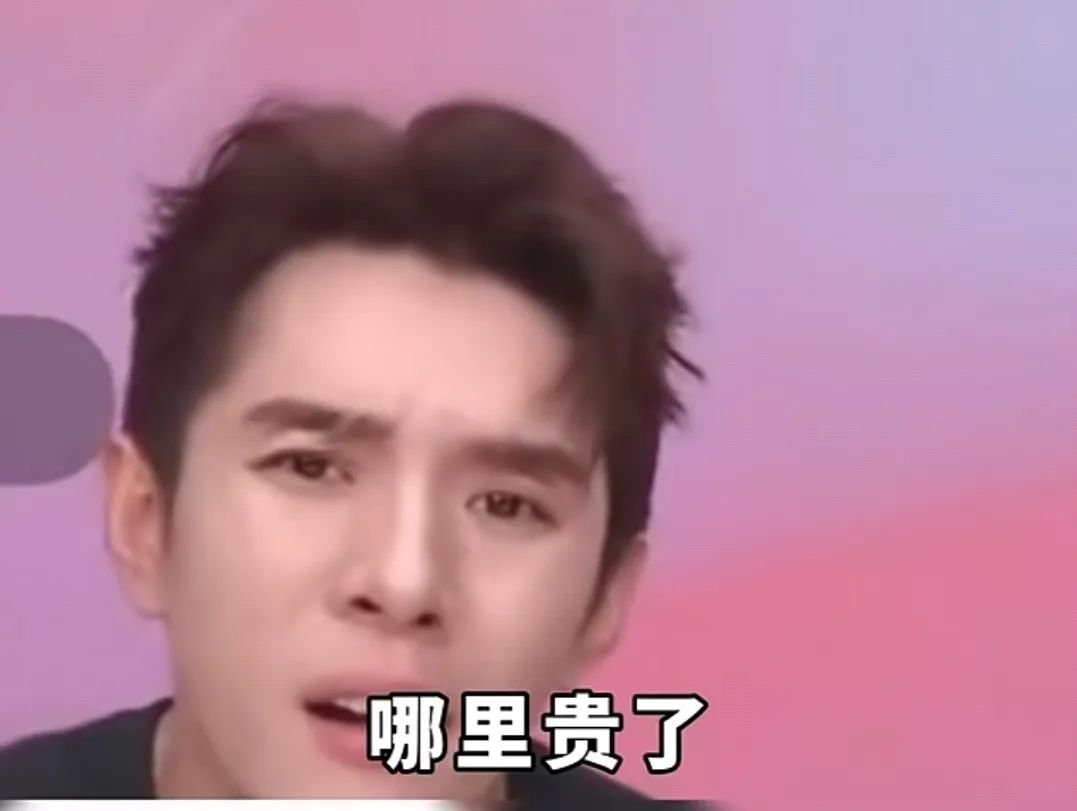
Bro, I'm offering you this coin at just $100 million FDV—where's the high price?
As a project team, your revenue comes from traffic * conversion rate
-
Traffic means how many channels (media, KOLs, etc.) write content for you and how much attention you gain
-
Conversion rate means whether people find your content interesting after reading it, whether they glance or read thoroughly, and whether they ultimately buy into your story and how much they spend.
Today we'll only discuss "how to tell a good story." Most project teams already have their products and know what they're doing, but fail to articulate their grand vision effectively. They often limit their own ambition when crafting narratives or end up telling clichéd, boring stories that neither VCs, exchanges, nor retail investors will buy.
Let's take Sign as an example—it's the hottest project recently
For project teams unsure how to craft a narrative, start from your product—you surely know what you’re building.
Let’s break down Sign’s products in plain language:
-
EthSign - On-chain contract signing with 2 million users who've signed 1.5 million contracts; aims to become the protocol for humans and AI agents to sign agreements
-
TokenTable, a token distribution platform—the Goldman Sachs of crypto, combining brokerage and investment banking services. Total revenue: $15 million USD.
-
Sign Pass, an identity system—a global passport including residency like Sierra Leone PR and UAE Golden Visa
-
Sign Protocol, the infrastructure powering the above three products
We first fed these details into my previously trained GPT model designed to help write narratives (though DeepSeek might work better now). Emphasize to GPT that the target audience is global VCs and old money (so it generates a larger vision)
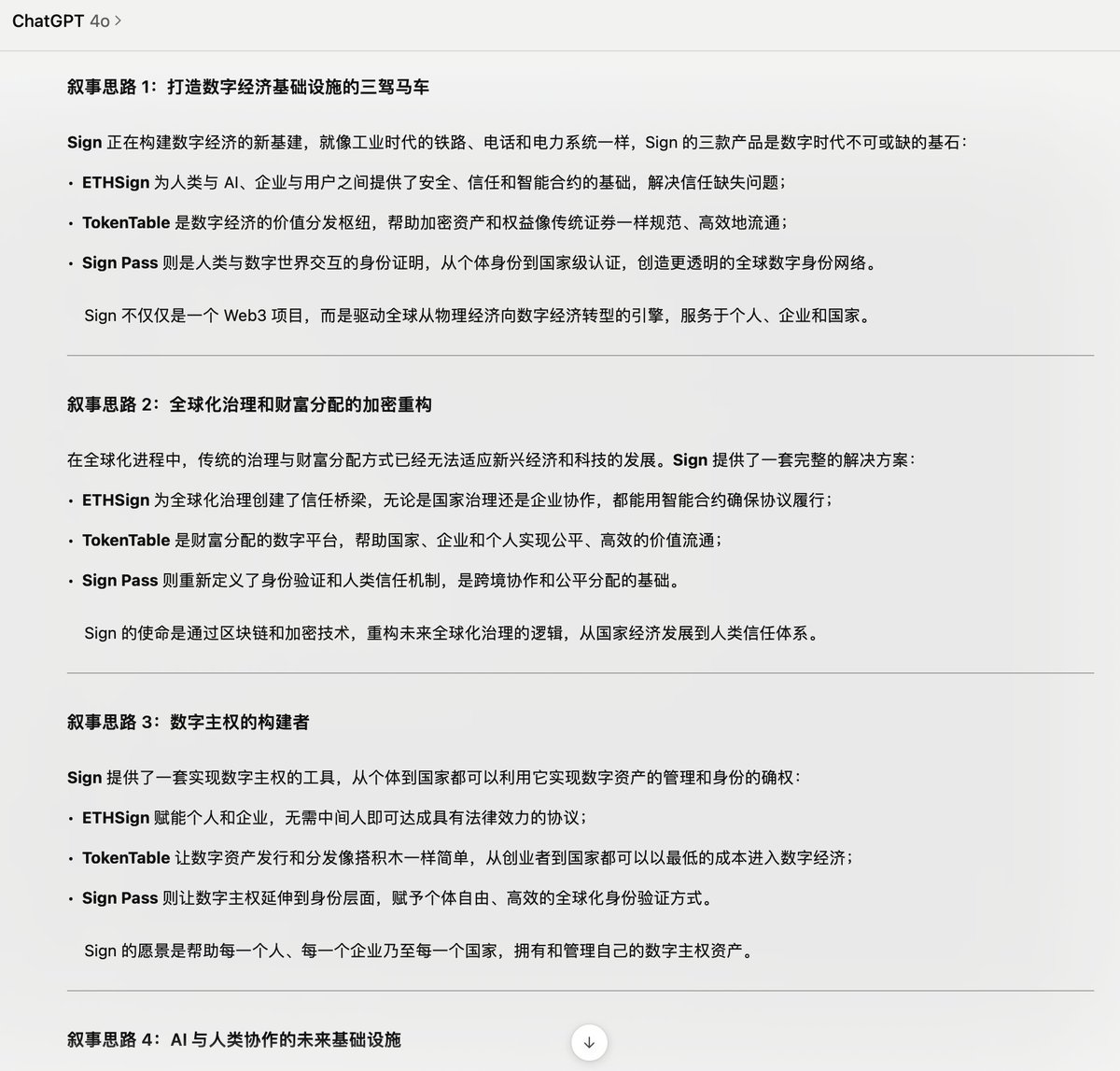
Above is GPT's initial response—at least we now have a general direction and some preliminary inspiration. But this is still far from sufficient and too scattered.
The best narrative is simple, big, and ideally carries some philosophical depth—this is how valuations shift from P/E to P/Dream.
Previous examples like Sonic had two strong narratives:
-
Solana Layer2—everyone knows what a layer2 is, everyone knows layer2s command high FDVs, no extra explanation needed,对标 OP
-
TikTok chain—too straightforward, doesn't even need explaining.对标 TON
Sonic’s narrative scores 90/100. The missing 10 points lie in philosophical depth. To achieve that final 10%, you need narrative aesthetic taste.
Let’s study one of my favorite narratives. This is Notion’s 2013 pitch deck.
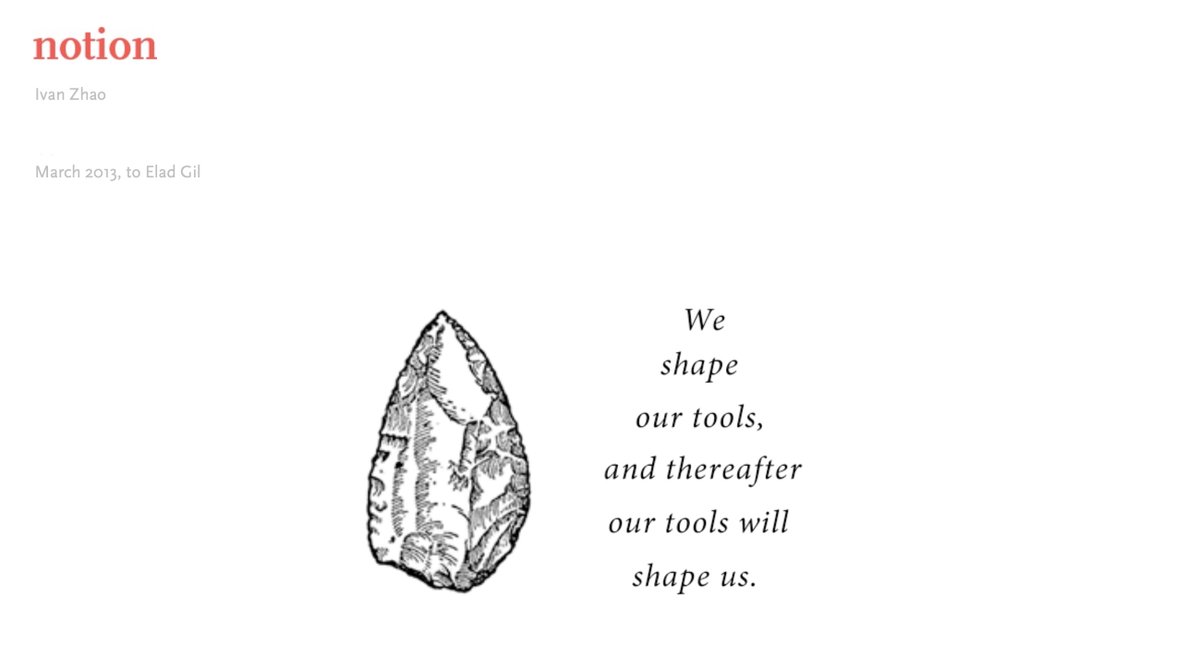
"We Shape our tools, and thereafter our tools will shape us"
This represents top-tier narrative aesthetics—simple, profound, and on-point.
It's nearly impossible to convey the beauty of the English phrase in Chinese. A rough translation would be:
"We shape our tools, and thereafter our tools will shape us"
Notion has countless keywords, but it picked just one—this is narrative "subtraction."
Notion could have chosen from efficiency, tools, inspiration, collaboration, creativity, and many others—but selected only "tools."
Narrative requires subtraction—less is more. When people think of you, they should recall only one positioning point; they won’t remember long, detailed explanations.
How do we implement this practically? Let's return to Sign. We directly asked ChatGPT—we hadn’t yet decided which keyword to assign to Sign. It could have been contracts, trust, signatures, collaboration, distribution, fairness, and many others.
We let GPT brainstorm freely.
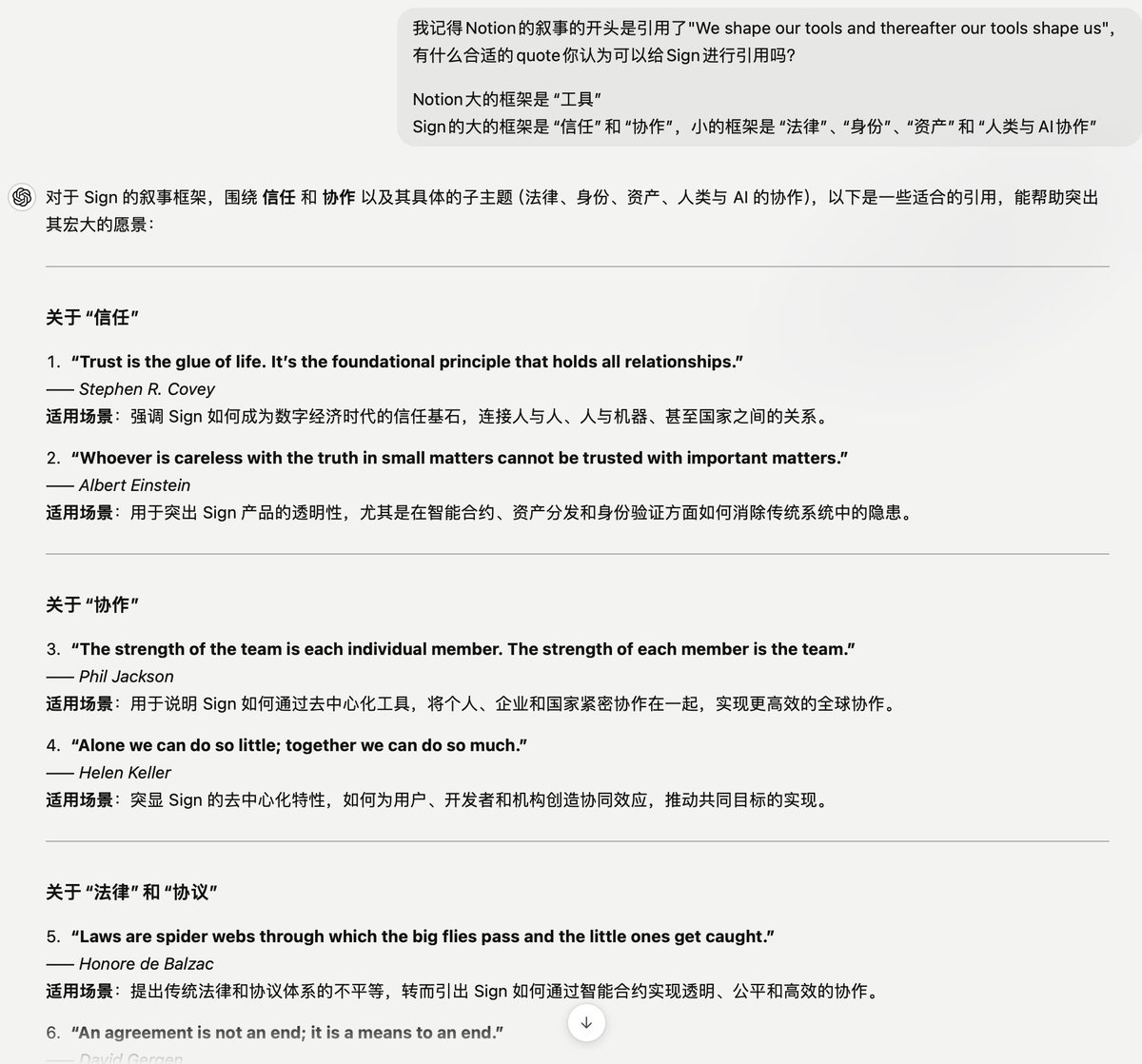
This time GPT’s output was too abstract, failing to identify Sign’s true keyword. The content wasn’t grounded or practical enough, too narrow. Let’s add more context.
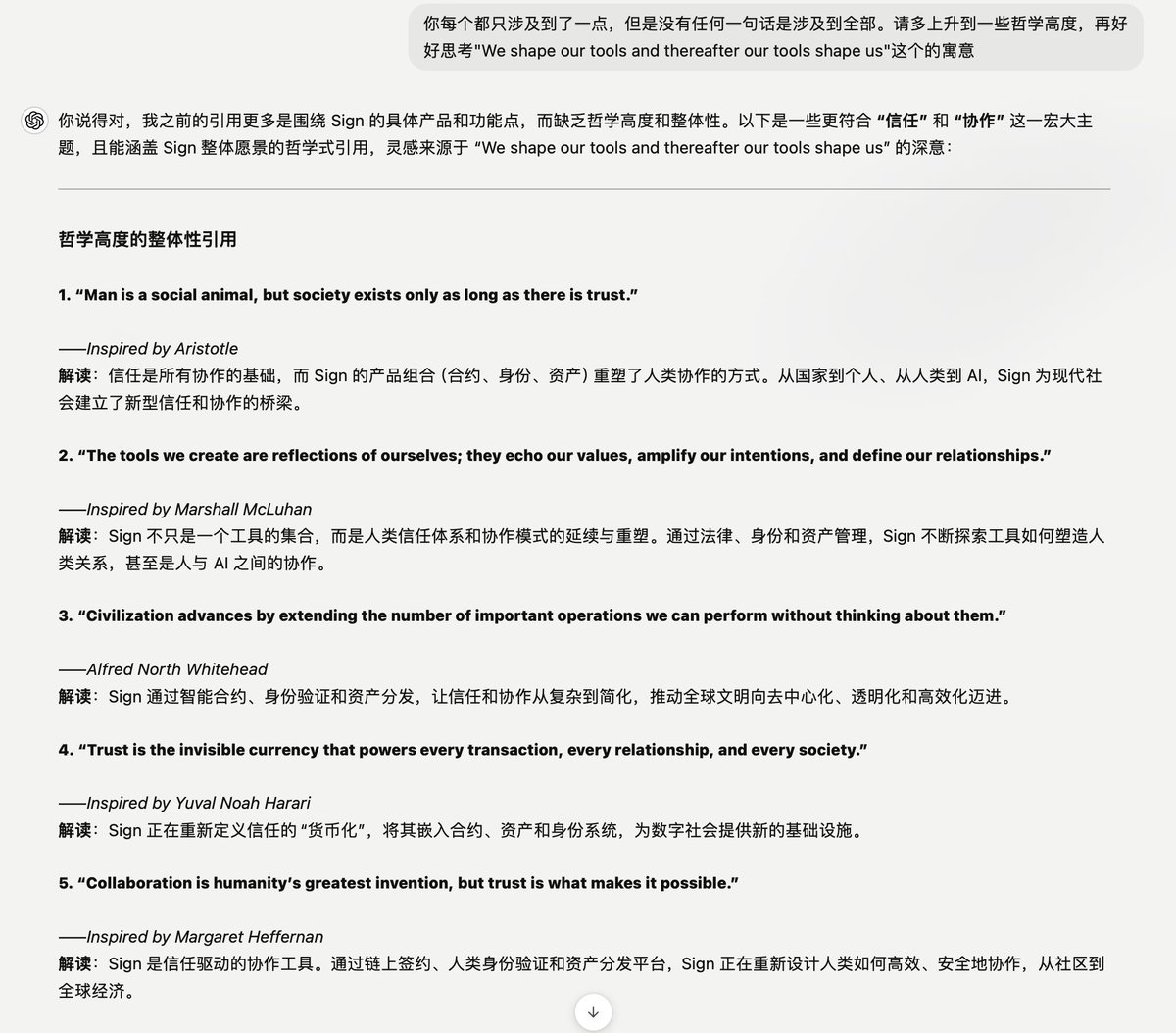
This round produced much better results. Among them, we caught this sentence:
"Trust is the invisible currency that powers every transaction, every relationship, and every society."
——Inspired by Yuval Noah Harari
Interpretation: Sign is redefining the "monetization" of trust, embedding it into contracts, assets, and identity systems, providing new infrastructure for digital society.
Why choose this sentence?
-
Highlights the keyword: monetizing trust. This is a civilization-level narrative—big enough and impressive-sounding
-
Follow-up keywords are transaction, relationship, society—exactly what Sign and the blockchain industry are building: various transactions, relationships, and societies—thus highly relevant
-
The quote draws from Yuval Noah Harari, author of Sapiens and Homo Deus—highly influential and widely recognized in tech philosophy circles. He's more sophisticated than popular fiction writers and more impactful than obscure academics—an ideal reference.
With this high-level philosophical starting point, the next step is aligning Sign’s business with Harari’s grand vision. We continued asking GPT.
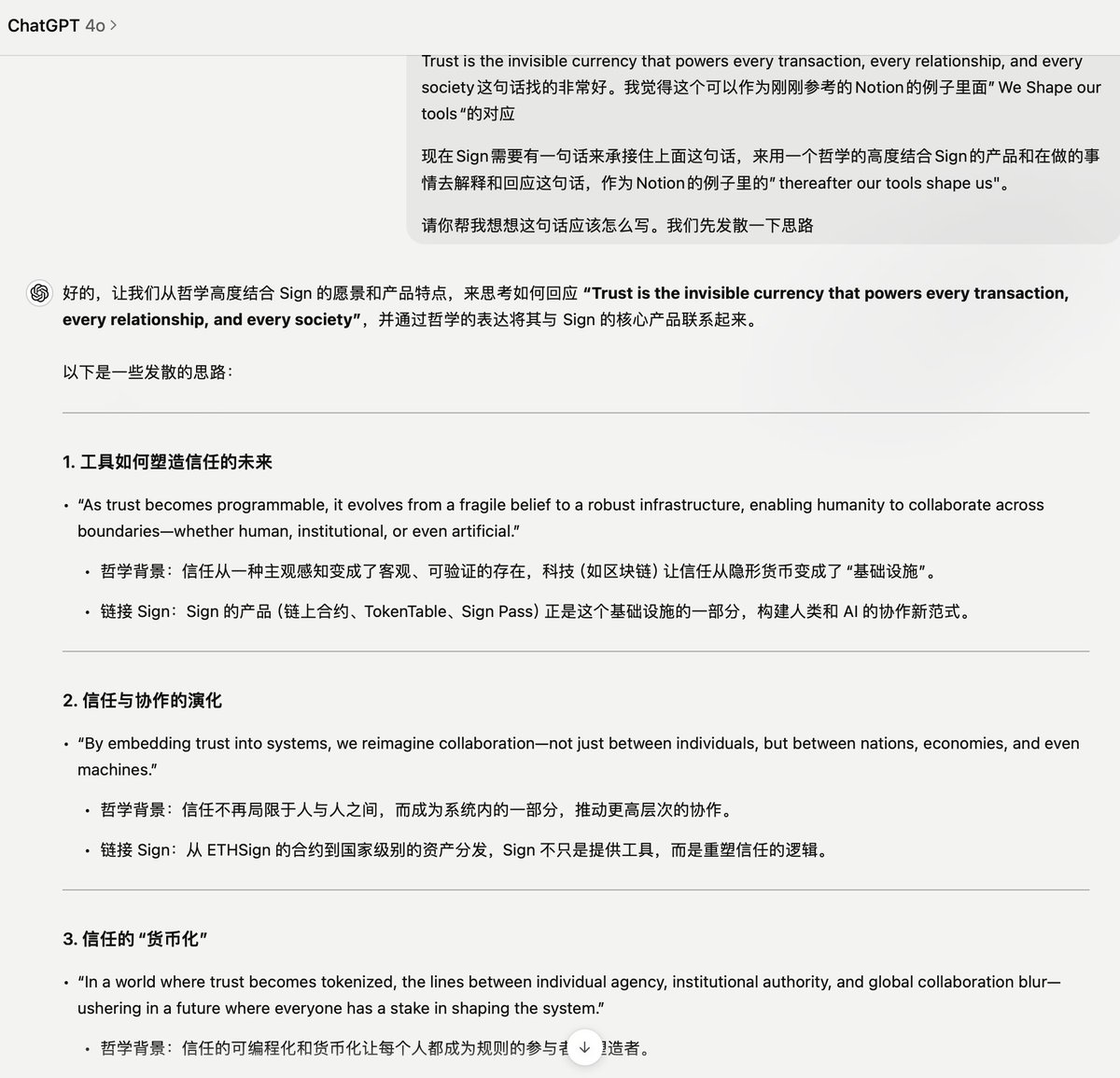
Its third point was solid, capturing the overarching theme of "trust." This topic is large, simple, and perfectly aligned with what Sign does. With direction set, we prompted GPT to brainstorm further for additional inspiration.
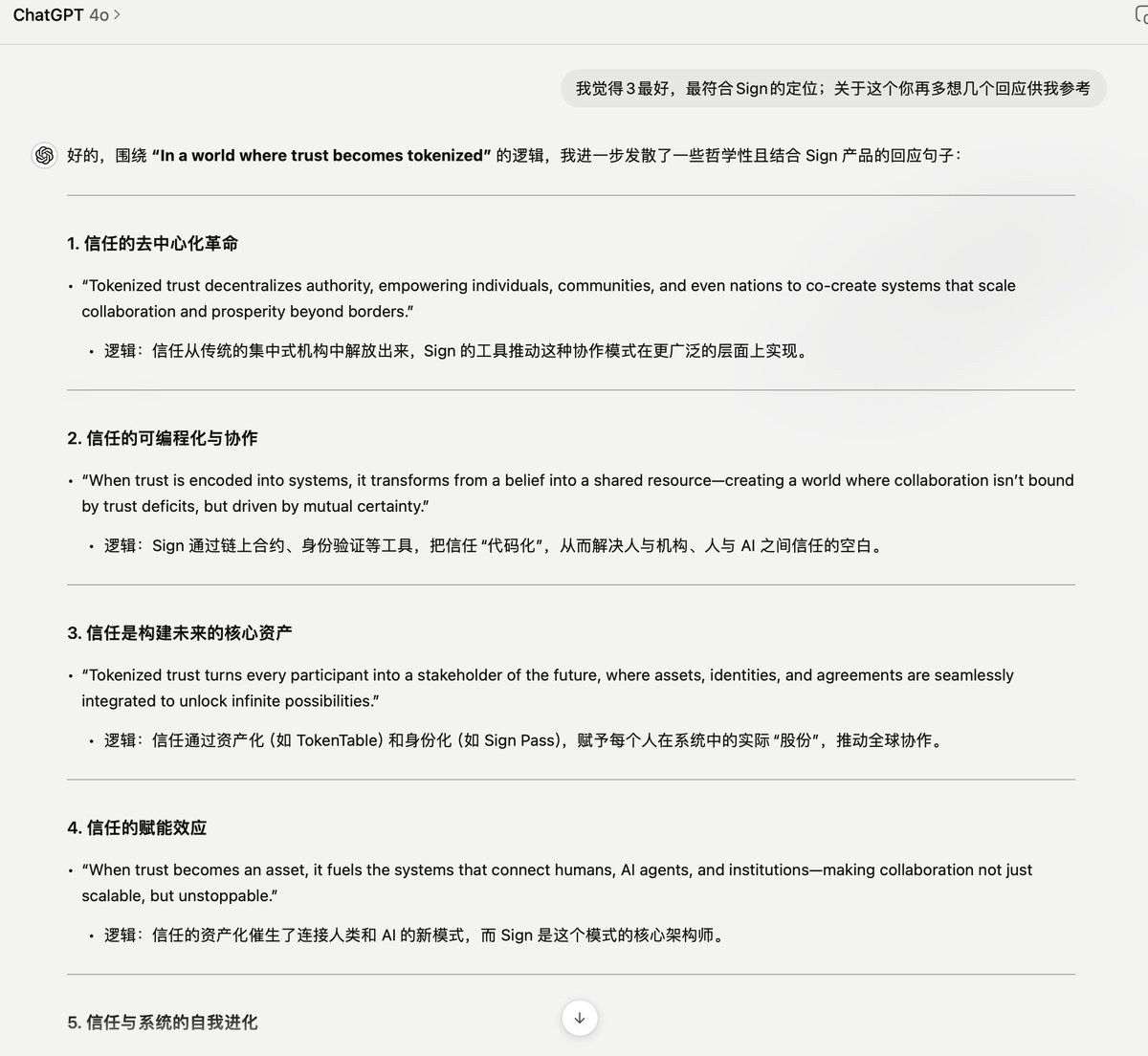
This time GPT offered several stale dead-ends like "decentralized revolution" and "empowerment effect," but the idea of "programmability" planted a seed we'd later use.
Then we instructed GPT to specifically align with Harari’s quote and see what it generated:
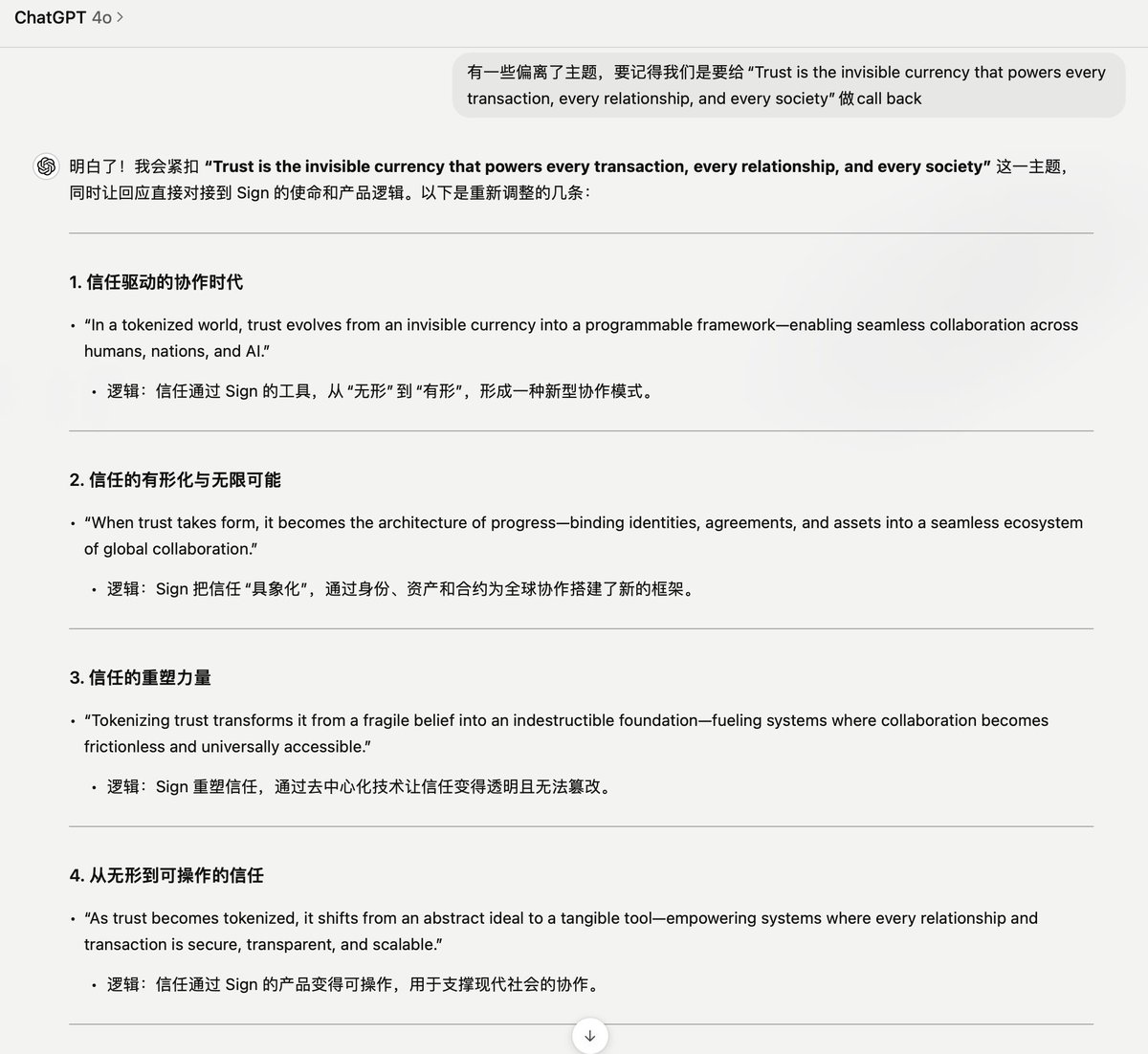
This round yielded many satisfactory responses—stories with both substance and tone. The first one was most suitable, requiring only slight refinement:
In a tokenized world, blockchain provides the trust foundation for human society, transforming trust from an invisible currency into a programmable framework, and Sign sets the standard for this new era of seamless collaboration across humans, nations, and AI.
After finalizing these two segments, we still needed a simple, powerful slogan to reinforce the message.
Using GPT's frameworks and the earlier hint about programmability, Potter had an Aha Moment.
And came up with the slogan:
SIGN MAKES TRUST PROGRAMMABLE.
(Human-AI collaboration converges here—coincidentally, Sign is also the first tool for humans and AI to sign agreements)
This slogan echoes the overarching theme while clarifying exactly how Sign executes. Potter and I celebrated with a high-five, then went downstairs to smoke Yuxi cigarettes.
Final result shown below (though not the ultimate version):
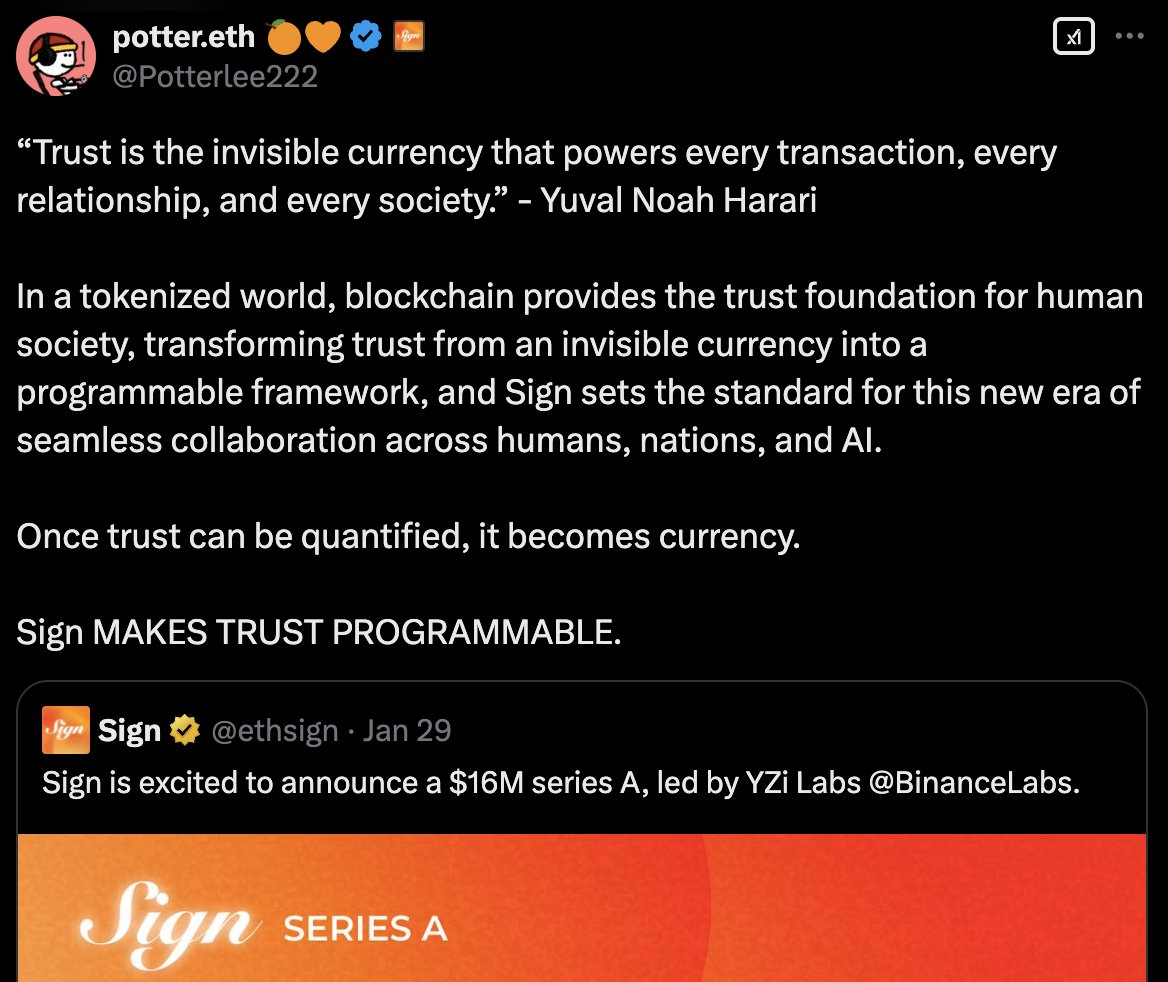
Let me translate it for you:
"Trust is the invisible currency that powers every transaction, every relationship, and every society."
- Yuval Noah Harari
In a tokenized world, blockchain provides the trust foundation for human society, transforming trust from an invisible currency into a programmable framework, and Sign sets the standard for this new era of seamless collaboration across humans, nations, and AI.
Once trust becomes quantifiable, it becomes currency.
Sign makes trust programmable.
While not as impactful as Notion’s line, it’s good enough—scoring 80 to 90 out of 100.
This only covers the vision section—just two short paragraphs.
A stronger blurb/one-pager should also include:
-
Why Now
-
Our Unique Position
-
Product
-
Traction
-
Fundraising & Revenue & Partnership
-
Team
Adding a few personal notes,
The Crypto Marketing 101 series was inspired by Sanpan Jiaozhu (Master of Three Platters) Mi Jia Wei Tuo. Thank you for consistently sharing valuable insights that greatly inspired me.
In 2024, I helped dozens of projects large and small with marketing strategy, starting with portfolios from my firm and later through word-of-mouth referrals from those who appreciated my work.
Marketing is far more than just hiring a few KOLs—most agencies now realize this. From obscurity to modest success (1 project listed on Binance, 2 on OKX + Upbit, countless Tier 2 listings, plus many memecoins exceeding $100M), a year of reading, networking, attending events, and burning midnight oil has brought me to what I consider a passable level—but I’ll keep striving for excellence.
Crypto Marketing 101 will continue updating, always open-source, preserving crypto spirit even amid markets ruled by scythes.
Feel free to DM me if you need help, and welcome to request Mango Labs materials.
I’m happy to assist, but free-riding isn’t acceptable.
Happy New Year, and best wishes for a successful start.
Join TechFlow official community to stay tuned
Telegram:https://t.me/TechFlowDaily
X (Twitter):https://x.com/TechFlowPost
X (Twitter) EN:https://x.com/BlockFlow_News
 @dov_wo






