








PolyFlow PayFi Use Case: Optimizing Supply Chain Finance through Blockchain
TechFlow Selected TechFlow Selected
PolyFlow PayFi Use Case: Optimizing Supply Chain Finance through Blockchain
This article aims to analyze financing needs in global trade supply chains and explore how blockchain and tokenization technologies can address these challenges.
 Navigating Web3 tides with focused insights
Global trade is a key driver of the modern economy, propelling globalization and technological advancement. Standard Chartered Bank predicts that global trade will grow by 55% over the next decade, reaching $32.6 trillion by 2030. However, there remains a significant gap in the availability of trade finance, particularly for small and medium-sized enterprises (SMEs) in developing countries.
This article aims to analyze financing needs within global trade supply chains and explore how blockchain and tokenization technologies can address these challenges. By examining the real-world application of PolyFlow’s supply chain finance solution, we can see how innovative PayFi use cases further enhance supply chain financial services.
What Is Supply Chain Finance
A supply chain is a global, integrated, and efficient organizational structure involving buyers, suppliers, manufacturers, distributors, retailers, and end users from different countries, all centered around a core product or service. Supply chain finance is a financial service model based on the creditworthiness of a core enterprise within the supply chain. It integrates data such as logistics, cash flow, information flow, and the operations of upstream and downstream enterprises.
Currently, the global supply chain finance market exceeds $1 trillion and is projected to reach $3 trillion by 2025. Asia holds the largest share of this market—over 60%—while Europe and the United States are also experiencing steady growth. Products and services such as accounts receivable factoring, supply chain lending, and warehouse financing are expanding, reflecting trends toward diversification and personalization.
Transforming Supply Chain Finance with Blockchain
The supply chain finance market holds immense value; however, the complexity of its value chain makes it difficult for stakeholders to synchronize information needs in real time, leading to inefficiencies. Most critically, this financing model heavily relies on the credit of core enterprises within the supply chain, leaving small and medium-sized enterprises (SMEs) largely excluded.
Ironic, then, that SMEs are precisely those most in need of financing. According to data from the International Finance Corporation (IFC), 65 million SMEs in developing countries have unmet financing needs. Despite broad recognition of this crucial market segment, it has yet to receive adequate attention.
As blockchain and tokenization technologies mature, an increasing number of projects are offering innovative solutions targeting this overlooked market segment. Blockchain technology has the potential to transform the current landscape of supply chain finance by enhancing market access and providing liquidity, transparency, and accessibility. Additionally, it can simplify trade complexities, improve transaction efficiency, and reduce information asymmetry.
A Real-World Case: PolyFlow
Let’s examine a supply chain finance scenario powered by PolyFlow:
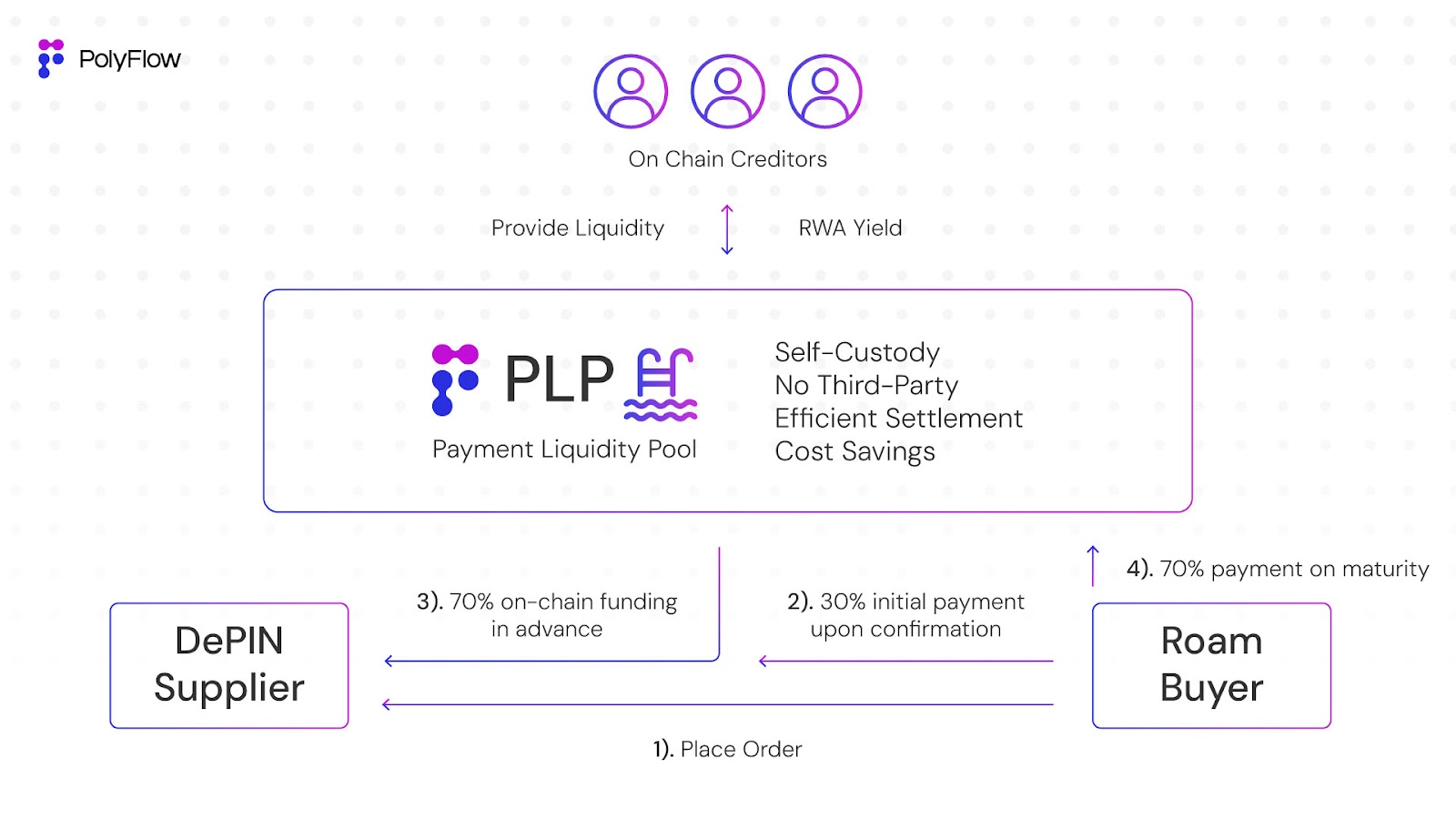
Buyer: Roam is a decentralized telecom operator focused on building a global open wireless network infrastructure using Web3 and Open Roaming technologies. It incentivizes user participation in network development and data sharing through innovative mechanisms. Roam provides users with high-performance DePIN router devices to encourage network engagement.
Supplier: The DePIN device supplier manages inventory based on Roam’s orders and plans production, which typically takes three months. In this scenario, Roam’s $1 million order is not paid in full upfront—usually, 30% of the order amount serves as an initial payment.
Financing Need: After receiving the order, the DePIN device supplier must begin production. However, the initial payment is often insufficient to cover raw material costs, production line setup, and completion of manufacturing. As a result, the supplier needs to seek financing from banks, using Roam’s purchase order as collateral.
Real-World Challenge: The difficulty lies in the fact that Web3 projects like Roam differ from traditional core enterprises and often struggle to obtain bank credit or fail to meet conventional credit criteria.
Solution: PolyFlow tokenizes Roam’s purchase order on the blockchain via its tokenized supply chain finance platform. This approach leverages on-chain liquidity to raise funds for the supplier based on Roam’s order, fulfilling the supplier’s financing needs.
Thus, this case creates a win-win-win situation. Roam can place an order by paying only the initial deposit; by tokenizing Roam’s accounts payable, the DePIN supplier gains immediate on-chain financing to support production; and on-chain liquidity providers can participate in tokenized supply chain finance assets to earn returns. Ultimately, this innovative integration of supply chain finance with blockchain technology realizes the vision of PayFi.
PolyFlow’s Core Role
PolyFlow plays a pivotal role in this supply chain finance scenario:
-
Liquidity Creation: Traditional supply chain finance primarily involves financial institutions such as banks. To increase liquidity and operational efficiency, funding parties require more diversified financing channels. Through PolyFlow’s tokenization platform, suppliers’ accounts receivable can be tokenized, enabling them to access liquidity via PolyFlow’s payment liquidity pool. This method meets suppliers’ financing needs while promoting efficient value transfer and capturing on-chain liquidity.
-
Credit Transmission: Typically, supply chain finance is accessible only to core enterprises in the value chain, often excluding smaller SMEs. PolyFlow’s payment ID helps SMEs anchor to the buyer’s credit rating, enhancing overall supply chain resilience and liquidity, while helping SMEs build a credit system on the blockchain.
Supply chain finance assets are classified as private credit, traditionally available only to large institutional investors and high-net-worth individuals. Through PolyFlow’s supply chain finance use case, liquidity providers can participate on-chain, incentivized by market-leading returns. Tokenization expands the investor base, heralding a new era of growth and efficiency. Ultimately, it promotes global economic development and contributes to a more sustainable and equitable financial landscape.
Looking ahead, the tokenization of trade assets offers multiple advantages for various participants and processes within complex global trade scenarios, including: 1) facilitating cross-border trade payments, 2) addressing financing needs among trade participants, and 3) leveraging smart contracts to improve trade efficiency, reduce complexity, and enhance transparency.
PolyFlow is steadily making these advancements a reality.
Social Media
To learn more about PolyFlow and stay updated on our latest developments, follow our official channels.
📣Mirror| 💬Global Community| 👾Discord| 🐦Twitter/X| 🌐Website
Contact Us
Join TechFlow official community to stay tuned
Telegram:https://t.me/TechFlowDaily
X (Twitter):https://x.com/TechFlowPost
X (Twitter) EN:https://x.com/BlockFlow_News
 @Polyflow_PayFi






