
Vitalik Fires the First Shot of "Reform"—Where Is the Ethereum Foundation Headed?
TechFlow Selected TechFlow Selected
Vitalik Fires the First Shot of "Reform"—Where Is the Ethereum Foundation Headed?
Old ships from the old world cannot sail to new continents; venturing into the unknown sometimes requires just a little more courage.
 Navigating Web3 tides with focused insights
Author: Wenser, Odaily Planet Daily
On January 18, Ethereum co-founder Vitalik Buterin announced a "major restructuring of the leadership structure at the Ethereum Foundation (hereinafter EF)."
The news sparked immediate controversy: some claimed he had finally "seen the light"; others said it was "high time to clean up EF's complacent leadership"; while some speculated that "due to Solana’s rapid ecosystem growth, Ethereum is feeling unprecedented pressure—Vitalik is panicking."
One thing is certain: Vitalik isn't the only one feeling the heat.
On the evening of January 22, Konstantin Lomashuk, founder behind Lido—one of Ethereum’s key infrastructure projects—retweeted a post about a “second foundation,” later clarifying it wasn’t meant to imply a second EF, but was just an ordinary tweet. Back in September, amid concerns over Ethereum’s slowing development, we published an article titled *Is Ethereum Sick? Will These Three Remedies Help?*, proposing potential solutions. Now, events seem to be unfolding exactly as we predicted.
Yet a more pressing question now emerges: How can Ethereum restore its former glory? Will EF reforms mark the dawn of revival? With these questions in mind, Odaily Planet Daily offers this systematic analysis of possible EF reform outcomes and Ethereum’s future trajectory for readers’ consideration.
Pride and Prejudice: The Two Faces of the Ethereum Foundation
On January 18, Vitalik Buterin, spiritual leader and co-founder of Ethereum, revealed that a major overhaul of EF's leadership structure has been underway for nearly a year. In other words, throughout 2024, EF’s leadership—led by Vitalik—had already begun a process of “self-revolution.” However, so far, the interim conclusion must be: this self-revolution has yielded little tangible progress.
Signals from Reform Goals: Focus on Ecosystem, Not Politics or Ideology
To clarify, Vitalik outlined the main goals of this transformation:
-
Enhance technical expertise within EF’s leadership;
-
Improve two-way communication and connections between EF leadership and both new and established ecosystem participants. Our responsibility is to support users (individuals and institutions), application developers, wallets, and Layer 2s;
-
Bring in fresh talent to improve execution capability and speed;
-
More actively support application developers, ensuring core values and non-negotiable rights—especially privacy, open source, and censorship resistance—are practically accessible to end-users, including at the application layer;
-
Further increase adoption of decentralized and privacy-enhancing technologies, as well as on-chain usage of Ethereum itself—for payments and treasury management.
Additionally, he emphasized what the reform goals do *not* include:
-
Enforcing a shift in ideology or culture (notably, he referenced moving “from a wef soyboy mindset to a Bronze Age mentality”—Odaily Planet Daily note: i.e., shifting from a softer, more inclusive perspective to an excessively results-driven, hyper-masculine worldview);
-
Actively lobbying regulators or powerful political figures—particularly in the U.S. or major nations—at the risk of compromising Ethereum’s status as a globally neutral platform;
-
Becoming a battleground for entrenched interests;
-
Evolving into a highly centralized organization, or positioning itself as Ethereum’s central “protagonist.”
Finally, he stated: “These things are not what EF does, and that won’t change. Those who seek different visions are welcome to start their own organizations.”
Reading carefully, Vitalik’s stated goals essentially mean: stick to a technical-first approach; uphold decentralization; firmly advance the Layer 2 roadmap—but concrete actions remain vague. Clearly, Vitalik’s proposed reforms remain superficial, and the results are thus unsurprising.
EF’s Most Controversial Issues: Transparency, Output, and Dumping Speed
Returning to the root causes of EF’s current困境, I identify three primary factors:
First, lack of transparency. This manifests not only in vague reporting of fund expenditures but also in delayed disclosures—standing in stark contrast to Solana’s agile and efficient operations. In December, EF released its Q3 2024 grant update, disclosing total funding of $12,848,780.33 across categories including community education, consensus layer, cryptography and zero-knowledge proofs, developer experience and tools, execution layer, Layer 2, protocol growth, and support. Community education received the largest share, funding initiatives like Blockchain Summer Bootcamp, BlockHack, and Building Builders. EF also continued supporting consensus clients such as Lighthouse, Nimbus, and Grandine, along with developer tools like Web3.js and OpenZeppelin’s account abstraction contracts. Notably, based on my knowledge, EF’s grants have not undergone independent third-party audits. (If counter-evidence exists, please correct me.)
Meanwhile, due to geographical and temporal constraints, EF’s grant allocation decisions remain concentrated in the hands of a few individuals—an expected outcome that nonetheless leaves many contributors without adequate recognition or support. At the beginning of January, Evan Van Ness, founder of the Week in Ethereum News (WiE), announced he would cease publication, citing a conversation with EF leadership indicating they saw no value in continuing WiE. For the remainder of 2024, WiE received minimal financial support from EF. While symbolic, EF leadership’s decision to cut even this token support clearly signaled WiE’s imminent termination.
Second, lack of demonstrable output. The public sees little evidence of EF’s actual work. Although Ethereum transitioned to PoS, at the organizational level, Proof-of-Work (POW)—as a metaphor for visible productivity—remains the most direct and relatively effective operational model. On this front, EF serves as a textbook negative example. “What you do” and “what others know you’ve done” are entirely different matters.
This issue is further compounded by structural flaws—a topic widely debated in crypto circles lately. As KOL @0xAllending pointed out, “One key reason Solana stands out in the blockchain race is its corporate-level operational rigor challenging ETH’s market dominance.” In contrast, Ethereum’s ecosystem—especially EF—remains stuck in a “decentralized community governance” model: top-down leadership, mid-tier researchers/developers, and general community members/hodlers. Dreaming of mass adoption under the banner of a “world computer” is nothing short of delusional.
Third, extremely fast token dumping. This is perhaps EF’s most criticized trait—not because other ecosystems don’t sell tokens, but because EF’s sales often coincide precisely with market tops. And when that happens, suddenly no one talks about “Ethereum faith” or “HODLing ETH.” According to Lookonchain data, since EF sold 100 ETH on December 17, ETH’s price has dropped roughly 17%. In 2024, EF sold 4,466 ETH (worth ~$12.6M) across 32 transactions, 15 of which occurred near short-term price peaks.
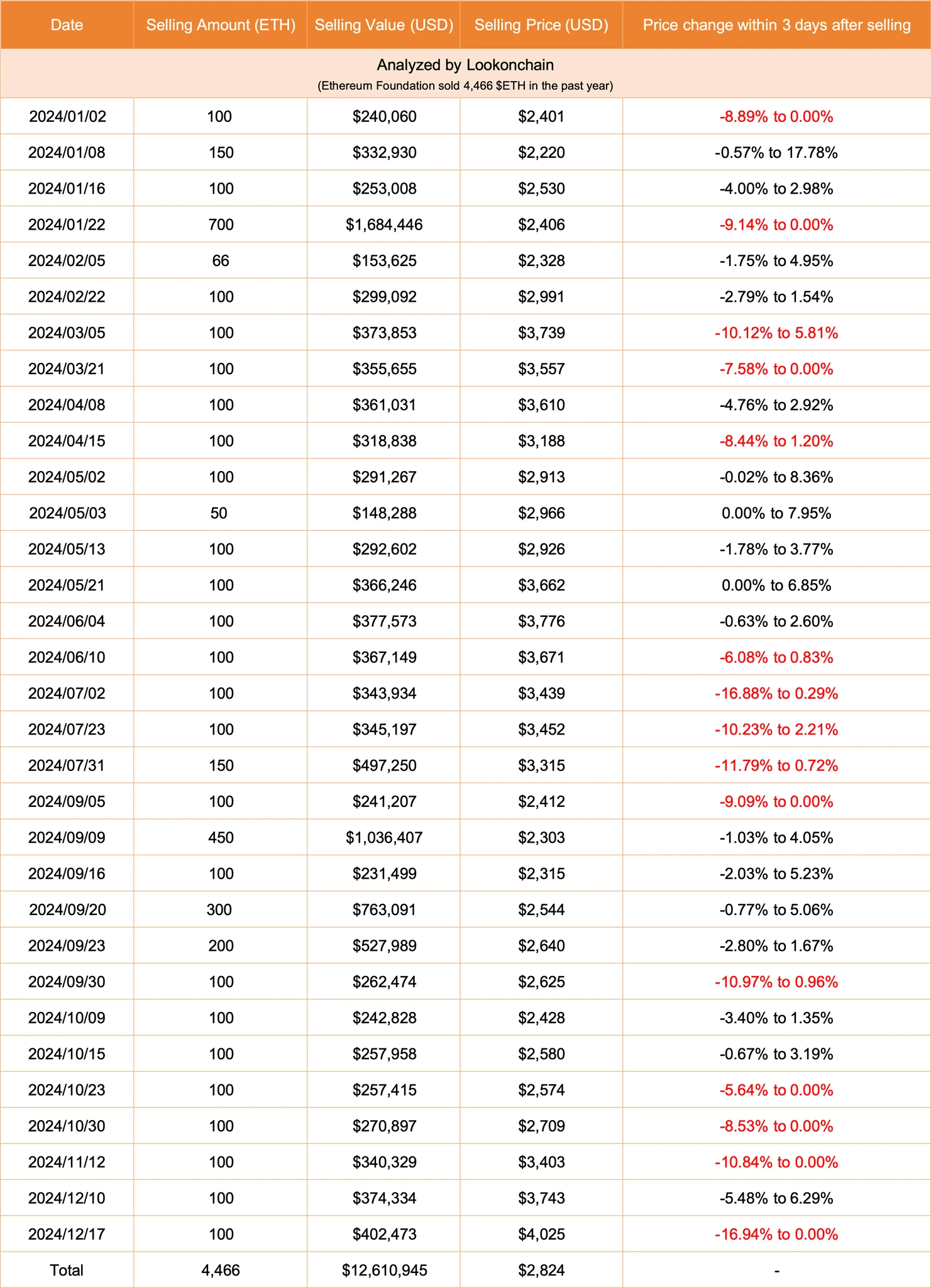
EF has long served as a “Top Signal”
Notably, Token Terminal data previously showed Ethereum L1 revenue plummeted nearly 99% since March 2024. On March 5, Ethereum L1 daily revenue peaked above $35M; by September 2, it had fallen to around $200K—the lowest daily figure of the year. At the time, analyst Kun warned that if this trend continued, L2s might dominate and could even abandon Ethereum’s mainnet—especially for consumer applications. Although revenue eventually recovered to pre-Dencun levels by year-end, signs of weakness in Ethereum’s core protocol income were unmistakable.
Digging deeper, pride and prejudice may be the leading culprits.
Root Causes: Pride as Original Sin, Prejudice as Constraint
In early December last year, EF researcher Justin Drake claimed Solana’s golden age was ending and posed no real threat to Ethereum. Despite Solana’s strong momentum, Drake argued Ethereum focuses on long-term gains (a familiar refrain). “Solana is peaking now, but I believe this marks the end of its golden era, as all its advantages in latency and throughput will vanish due to fundamental architectural limitations making it unscalable.” Currently, Ethereum developers heavily rely on Layer 2s for faster, cheaper transactions. Drake added: “I see Ethereum L1 competing with Bitcoin’s ecosystem, while L2s compete with Solana. Thus, competing with Solana isn’t even L1’s responsibility—we should compete on security and health. If there’s any competition with Solana, it should come from apps and L2s.”
Similarly, when Evan Van Ness explained WiE’s shutdown, he referred to Solana as “Sqlana,” seemingly implying it’s a centralized database—a jab echoed in the comments. Veteran node operator @JustDoingItBig expressed bewilderment: In 2018, Bitcoin maximalists mocked Ethereum nodes as “centralized databases”; now, Ethereum supporters act no better.
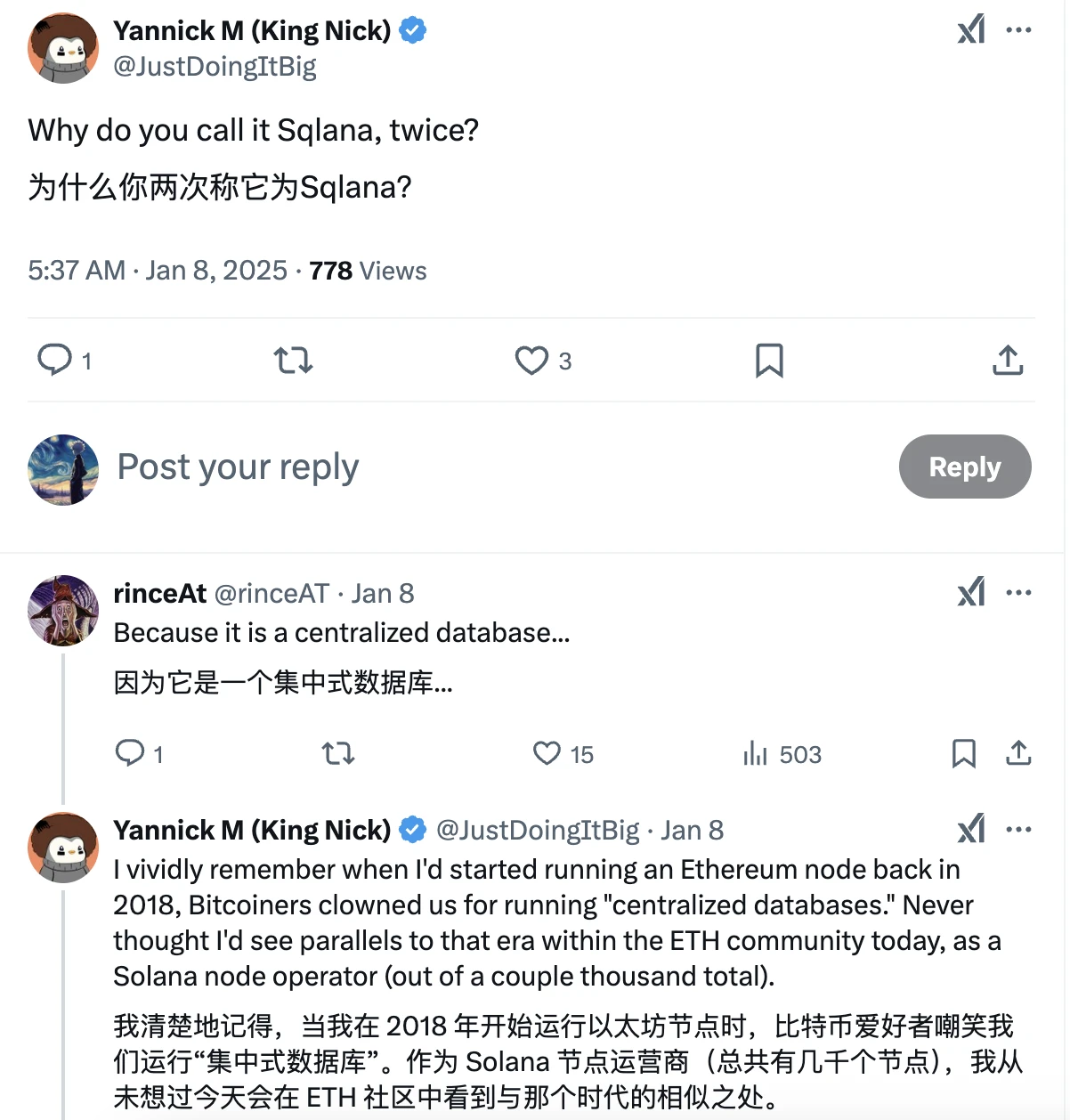
History keeps rhyming
From personal observation, most Ethereum community members still express positive support for EF, while critics tend to be ETH traders or retail investors. One view representing many “loyal EF supporters” comes from community member fishbiscuit (@not_qz), who previously responded to various criticisms of EF:
-
Social media activity: Like Solana Foundation, EF historically focused on retweets but has recently become more proactive in original posting;
-
On-chain engagement: EF has staked 42,000 ETH to support client development, funded on-chain projects like EIP-1559 NFTs and Beacon Book, disbursed grants via mainnet and L2s, and supported crypto payments at events like Devcon;
-
ETH selling: Regarding accusations of dumping ETH, he noted EF uses diversified strategies to manage market pressure, urged against double standards, highlighted regulatory challenges, and called for rational appreciation of EF’s contributions and more constructive dialogue.
Indeed, despite EF’s many issues, community tolerance remains remarkably high.
In a way, this reaffirms a simple truth: your position determines your perspective. Once you’re on the Ethereum ship, you sail together through storm and calm.
Conflict Points: Vitalik Under Pressure, Attacked Executive Director Aya, and a Fragmented Ethereum Community
As time passes, the tensions surrounding EF’s reform have intensified, focusing squarely on Ethereum co-founder Vitalik, EF Executive Director Aya, and Ethereum’s increasingly fragmented community.
The Dilemma of a Spiritual Leader: Change vs. Loyalty
Since announcing the EF overhaul on the 18th, Vitalik has found himself at the epicenter of mounting pressure. On one hand, ETH’s poor price performance and Ethereum’s exit from high-growth mode demand urgent action. On the other, EF’s core team faces growing pains—symbolized by pivotal departures such as researcher Justin Drake and Dankrad Feist joining Eigenlayer, and core researcher Danny Ryan leaving EF last year—testing old loyalties forged during earlier revolutionary days.
Recently, early Ethereum core developer Eric Conner’s announcement to leave the Ethereum community stirred debate (though, per one community member, this isn’t his first “farewell”). What sets this apart is his claim that as Vitalik retreats behind the scenes, EF has grown increasingly opaque and disconnected from the community. He described EF as exhibiting an “anti-victory and anti-competition mindset,” causing many to question whether they should stay—aligning ironically with Vitalik’s earlier reform statement about what EF *shouldn’t* become.
According to Rootdata, 11 EF employees have resigned, including early BD staff and Danny Ryan, the architect of the PoS transition. Based on a chart from May 2024, most ex-EF members have launched their own projects—typically remaining within the EVM ecosystem.
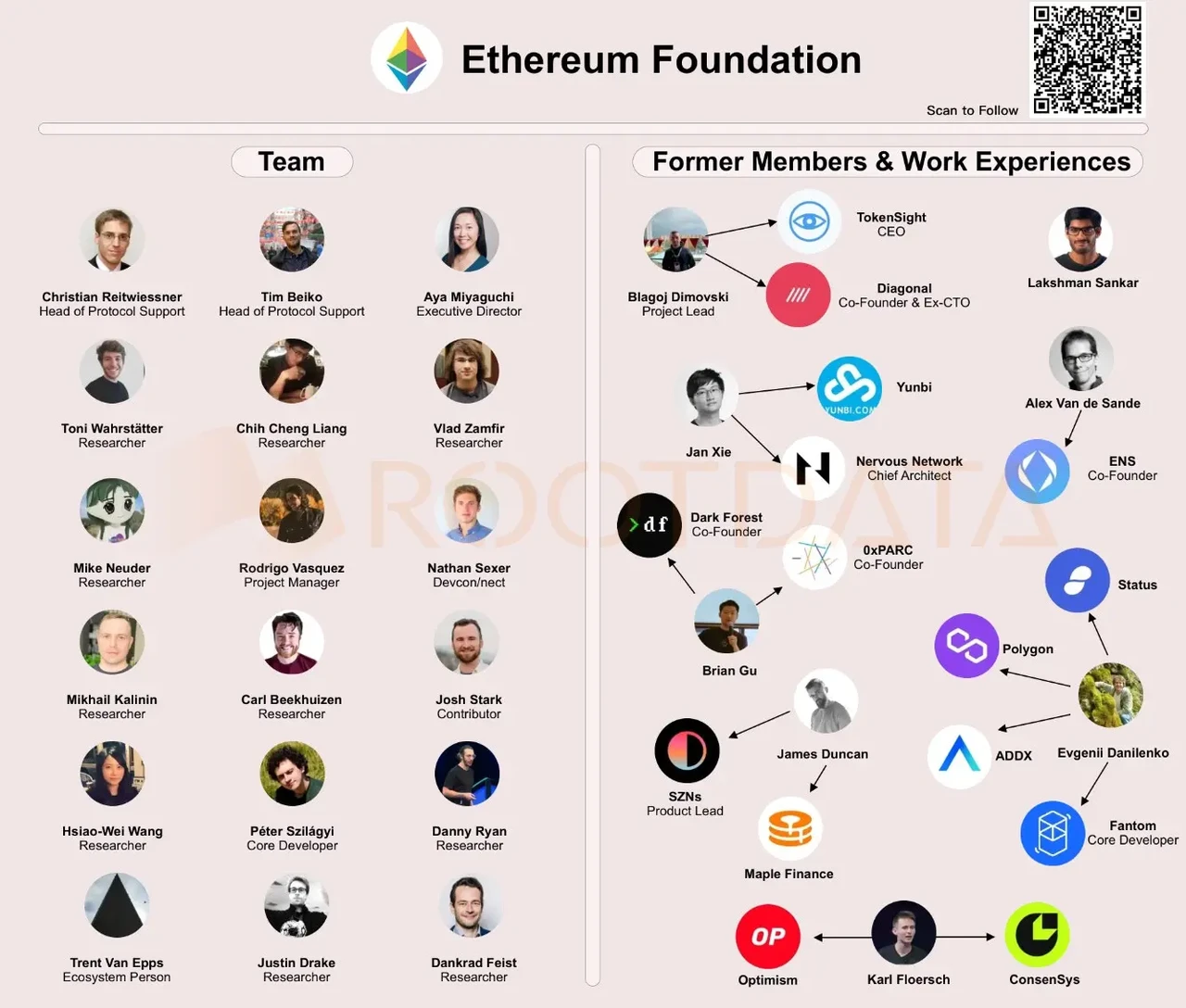
EF-related personnel, May 2024
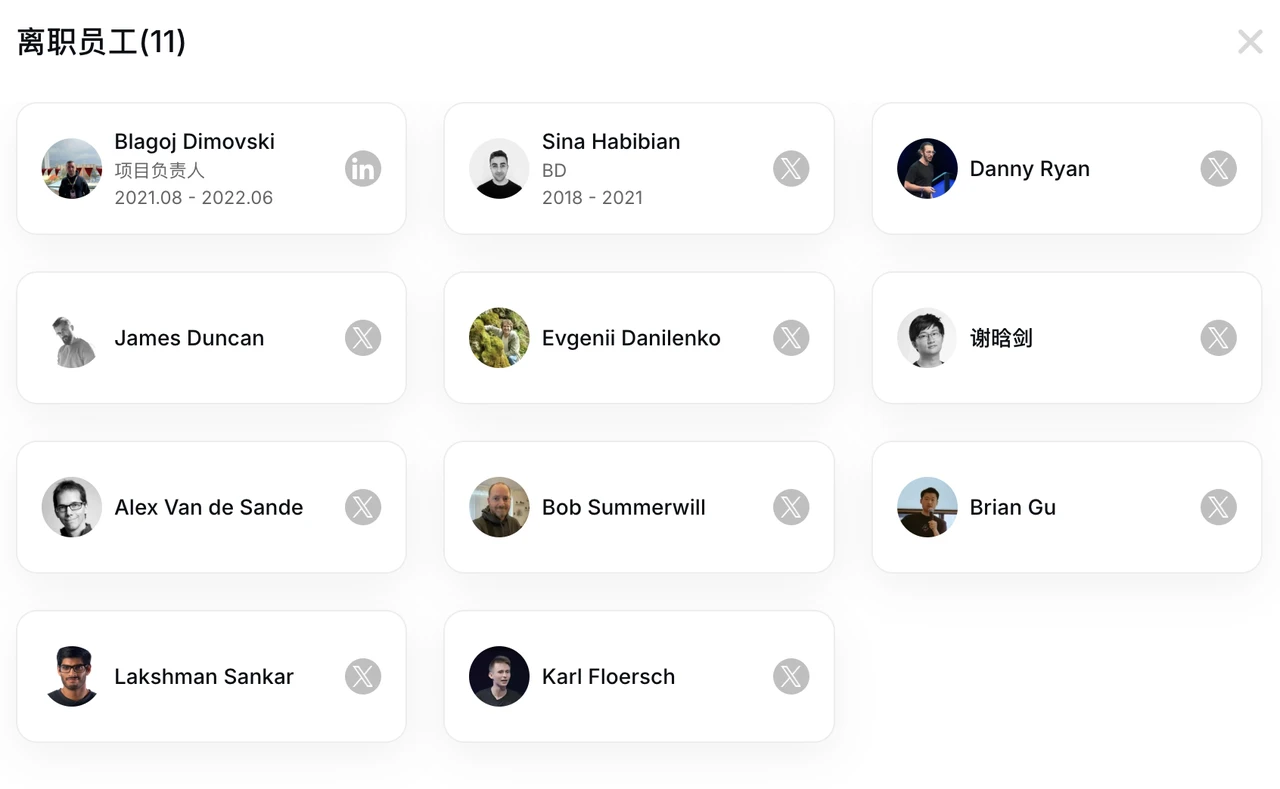
List of EF Departures
Current EF staff includes Executive Director Aya, protocol support lead Tim Beiko, and researchers like Justin Drake. Yet organizational chaos is evident: only recently did Alex Stokes, an EF researcher, announce he’d co-lead the research division with barnabe.eth—revealing to many for the first time that EF’s research arm comprises five teams: applied research, consensus R&D, cryptography, protocol security, and RIG.

Current EF Staff (16 people)
This disorganized structure fuels widespread criticism, much of it directed at EF Executive Director Aya.
To defend his longtime ally, the usually composed Vitalik stepped in, assuming a “dictatorial” role: On January 21, he responded to community backlash, stating, “I am the one deciding the new EF leadership team. One goal of the ongoing reform is to establish a proper board for EF—but until then, it’s just me. Pressuring EF leadership creates a toxic environment for top talent.”
Aya’s Middle Path: Anti-Speculation, Pro-'Zen'
Many may not know much about EF Executive Director Aya, yet she has been a pivotal figure in Ethereum’s evolution.
In our previous article *Where Is the Road? Analyzing Three Abstract Challenges Facing Ethereum Today*, we briefly introduced her. In a 2019 interview, she said: “For a blockchain full of infinite possibilities like Ethereum today, the path forward may involve not just one, two, or three voices, but many. Our job (at EF) is coordination—not making final decisions. Decisions can be made by our members, who may participate in the process without needing to control it entirely.”
In a June 2023 *Wired* magazine interview, Aya reiterated: “Regarding crypto speculation, if I’m the only one saying ‘no,’ it doesn’t matter. So I try to spread this mindset among others—like a Zen practitioner. Once rooted, people can be motivated without money, punishment, rules, or laws. Because we’re thinking about how to protect Ethereum’s culture after we and EF are gone. If this mindset becomes a kind of ‘Zen’ path, that would be amazing.”
This aligns closely with Vitalik’s views—drawing fierce criticism from today’s market. Many have attacked Aya, calling for her resignation. Some suggested Danny Ryan replace her, prompting Ryan to clarify: “Aya has contributed greatly to Ethereum’s development—please stop attacking her,” and reaffirmed: “EF continues to grow and improve, with or without me. I trust the Ethereum community will develop respectfully and rationally.”
Per LinkedIn, Aya graduated from Seattle University’s business school, previously worked at Kraken handling Japanese markets, and joined EF as Executive Director in 2018.
A Fragmented Ethereum Community: Consensus, Liquidity, and Attention
The third major conflict facing Ethereum today is fragmentation:
First, fragmentation in consensus—over Ethereum’s value, purpose, mission, vision, and short-to-long-term goals;
Second, liquidity fragmentation caused by the L2 strategy, weakening ETH’s price support;
Third, attention fragmentation—the most critical challenge in crypto—where focus shifts from crowded, slow-moving ETH to hotspots like Solana, known for wealth creation and rapid innovation.
In contrast, Solana’s leadership exhibits clearer thinking. Solana co-founder Anatoly Yakovenko once stated: “Solana is the ‘pure blockchain.’ No DA layer, no L2, no L3, no distractions. Just a fast and cheap blockchain.” He added: “Multiple L2s make no sense—if a single L2 can handle parallel execution, it can consume all blob space and serve every use case.” Furthermore, he argued: “Only six core smart contracts matter; any optional complexity that increases business risk for developers is harmful.” In a debate with an EF researcher, he claimed: “Ethereum’s biggest problem is uncertainty around the long-term value of DA and the ‘ultrasound money’ narrative for ETH”—a view shared by Uniswap founder Arthur Hayes.
Clearly, Ethereum needs more detailed solutions to escape this predicament.
A Three-Dimensional Solution to the “Ethereum Crisis”: Mindset, Communication, and Positioning
Based on the above, I believe resolving the “Ethereum crisis” requires progress in three areas:
Let Go of Prejudice, Let Go of Dogma
First, EF leadership—led by Vitalik—must reconsider its fixation on the long-term “world computer” vision and instead focus on practical short- and medium-term actions.
Promising steps include EF launching a new X account, the founding of Etherealize—a Wall Street-facing institutional marketing firm backed by Vitalik and EF—and EF’s decision to allocate 50,000 ETH (~$150M) via a 3/5 multisig wallet to participate in Ethereum’s DeFi ecosystem.
Additionally, recent developments show Vitalik finally abandoning his rigid stance on preserving Ethereum mainnet’s neutrality and unilateral support for L2s. He now explicitly encourages Layer 2s to contribute a portion of fees back to ETH—via fee burning, permanent staking with proceeds donated to Ethereum public goods, or similar mechanisms. For details, see our article *Under Heavy Criticism, Vitalik Calls on L2s: Come Back and Support ETH.*
Once this “feudal reduction” begins, the “ghost chains” within the EVM ecosystem are likely to see meaningful resolution.
Listen to the Community, Communicate Regularly
Second, EF must stop being an ostrich burying its head in the sand, ignoring external feedback and community sentiment. While EF leaders—including Vitalik—may lack the title of “emperor,” they hold de facto leadership power. Hence, the advice “favor virtuous officials, distance yourself from sycophants” applies. Don’t let flattery and Grant-seeking appeasers cloud your judgment.
Reduce academic debates. Increase regular AMAs with representative organizational figures. If it’s a technical person, talk tech. If it’s a marketer, discuss market strategy. Those who contribute nothing but collect salaries and make arbitrary decisions should be removed from EF promptly.
Most importantly, avoid being trapped in an information bubble.
Store of Value OR Medium of Exchange? That Is the Question
Finally, there’s the matter of ETH and Ethereum’s identity. With dozens of L2s fragmenting the ecosystem and ETH’s existing interest groups too large (i.e., too many profit-takers), ETH’s viability as a store of value grows increasingly difficult. The “digital silver” narrative alone can no longer convince the market.
A payment-focused role better fits current demand. Here, Base’s Coinbase Wallet consumer chain may represent a key future direction for Ethereum. While Vitalik insists on maintaining Ethereum’s neutrality and decentralization—making U.S.-aligned collaborations difficult in the short term—this remains an unavoidable issue in the long run.
Moreover, as Marc Zeller, founder of Aave Chan Initiative (ACI), previously suggested: “To fix EF’s problems, convert EF’s remaining ETH into a market-tested LST portfolio, cut 95% of current subsidies—especially dubious initiatives like ‘running nodes in Vorkuta’—stop selling ETH, use LSTs to borrow stablecoins via Sky/Aave, and reduce operating expenses”—an idea worth considering.
However, proposals like “fire 80% of non-developers and current leaders” or “hand official accounts to a few extremely active ETH maximalists” seem overly simplistic.
Lastly, the ultrasound.money community—once uniting many ETH maximalists—eventually faded into obscurity. It’s a regrettable outcome. Perhaps with EF reforms, such communities may find new transformation opportunities.
Conclusion: “Don’t Live Off Past Achievements—Make New Ones”
In Ethereum’s early days, EF’s hands-off leadership fostered rapid ecosystem growth. But after multiple bull and bear cycles, if the vision of “mass adoption” remains genuine, new approaches are needed—rather than clinging to past glories of being “crypto’s #1 ecosystem,” resisting progress.
TRUMP tokens brought millions into crypto—there’s nothing wrong with chasing wealth creation. Compared to Web2’s privacy sacrifices, viral trends and wealth booms are the “Trojan horse” crypto offers traditional finance. Only when crypto economics fully integrates with global financial systems will we witness the true flowering of crypto across the universe.
By eliminating wrong answers, we gain greater courage and strength to face new challenges in the crypto world.
On this journey, countless others walk beside me—so I remain confident. I hope you do too.
Join TechFlow official community to stay tuned
Telegram:https://t.me/TechFlowDaily
X (Twitter):https://x.com/TechFlowPost
X (Twitter) EN:https://x.com/BlockFlow_News
 Odaily