Trump's cryptocurrency allows Chinese to earn hundreds of millions, splitting America's crypto faction
TechFlow Selected TechFlow Selected
Trump's cryptocurrency allows Chinese to earn hundreds of millions, splitting America's crypto faction
Is it really good for the industry?
 Navigating Web3 tides with focused insights
By: BlockBeats
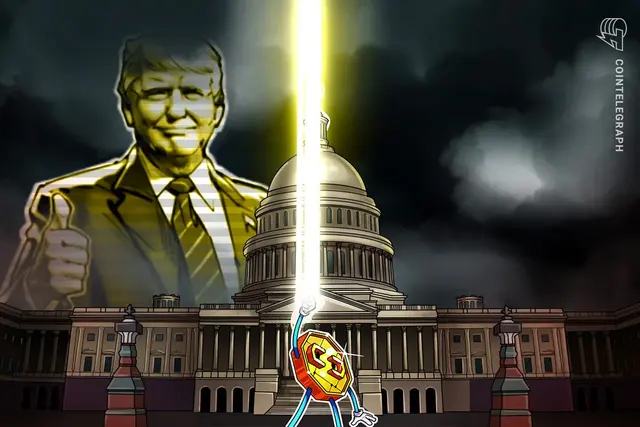
On the eve of his inauguration as U.S. President, Trump delivered a shock to both the American people and the world. In the final two days before constitutional salary rules would take effect for him, the Trump family pulled in tens of billions of dollars from the crypto market via a MEME coin.
"The U.S. President leads the way in launching a cryptocurrency"—this is truly an unprecedented event, with $TRUMP achieving unparalleled mainstream attention and wealth creation. Within just one weekend, its daily trading volume on Binance surpassed $10 billion, briefly overtaking even BTC. From Wall Street institutions to elderly couples strolling along Shanghai's Bund, everyone around the globe began asking how they could join this feast.
Interestingly, this quintessentially "American MEME coin" turned out to benefit Chinese retail traders among the most. Because the token launched during nighttime in the Eastern U.S., most American citizens missed the initial trading window. According to on-chain data and social media analysis, half of the more than 100 addresses that earned over $1 million in profits originated from Chinese-speaking communities. Meanwhile, due to legal controversies and internal disagreements, Trump’s move has sharply divided the crypto community.
A Review of the Token Launch
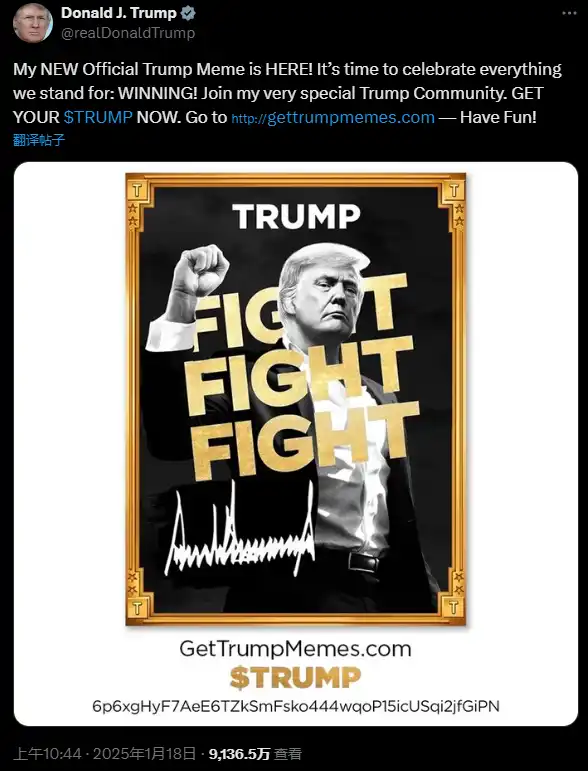
On January 18, incoming U.S. President Donald Trump announced on his social media account the launch of his personal Meme coin $TRUMP, inviting users to visit the official website to claim the token. The site declared TRUMP as the sole “official Trump Meme Coin.”
The official website gettrumpmemes.com revealed that 80% of the TRUMP supply is held by Fight Fight Fight LLC—a company affiliated with Trump Organization through CIC Digital and CIC. The website stated that TRUMP had an initial issuance of 200 million tokens on Day One, with a total supply expected to reach 1 billion over three years, gradually increasing. CIC Digital and its affiliates will receive revenue generated from TRUMP trading activities, which will be locked for 3–12 months and fully unlocked within 24 months.
Initially, there was skepticism about the news, with some suspecting that Trump’s account might have been hacked. But hours later, the post remained live without any retraction, and the TRUMP token surged rapidly. Twelve hours after launch, its price reached approximately $30, giving it a FDV (Fully Diluted Valuation) of $30 billion. By 8 PM Beijing time on January 19, according to CoinMarketCap data, the TRUMP price had peaked at $85.2 within a day and a half, reaching a maximum circulating market cap of $85.2 billion. This single asset boosted Trump’s net worth by $68.16 billion (approximately RMB 498.93 billion), more than tenfold compared to his pre-launch valuation. On the 19th, major exchanges including Binance, Coinbase, and OKX announced spot trading listings for TRUMP (OFFICIAL TRUMP). Alongside the rise of Trump-related assets and SOL used to purchase them, all other cryptocurrencies were drained—ETH dropped as low as $3,127, down 12% from early on the 18th, while other meme coins and AI agent tokens also fell significantly.
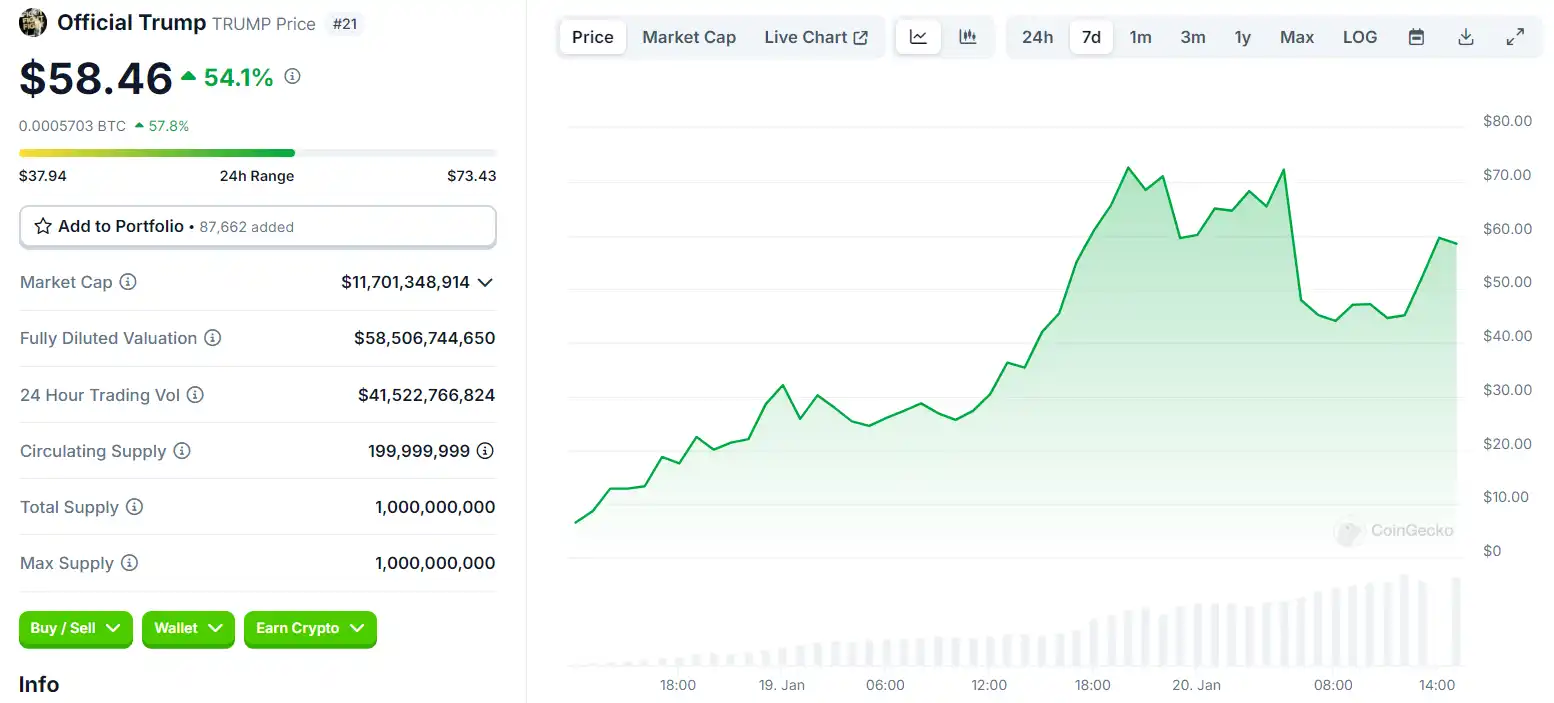
Image source: CoinMarketCap
Just as $TRUMP reached fever pitch and extreme FOMO levels, Melania Trump capitalized on the momentum by launching her own cryptocurrency, MELANIA, on the Solana blockchain. On the 20th, Melania posted on social media: “Official Melania Meme is live,” accompanied by a purchase link.
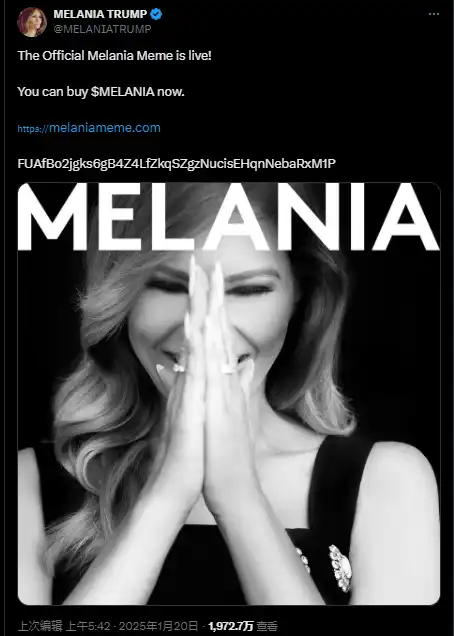
The Trump family's bandwagon-style token launches dealt a heavy blow to the market. While MELANIA rode FOMO sentiment to surge to a $1.2 billion market cap, nearly every other cryptocurrency plummeted. TRUMP’s market cap halved from $75 billion to $3.5 billion; SOL dropped from $176 to $235 (note: likely typo in original); Bitcoin briefly declined by 6%. The crypto community angrily accused the Trump family of treating cryptocurrencies like a personal ATM, blurring the line between governmental roles and private financial gain—an outright exploitation of presidential influence for personal profit. Numerous media outlets criticized the Trump family's actions, condemning this money-making scheme.
One Side Gets High, the Other Takes the Bag: Asian Crypto Traders Strike Gold vs. American Retailers Paying for Faith
Hu Xijin, former chief editor of Global Times, commented on Trump’s token launch: “Capitalism! So the presidency can be monetized like this! Mr. Trump has truly broadened my horizons as someone living in a socialist country.” But perhaps even more astonishing to this veteran journalist is that aside from insider trading, the biggest beneficiaries of Trump’s token launch were Asian on-chain traders.
The chart below shows the TRUMP trading trend based on Eastern Time. The token launched at 9 PM on Friday, January 17—10 AM Saturday in Beijing. As shown, the sharp price increases between January 18 and 19 occurred primarily during Asian trading hours.
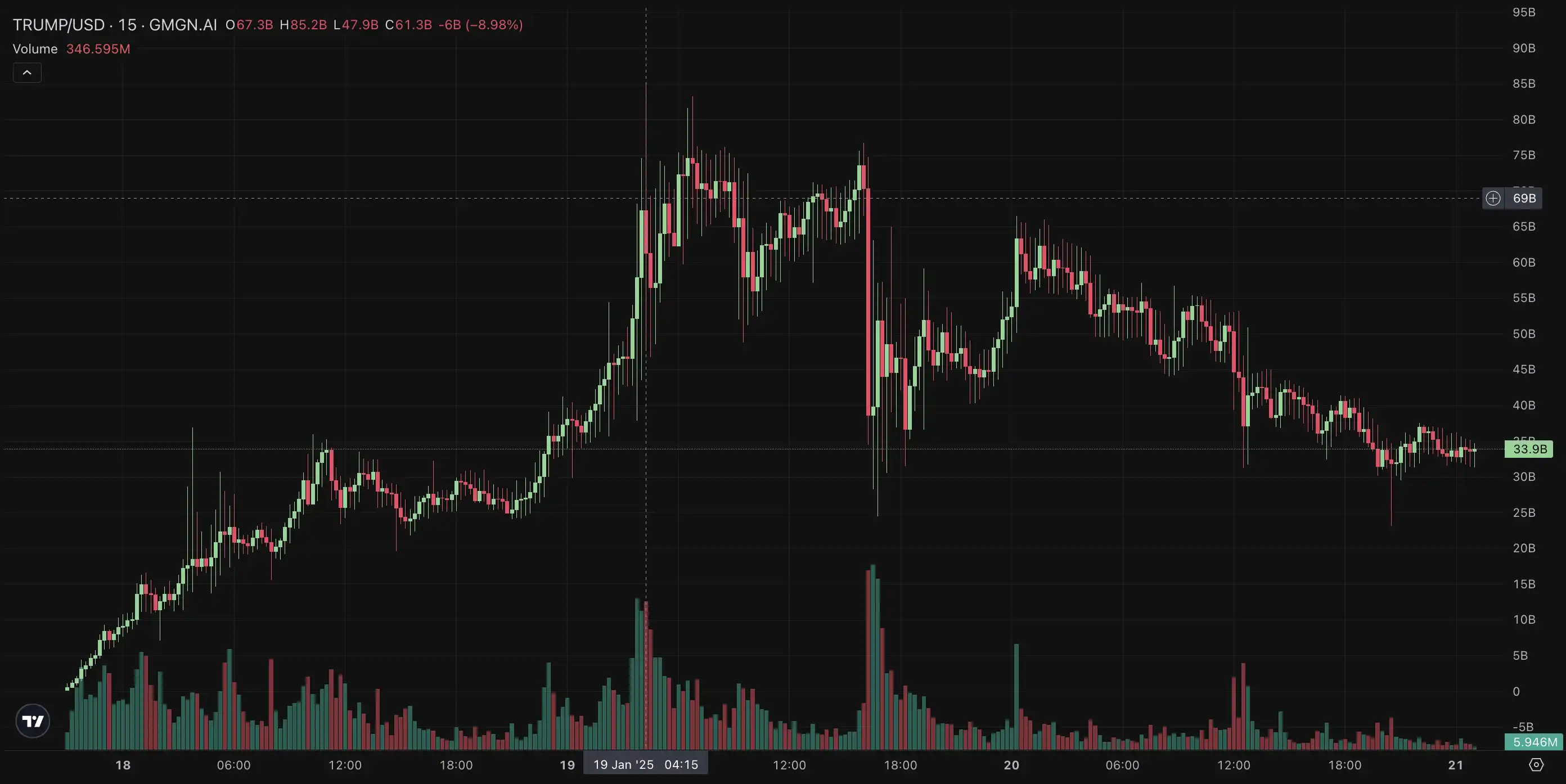
TRUMP Trading Chart (New York Time)
On January 18, just one hour after TRUMP launched and its market cap exceeded $100 million, community tracking showed that 10 Chinese KOLs had already made over $1 million in profit.
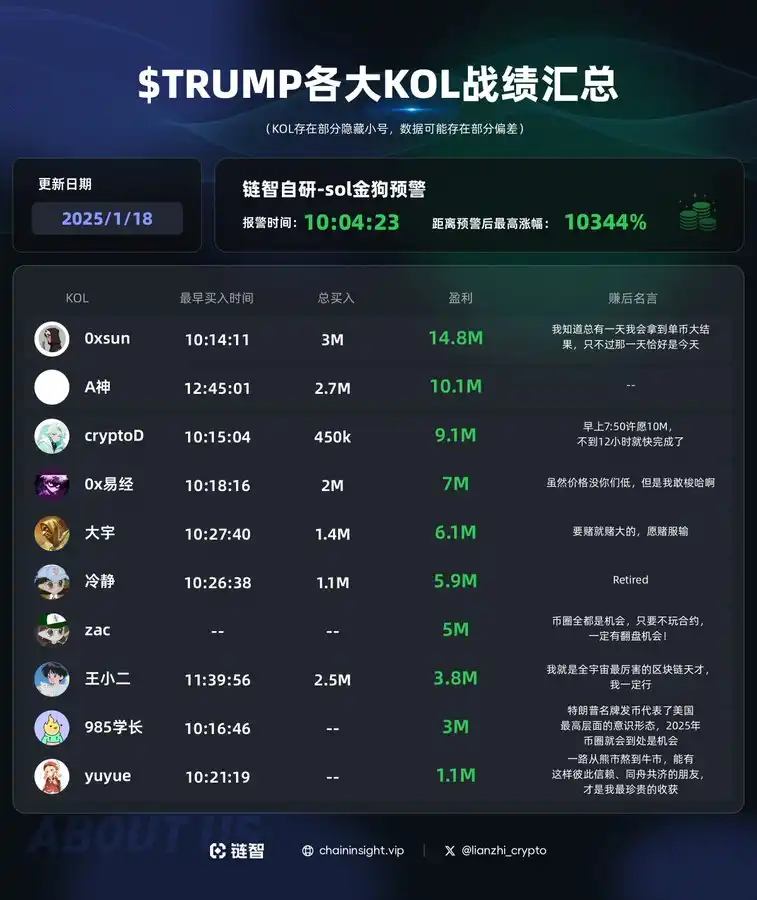
Image source: Lianzhi
When TRUMP’s market cap hit $15 billion—just four hours after launch—Chinese KOL 0xSun shared his PnL on X: initial cost of 3,010 SOL, $10 million in profit. A day later, before transferring his holdings to CEX, 0xSun updated his PnL showing $27.5 million in gains.
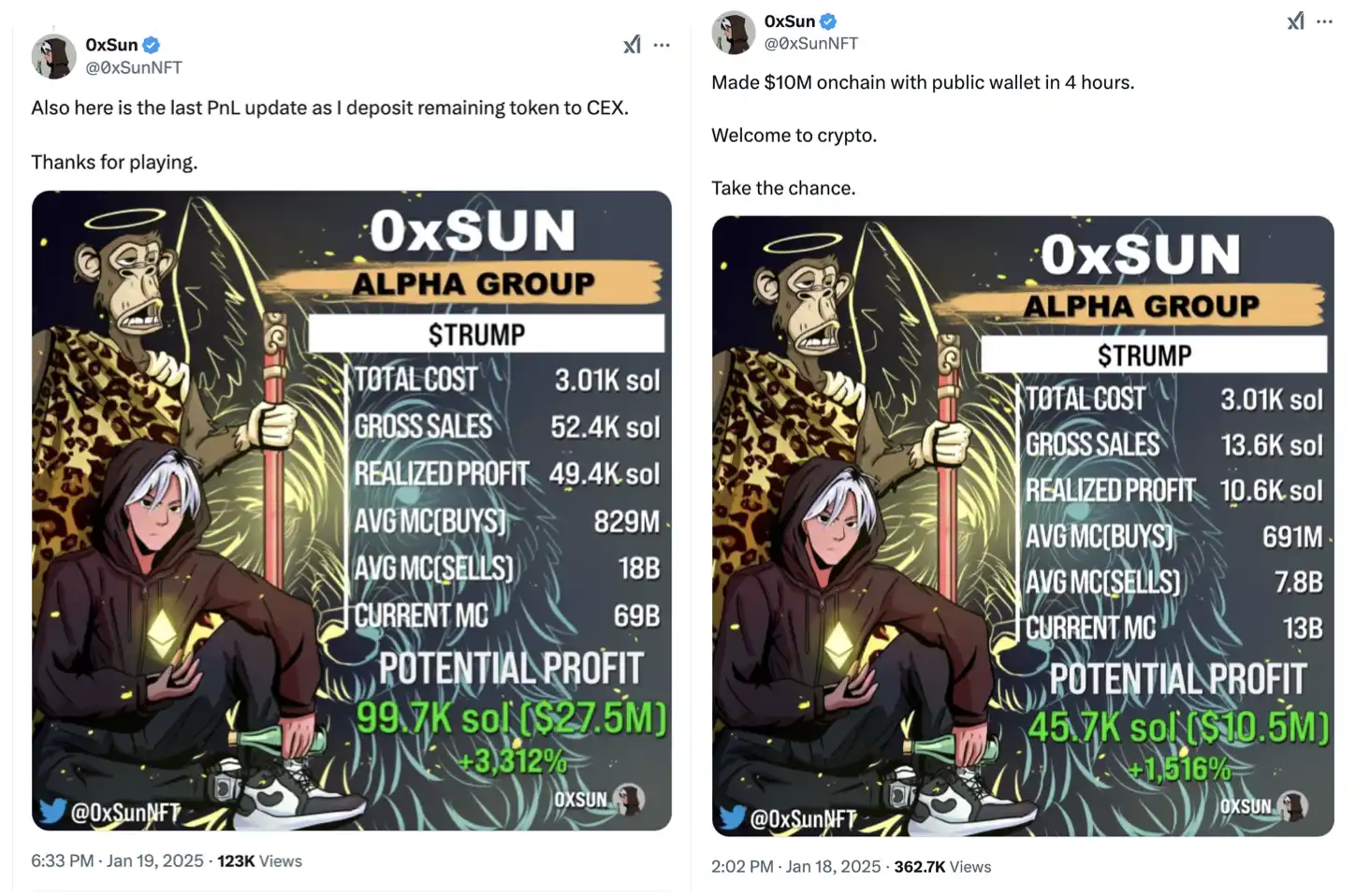
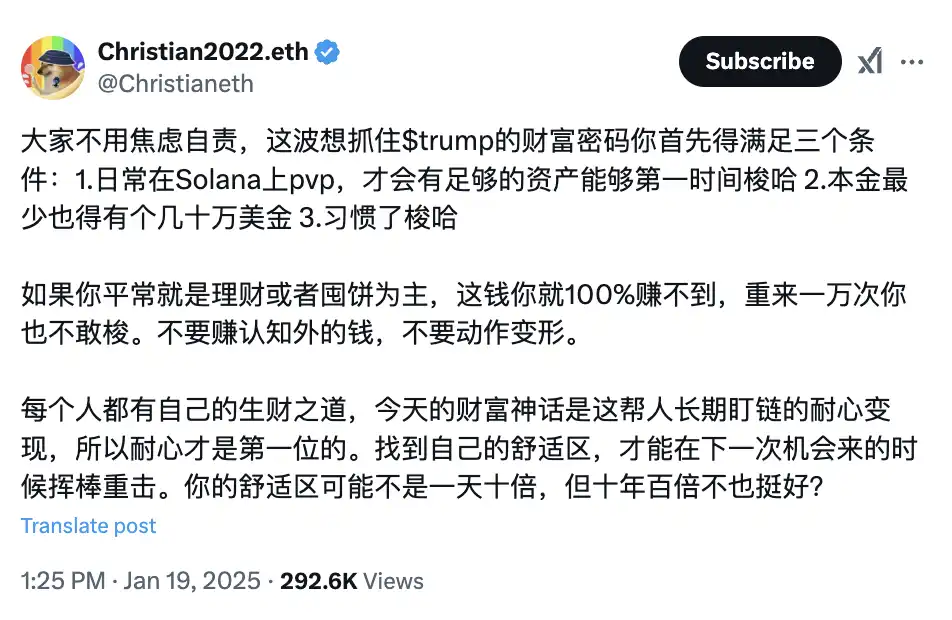
“Four hours—but also three years spent living on-chain since I first entered crypto, sitting still for over ten hours every day,” 0xSun wrote in a tweet. As TRUMP’s market cap soared past $30 billion, the Chinese community reacted with awe and regret over not securing bottom-level positions. Christian, founder of 0xinfini, offered an explanation: without substantial capital and going all-in immediately on Solana, it was impossible to achieve big results on TRUMP.
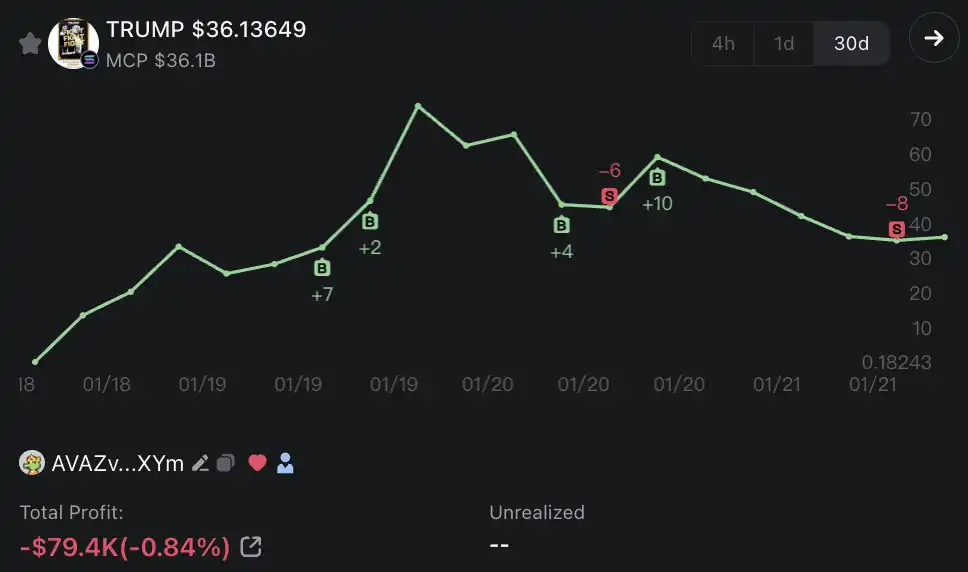
In contrast, American retail investors appeared far more passive. Publicly disclosed profitable trades among English-speaking communities were rare—even top-tier meme KOL Ansem exited at a loss.
An address linked to Ansem didn’t buy until Beijing time on January 19, when TRUMP’s market cap had already surpassed $30 billion—around the time Kraken listed TRUMP spot trading. On January 20, shortly before and after Robinhood announced TRUMP listing, Ansem added more positions. On January 21, he sold all holdings, limiting total losses under $80,000.
American YouTuber voidzilla ranted in a video: “This behavior is unprecedented in terms of stupidity and fraudulence. Using the days before inauguration to hype a speculative project is absolutely staggering. With only two days left until the inauguration, he should be drafting his inaugural address—not issuing a meme coin. Exploiting power for such manipulation during a critical moment in the presidential campaign not only makes history but also blatantly tramples every moral boundary.”
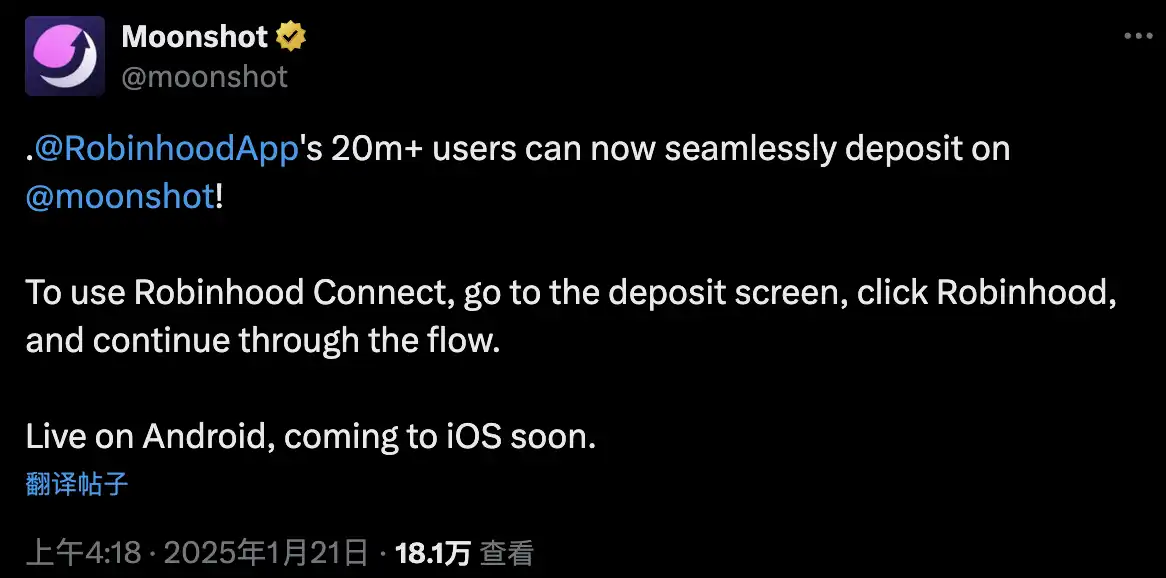
Yet the president’s brand continued to attract retail investors. Moonshot alone gained about 400,000 new users on January 18. Twitter was flooded with posts explaining how to use Moonshot to buy TRUMP, with some users complaining about its complexity. In one discussion thread, someone recommended using Phantom Wallet; another replied: “I just wanted to deposit cash or USD, but it forced me to buy SOL or Bitcoin.”
Additionally, because U.S. banks do not operate large transfers or certificates of deposit over weekends, American investors faced further delays, missing the crucial entry window and becoming late-stage liquidity providers as prices rose.
On one hand, Asia-based, always-on-chain traders identified the opportunity and took large positions at the right time. On the other, American retail investors, constrained by compliant purchasing channels like Moonshot and fueled by loyalty to their national leader, overlooked early opportunities and willingly became exit liquidity for insiders and whales.
How Much Has the Trump Family Earned From the Crypto Market?
After Melania Trump launched her namesake token, $TRUMP’s price immediately dropped from $78 to $35. Then, news that Robinhood would list $TRUMP caused it to rebound again. These coordinated headlines and market-making moves highlight the terrifying precision of behind-the-scenes capital operations—maximizing each exit opportunity seamlessly. This isn’t the first time the Trump team has profited from blockchain ventures, but it’s certainly the most sensational. So how much has the Trump team actually made in the crypto space?
Cryptocurrency Political Donations
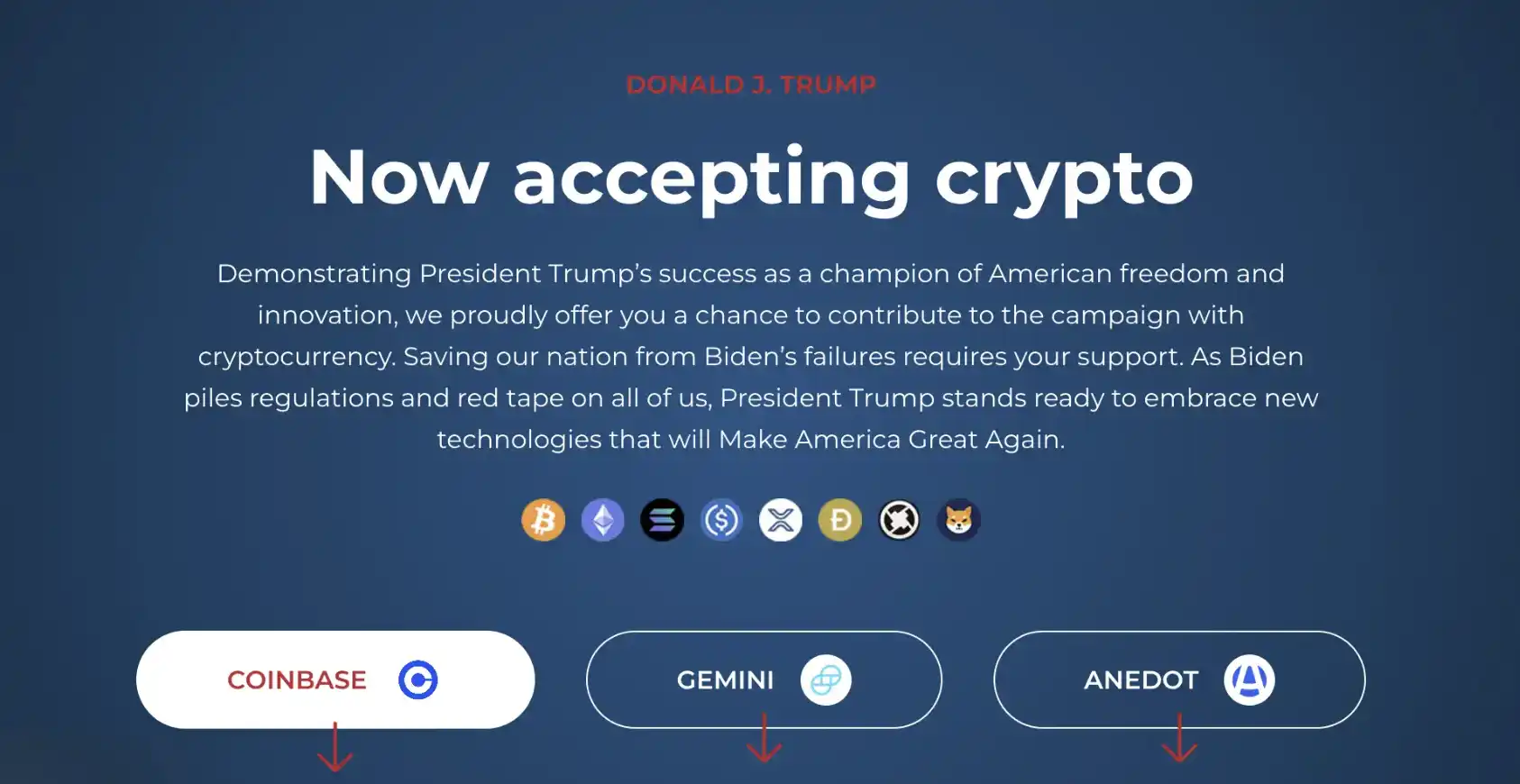
Trump became the first presidential candidate to officially accept crypto donations, receiving not only BTC but also ETH, SOL, Dogecoin, and other memecoins. Ultimately, the value of received cryptocurrencies exceeded $4 million. Additionally, millions in traditional investments came from supporters within the crypto industry.
Raking in $20 Million from NFTs—Just Warming Up
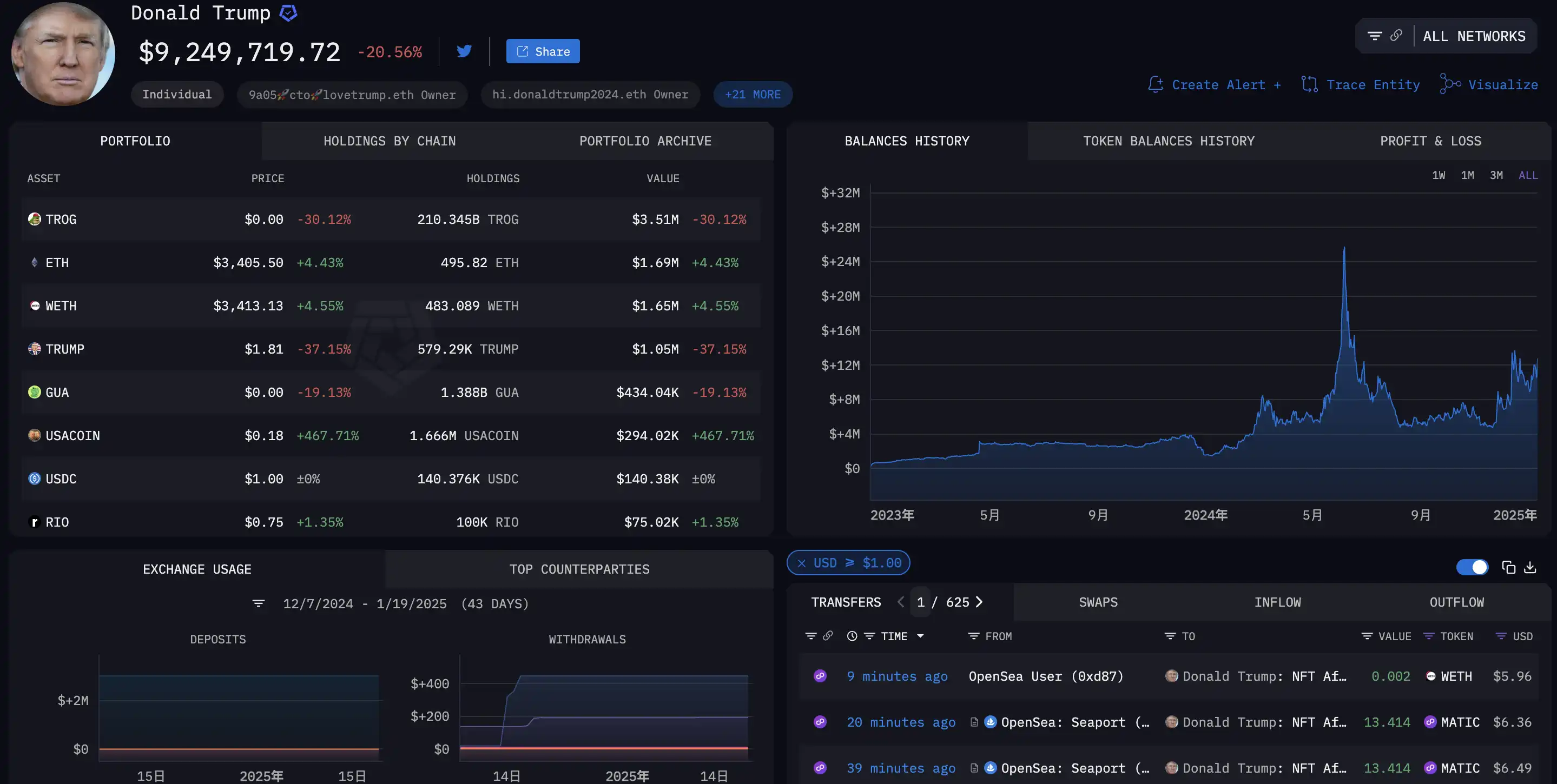
In December 2022, Trump launched his first series of Trump-themed NFTs—trading cards featuring various portrayals of himself. A total of 45,000 cards were issued at $99 each. They sold out within 24 hours, generating $4.5 million. This gave Trump, previously not aligned with crypto circles, a taste of success. His team went on to release four similar collections on Polygon—including one limited special edition—and one collection on Bitcoin, selling nearly 200,000 Trump trading card NFTs. Sales and royalties brought the Trump team over $20 million in revenue.
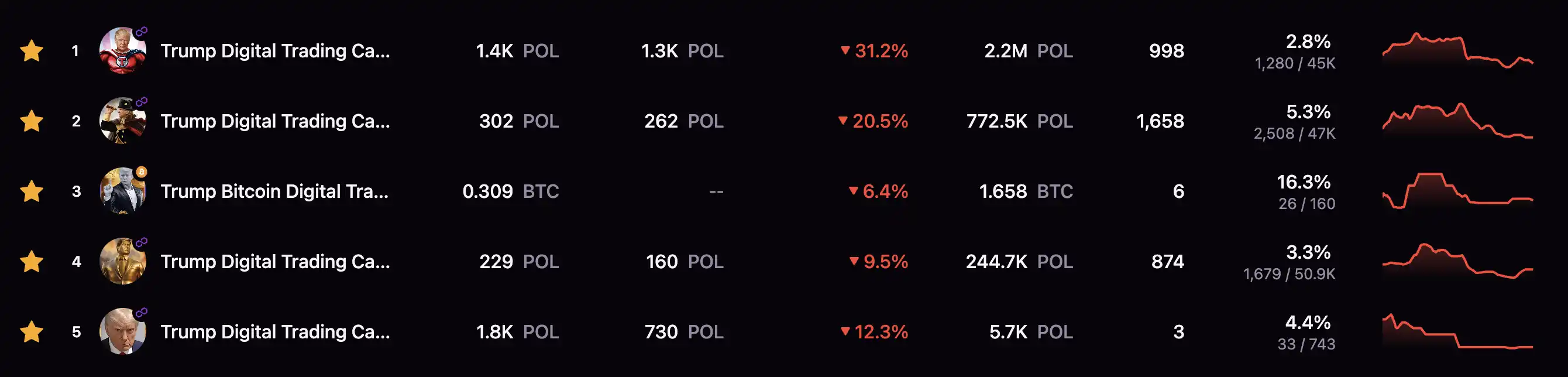
The key player behind these projects was CIC Digital LLC, founded in 2021 by Trump’s lawyer John Marion and former advisor Nick Luna. NFT INT LLC, the issuer of “Trump Digital Trading Cards,” declared itself an independent entity, stating it does not belong to, nor is managed or controlled by Donald J. Trump. Instead, it licensed Trump’s name and likeness from CIC Digital LLC to create and sell the NFT series. However, further investigation into NFT INT LLC reveals suspicious details: its website lists a contact address at a UPS Store in Park City, Utah, while its registered address is in Cheyenne, Wyoming—about 480 km away—often referred to as America’s “Cayman Islands,” suggesting the company may be a shell entity.
Targeting DeFi “Rugs”—$300 Million Is Pocket Change
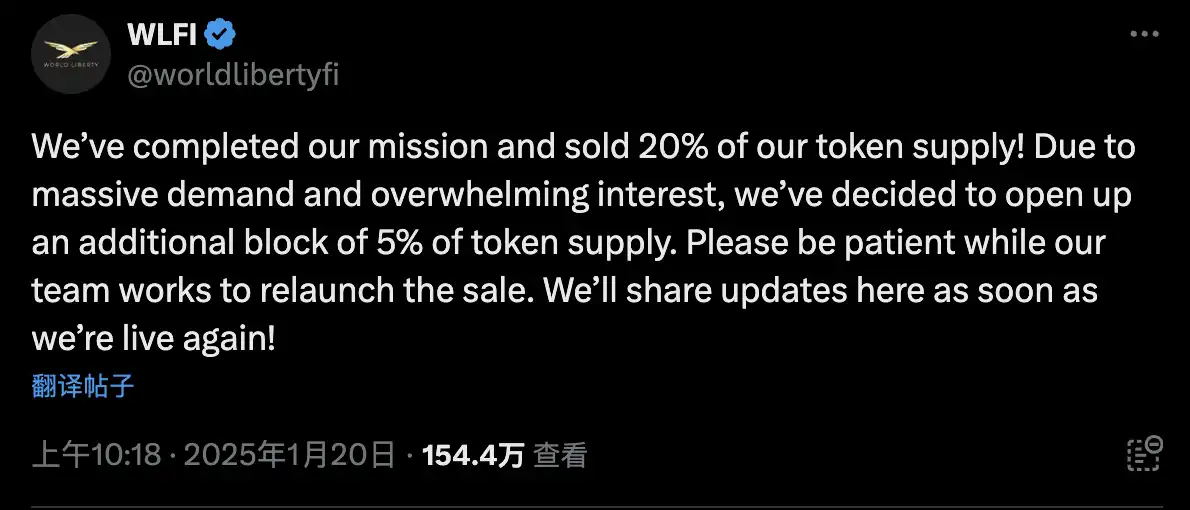
World Liberty Fi was jointly launched by President Trump, Donald Trump Jr., and Eric Trump. Donald Trump Jr. emphasized this wasn’t just a simple memecoin but a platform aiming to deliver decentralized top-tier financial and banking tools, strictly complying with regulations to ensure user safety. Interestingly, amid the frenzy around Trump’s $TRUMP memecoin, the Trump family’s DeFi project World Liberty Financial (WLFI) successfully sold out its public offering of 20 billion tokens this morning at $0.015 per token, raising $300 million. Justin Sun, founder of the Tron blockchain, personally contributed $30 million and announced an additional $45 million investment through Tron DAO.
After the initial 20% public sale allocation sold out, WLFI “generously” opened an extra 5% for community purchases. If fully subscribed, this would add another $75 million to the funds raised.
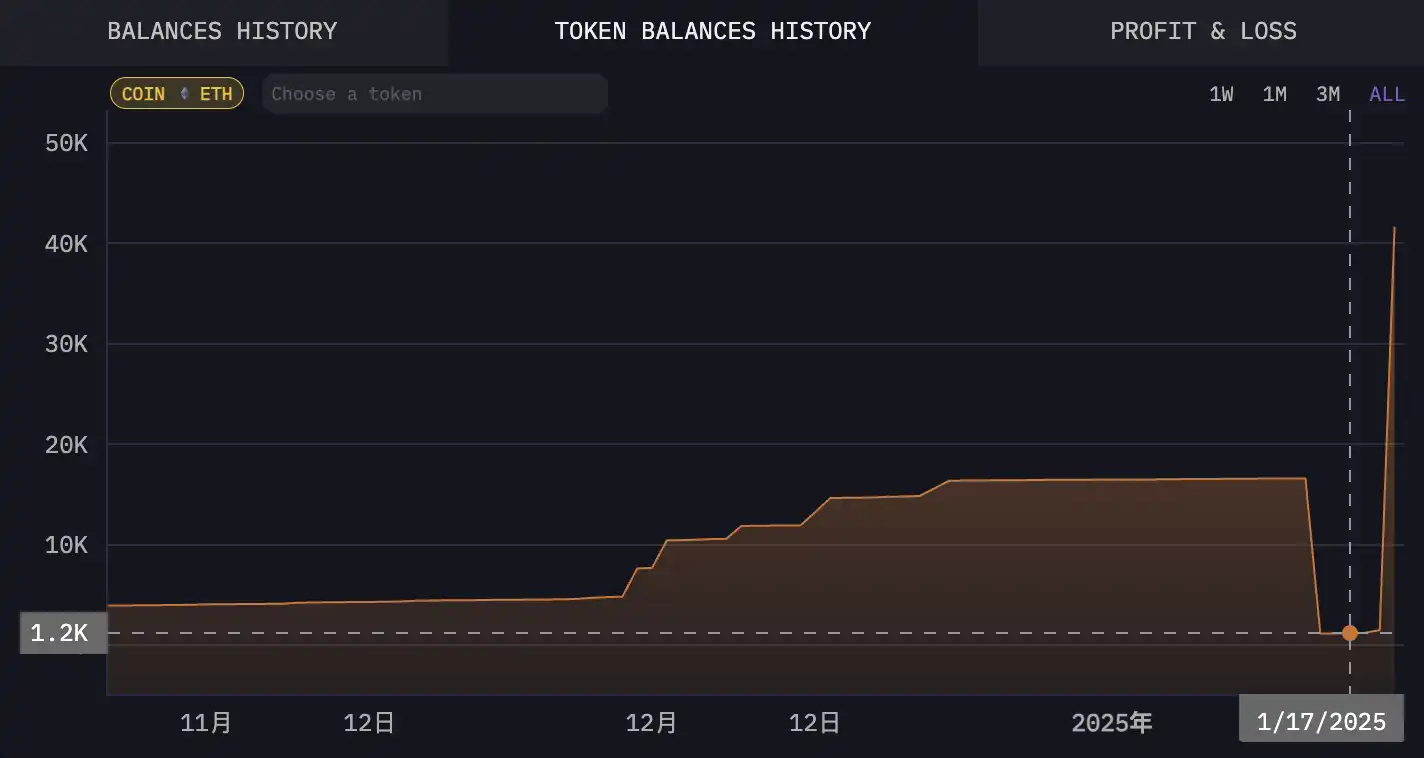
Notably, two days before $TRUMP’s launch, the WLFI address suddenly reduced its Ethereum holdings from 17,000 ETH to just 1,200 ETH—transferring the rest to Coinbase or other addresses. Then, as $TRUMP drained liquidity across chains and many ETH holders shifted to Solana, starting on the 19th, multiple purchases of Ethereum resumed. Current holdings now exceed 42,000 ETH, turning prior losses into gains and making ETH over one-third of the wallet’s total assets—an expertly timed swing trade.
The Ultimate Weapon: An Unprecedented Crypto Market Rebalancing Event
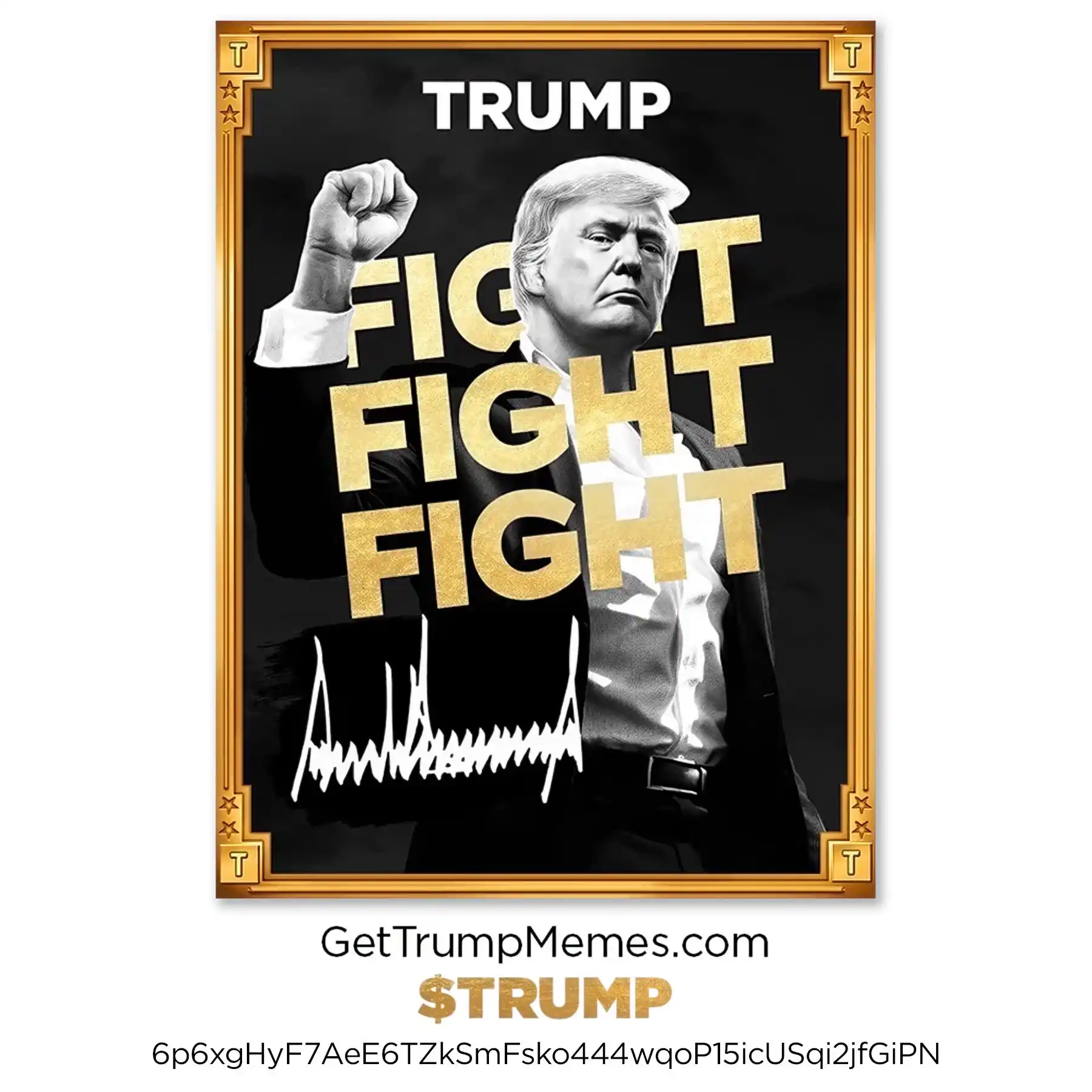
This is probably the image you’ve seen repeated most frequently in recent days. A U.S. President launching a memecoin—something unimaginable—somehow becomes plausible when it involves Trump. In reality, it took the Trump family three generations to accumulate $4 billion in wealth. Yet after launching a memecoin, its market cap hit $80 billion in just two days—over a century of effort eclipsed by 48 hours of global euphoria. At its peak, $TRUMP had an FDV of $80 billion. Assuming 20% circulation, that’s $16 billion in real market cap. Now, actual market cap stands at around $6 billion. The $10 billion in liquidity siphoned from the broader market largely vanished. Regardless of how much new demand Trump’s influence generated, the short-term impact of a single token on a market typically valued between $1 trillion and $2 trillion was massive.
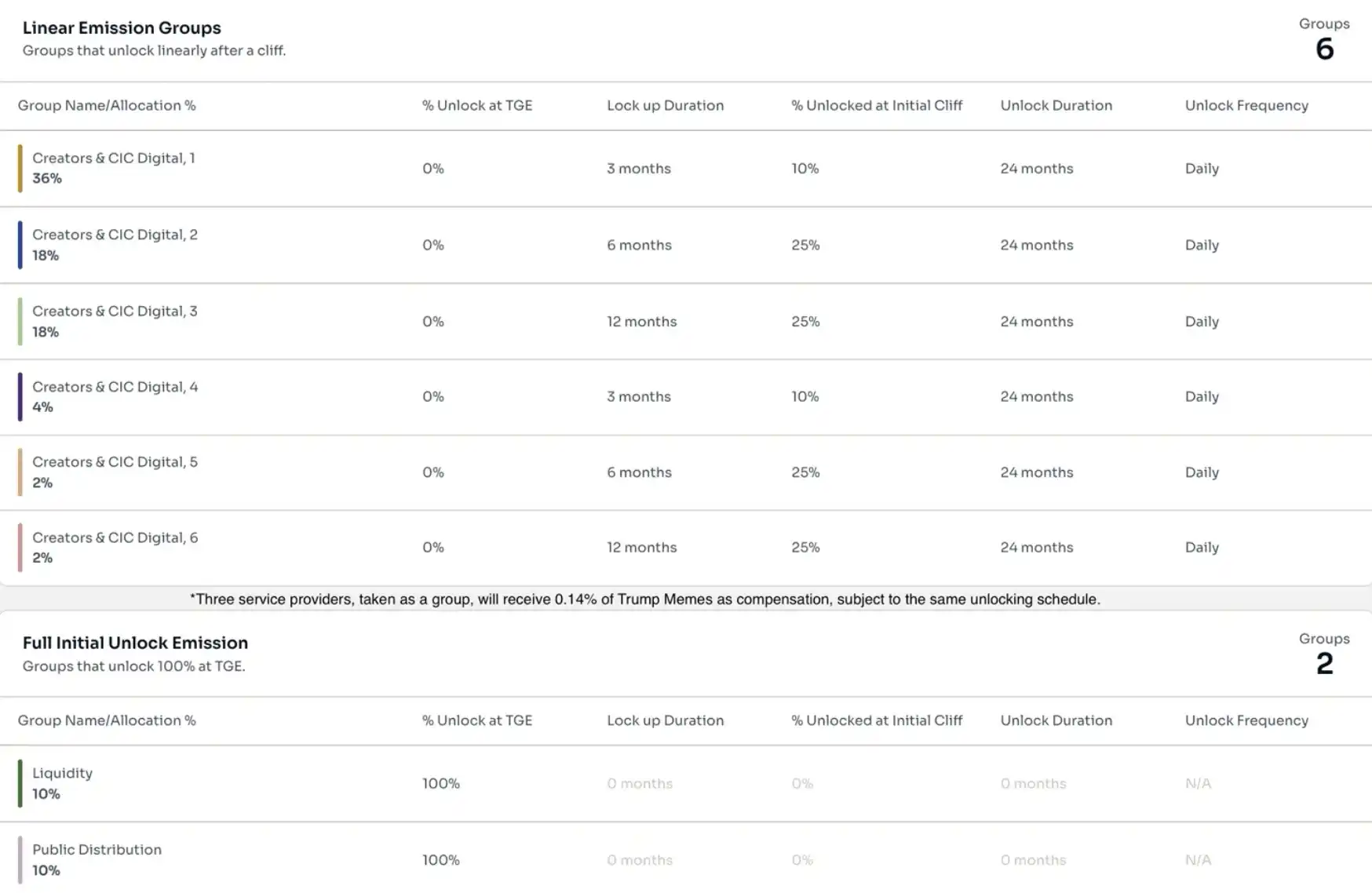
The companies behind $TRUMP include CIC Digital LLC and Fight Fight Fight LLC—both holding 80% of the $TRUMP token supply. Although the full unlock period spans three years, the largest portion—40%—begins unlocking as early as month three. While we don’t know exactly how much insider traders profited beyond that 80%, the fact that Coinbase, Robinhood, and Moonshot (which allows deposits directly from Robinhood) have all listed $TRUMP suggests ongoing support from Trump supporters, traditional stock investors, and countless new retail participants will sustain interest and market cap for some time. Even if the market cap drops to half its current level three months from now, the unlocked 4% stake could still yield several billion dollars in liquidity.
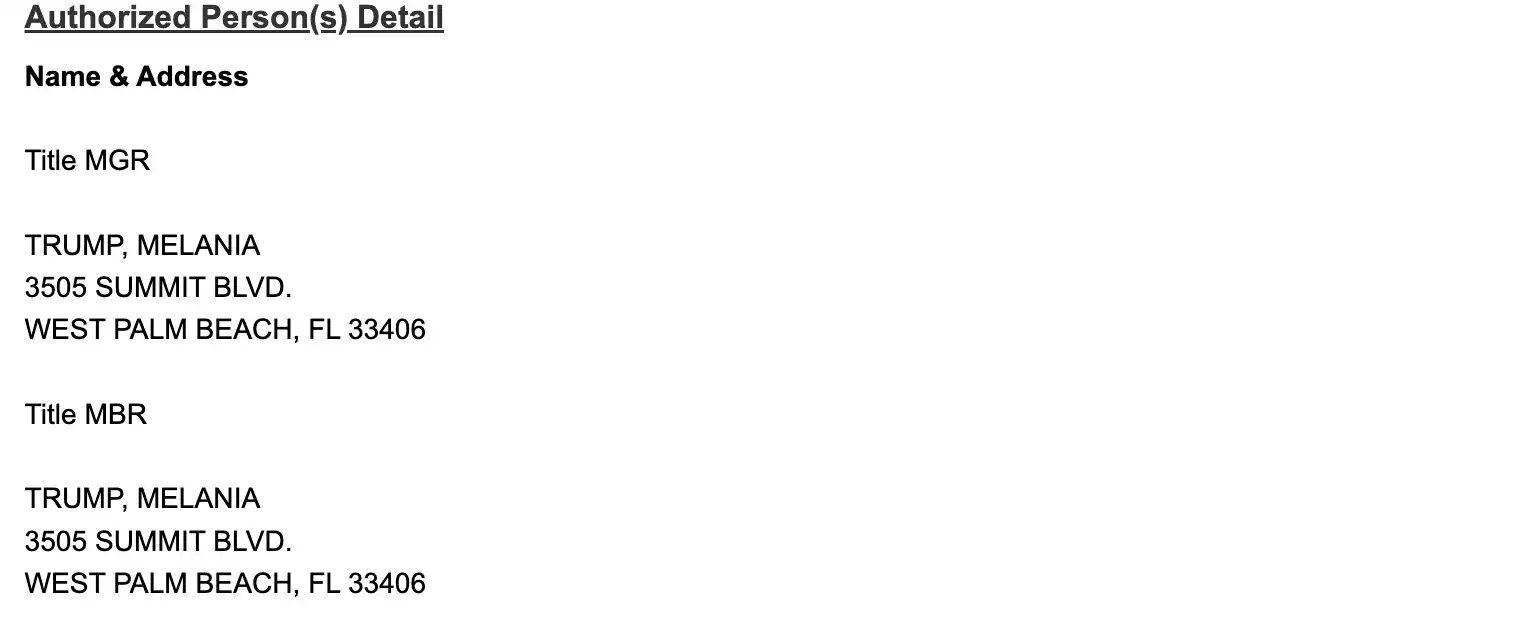
Melania Trump’s token $MELANIA, like her husband’s project, is technically “unrelated” to the President. It is issued by MKT World, LLC. Public records show Melania holds dual roles as member and manager within the company. The company’s address—3505 SUMMIT BLVD., WEST PALM BEACH, FL 33406—is very close to the Trump family residence in Florida.
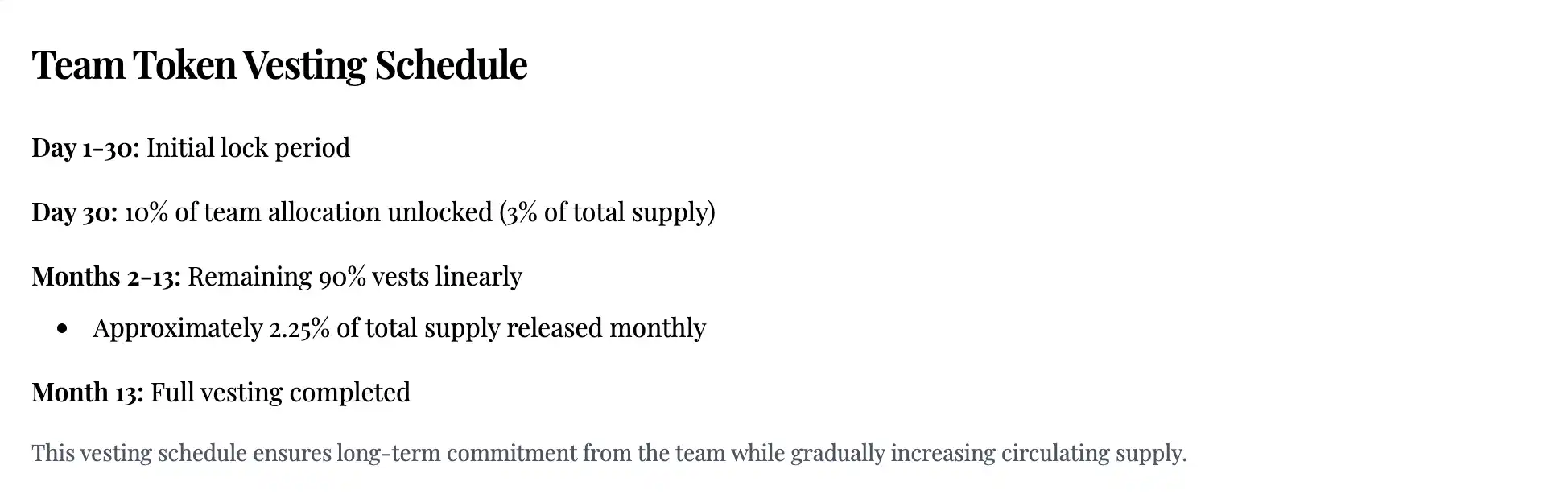
The tokenomics of $MELANIA differ significantly from $TRUMP. Team share: 35%; Treasury: 20%; Community: 20%; Public Sale: 15%; Liquidity: 10%. The biggest difference lies in vesting schedules: TRUMP’s team allocation is locked for three years, whereas MELANIA’s team faces only a 30-day full lockup. Starting on day 30, 10% unlocks, followed by linear monthly releases over months 2–13 until full unlock at month 13. Such short-term, opaque distribution caused the market cap to plunge continuously from $15 billion to $3.3 billion—just 20% of its peak—behaving no differently than a typical scam “pump-and-dump” memecoin. Many speculate whether $MELANIA was merely a tactical move to manipulate $TRUMP’s price action.
No matter what, the Trump team’s previous fundraising attempts retained a sliver of rationality. But these recent actions have left observers stunned. Regardless of disclaimers or legal loopholes, one fact remains undeniable: before making America great again, Trump first made crime great again.
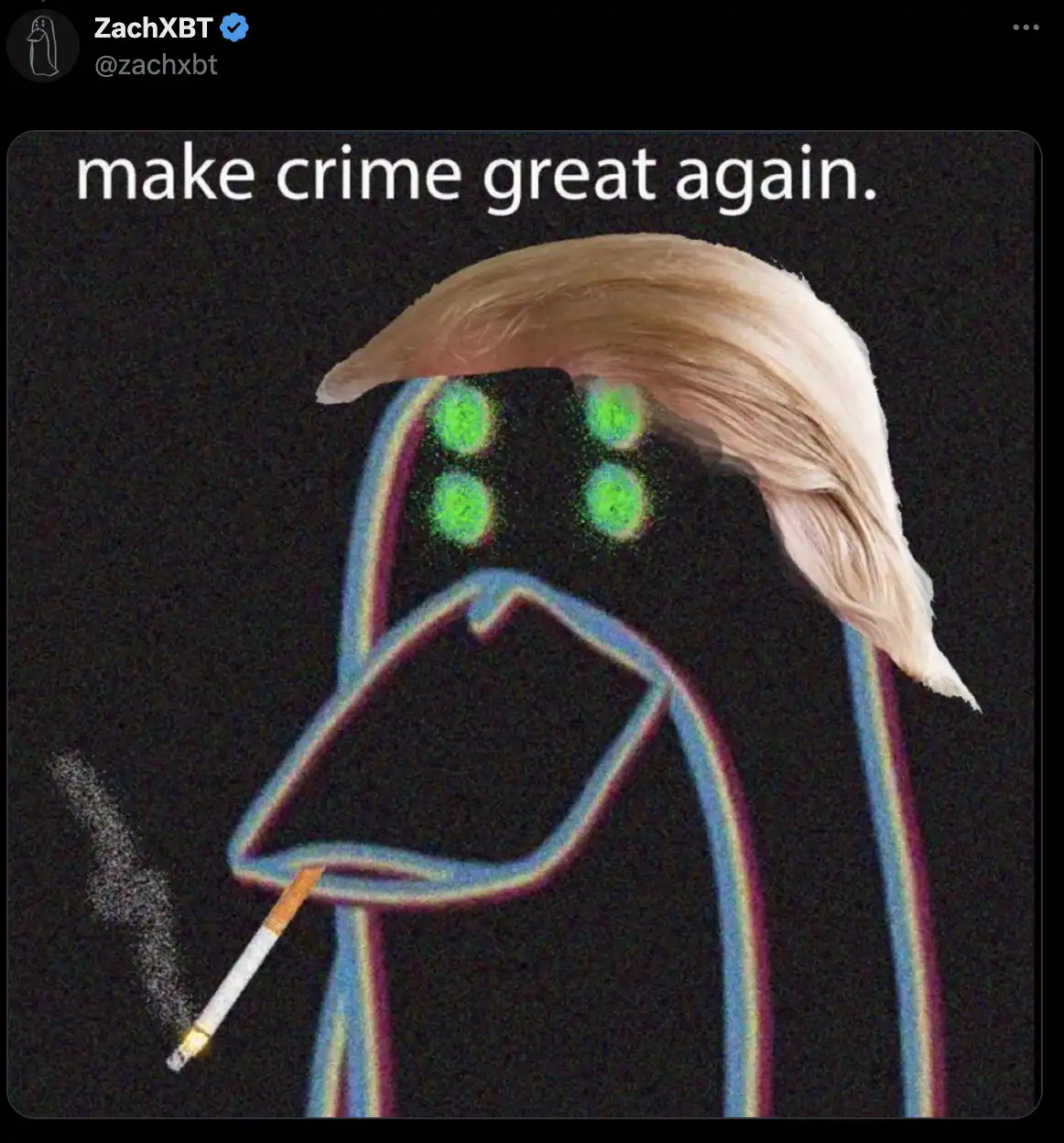
Pro-Trump Crypto Insiders Speak Out: Is the 'Trump Crypto Faction' Splitting?
In fact, not everyone supports Trump’s direct involvement in launching a token. His earlier NFT venture, earning $20 million, seemed relatively “mild,” and many in the community hadn’t yet processed the implications.
But today’s situation is entirely different. To circumvent presidential investment restrictions, on the eve of assuming office, Trump and his wife leveraged token launches, strategic locking, and early buying/high selling to enable their entire network of interests to reap enormous, risk-free profits almost overnight.
Many people can exploit the crypto market—but not the President. This has sparked widespread concern.
Venture capitalist Nick Tomaino wrote on X: “Trump owns 80% of the Trump coin and scheduled the launch just days before inauguration. This is clearly predatory—many people could get hurt.”
Anthony Scaramucci, banker and former White House Communications Director under Trump (who served only 10 days before being fired), also criticized on X: “Trump’s meme coin harms the crypto industry—we can’t fool ourselves.”
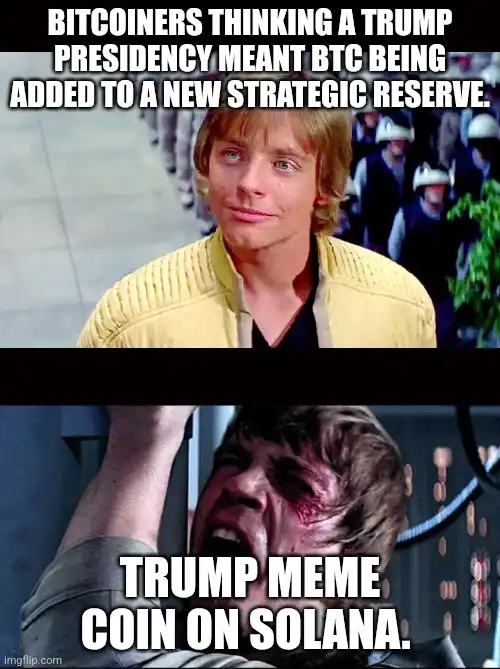
Image source: community
More awkwardly, the crypto community itself now faces embarrassment. We donated political contributions repeatedly. We chanted “Fire Gary Gensler.” We yearned for a pro-crypto president who would bring greater visibility and liquidity to our industry.
Did we succeed? Yes. According to community and exchange insiders, a well-known platform normally sees only hundreds of daily signups and $700,000 in OTC volume. But on January 20, it recorded 120,000 new registrations and $100 million in OTC volume. Another leading exchange saw millions of new users in just three days.
But the path to this achievement wasn’t through adopting Bitcoin as a national strategic reserve, approving new ETFs for major cryptocurrencies, or passing progressive crypto legislation—it was by launching a memecoin that drained most of the crypto ecosystem’s liquidity.
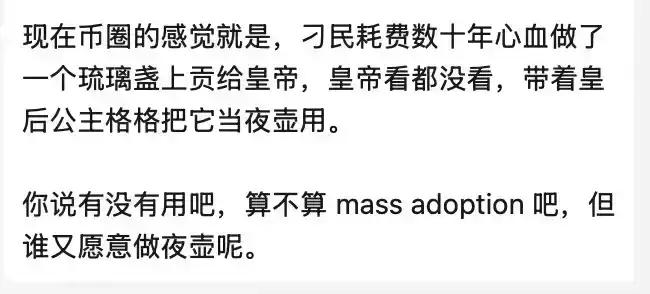
Image source: community WeChat
It’s neither dignified nor ethical. Many who once supported Trump are now publicly opposing him.
“This is absolutely absurd,” said Nic Carter, founding partner at crypto investment firm Castle Island Ventures and self-proclaimed Trump supporter. “They’re launching a meme coin to see just how ridiculous it can get.”
Even Bitcoin Magazine, a pro-Trump crypto media outlet during the election, called TRUMP a “shitcoin” on social media.
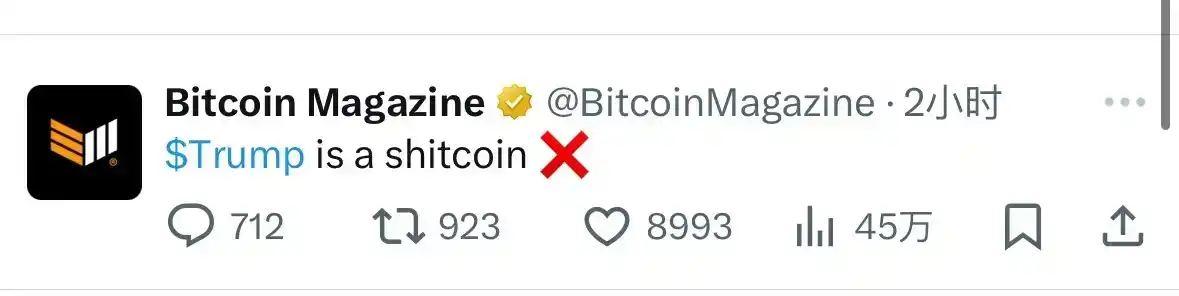
Recall that Trump was marketed as the “first Bitcoin president,” a narrative heavily promoted by Bitcoin Magazine. At their flagship event Bitcoin 2024, Trump personally took the stage, announcing a Bitcoin Strategic Reserve, vowing to make the U.S. the global crypto hub and Bitcoin superpower, and promising to fire SEC Chair Gary Gensler. His pro-crypto policies originated from that speech.
“In my view, this is nothing more than a pump-and-dump scheme for self-enrichment—an unethical act—and those participating (or rather, ‘fans’) are utterly foolish,” authors at Bitcoin Magazine now openly criticize.
Media values flow top-down. David Bailey, CEO of Bitcoin Magazine, though formerly a Trump campaign advisor, reportedly tried to dissuade Trump from launching the memecoin.
He repeatedly clarified on social media: “I have no connection to Trump’s memecoin—no prior notice, no financial interest,” and “My advocacy has always been beneficial to Bitcoin and the nation.”
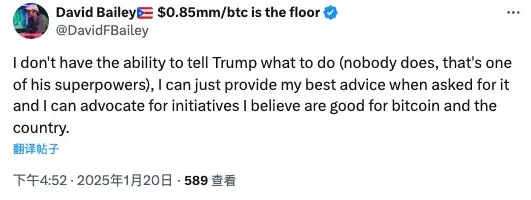
As a former crypto advisor to the campaign, David Bailey now functions more as a mediator between Trump and the community. Despite disagreeing with the token launch plan, he strives to calm tensions: “I’m deeply grateful for everything Trump has done and will continue to do for Bitcoin and the entire industry,” “Events like Ross [Ulbricht]’s release will happen,” “I’ll keep doing my best to support the president and his family’s embrace of Bitcoin and offer honest advice when needed.”
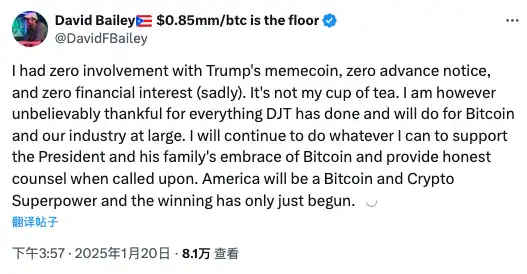
This indicates that Trump’s inner circle in crypto has now split ideologically into two factions.
Bitcoin Magazine represents one faction. Opposite them stands the so-called “Crypto Council,” whose members were personally appointed by Trump.
David Sacks, chairman of the Crypto Council, is best known as a co-founder of PayPal and later gained fame by creating Yammer and selling it to Microsoft for $1.2 billion. In crypto circles, Sacks is most notable as an investor at Multicoin Capital and a staunch Solana maximalist.
“One of the dumbest attacks against me this year was claiming I dumped SOL on retail. If that were true, they’d all be rich by now—congratulations to all SOL holders,” Sacks once said, having never sold SOL even during the FTX collapse.
Given that $TRUMP is built on Solana and Sacks remained silent on these “zero-sum memecoins” during Trump’s announcement, many believe the Crypto Council chair must have been involved.
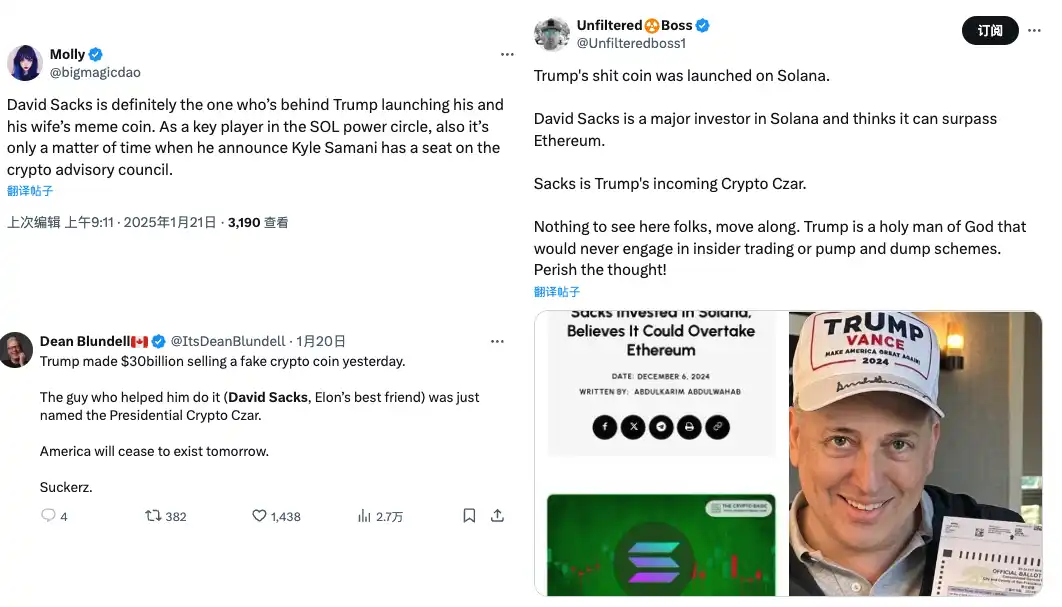
Another piece of evidence: Sacks has a “criminal record.” In March 2024, he posted about a memecoin named $Sacks tied to his own name.
Though he later tweeted nine times telling people not to buy it, this still confirms he “once launched a coin”—using the exact same playbook as $TRUMP. (Community members report Sacks recently deleted his $Sacks-related posts.)
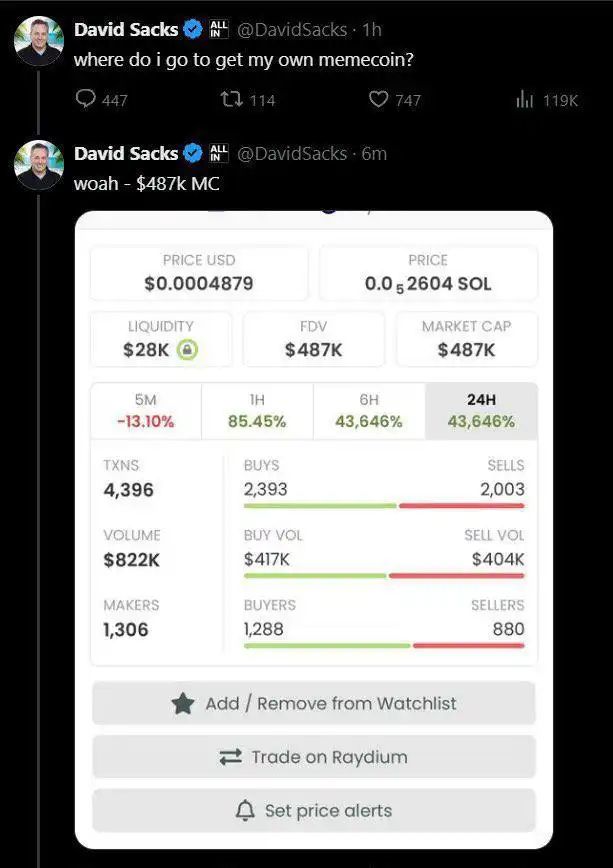
Image source: community
This has turned many against David Sacks, viewing his tactics as overly opportunistic and aggressively profit-driven. Even if Sacks wasn’t directly involved, as head of the Crypto Council, he bears responsibility for this incident. Rumors have even circulated about replacing the entire leadership of Sacks’ council with a new team.
According to an anonymous Washington-based crypto lobbyist, nearly everyone in the crypto sector is now scrambling for a seat on the council. Giants like a16z, Coinbase, Paradigm, Ripple, Kraken, and Circle are all keenly interested, seeking influence over U.S. crypto policy reform.
With even ordinary council seats now highly coveted, every word and action by Chairman David Sacks carries immense weight.
This isn’t the first time the Trump team has shown instability. During his previous term, infighting and frequent staff turnover were common.
In this upcoming term, besides the battle for council seats, internal political risks within Trump’s team manifest in other ways.
Without naming names, Messari founder Ryan Selkis tweeted urging Trump to fire those responsible for launching the $MELANIA project: “The team lacks professional competence, risks significant financial and reputational damage, and failed to adequately consider Trump’s interests.” Selkis pointed out the flaws in $MELANIA.
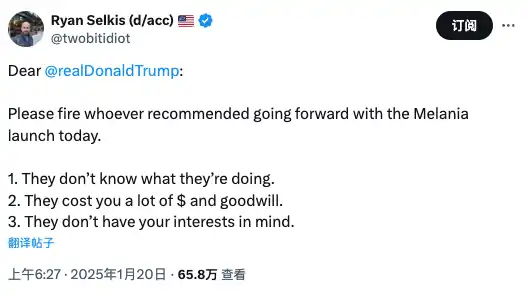
Compared to $TRUMP, Melania’s $MELANIA launch was indeed far more haphazard. Frontend code was incomplete, images unoptimized, the website built only one day prior, and legal texts poorly drafted. Many netizens speculate that $MELANIA differs greatly from $TRUMP in execution, possibly operated by different teams.
“If my sources are correct, $TRUMP was pushed by the crypto czar, while $MELANIA was handled by the worldliberty team. But one thing’s certain: these two tokens weren’t run by the same team,” multiple community members reported.
How Long Does It Take to Burn Trust?
TRUMP emerged at a pivotal moment just before Trump’s inauguration—an event that shocked the world and initially energized the crypto community. We’ve long hoped for crypto to present a more compliant, stable, and secure image to mainstream audiences. Under such hopes, $TRUMP carried immense expectations—it came from the soon-to-be U.S. President. Who wouldn’t imagine this as the beginning of the new U.S. government embracing crypto? Could this historic moment cast crypto in a positive light and draw massive new attention?
TRUMP came from Trump—but disappointingly, not from “President Trump,” but from “Businessman Trump.” “President Trump” could have set higher ethical standards and stronger legal compliance in launching $TRUMP and advancing the broader crypto market. Instead, “Businessman Trump” displayed naked greed and disregard for ethics, treating the crypto market purely as an ATM to monetize his influence, hastily launching asset after asset to extract more profits.
At the end of the day, Trump only pays lip service to the crypto industry for votes. Did he ever seriously consider how to genuinely advance this industry? What we see is a self-centered figure, indifferent to basic industry norms and ethics, placing himself above the entire crypto market. To Trump, the crypto market might feel no different than setting up a roadside stall outside his home—as long as people are willing to pay for his influence, why should he see anything wrong with his actions?
Melania’s token launch has become a bitter joke within the crypto community—a mockery of our naive expectations.
From a speculator’s view, this is undoubtedly a golden era of speculation—no better narrative or thrill exists. But is it truly good for the industry?
What Trump stands to lose isn’t just the crypto community’s trust, but also the moral integrity and responsibility expected of a U.S. President.
Join TechFlow official community to stay tuned
Telegram:https://t.me/TechFlowDaily
X (Twitter):https://x.com/TechFlowPost
X (Twitter) EN:https://x.com/BlockFlow_News
 BlockBeats