Exclusive Interview with Lily Liu, Chair of the Solana Foundation: Building a Blockchain Ecosystem is Like Climbing the Tower of Babel
TechFlow Selected TechFlow Selected
Exclusive Interview with Lily Liu, Chair of the Solana Foundation: Building a Blockchain Ecosystem is Like Climbing the Tower of Babel
Facing the "unprecedented traffic surge," Solana's official team remained unusually calm and restrained.
 Navigating Web3 tides with focused insights
Interviewee: Lily Liu, President of the Solana Foundation
Interview & Article: Anderson Sima, Executive Editor, Foresight News
If we were to conduct a background survey of entrepreneurs in the Web3 world, it would be easy to notice that founders at the top tier of ecosystems and projects are mostly immigrants. Vitalik Buterin, founder of Ethereum, is of Russian descent; CZ (Changpeng Zhao), founder of Binance, is Chinese-Canadian; Elon Musk, the world's richest man who has long followed the crypto space, is originally from South Africa.
AnnaLee Saxenian, a scholar at the University of California, coined a term for this group of immigrants—"New Argonauts." In Greek mythology, the Argonauts were a band of heroes who sailed on the ship Argo in search of the Golden Fleece. Saxenian uses this metaphor to describe modern tech migrants—those who travel from their home countries to new "lands of opportunity," acquire valuable knowledge, skills, and resources, then return home bearing the "Golden Fleece" to drive innovation and technological progress in their native regions.
Solana, which has survived multiple near-death experiences, fits this narrative as well. Of its two co-founders, Anatoly Yakovenko is of Ukrainian descent and Raj Gokal hails from India. Meanwhile, Lily Liu, who leads the Solana Foundation, is also of Chinese heritage.
Lily’s ancestral hometown is Changsha, Hunan. Her parents left mainland China for Taiwan in 1949, later moved to the United States for studies, and settled there as first-generation immigrants. Lily was born in the U.S., yet she still carries cultural imprints of her "spicy girl" roots—flavors shaped by the kitchen aromas of her grandparents’ daily cooking during her childhood. After graduating from Stanford University, Lily re-entered mainland China for her career, working for many years in cities like Beijing and Shanghai. By chance, she began exploring Bitcoin and blockchain technology around 2013. In 2021, upon invitation from Solana co-founders Anatoly Yakovenko and Raj Gokal, she officially joined Solana to lead foundation operations.
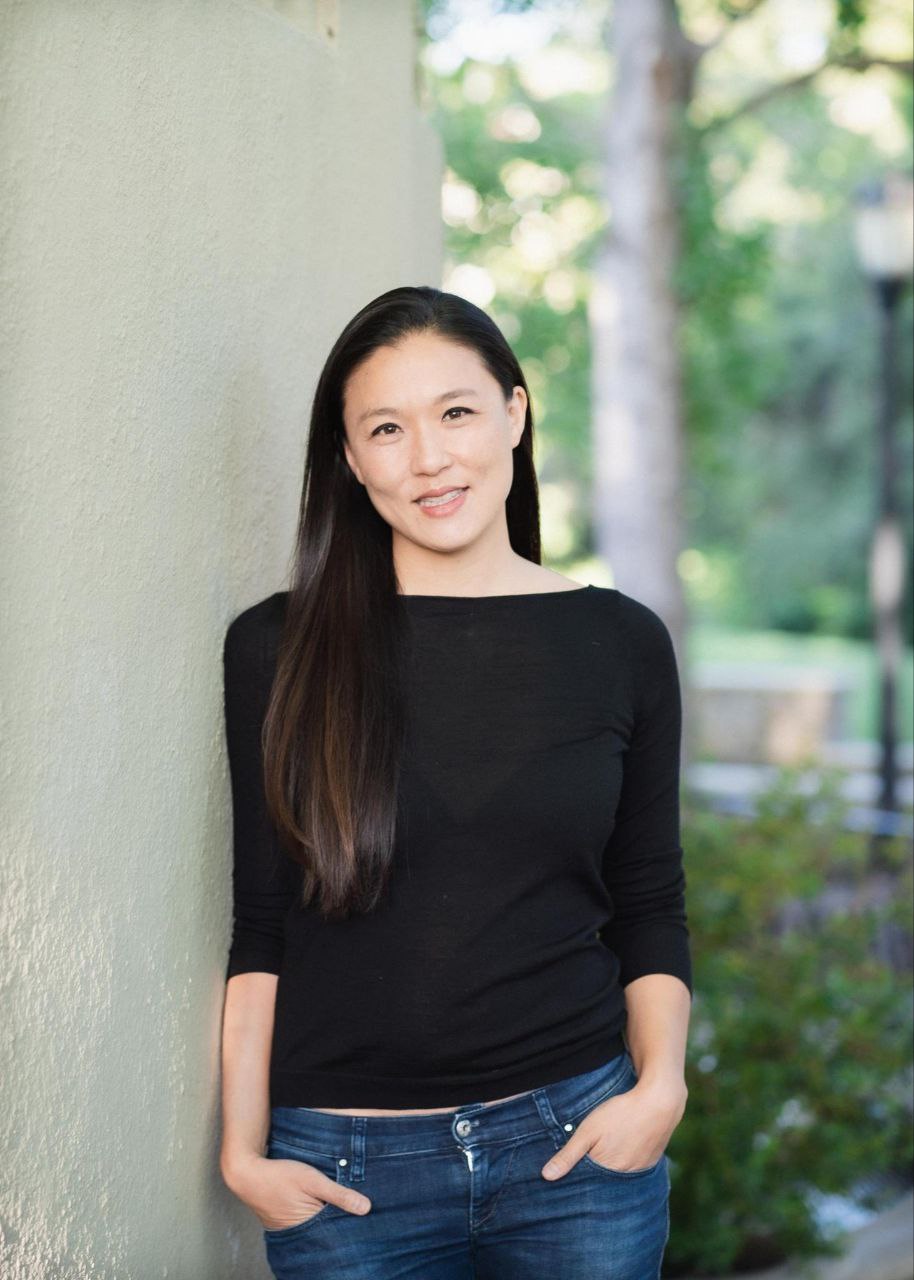
At the beginning of 2025, Foresight News conducted an exclusive interview with Lily. In her view, the current Solana ecosystem does not focus solely on any single type of application innovation such as Memecoins. Rather, Solana aims to become a global emerging financial infrastructure. This explains why communities have flocked to Solana during the recent Memecoin craze—yet official responses from Solana have remained notably calm and restrained amid this surge of attention.
Below is the full transcript, slightly edited:
Foresight News: The year 2024 has just passed. What were Solana’s key developments?
Lily:
By virtually every metric, our ecosystem achieved significant growth in 2024. We saw strong upward trends in transaction volume, user numbers, and capital inflows. Around September or October last year, we surpassed Ethereum on several critical indicators. One was economic value capture at the blockchain level—we overtook Ethereum in October. Additionally, when looking at application-layer revenue, we also exceeded Ethereum. According to recent developer reports, which annually track developer counts across regions over the past six years, our developer community has been the fastest-growing since July last year.
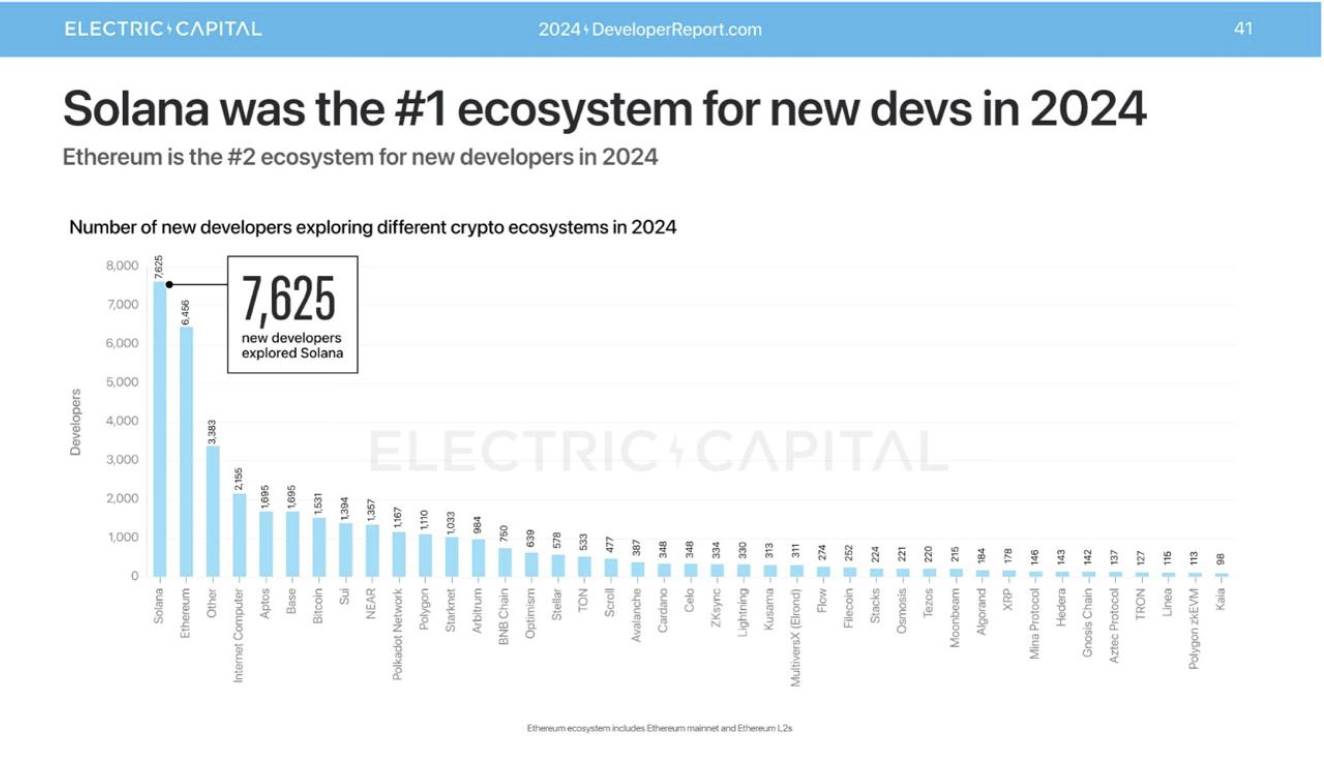
Ethereum currently has about 20,000 developers, having started with smart contracts back in 2015—an early head start. We now have approximately 7,500 developers. Though we began five years later than Ethereum, our growth rate is extremely rapid.
As shown in these data, our blockchain ecosystem has become increasingly rich and valuable, attracting more developers and community participants. The primary goal of application development is to attract users and build profitable products, creating a virtuous cycle.
In 2024, Solana set multiple all-time highs across various metrics.
Foresight News: If you had to pick one keyword to summarize Solana’s performance in 2024, what would it be?
Lily:
It wouldn’t be Memecoin. (Laughs)
Foresight News: What will be Solana’s priorities in 2025?
Lily:
We have several internal strategic plans. Our framework for blockchain growth resembles a three-tier structure. The foundational layer is the blockchain itself—the bedrock of the entire ecosystem. Think of it as land: without it, neither developers nor users can operate.
The second layer is the application layer, where developer communities build applications. Just as fertile land needs houses and developers to create a functioning society, we need people building and operating apps to form an economic system.
The third layer is the “city” layer. For an ecosystem to thrive like successful global cities such as New York, Hong Kong, or Singapore, it needs both culture and unique economic models. As we develop, we must continue innovating in the blockchain network—pushing technical boundaries, increasing bandwidth, and reducing latency at the base layer.
On the application side, our focus is on founders, applications, and tokens. A seminal industry article from 2017 argued that value in blockchains is primarily captured at the application layer—similar to how Facebook and Google captured immense value in Web2. This idea has taken root in the blockchain space: we should prioritize the second layer.
The core asset of our ecosystem is talent. To extend the city analogy: what makes New York truly New York is its international talent pool. Blockchains require technology, but talent is paramount. Over the past decade, many blockchain projects have emerged, yet only Ethereum and Solana have cultivated large-scale developer ecosystems—because building a thriving ecosystem is hundreds of times harder than launching a project.
We’ve always emphasized developers, but today, building successful applications requires broader capabilities—not just coding, but product design, marketing, and more. From day one, blockchain, as envisioned in the Bitcoin whitepaper, promised individual digital ownership and even community ownership—a radical departure from traditional corporate or state-based ownership models, opening up new possibilities.
To realize this vision, several conditions are needed: a high-performance network, a vibrant developer community, sufficient assets, and sound mechanisms for utilizing those assets. On the application layer, we aim to build a robust economic system with a strong focus on on-chain assets.
Moreover, beyond hard technical capabilities, we also need “soft power”—such as culture. Explaining why New York has its unique vibe comes down to intangible qualities. Building a city requires both hardware and software—the latter including human connections and shared culture. Take Abu Dhabi and Dubai: over the past 20–30 years, while developing physical infrastructure, they’ve also attracted cultural institutions like the Louvre Abu Dhabi to cultivate cultural appeal.
Digging deeper, if we want to build a vast economic system on blockchain and attract real assets, we must enable things impossible in traditional systems. So far, blockchain’s allure has largely been speculative. But in the long run, an economy isn’t just about trading—it’s an exchange system. All economies involve transactions, but payments go beyond buying and selling—they’re forms of exchange.
Currently, speculation dominates our industry: an asset rising from $0 to $10 provides early market validation. But long-term, we envision not only trading-focused applications but also large markets centered on payments. We’re not limiting ourselves to either. Our goal is to be a general-purpose platform—just as the internet isn’t just email or a single app. We aim to attract diverse assets and provide financial services across the entire spectrum.
Foresight News: Trump is about to take office. How does Solana view the incoming U.S. government’s crypto regulation?
Lily:
We’re closely watching the Trump administration. Over the past four years, the U.S. government hasn’t been supportive of blockchain—and at times actively opposed crypto. But now, things are shifting. The new administration shows greater recognition and support for technology. We know that over the past 30 years, the U.S. has led every wave of technological advancement in Silicon Valley. We believe the new government will recognize blockchain’s strategic importance to America. Therefore, we are highly optimistic and already planning future collaboration with the U.S. government.
Foresight News: Wall Street poured significant funds into Bitcoin spot ETFs in 2024, but that capital hasn’t flowed into broader ecosystems. Under the new U.S. administration, will we see more talent and capital entering the crypto space?
Lily:
Yes, each cycle brings in more people from diverse backgrounds. The types of talent and capital attracted depend on which application areas are trending.
This cycle is seeing growing interest in novel applications—for example, structured financial products on-chain that mirror traditional finance, offering vast design potential. This opens doors for Wall Street professionals to contribute. We’re already seeing new innovations like Ethena, a novel stablecoin with its own technical architecture. Talent from traditional finance can study such models and adapt conventional financial designs for on-chain use. These integrations will spawn new products and visions, driving ecosystem growth.
Foresight News: Vitalik commented that Solana lacks sufficient decentralization. Yet, many projects recently announced moves to Solana. How do you view the competitive relationship between Solana and Ethereum?
Lily:
I deeply respect Ethereum’s original team. Their vision in 2015 to build Ethereum and actually deliver the technology was extraordinary. They genuinely valued decentralization and understood its significance. Last year, Vitalik wrote articles outlining principles and visions fully aligned with blockchain’s core ideals.
But Ethereum and the EVM ecosystem have evolved significantly. The EVM community is now vast, and some old metrics no longer reflect reality. We can’t keep viewing things through outdated lenses. The understanding of decentralization has changed dramatically since 2020. Many oversimplify it—believing more nodes automatically mean a better chain—but that’s not accurate.
We made deliberate technical choices, such as raising node requirements and costs—about double that of Ethereum (not tenfold)—to enhance product functionality and user experience, easing burdens for users and developers. Thus, some industry views on decentralization are based on outdated or incorrect assumptions.
Additionally, some Layer-2 projects claim to prioritize decentralization while employing centralized components—like using a centralized sequencer—which is logically inconsistent.
Foresight News: What about your relationship with Sui and Base ecosystems?
Lily:
I know many developers appreciate Sui’s programming language. We welcome competition—it pushes us to innovate faster and better. Sui has built a successful ecosystem focused on products, applications, and users. We hope to learn from them.
Regarding Base, recall Bitcoin’s original vision: community ownership, emphasizing individual and collective control. But Base presents a contradiction. Last year’s data shows most of its network fees went directly to Coinbase’s profits, with very little flowing back to the Ethereum mainnet—most retained internally.
On an annualized basis, Coinbase earned nearly $100 million from Base. As a company serving shareholders, this is understandable. But from a blockchain philosophy standpoint—centered on individual and community ownership—Base primarily represents corporate ownership, which contradicts core blockchain values.
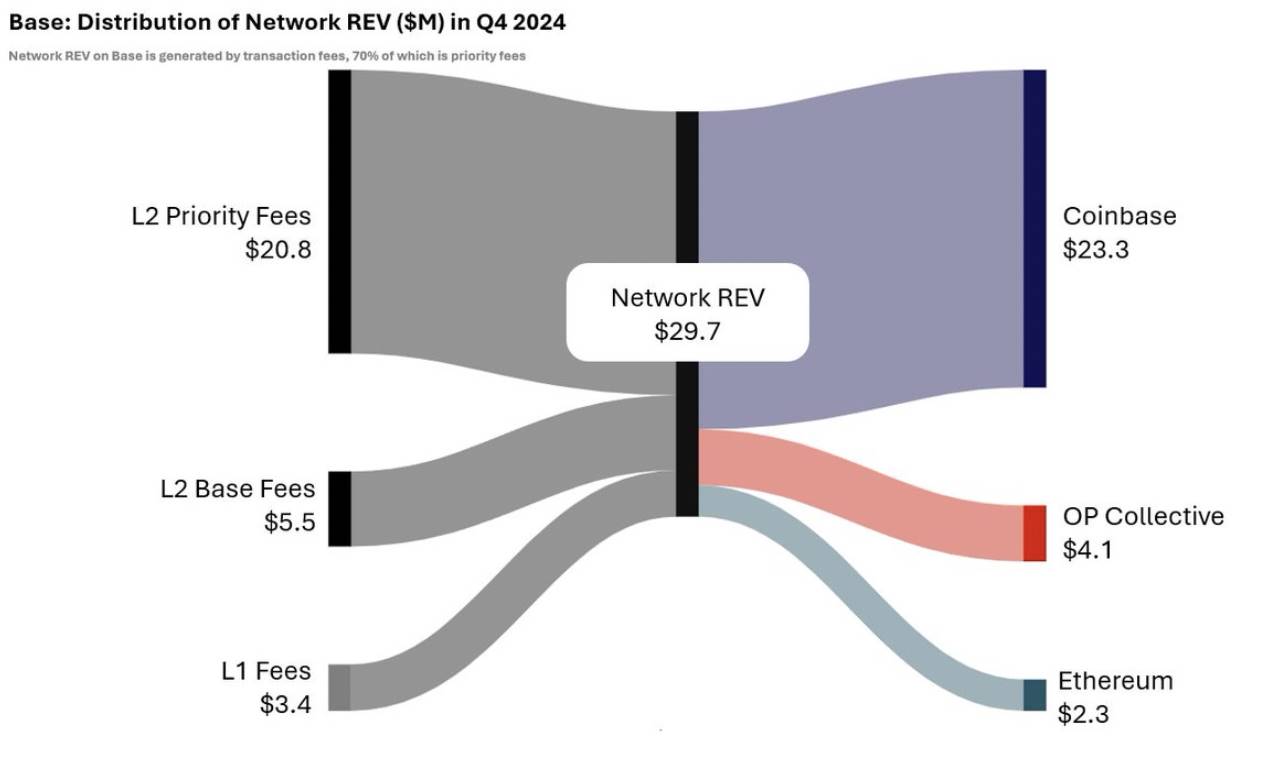
Coinbase Q4 2024 Revenue Breakdown, image source: X
Foresight News: The two hottest sectors in 2024 were Memecoins and AI Agents. What’s your take on them?
Lily:
To me, Memecoins are a form of asset. Each cycle brings different tech trends—NFTs, GameFi, DePIN—and they all share one thing: they need traffic. Wherever the traffic flows, people follow.
When I joined Solana, the community saw it as an NFT chain. Later, a DePIN chain. Now, jokingly, a “Meme chain.” But we’ve never defined ourselves as serving just one niche. We aim to be a general-purpose platform.
Many AI projects choose to launch tokens on Solana because of its high performance, speed, low fees—and crucially, because Solana offers traffic. Without visibility, there’s no pricing.
No one calls Ethereum a “single-use” chain because it was designed from the start as a general-purpose computer. After years of development, we’ve become exactly that—a general-purpose platform.
Foresight News: What’s your view on AI + Crypto?
Lily:
I believe every new technology follows a “Gartner Hype Cycle.” Each goes through initial discovery and explosive hype, followed by a trough of disillusionment, then gradual recovery, and finally stable growth. Blockchain has followed this path—first NFTs, now Memecoins and AI. These will endure long-term but must pass through this cycle.
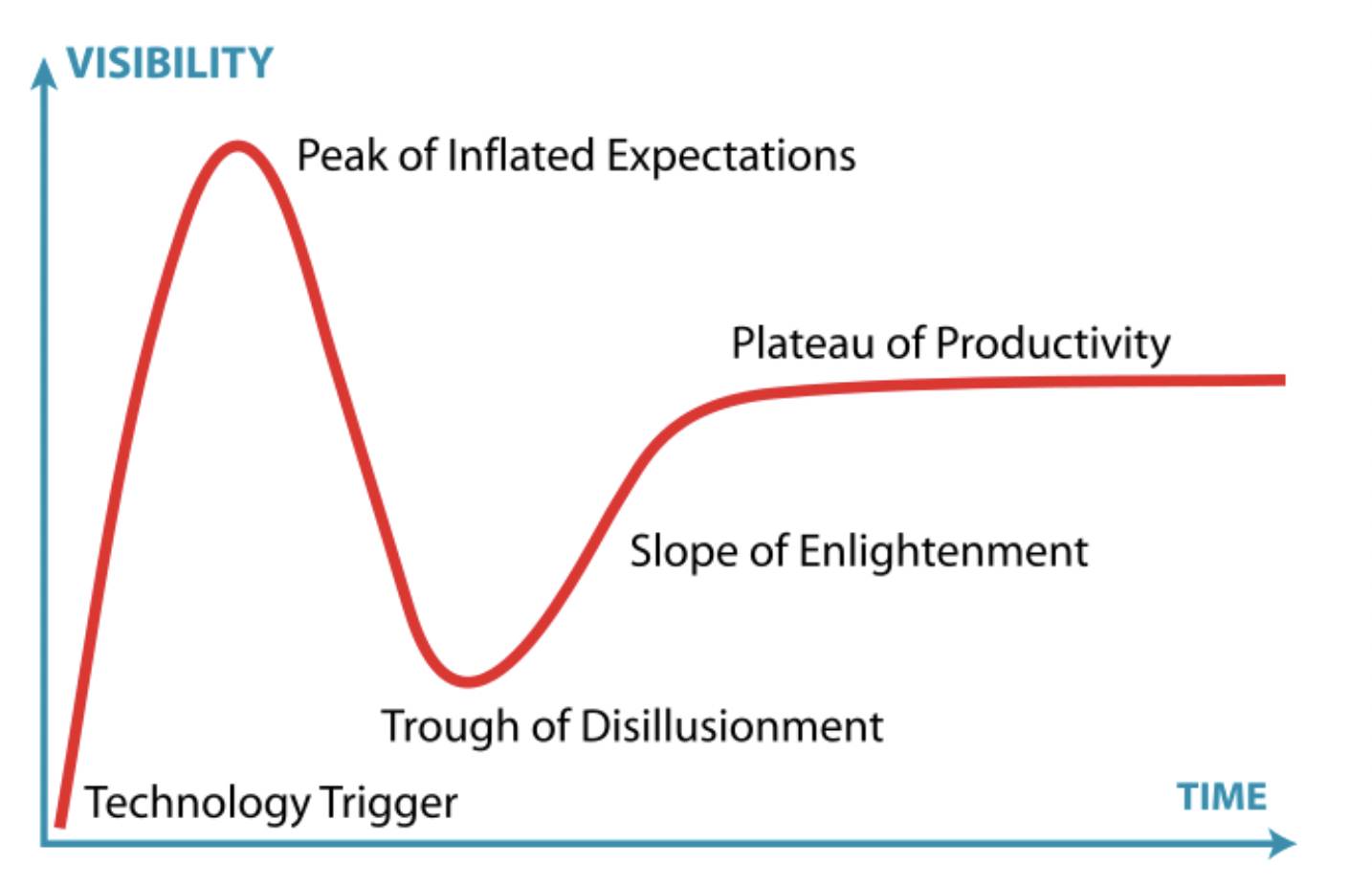
Gartner Hype Cycle, image source: Wikipedia
I think AI is currently in the first phase—experiencing massive growth with long-term potential, but likely overhyped. Many so-called innovations were discussed a decade ago—like AI-driven trading. Now, some applications are finally implementing these ideas.
Foresight News: Let’s dive deeper into the Solana ecosystem. Backpack Exchange recently acquired FTX Europe’s derivatives license. Did the Solana Foundation play any role in this?
Lily:
Not at all. Honestly, I only learned about this news from you just now—I should go congratulate them. (Laughs)
Foresight News: In 2024, Solana launched Blinks and updated its mobile phone to the second generation. But after the initial buzz faded, did these initiatives stall?
Lily:
Blinks is a developer tool, not a consumer-facing product. Its purpose is to empower developers to build new products that end users can enjoy. Long-term, Solana plans to integrate many features, and Blinks is one of the key tools for developers. Launched six months ago and now open-source, many are already using it behind the scenes to build payment apps, token issuance tools, and more. Its uniqueness lies in enabling seamless integration and usage within any social media platform.
Foresight News: What about the Solana phone?
Lily:
The phone isn’t a product developed directly by our foundation—it’s a project by another team. The second-generation device, Seeker, hasn’t been officially released yet. From the foundation’s and broader ecosystem’s perspective, mobile devices are critically important because most global internet users access it via smartphones. Currently, blockchain experiences on mobile face challenges: security issues, and restrictive policies from Apple and Google’s App Stores—such as Apple’s 30% commission—which affect both business models and software solutions.
Some teams are attempting to rebuild the integration of blockchain and mobile devices from scratch. We strongly welcome diverse mobile hardware and software efforts. There are phones targeting different price points—$99 devices aimed at African and South American markets, and others around $500. We believe multiple options are essential to meet varied consumer needs.
Foresight News: Recently, winning projects from Solana hackathons have gained popularity in the community. What’s your take?
Lily:
I see our hackathons primarily as technical and developmental events. It’s natural for people to care about monetization, but our main focus is nurturing developer community growth from a technical standpoint. I especially hope to see more representation from the Chinese-speaking region at these hackathons, as I’ve always viewed it as a vital market.
Our industry has two major markets: the U.S. and the Chinese-speaking world. Since joining the Solana Foundation three years ago, we’ve worked on global expansion, turning Solana into an international brand, operating in about 20 countries. If we categorize markets by talent and capital, only the U.S. and China possess both. Europe excels in high-end developer talent, India in developer volume, and the Middle East in capital.
Over the past four years, both the Chinese-speaking region and the U.S. faced regulatory constraints. Now, the U.S. is opening up, and the Chinese-speaking region is seeing renewed opportunities for technical collaboration. I’m highly optimistic about this region and eager to attract its talent—because talent is the most valuable asset in any ecosystem.
Our challenge is how to attract such talent. It ultimately comes down to what our project offers. Attracting talent means convincing them to leave stable jobs and start something new—that’s a high bar. I understand different regions have different considerations, so we continuously rethink how to make Solana more appealing and recognized by top talent.
Foresight News: There are many foundations in the industry. How do they differ from traditional foundations, and what roles do they play?
Lily:
A foundation is first and foremost a legal entity, which enables blockchain projects to operate within existing legal frameworks—since current laws require formal entities. I remember Ethereum initially chose to register a foundation in Switzerland—an early experiment that others later followed.
Traditional foundations, like the Gates Foundation, are typically funded through profits from companies like Microsoft, often for tax optimization—donating earnings to reduce tax liability, or even avoiding taxes altogether.
Blockchain foundations, however, serve a completely different purpose. While also legal entities, their assets don’t come from self-generated profits but are allocated by the project itself. Their role is to act as stewards of community ownership, providing public goods—much like governments provide public services. This includes supporting developer tools and coordinating public infrastructure development. Since most companies focus on proprietary, profit-driven products, they won’t fund these communal needs. That’s where foundations step in. In this sense, blockchain foundations resemble city governments. We are civil servants in the tech realm—here to serve the community.
Foresight News: In many industries, gender issues and related topics are sensitive. What’s your view on women in the blockchain workforce?
Lily:
I’ve worked in this space for 10 years, and I’ve never felt gender affected my work performance or environment. Perhaps my experience has been fortunate, but I’ve always believed this industry welcomes innovation from people of all backgrounds. A brilliant 20-year-old developer and a seasoned 50+ trader from Wall Street can collaborate seamlessly. Blockchain doesn’t care about your past—it values contributions. Whether male or female, which language you speak, your background, or age—it doesn’t matter. Of course, misconduct exists anywhere—one harasser doesn’t represent our entire industry.
I believe blockchain offers tremendous opportunity—equal access, not equal outcomes, but equal opportunity. This isn’t achievable everywhere, due to economic, political, or employment barriers in many countries. That’s why the blockchain ethos is so powerful—it draws people not only for technology or profit, but for the promise of equality, enabling anyone, from any background, to join a global platform.
Join TechFlow official community to stay tuned
Telegram:https://t.me/TechFlowDaily
X (Twitter):https://x.com/TechFlowPost
X (Twitter) EN:https://x.com/BlockFlow_News
 Foresight News