








Galaxy 2024 Q4 Crypto Venture Capital Report: Crypto VC Remains Challenging
TechFlow Selected TechFlow Selected
Galaxy 2024 Q4 Crypto Venture Capital Report: Crypto VC Remains Challenging
Although Bitcoin has reached a new all-time high, crypto venture investment activity remains far below previous cycle peaks.
 Navigating Web3 tides with focused insights
Author: Alex Thorn, Gabe Parker, Galaxy
Translation: Luffy, Foresight News
Introduction
2024 marked a landmark year for the cryptocurrency market, beginning with the launch of spot Bitcoin exchange-traded products (ETPs) and concluding in November with the most crypto-supportive U.S. presidential election and Congress in history. The total market capitalization of the crypto market grew by $1.6 trillion in 2024, an 88% year-on-year increase, reaching $3.4 trillion by year-end. Bitcoin alone added $1 trillion to its market cap, approaching $2 trillion by the end of the year. The momentum in the crypto market this year was driven not only by Bitcoin's rapid price surge but also by Memecoins and AI-related cryptocurrencies. For much of the year, Memecoins dominated headlines, with most on-chain activity occurring on the Solana blockchain. In the second half, AI agent-related crypto projects emerged as the new focus.
Venture capital (VC) investment in the crypto sector remained challenging throughout 2024. Mainstream trends such as Bitcoin, Memecoins, and AI agents are generally ill-suited for traditional venture investing. Memecoins can be launched with just a few clicks and, along with AI agent tokens, operate almost entirely on-chain using existing infrastructure primitives. Previously popular sectors from the last market cycle—such as decentralized finance (DeFi), gaming, metaverse, and non-fungible tokens (NFTs)—either failed to capture significant market attention or have matured to the point where they require less funding and face increasingly fierce competition. Most crypto market infrastructure businesses have already been built out and are now in later stages of development. With anticipated regulatory changes under the next U.S. administration, these areas may also face growing competition from traditional financial services intermediaries. There are signs that new themes are emerging and could become key drivers of future capital inflows, though many remain nascent or even embryonic: notable among them are stablecoins, tokenization, DeFi-TradFi convergence, and the intersection of crypto and AI.
Macroeconomic and broader market forces also posed headwinds. The high-interest-rate environment continued to pressure the venture capital industry, making capital allocators less willing to take on higher risk. This squeeze affected the entire VC sector, and crypto venture investing—perceived as particularly risky—was likely hit harder. Meanwhile, major generalist venture firms largely remained cautious toward the space, possibly still reeling from the collapse of several prominent VC-backed companies in 2022.
Therefore, despite significant future opportunities—whether through the resurgence of existing narratives or the emergence of new ones—crypto venture investing remains highly competitive and relatively subdued compared to the frenzy of 2021 and 2022. While both deal counts and investment amounts increased, the number of new funds stagnated and capital allocated to VC funds declined, creating an especially competitive landscape that favors founders in valuation negotiations. Overall, venture investment remains far below the levels seen in the previous market cycle.
Nonetheless, rising institutional adoption of Bitcoin and digital assets, growth in stablecoins, and potential regulatory shifts that could finally enable DeFi-TradFi integration point to new avenues for innovation. We expect venture activity and interest to rebound significantly in 2025.
Key Takeaways
-
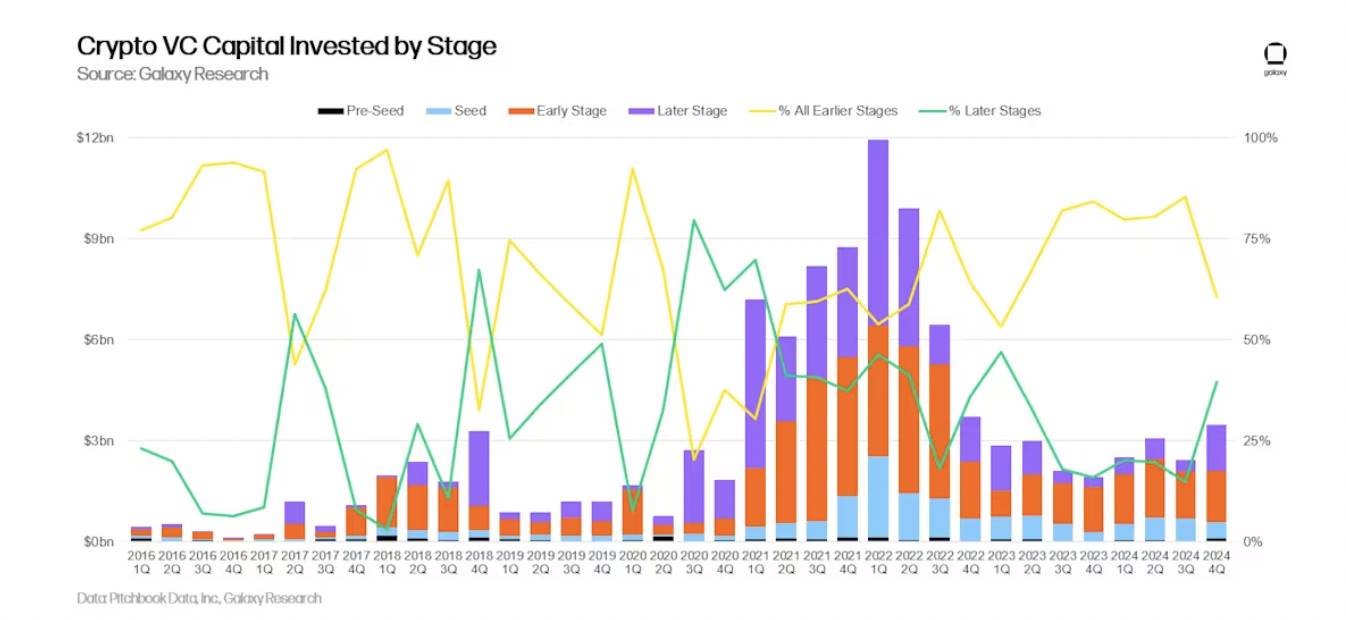
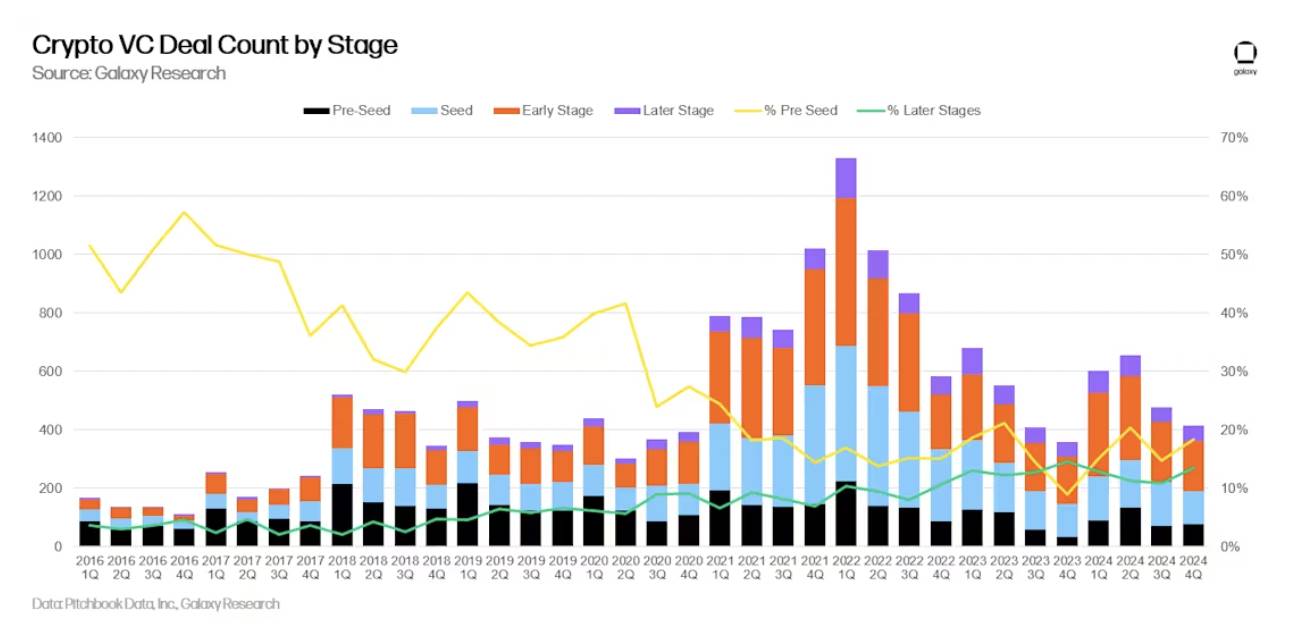
In Q4 2024, venture capital investment into crypto startups reached $3.5 billion (up 46% quarter-on-quarter), across 416 deals (down 13% QoQ).
-
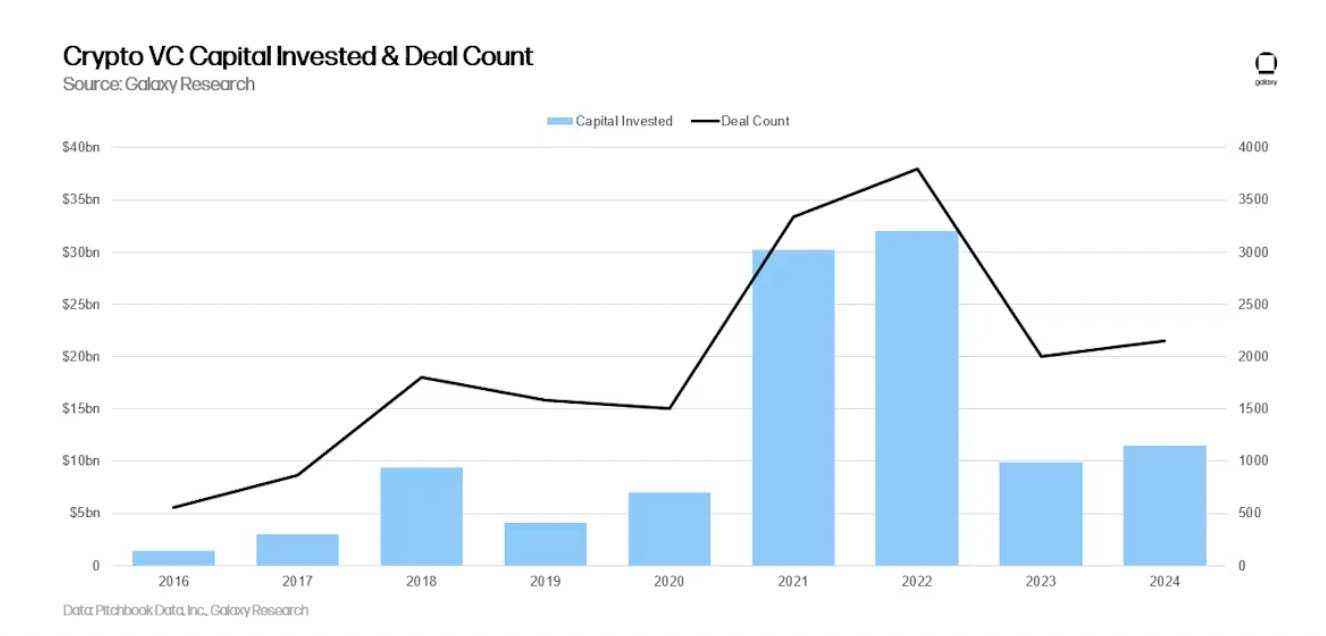
For all of 2024, VC firms invested $11.5 billion into crypto and blockchain startups across 2,153 deals.
-
Early-stage deals attracted the majority of capital (60%), while late-stage deals accounted for 40% of invested capital—a significant increase from 15% in Q3.
-
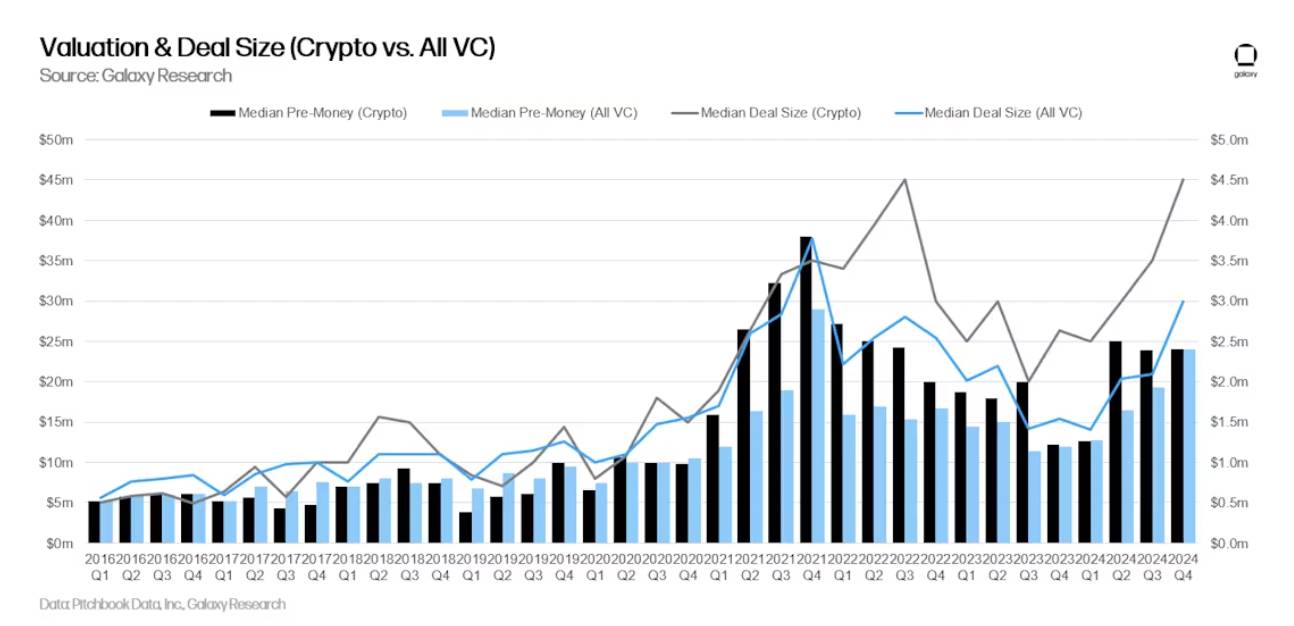
Median valuations for VC deals rose in Q2 and Q3, with crypto deal valuations growing faster than the broader VC industry, though they plateaued quarter-on-quarter in Q4.
-
Stablecoin companies raised the most capital, led by Tether’s $600 million raise from Cantor Fitzgerald, followed by infrastructure and Web3 startups. Web3, DeFi, and infrastructure companies saw the highest number of deals.
-
In Q4 2024, U.S.-based startups received the largest share of investment capital (46%), with Hong Kong-based firms increasing their share to 17%. By deal count, U.S. startups led at 36%, followed by Singapore (9%) and the UK (8%).
-
In fundraising, allocator interest in crypto-focused VC funds dropped to $1 billion across 20 new funds.
-
In 2024, at least 10 crypto venture funds raised over $100 million each.
Venture Investment Overview
Deal Count and Investment Volume
In Q4 2024, venture capitalists invested $3.5 billion into crypto and blockchain-focused startups (up 46% QoQ), across 416 deals (down 13% QoQ).
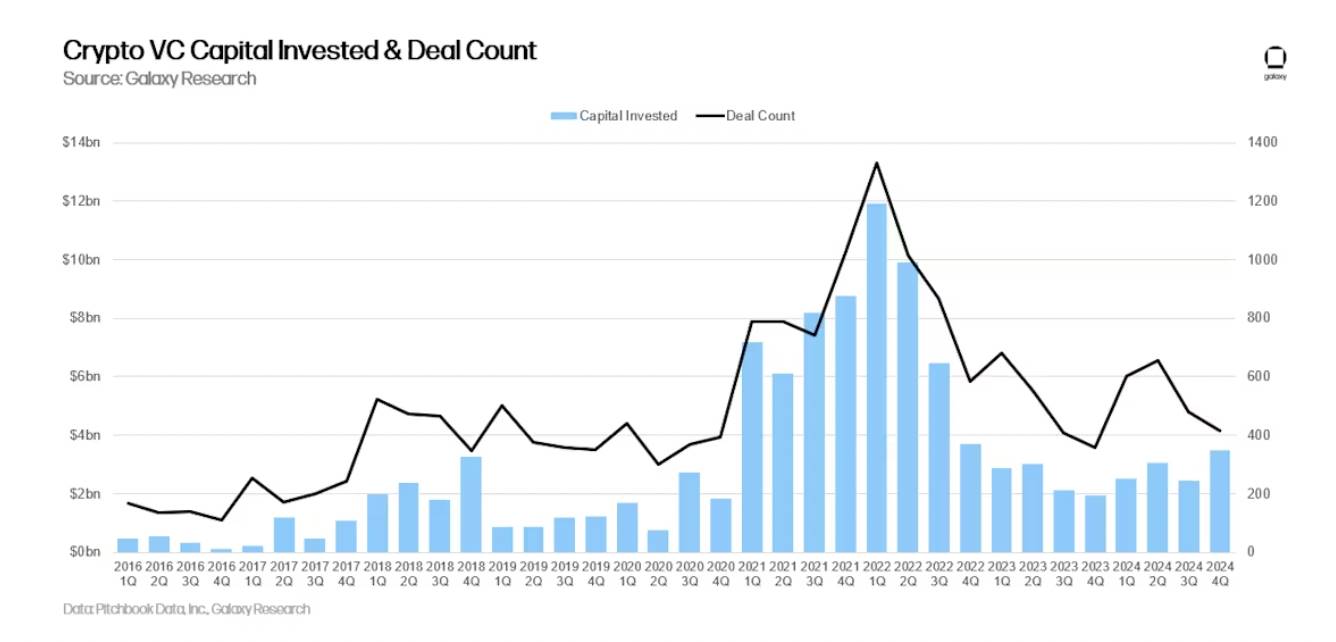
For the full year 2024, VCs invested $11.5 billion into crypto and blockchain startups across 2,153 deals.
Investment Volume vs. Bitcoin Price
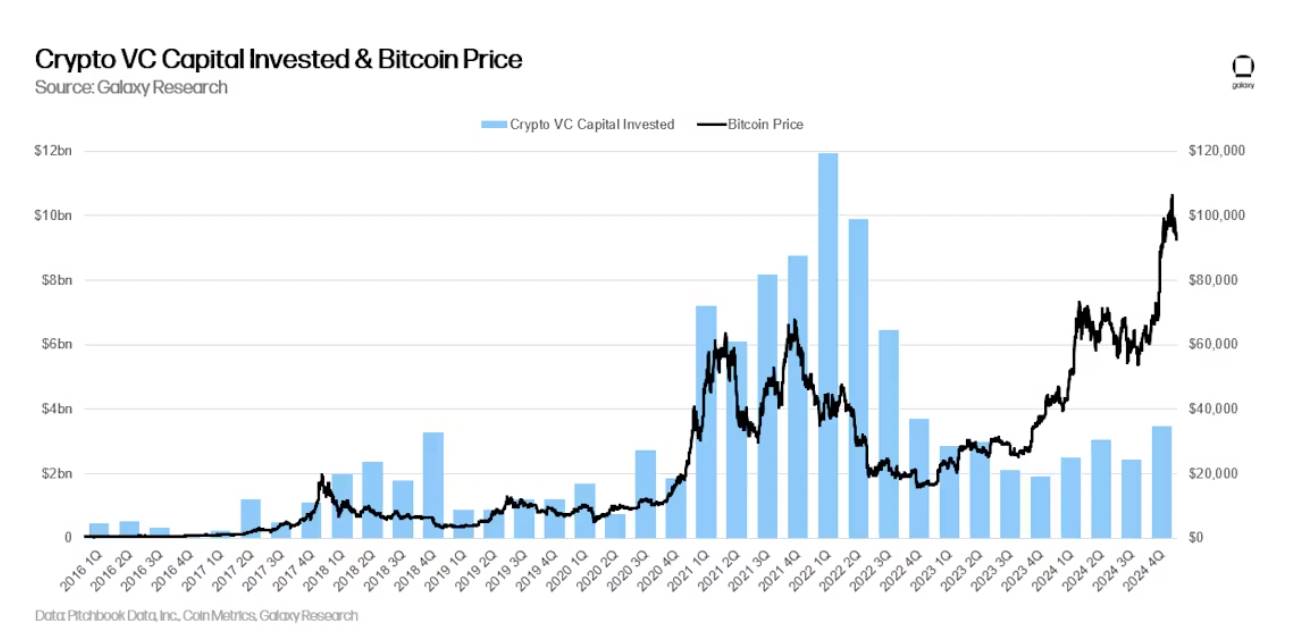
Over past cycles, there has been a long-term correlation between Bitcoin prices and investment volumes into crypto startups. However, this relationship was notably absent over the past year. Since January 2023, Bitcoin’s price surged dramatically, but venture investment did not keep pace. Reduced interest from capital allocators in both crypto and broader VC investing—combined with the market’s strong preference for the Bitcoin narrative, sidelining many of the hot themes from 2021—help explain this divergence.
Investment by Stage
In Q4 2024, 60% of venture capital went to early-stage companies and 40% to late-stage companies. VCs raised fresh capital in 2024, and crypto-focused funds may still have deployable capital from large fundraisings conducted years earlier. The share of funding going to late-stage companies increased since Q3, partly due to Tether’s reported $600 million financing from Cantor Fitzgerald.
The proportion of pre-seed deals rose slightly, remaining healthy compared to prior cycles. We track pre-seed deal share as a proxy for entrepreneurial activity.
Valuations and Deal Sizes
In 2023, valuations for VC-backed crypto companies declined sharply, hitting their lowest level since Q4 2020 by the end of the year. However, as Bitcoin reached new all-time highs in Q2 2024, valuations and deal sizes began to rebound. Q2 and Q3 2024 saw valuations reach their highest levels since 2022. The rise in deal sizes and valuations in the crypto sector mirrored broader VC trends, though the recovery in crypto was stronger. The median pre-money valuation for deals in Q4 2024 was $24 million, with an average deal size of $4.5 million.
Investment by Category
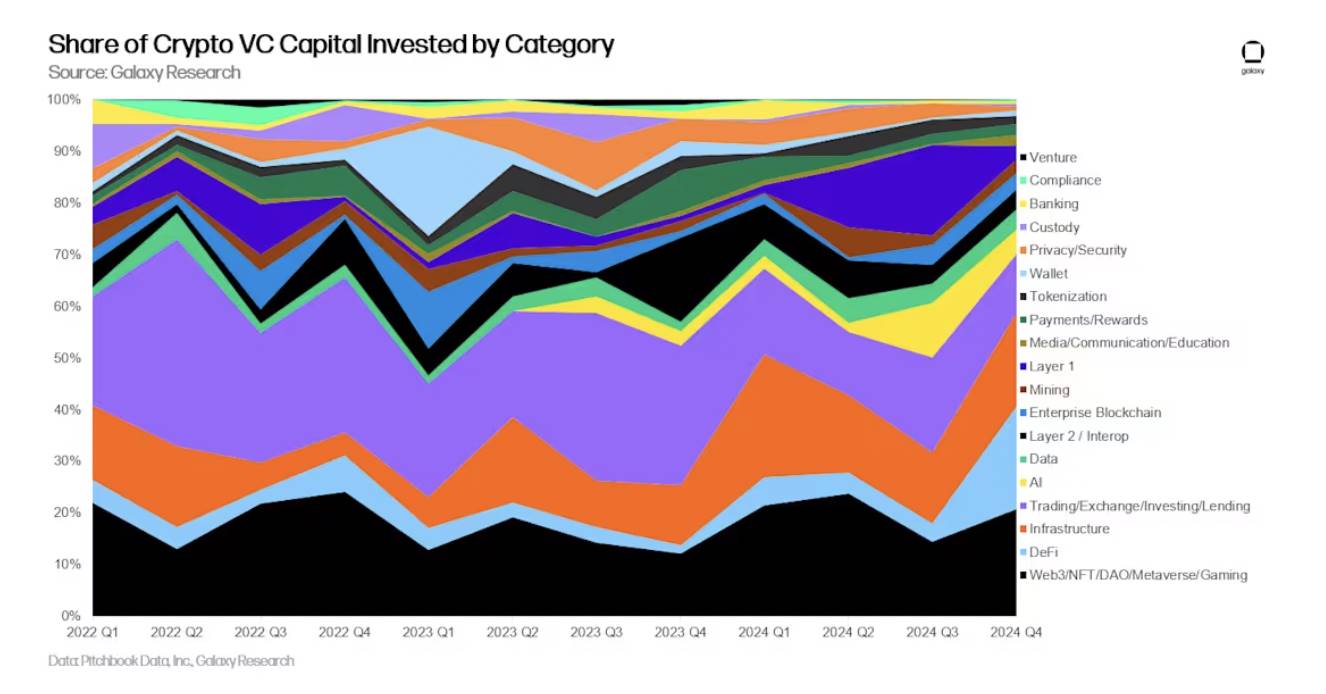
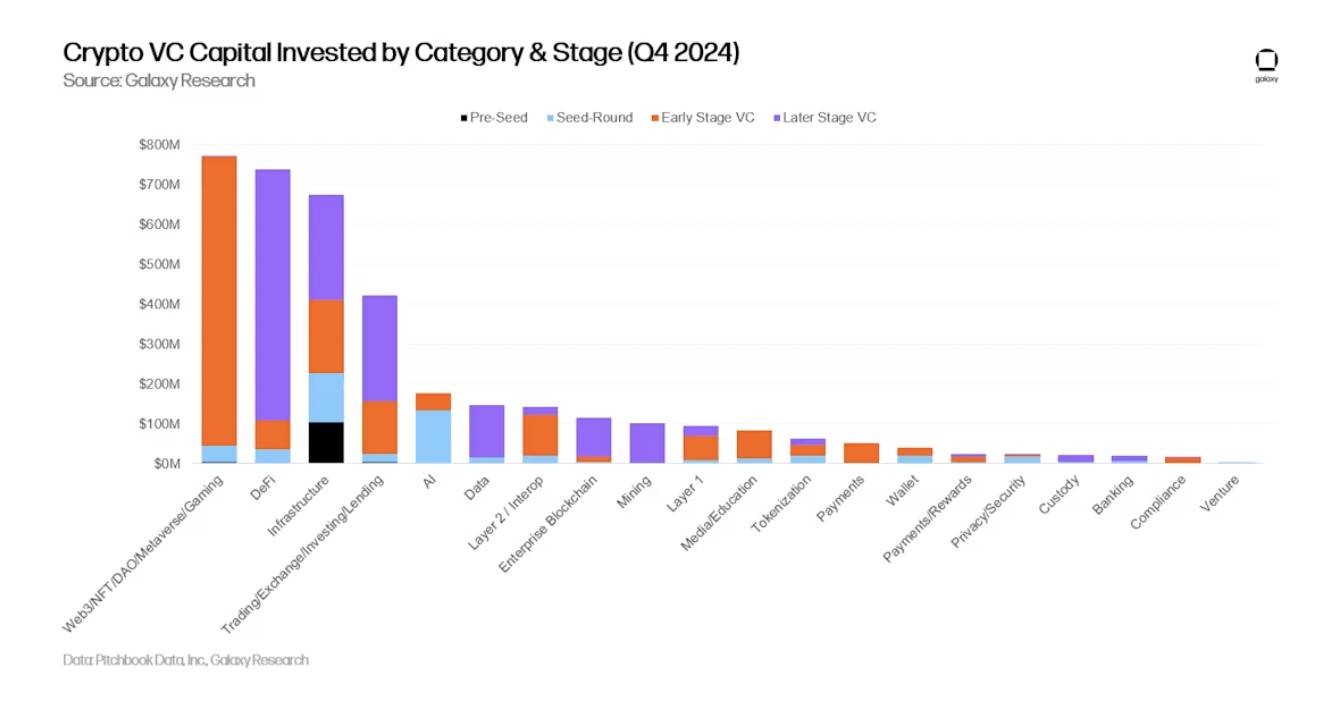
In Q4 2024, companies and projects in the "Web3/NFT/DAO/Metaverse/Gaming" category received the largest share of venture capital (20.75%), totaling $771.3 million. The three largest deals in this category were Praxis ($525 million), Azra Games ($42.7 million), and Lens ($31 million). DeFi’s dominance in total crypto VC funding stemmed from Tether’s $600 million transaction with Cantor Fitzgerald, which acquired a 5% stake in the company (we classify stablecoin issuers under our broad DeFi category). Although this deal wasn’t structured as a traditional VC round, we include it in our analysis. Excluding Tether’s deal, DeFi would rank 7th by investment volume in Q4.
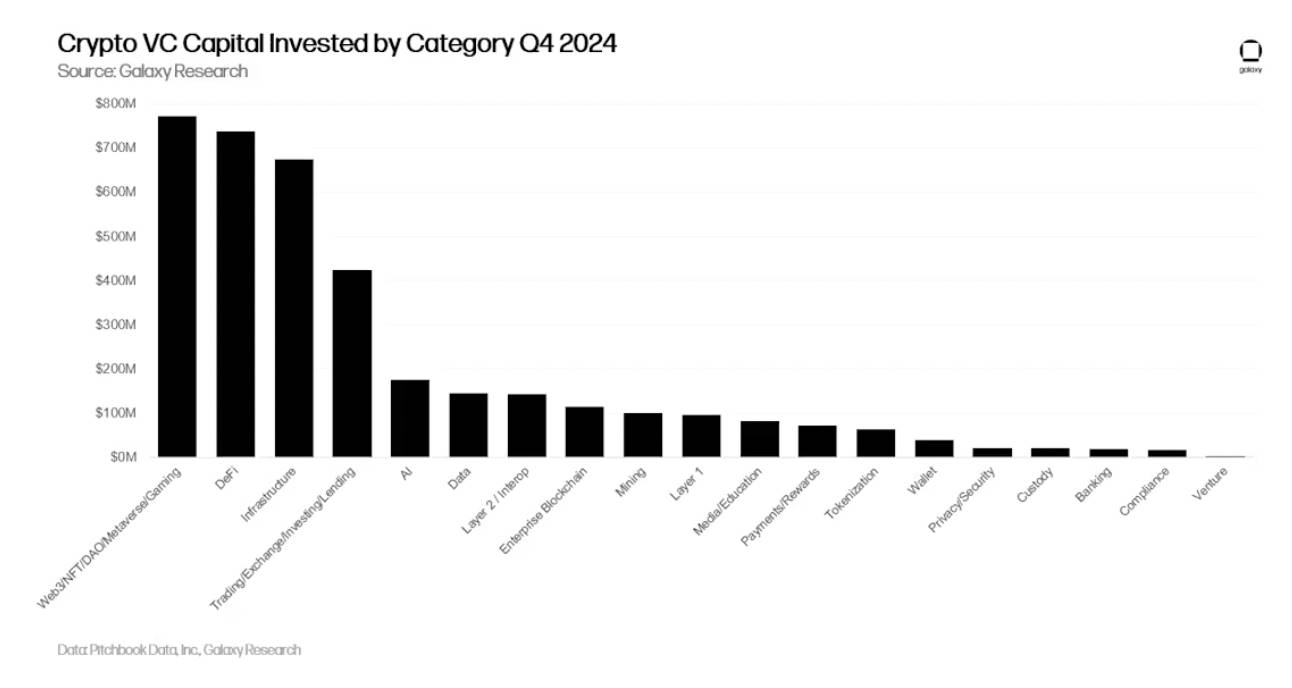
In Q4 2024, capital deployed to startups building Web3/NFT/DAO/metaverse and infrastructure products increased by 44.3% and 33.5% QoQ, respectively. This rise in capital allocation share was primarily due to sharp declines—85% and 55% QoQ since Q3 2024—in capital allocated to Layer 1 and crypto-AI startups.
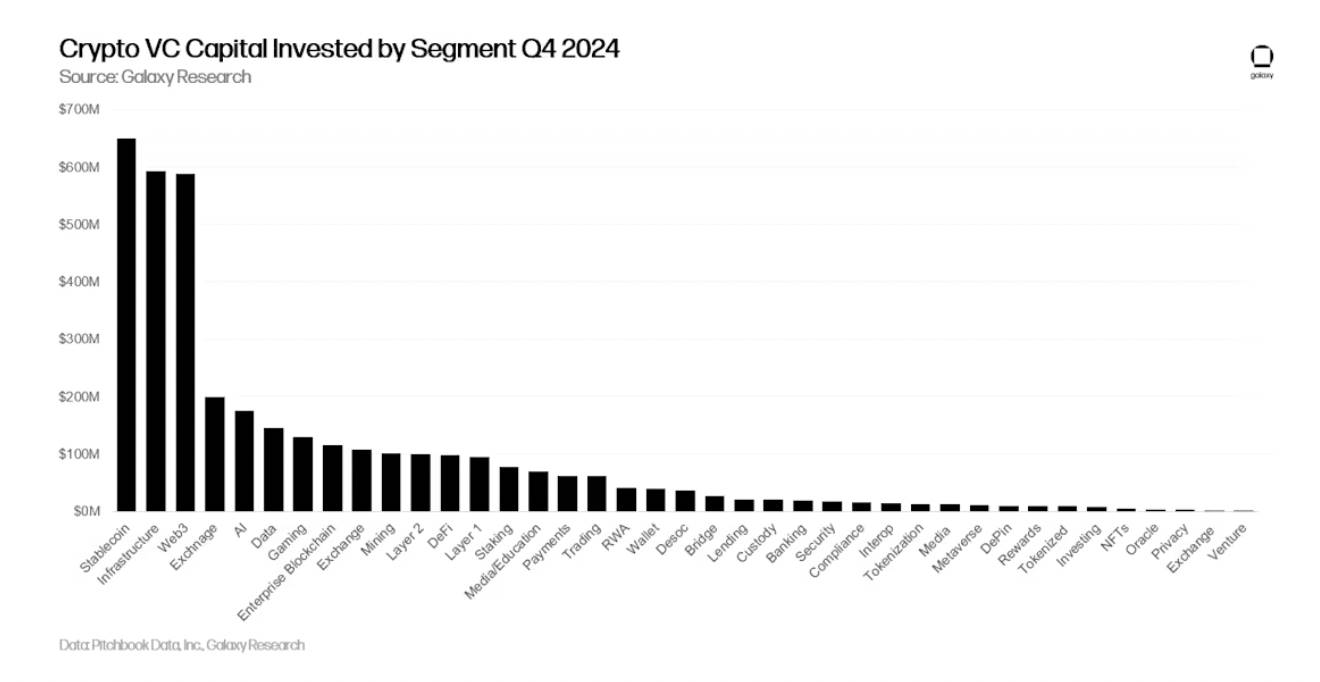
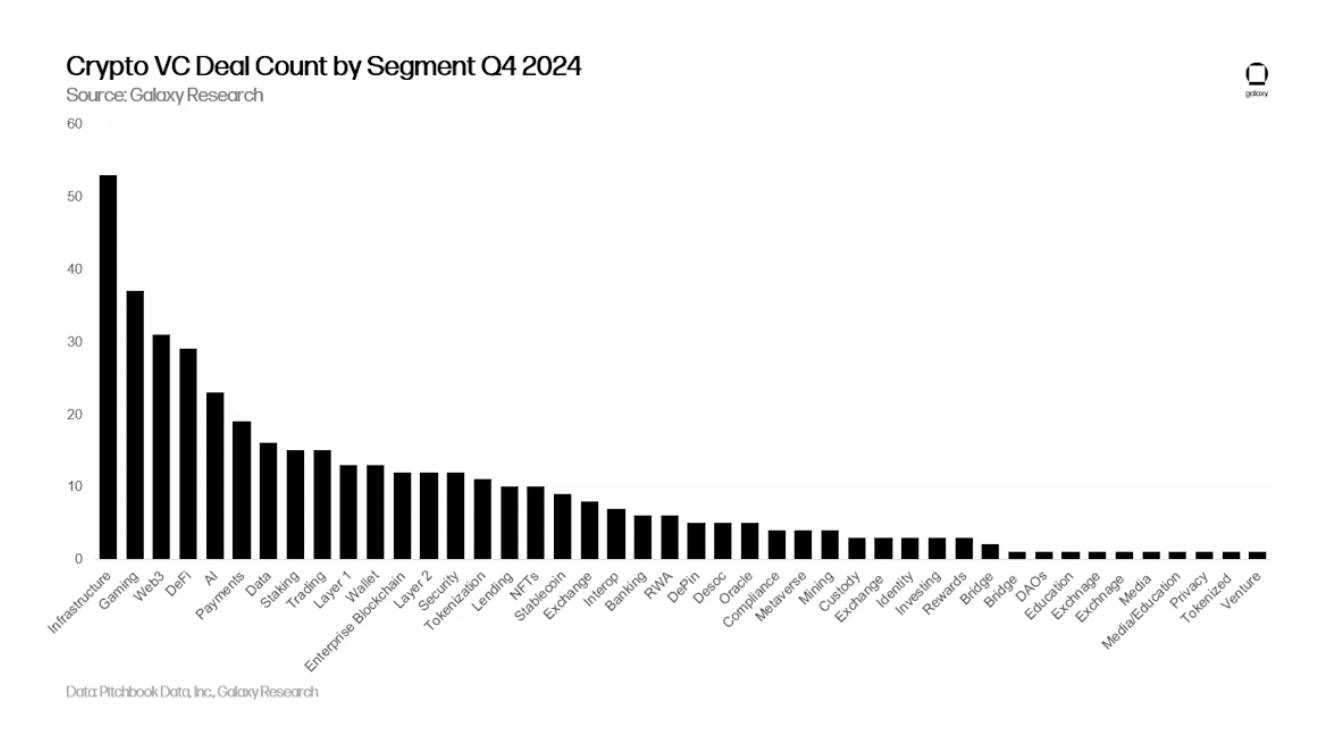
Breaking down these broader categories further, crypto projects building stablecoins received the largest share of investment in Q4 2024 (17.5%), raising $649 million across nine tracked deals. However, Tether’s $600 million deal accounted for the vast majority of total stablecoin funding in the quarter. Startups developing infrastructure ranked second, raising $592 million across 53 deals. The top three crypto infrastructure deals were Blockstream ($210 million), Hengfeng Company ($100 million), and Cassava Network ($90 million). Following infrastructure, Web3 startups and exchanges ranked third and fourth in capital raised from crypto VCs, at $587.6 million and $200 million respectively. Notably, Praxis was the largest Web3 deal of Q4 2024 and the second-largest overall, raising $525 million to build an “internet-native city.”
By deal count, the Web3/NFT/DAO/Metaverse/Gaming category led with 22% of total deals (92 deals), including 37 gaming and 31 Web3 deals. Infrastructure and trading/exchange/investment/lending startups recorded 77 and 43 deals respectively in Q4 2024.
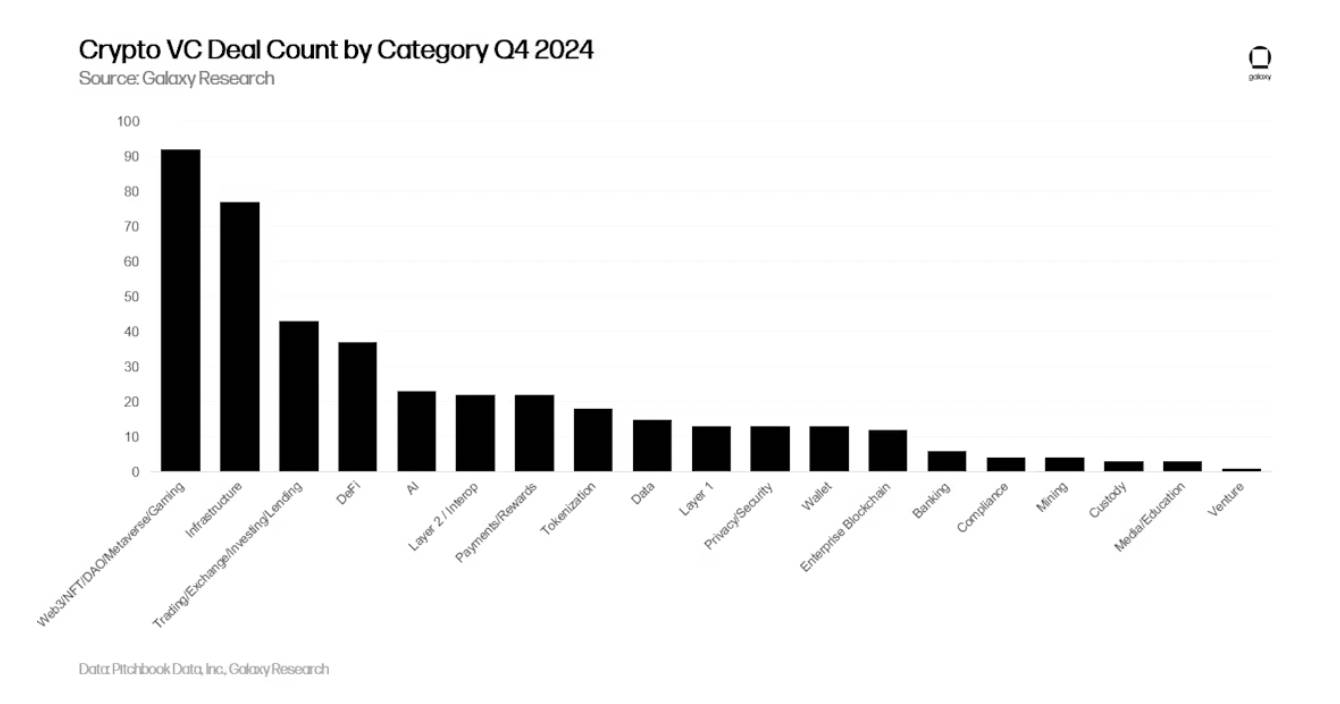
Projects and companies providing crypto infrastructure ranked second in deal count, accounting for 18.3% of total deals (77 deals), up 11% QoQ. Following infrastructure, those building trading/exchange/investment/lending products ranked third with 10.2% of deals (43 deals). Notably, wallet and payment/reward-focused crypto companies saw the largest QoQ increases in deal count—111% and 78% respectively. Despite these large percentage gains, wallet and payment/reward startups involved only 22 and 13 deals respectively in Q4 2024.
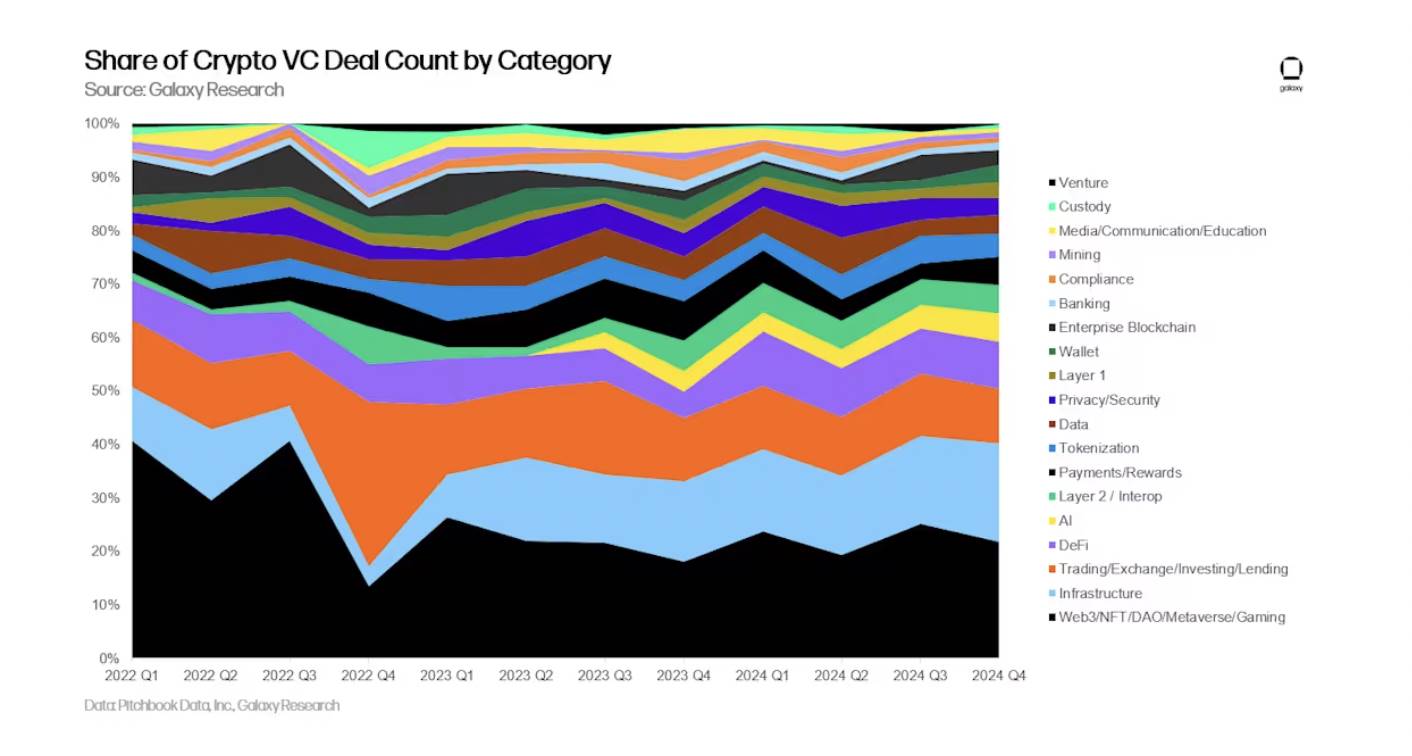
After further segmentation, projects building crypto infrastructure had the highest number of deals across all subcategories (53 deals). Gaming and Web3-related crypto companies followed closely, completing 37 and 31 deals respectively in Q4 2024—nearly identical rankings to Q3 2024.
Investment by Category and Stage
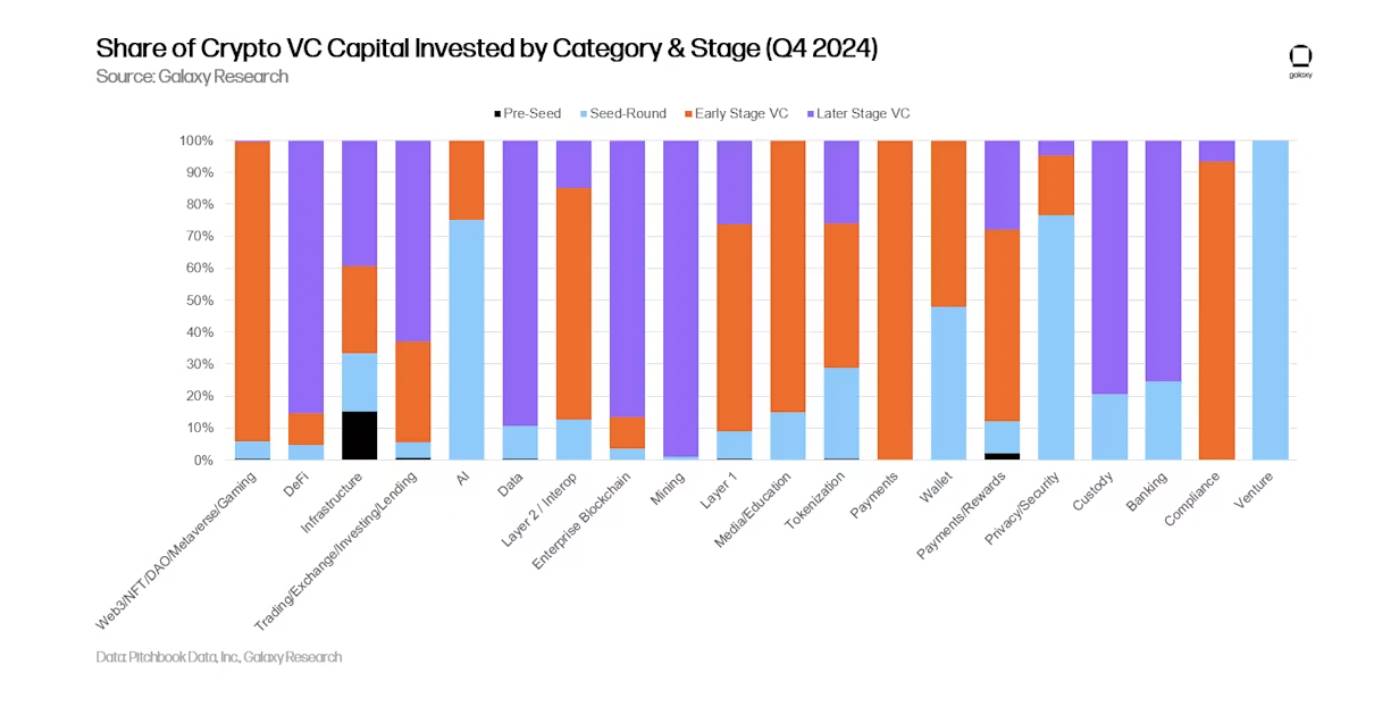
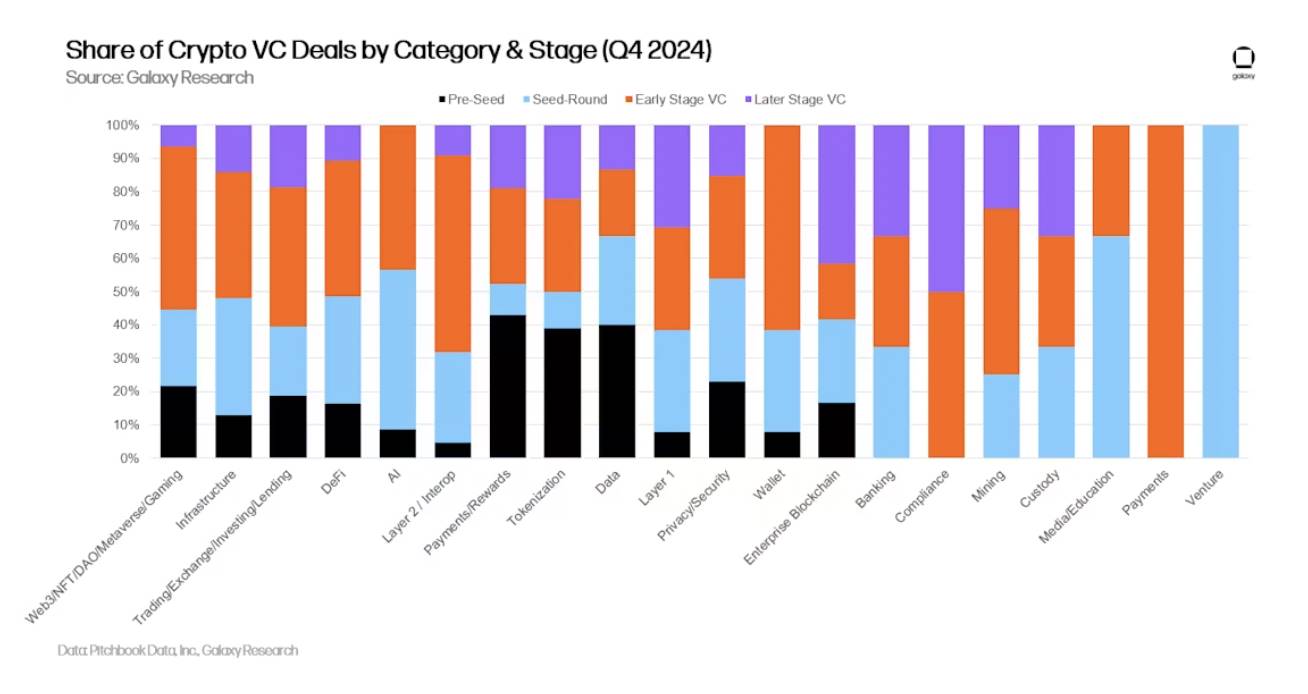
Breaking down investment volume and deal count by category and stage provides clearer insight into which types of companies are raising capital within each category. In Q4 2024, the vast majority of funding in Web3/DAO/NFT/Metaverse, Layer 2, and Layer 1 went to early-stage companies and projects. In contrast, a significant portion of VC funding in DeFi, trading/exchange/investment/lending, and mining went to late-stage companies.
Analyzing the distribution of investment across stages within each category reveals the relative maturity of various investment opportunities.
Similar to Q3 2024, a large portion of Q4 2024’s completed deals involved early-stage companies. Tracked crypto VC deals in Q4 2024 included 171 early-stage and 58 late-stage deals.
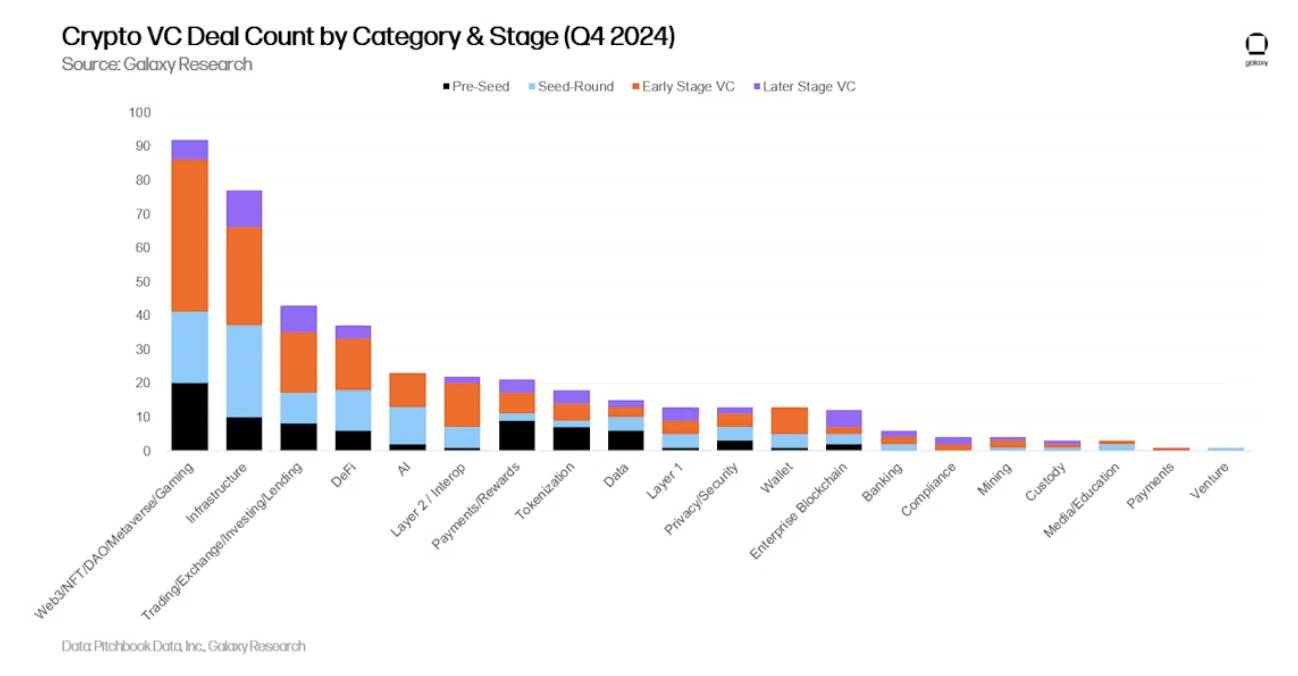
Examining the share of deals by stage within each category helps understand the developmental phase of each investable sector.
Investment by Geography
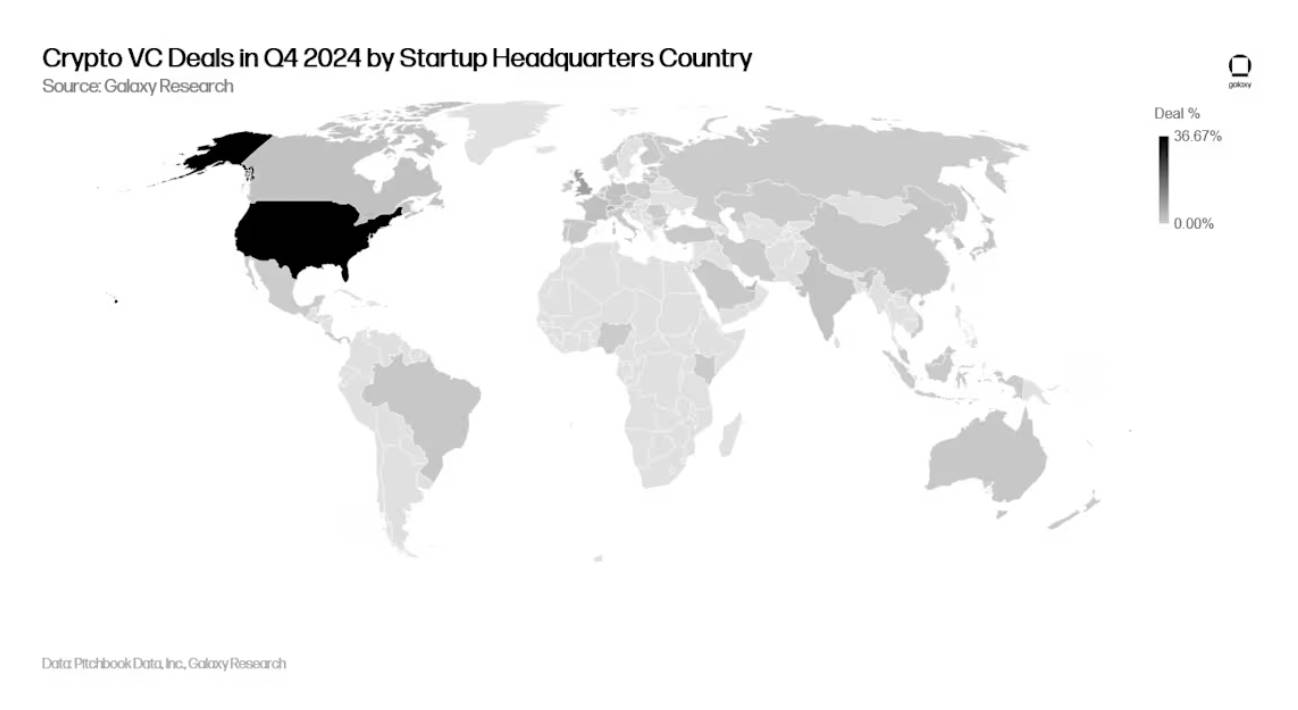
In Q4 2024, 36.7% of deals involved companies headquartered in the United States, followed by Singapore (9%), the UK (8.1%), Switzerland (5.5%), and the UAE (3.6%).
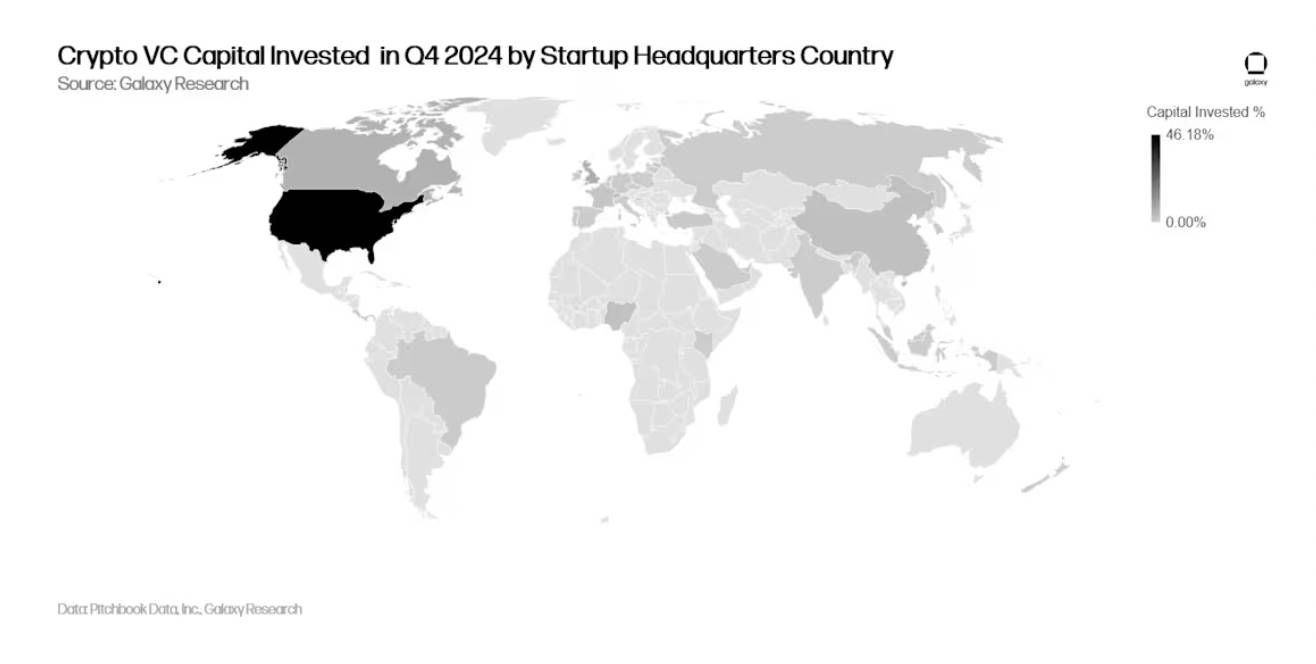
U.S.-headquartered companies received 46.2% of all venture capital, down 17 percentage points QoQ. Conversely, startups based in Hong Kong saw a sharp increase in VC funding, capturing 17.4% of total investment. The UK accounted for 6.8%, Canada for 6%, and Singapore for 5.4%.
Investment by Year of Incorporation
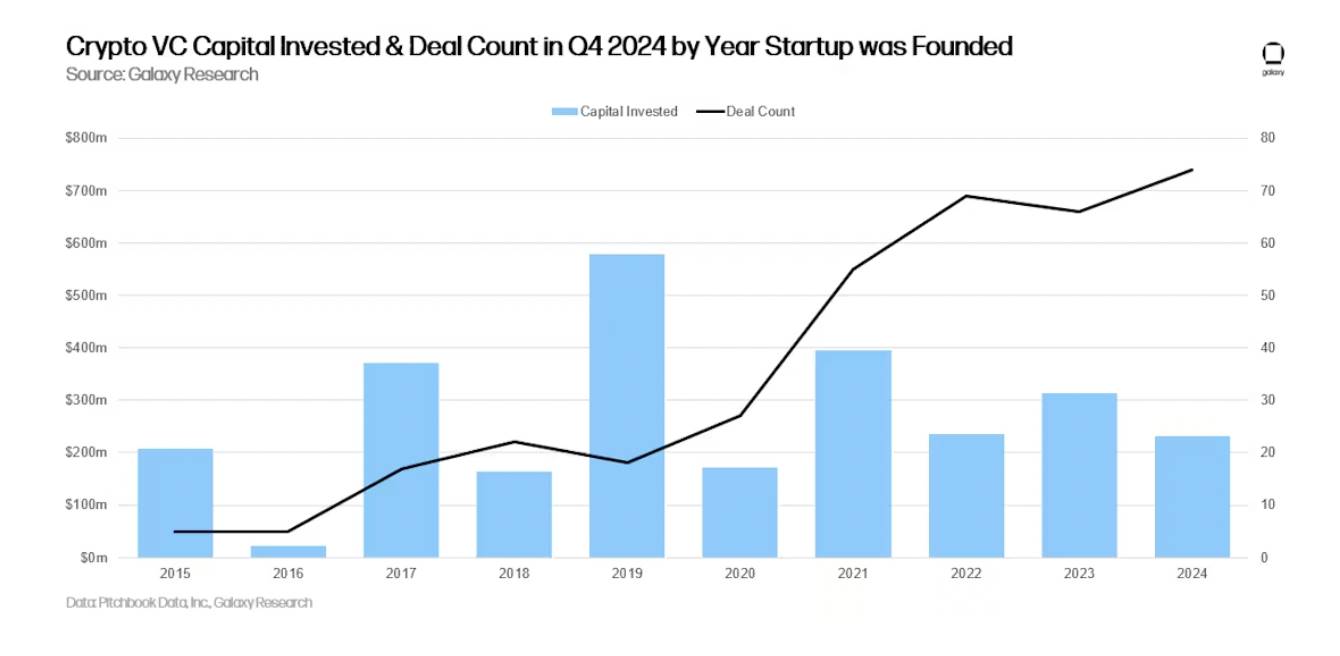
Companies and projects founded in 2019 received the largest share of funding, while those founded in 2024 had the highest number of deals.
Crypto Venture Fundraising
Fundraising for crypto venture funds remains challenging. The macro environment in 2022 and 2023, combined with turbulence in the crypto markets, caused some capital allocators to scale back their commitments to crypto VC compared to the levels seen in 2021 and early 2022. At the start of 2024, investors widely expected interest rates to fall sharply during the year, though rate cuts only began materializing in the second half. Since Q3 2023, total capital allocated to VC funds has declined quarter-on-quarter, despite a slight increase in the number of new funds raised in 2024.
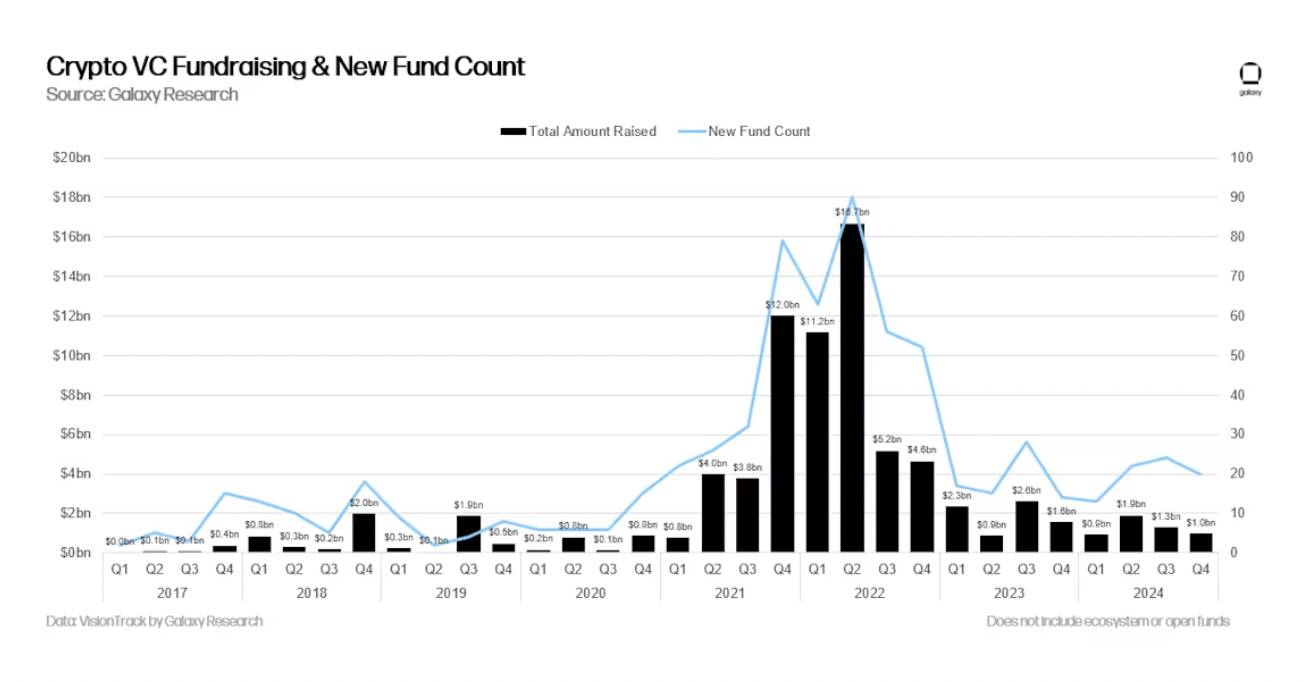
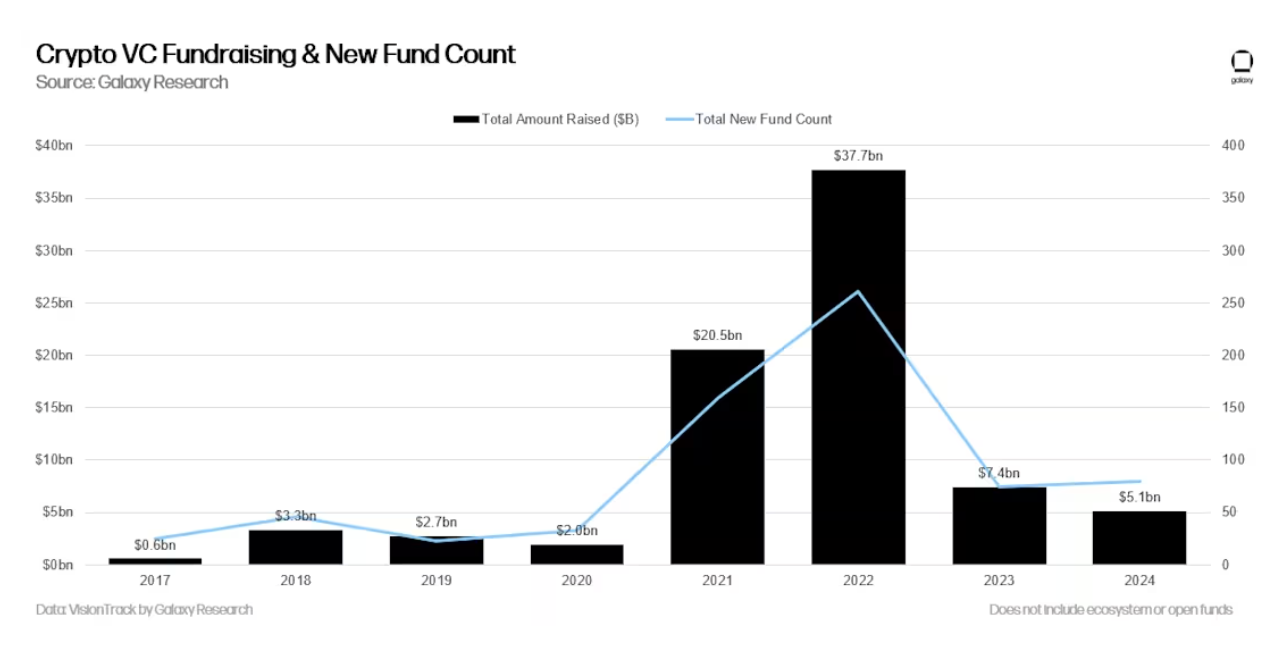
2024 was the weakest year for crypto VC fundraising since 2020, with 79 new funds raising $5.1 billion—far below the frenzied levels of 2021–2022.
While the number of new funds increased slightly year-on-year, declining allocator interest led to smaller fund sizes. The median and average fund sizes in 2024 fell to their lowest levels since 2017.
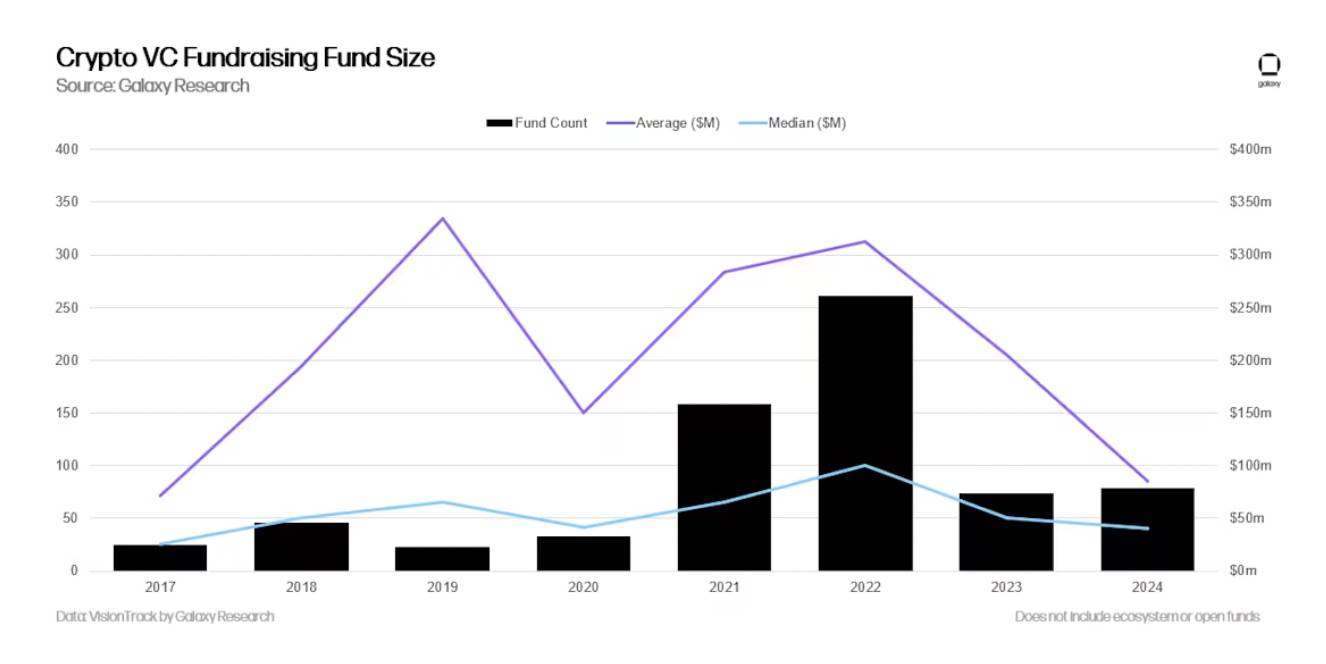
In 2024, at least 10 crypto venture funds actively investing in crypto and blockchain startups raised new funds exceeding $100 million each.
Conclusion
-
Market sentiment is improving and investment activity is rising, but it remains far below previous cycle peaks. Although the circulating crypto asset market has clearly recovered since late 2022 and early 2023, venture investment remains well below prior bull market levels. During the 2017 and 2021 bull runs, VC activity closely tracked crypto asset prices. Over the past two years, however, despite rising crypto prices, VC activity has remained depressed. This stagnation stems from multiple factors, including a “barbell market” where Bitcoin dominates center stage while marginal net activity comes largely from Memecoins—projects that are difficult to fund and questionable in sustainability. Enthusiasm is growing for projects at the intersection of AI and crypto, and anticipated regulatory changes could unlock opportunities in stablecoins, DeFi, and asset tokenization.
-
Early-stage investments remain dominant. Despite numerous headwinds, the continued focus on early-stage deals bodes well for the long-term health of the broader crypto ecosystem. Late-stage investment progressed in Q4, primarily due to Cantor Fitzgerald’s $600 million investment in Tether. Even so, entrepreneurs with innovative ideas can still find supportive investors. We believe that in 2025, projects and companies focused on stablecoins, AI, DeFi, tokenization, Layer 2, and Bitcoin-related products are well-positioned to perform strongly.
-
Spot exchange-traded products (ETPs) may pressure venture funds and startups. In the U.S., some allocators have made notable investments in spot Bitcoin ETPs, suggesting that large investors (pensions, endowments, hedge funds, etc.) may prefer gaining exposure through these large, liquid instruments rather than early-stage venture capital. Interest in spot Ethereum ETPs is also beginning to rise. If this trend continues, or if new ETPs covering other Layer 1 blockchains are launched, demand for investment in areas like DeFi or Web3 could shift toward these ETPs rather than venture capital.
-
Fund managers continue to face a difficult environment. While the number of new funds increased slightly year-on-year in 2024, total capital allocated to crypto VC funds was slightly lower than in 2023. The macro environment continues to pose headwinds for allocators, but significant changes in the regulatory landscape could reignite interest in the crypto sector.
-
The U.S. remains dominant in the crypto startup ecosystem. Despite an extremely complex and often hostile regulatory regime, U.S.-based companies and projects still account for the majority of completed deals and capital raised. The incoming presidential administration and Congress are expected to be the most crypto-friendly in U.S. history. We anticipate that American dominance will strengthen further, especially if certain regulatory developments unfold as expected—such as stablecoin frameworks and market structure legislation—that would allow traditional U.S. financial services firms to meaningfully enter the crypto space.
Join TechFlow official community to stay tuned
Telegram:https://t.me/TechFlowDaily
X (Twitter):https://x.com/TechFlowPost
X (Twitter) EN:https://x.com/BlockFlow_News
 @galaxyhq










