HashKey Chain Releases 2025 Roadmap: Empowering Asian Developers and Ecosystem, Advancing BTCFi, RWA, and PayFi
TechFlow Selected TechFlow Selected
HashKey Chain Releases 2025 Roadmap: Empowering Asian Developers and Ecosystem, Advancing BTCFi, RWA, and PayFi
In 2025, HashKey Chain's vision continues to evolve and materialize as planned. Though the dream may be distant, pursuit will lead to its attainment; though the aspiration may be challenging, persistence will make it possible.
 Navigating Web3 tides with focused insights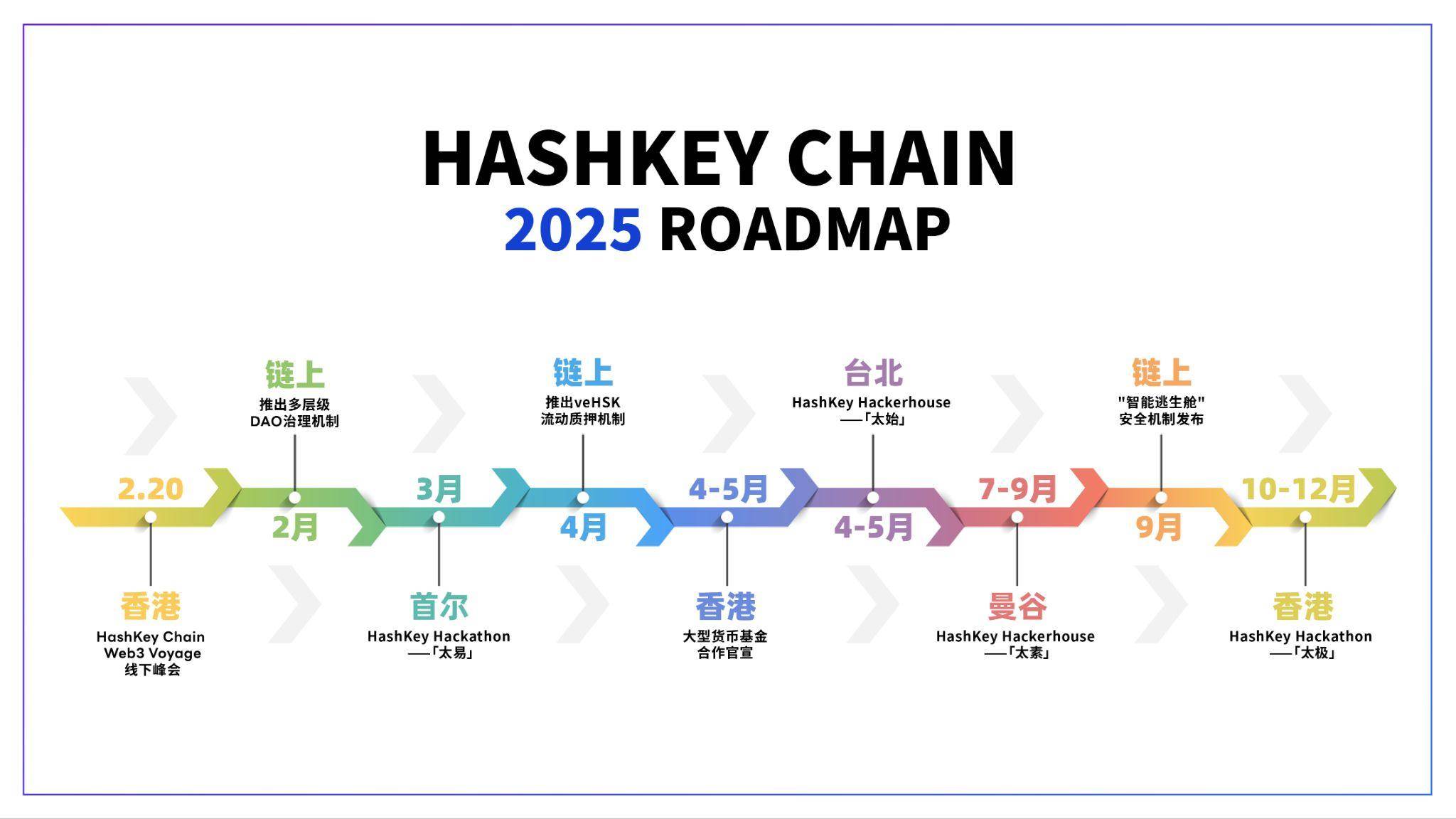
As time moves forward and new chapters unfold, HashKey Chain officially unveils its 2025 roadmap, presenting our latest development plans for the year to users, developers, communities, and all ecosystem partners who have continuously supported us.
As a public blockchain that has been live on mainnet for less than a month, HashKey Chain remains in its early stages. We are deeply grateful for the support and trust from every user, community member, and partner. In just a few short months since announcing HashKey Chain, we’ve already delivered solid results. During the testnet phase, HashKey Chain achieved over 25.8 million transactions, attracted more than 870,000 wallet addresses, maintained an average block time of 2 seconds, offered gas fees as low as 0.1 Gwei, saw 50 projects successfully deployed, and engaged over 300,000 community members. Since mainnet launch, within less than a month, the network has drawn 11 project teams to deploy, accumulated 980,000 on-chain transactions, and has been recognized by numerous media outlets and institutions as one of the most promising Ethereum Layer 2 chains for growth in 2025.
The native token of the HashKey Chain ecosystem, HSK, was listed on major exchanges including HashKey Global, KuCoin, Gate.io, BingX, MEXC, and WOO X starting November 2024. Within a month of its TGE, HSK achieved a peak increase of 270%.
HashKey Chain’s vision is to become a bridge connecting Web2 and Web3—bringing Web2 assets into Web3 to enrich the asset base and application scenarios of Web3, while applying Web3’s innovative asset issuance models back to Web2 to unlock liquidity for traditional Web2 assets, ultimately creating a seamlessly interconnected world between Web2 and Web3.
Aligned with this vision, HashKey Chain focuses on BTCFi, PayFi, RWA, and stablecoins to build compliance-oriented on-chain financial infrastructure, aiming to establish a full-stack Web3 solution that connects Web2 and Web3. This not only highlights HashKey Chain’s unique competitive edge but also reflects HashKey Group’s mission and determination as an industry pioneer.
In 2025, HashKey Chain’s vision continues to evolve and materialize according to plan. Though dreams may seem distant, pursuit makes them attainable; though aspirations may be challenging, persistence brings them to life.
Technical Breakthrough: Introducing the "Smart Escape Pod" Security Mechanism and Multi-Tiered DAO Governance
Security Mechanism: Smart Escape Pod
In the evolution of blockchain technology, Layer 2 solutions have brought unprecedented scalability, but also introduced new security challenges. At the start of 2025, HashKey Chain introduced the “Smart Escape Pod” mechanism—a revolutionary advancement in Layer 2 security. By periodically syncing state Merkle trees to Layer 1 at fixed block intervals, this mechanism ensures final asset security. When anomalies occur in the Layer 2 network or DeFi protocols, smart contracts automatically trigger protective measures, enabling users to safely and swiftly withdraw their assets back to the mainnet. This innovative design provides unparalleled asset security, eliminating the risk of Layer 2 becoming an “asset black hole.”
Governance Mechanism: Multi-Tiered DAO
HashKey Chain’s governance is built upon a carefully designed multi-tiered DAO architecture. Our DAO is more than just a voting system—it's a comprehensive framework for risk prevention and decision execution. A Security Council DAO enables rapid response to potential threats, while a Technical Audit DAO focuses on deep analysis and validation. This layered structure ensures both professional decision-making and operational flexibility. Through staking mechanisms and reputation systems, we’ve established effective incentive models ensuring participants receive rewards proportional to their contributions. A fair and transparent dispute resolution mechanism further strengthens trust across the entire ecosystem.
By tightly integrating these two core mechanisms, HashKey Chain is redefining Layer 2 security standards and governance models. We’re not only delivering unprecedented asset protection for users, but also building a truly decentralized and sustainable ecosystem. Here, security is no longer optional—it's a fundamental feature embedded in the protocol architecture. Governance is no longer theoretical—it's a tangible reality backed by clear mechanisms and incentives.
Product Innovation: Launching veHSK Liquid Staking to Capture HSK Value
As markets evolve and user demands shift, traditional staking models have begun revealing limitations. Despite high annualized yields, they often suffer from poor liquidity and exclusion from additional gains offered by other DeFi protocols—posing new challenges for users seeking higher returns and greater flexibility.
To address this, HashKey Chain is enhancing its staking platform by introducing veHSK—an innovative mechanism transforming staking from a simple yield model into a dynamic, expandable ecosystem that offers users more stable and diversified income opportunities.
Within HashKey Chain’s staking system, veHSK is not merely a derivative of staked HSK—it is a purpose-built token with multiple utilities and significant advantages. Users who stake HSK to generate veHSK gain access to a range of enhanced benefits:
● Higher Yields: As an upgraded form of staking, veHSK allows users to earn stable base returns plus additional income through participation in liquidity provision, lending, and other DeFi applications. These extra yields come from platform-generated value and broader ecosystem engagement.
● Increased Governance Weight: veHSK holders receive additional voting power in platform governance. This gives users greater influence over key decisions such as platform direction and parameter settings—not only securing economic benefits but aligning long-term interests between users and the platform. This mechanism enhances decentralization and strengthens user-platform alignment.
● Liquidity Incentives and Market Efficiency: In future ecosystem designs, veHSK will play a critical role in liquidity pools. By integrating veHSK with DeFi protocols, users can earn transaction fees and liquidity mining rewards while maintaining their staking positions. This increases capital efficiency, boosts ecosystem activity, and promotes diversity.
Compared to traditional staking, HashKey Chain’s integration of veHSK with liquidity protocols delivers superior flexibility and return potential. Users can deposit veHSK into platform liquidity pools, making it compatible with various DeFi protocols and injecting capital into the broader ecosystem. This solves the liquidity constraints of conventional staking and enables participation in a wider range of DeFi applications.
For example, under the veHSK model, holders can convert their veHSK into liquidity assets within protocols, earning returns from trading and lending activities—maximizing investment returns. By combining staking, liquidity, and governance, this mechanism creates a multi-layered revenue model, forming a more sustainable and diversified economy.
Moreover, veHSK’s liquidity can be interoperable with other protocols via smart contracts, further improving capital efficiency. This approach not only offers highly liquid investment options for veHSK holders but also strengthens the platform’s market performance, increasing asset fluidity and user engagement.
Building a Vibrant Developer Ecosystem
Ecosystem vitality and user adoption are two pivotal factors determining the ultimate success of any public blockchain, and developer innovation lays the foundation for both.
Therefore, in ecosystem development, HashKey Chain places developers at the core. Technically, leveraging OP-Stack, HashKey Chain provides high-performance infrastructure and a complete suite of developer tools, streamlining deployment and development processes to accelerate the journey from idea to product. Additionally, to empower developers building on the HashKey ecosystem, we offer generous Grant programs and ecosystem support—leveraging the extensive resources, global investment footprint, and rich blockchain project experience of the entire HashKey Group and its partners—to provide early-stage backing and cold-start assistance for developers and high-potential projects.
On December 11, 2024, HashKey Chain launched its $50 million Atlas Grant Program, aimed at identifying top-tier Web3 projects and providing comprehensive empowerment to achieve exponential growth in applications and users on HashKey Chain. The first round of the Atlas Grant allocates $10 million worth of HSK tokens. Recipient teams will receive non-dilutive funding, technical mentorship, partnership opportunities, and invitations to events like hackathons.
The application window for the first round runs from December 10, 2024, to January 10, 2025, with winners announced on January 20. To date, over 100 projects have applied. Application link: https://github.com/orgs/HashkeyHSK/discussions/new?category=session-1.
In 2025, HashKey Chain will roll out the second, third, fourth, and fifth phases of the Atlas Grant in Q1, Q2, Q3, and Q4 respectively. Each phase will distribute $10 million worth of HSK tokens as incentives. We aim to grow together with developers, co-building a thriving, open Web3 ecosystem, creating flagship applications with real traffic across multiple major public chains, and driving exponential growth in HashKey Chain’s application layer and user base.
Beyond substantial grant funding, HashKey Chain has launched a unique developer event series inspired by ancient Chinese philosophy. Drawing from the five cosmological stages of creation—"Tai Chu," "Tai Yi," "Tai Shi," "Tai Su," and "Tai Ji"—this series establishes a progressive innovation framework covering the full journey from ideation to implementation. The program includes three Hacker Houses and two Hackathons, offering developers unprecedented support across technical guidance, ecosystem resources, and philosophical inspiration.
The first HashKey Hacker House concluded successfully in Hong Kong on December 22, 2024, attracting hundreds of talented developers and project teams from around the world. It showcased global technical excellence and market insight, reinforcing HashKey Chain’s image as an innovator and trusted leader within the global developer community. In 2025, HashKey Chain will host four Hackathons/Hacker Houses in South Korea, Taiwan, Japan, and Thailand under the themes “Tai Yi,” “Tai Shi,” “Tai Su,” and “Tai Ji.” We welcome outstanding global developer teams to compete for generous prizes and investment opportunities.
Continuously Empowering BTCFi, RWA, and PayFi—Building the Bridge Between Web2 and Web3
HashKey Chain is building compliance-focused on-chain financial infrastructure centered on BTCFi, PayFi, RWA, and stablecoins, aiming to create seamless financial bridges and full-stack Web3 solutions connecting Web2 and Web3.
1. BTCFi (Bitcoin Financial Applications)
Over the past two years, the crypto industry has undergone transformative changes, especially within the Bitcoin ecosystem, which now exhibits entirely new characteristics. This includes the emergence of BTC Layer 2 networks holding TVL, a growing number of Bitcoin holders seeking passive yield, and traditional regulated institutions aggressively purchasing Bitcoin following the approval of spot Bitcoin ETFs—gradually forming a dedicated ecosystem and infrastructure around these players.
The surge in Bitcoin’s ecosystem has accelerated the rapid development of BTCFi. By the end of 2024, the total market size of BTCFi approached $50 billion. On-chain TVL on the Bitcoin network—including Layer 2 and sidechains—stood at approximately $2 billion, representing just 0.1% of Bitcoin’s total market cap, compared to 15.7% for Ethereum and 5.6% for Solana. We believe BTCFi still holds tenfold growth potential.
In 2025, HashKey Chain will issue a wrapped BTC (wBTC) asset called HashKey BTC. With absolute asset security guaranteed, HashKey BTC will deliver stable and attractive on-chain yields for BTC holders, unlocking the trillion-dollar potential of BTCFi. HashKey BTC will use an over-collateralization mechanism to ensure network security and prevent systemic risks.
Furthermore, HBTC will offer above-market-average staking yields by bundling lending returns, liquidity mining rewards, restaking yields, and HashKey platform point incentives. We will actively vet high-quality projects to help users avoid risks, building a secure and open BTCFi ecosystem on-chain where Bitcoin investors and institutions can utilize BTCFi derivatives under conditions of compliance and safety.
2. RWA (Real World Assets Tokenization)
According to The Defiant, the total market cap of RWA hit a record high of $14 billion in December 2024. Tokenized private credit and tokenized government bonds were the two largest segments, accounting for $9.5 billion and $3 billion respectively—representing 89% of the entire on-chain RWA market. Since the beginning of 2024, the RWA market has grown by 66%, signaling strong institutional interest.
The RWA narrative stems from massive adoption, driven primarily by the trend of tokenizing traditional financial assets and investor demand for higher liquidity and transparency.
Hong Kong, as a global financial hub, provides an ideal environment for RWA innovation. Based in Hong Kong and committed to compliance, HashKey Chain aims to bring high-quality financial products from traditional institutions into the blockchain space.
In December 2014, HashKey Group partnered with Cinda International Asset Management to launch STBL, the first digital tokenized short-term asset-backed liquidity note issued by a Hong Kong financial institution. Hash Blockchain Limited (“HashKey Exchange”) serves as the initial distributor of STBL. Going forward, Cinda International plans to expand STBL issuance onto HashKey Chain and introduce innovative incentive mechanisms to broaden its investor base.
STBL is backed by AAA-rated money market fund (MMF) portfolios. Each STBL has a face value of $1 USD, is transferable 24/7, and distributes accrued daily interest automatically to qualified investor wallets in the form of newly minted tokens on each monthly payout date.
In 2025, HashKey Chain will enable developers to tokenize traditional assets in real estate, commodities, and art, promoting asset liquidity and market transparency, and injecting new momentum into practical blockchain applications.
3. PayFi (Payment Finance Solutions)
PayFi, short for Payment Finance, is an innovative paradigm that integrates payments and finance, emphasizing “instant settlement” to enhance efficiency in speculative trading and various financial operations.
Traditional payment systems rely on banks and third-party intermediaries, resulting in high fees and slow settlements. PayFi leverages blockchain to enable peer-to-peer payments, eliminating costly intermediary fees. Meanwhile, smart contract automation reduces human intervention, ensuring secure, transparent, and error-free transactions.
HashKey Chain provides foundational technical support to help developers build secure and efficient payment solutions, accelerating the digital transformation of global payment systems.
4. Stablecoins
Stablecoins serve as a vital medium bridging Web2 and Web3, with broad real-world applications.
Hong Kong enforces strict regulations on fiat-backed stablecoin issuers, requiring full backing by high-quality, highly liquid reserve assets. Currently, only licensed stablecoin issuers, authorized institutions, licensed corporations, and licensed virtual asset trading platforms are permitted to issue stablecoins. As one of Hong Kong’s first licensed platforms serving retail users, HashKey Exchange has partnered with companies like Oanbi Technology and Allinpay International to launch Hong Kong dollar-pegged stablecoins. In 2025, more compliant stablecoin issuers will launch regional stablecoins on HashKey Chain.
Through stablecoin ecosystem development, HashKey Chain advances the real-world application of blockchain in cross-border payments and decentralized finance, significantly improving global transaction efficiency.
In 2025, competition among new blockchains remains fierce. Among over 200 Ethereum Layer 2 chains, HashKey Chain must forge its own distinct path to stand out.
Backed by HashKey Group, HashKey Chain holds leading advantages in compliance, global ecosystem resources, and its dual-directional bridge function between Web2 and Web3. What sets us apart from other Layer 2s is that HashKey Chain wasn’t created just to launch a chain, but emerged from real market needs. Our ultimate goal is to drive mass adoption of Web3 in everyday life, empowering developers to build Web3 applications for billions of users, bringing Web2 assets into Web3, and ultimately creating a seamlessly integrated world where Web2 and Web3 coexist in harmony.
Join TechFlow official community to stay tuned
Telegram:https://t.me/TechFlowDaily
X (Twitter):https://x.com/TechFlowPost
X (Twitter) EN:https://x.com/BlockFlow_News