








Senior Player's Agent Investment Review: The Most Distant Opportunity Isn't Missing a 100x, But Failing to See What's Right Before Your Eyes
TechFlow Selected TechFlow Selected
Senior Player's Agent Investment Review: The Most Distant Opportunity Isn't Missing a 100x, But Failing to See What's Right Before Your Eyes
When you can recognize a trend, you can quickly commit capital without excessive hesitation.
 Navigating Web3 tides with focused insights
Author: Tomb
Translation: TechFlow
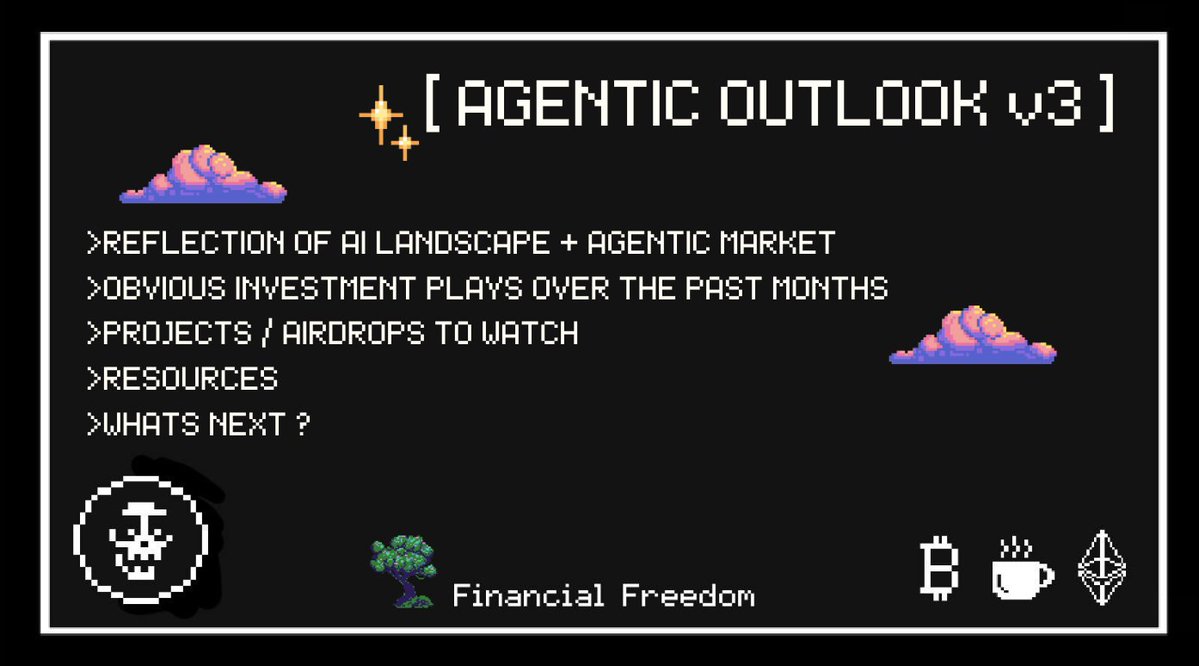
Key Takeaways from This Thread
-
Review recent developments in AI agents and artificial intelligence over the past few months;
-
Reflect on some of the obvious investment opportunities in the market;
-
Took a brief break during the New Year period, observed events from a third-party perspective, and deeply reflected on past successes and mistakes;
-
Going forward, I will try to clearly share all my thoughts;
Reviewing Recent Developments in AI Agents and AI
AI Agent Recap
-
Very satisfied with performance at the end of last year.
-
We entered narratives around AI, agents, and infrastructure (Infra) very early—from September to early October.
-
Rather than overcomplicating analysis, we clearly recognized these as the next phase of the AI supercycle (with more major catalysts still ahead).
-
This kind of mature judgment comes from long-term experience catching market narratives. When you can identify such trends, you can deploy capital quickly without hesitation.
-
Even now, I see people arguing about trivial matters—like ChatGPT wrapper apps, specific agent features, or whether a protocol replied promptly.
-
But does any of that really matter? We're here to make money, not to prove we're right.
-
The key is understanding which stage of the market cycle you’re in. Each cycle has its own rules and strategies.
-
This is why many people hold onto older projects for too long and miss out on “easy mode” trending opportunities. By "older," I don’t mean chronologically old, but relatively outdated compared to the rapid pace of industry development.
-
Remember, new trends emerge every day, and capital rotates faster and faster—if teams fail to clearly communicate their vision or show a clear roadmap, funds will flow to protocols with stronger communication and faster execution.
-
When I first encountered Goat, I immediately saw its potential and started following it early. What surprised me was how long it took others to bridge over to Base or start exploring agents on Solana.
-
This delay is largely due to the "mid-curve effect" (overly complex thinking) and market panic. If you’ve only just realized this now, you should seriously reflect on why.
-
I'm grateful for the past few months—I didn’t suffer significant losses.
-
I caught ai16z at a $30M market cap, got into aixbt also at $30M, and invested in several gaming and conversational projects below $10M market cap.
-
Of course, I missed some opportunities like Zerebro, Fartcoin, Snai, and Swarm Node—but that’s okay. You can’t catch everything. What matters is reflecting on why they succeeded and why I missed them.
Quality
As always, quality remains the deciding factor:
-
Top-tier developers;
-
Strong branding;
-
Innovative ideas or unique technology with competitive advantages;
-
Cohesive, high-quality community;
-
Clear and valuable communication;
These are the core elements we consistently focus on. If two or more of these are missing, there’s risk—because another team will eventually do it better.
For example, in the current Virtuals environment, whenever a high-quality team launches an AI agent or related infrastructure project, I jump in early ("all-in"). Teams with doxxed identities who have been深耕 in this space for over five years and participated in multiple protocols—once I spot them early, I act decisively.
-
You don't need large amounts of capital to generate substantial returns. For instance, I discovered GEKKO when it first launched at a $4M market cap. It was built by the Axal team and backed by a16z—that was enough for me. I invested immediately. It grew from $4M to $40M in market cap, delivering excellent returns. I believe it still has room to grow. Turning $4,000 into $40,000 could equal someone's annual salary. Sometimes, you don’t need massive investments—$2,000 or $4,000 can yield impressive results. Don’t underestimate the power of small capital.
-
Another project I've been investing in is Acolyt—the team is extremely strong, similar in narrative to GEKKO. As I mentioned before, if there are 100 different AI agents providing high-quality market alpha, the only things that differentiate them are identity, user interface (UI), brand, developer caliber, etc.—just like in other areas of life.
This is exactly what I’m looking for: teams that have been building quietly for a long time—passionate, consistently tweeting, constantly launching new products. These top-tier developers are the only place my money goes. Nowhere else.
What to Avoid
-
Avoid anonymous solo developers, especially when building speculative agent projects—this carries high risk.
-
Another red flag: agent projects launched by individual influencers ("celebrity founders"). These are often abandoned shortly after launch because the founder underestimates the responsibility involved.
Struggling Narratives
-
I must admit, there are certain narratives I personally believed in strongly, but their progress has hit roadblocks. It’s not that these projects are bad—it’s that their momentum has slowed down relative to expectations.
It’s frustrating to invest in a project with bright prospects only to see it underperform while surrounding projects surge 2–3x in short periods.
-
These projects often fall into the "slow burn" category or end up becoming supporting tools for other, more dominant projects.
-
Examples include $GRIFT + $REALIS + $OMEGA. I still hold some positions, but in hindsight, I should have cut losses earlier and reallocated capital to stronger AI infra plays like REI and ARC, where potential is clearer and performance more consistent.
-
I initially allocated around $100K–$120K into these experimental projects, expecting them to capture larger market share. In retrospect, Griffain—a Solana-backed project—proved significantly stronger, while Realis needs more time to mature, possibly due to being too far ahead of its time or having a smaller team.
-
Looking back, after achieving 20–30x gains on something like $GAME, you might feel wealthy enough to "experiment" or take risks, making you less sensitive to slow-moving projects. But as traders or investors, we shouldn’t treat our capital this way.
In the coming weeks, I’ll continue sharing observations on agents and market dynamics, while also watching for the next potential rotation. We all know no narrative lasts forever. That doesn’t necessarily mean the agent story is over—just that it may be entering a new phase.
Remember, the market is accelerating across the board. If you slack off, you get left behind. Stay vigilant every single day—because the “hot potato” is getting hotter.
Reviewing Some Obvious Market Opportunities
Some market opportunities are obvious to some, but not to others. I won’t list every example, but I’ll share key cases and how I approached these narratives.
VIRTUALS
When I first saw GOAT take off, I was captivated. Recognizing its potential, I invested immediately. But then I completely missed $ZEREBRO and $BULLY, both of which have delivered outstanding performance since. That pushed me to search even harder for the next opportunity.
That’s when I found aixbt. Once I understood its functionality and positioning, I knew it was the next one to watch—especially after seeing discussions around $GOAT, $ZEREBRO, and $BULLY in the community. I noticed the market was shifting from entertainment-focused projects to utility-driven ones. This shift is precisely what led me to explore Base, Virtuals, $GAME, and $CONVO.
Actually, it was Jeff's thread about how Virtuals could become a billion-dollar protocol that solidified my conviction. The tokenomics, branding, and Base chain ecosystem advantages he outlined further convinced me of Virtuals’ massive potential.
Studying $GAME finally helped me grasp the concept of "frameworks." This knowledge allowed me to capture many strong investment opportunities in the following weeks. While I’m not a technical expert and can’t fully understand every detail, I’m deeply interested in this space and committed to learning as much as possible.
Interestingly, I did *not* invest when Virtuals reached a $500–600 million market cap.
Here’s the point: when you recognize the potential of an ecosystem—say, it could grow into a $5B, $10B, or even $20B space—you need to focus on two things: first-movers, and agents that consistently occupy user mindshare.
For example, $LUNA was a classic first-mover, while $VADER was the first DAO/alpha project.
There are many promising projects within this ecosystem. For me, the team is the most critical factor, followed by concept and utility, then branding and identity. Together, these three form the “holy trinity.”
Here are some notable projects worth studying:
> $WAI;
> $ACOLYT;
> $SEKOIA ;
> $GEKKO ;
All of these deserve attention, especially those within the Agentstarter ecosystem.
AI16z
Might sound random, but when I first came across and promoted daos.fun, I almost invested in AI16z purely based on the name. After digging deeper into projects funded by Marc like Truth Terminal, I became confident this was one to watch.
Learning that the AI16z DAO was attracting top global developers and actively building out its ecosystem and frameworks strengthened my conviction. GitHub activity kept rising, momentum was building rapidly—this wasn’t something explainable by “mid-curve thinking.”
Despite some FUD (fear, uncertainty, doubt) along the way, test projects within their agent ecosystem like $ELIZA and $DEGENAI showed strong potential. For instance, Eliza reached a $160M market cap, and @degenspartanai hit $100M. With AI16z continuing to expand, both are expected to grow further—these were very clear opportunities.
Other Ecosystems
In Agentic Outlook One, I analyzed each major launchpad/protocol and their alpha agents or beta projects:
-
Creator.Bid | $BID (potential dark horse)
-
Algo | Grew from $2–3M to $25M market cap (obvious opportunity)
-
AVA | Rose from ~$25M to $150M
-
@dasha | Jumped from $15M to $150M
Other ecosystems worth watching:
-
$UOS
-
$AIMONICA
-
$STOIC
Additional ecosystems to monitor:
-
griffain | $GRIFFAIN
Many of these projects have already delivered multi-bagger returns.
Full analysis available here: Link
This list could go on—these projects still have significant upside. They represent very obvious investment opportunities.
Still, I continue holding other projects I believe in, like $GRIFT and $REALIS. I think they simply need more time and minor adjustments to perform well.
Here are some I haven’t had time to analyze deeply but still deserve attention:
Among these, $REI deserves special attention.
Beyond on-chain ecosystems, I’m very bullish on the convergence of decentralized finance (DeFi) and agents:
-
Another one to watch is the continued development of Uomi.
Stick with projects that have strong teams, robust infrastructure (Infra), and high attention/momentum/mindshare—and you won’t go wrong.
To me, the lifecycle of most agents is short because they struggle to maintain sustained market attention. However, AIXBT and GOAT stand out as exemplary success stories and benchmarks in the agent space.
Why reflect on all this?
Because it helps you spot the next great investment opportunity.
Things to Watch
-
Pay attention to early-stage projects like $GNON, $PROJECT89, $AVB.
-
$OPUS has dropped 85% in market cap—many early AI projects may now be near bottom.
-
We should check whether these projects are still actively developing. Remember, the potential of AI infrastructure (Infra) and agents remains enormous.
-
New ideas and concepts emerge every week—these new entrants often come with stronger teams and better branding, so we must continuously scan the entire market.
-
I’m not saying these projects are bad—only that the market moves extremely fast. Many traders who achieved 80–100x returns quickly take profits and rotate into the next attractive opportunity, whether it’s swarm intelligence, DeSci (decentralized science), or DeFi agents.
-
Strong teams always find ways to stay relevant in the long run.
Finally, some notable trends:
-
There are currently many hackathons underway, spawning fascinating new ideas and projects. Participating helps broaden your perspective and deepen your understanding of future tech trends.
Data Sources for AI Agents:
-
Decentralised.Co, in collaboration with Sentient Market;
In the coming days, let’s discuss the future direction of the agent space together—so we can stay ahead when market narratives shift.
Join TechFlow official community to stay tuned
Telegram:https://t.me/TechFlowDaily
X (Twitter):https://x.com/TechFlowPost
X (Twitter) EN:https://x.com/BlockFlow_News
 @tombheads






