









Five Catalysts: Will ETH Turn the Tide This Year?
TechFlow Selected TechFlow Selected
Five Catalysts: Will ETH Turn the Tide This Year?
Ethereum needs to consider whether its core narrative positioning is still accepted and recognized by the public.
 Navigating Web3 tides with focused insights
Author: 1912212.eth, Foresight News
For investors holding Ethereum in 2024, it has been a year full of bitterness and challenges—sweetness has been notably absent. In terms of returns, Ethereum has significantly underperformed Bitcoin and also lagged behind many other public blockchains. Solana has already reached new all-time highs, delivering over 20x returns from its lows, while SUI surged from $0.5 to nearly $5 at its peak—a near tenfold gain.
Ethereum has faced mounting skepticism this year due to lackluster ecosystem activity. Compared to the DeFi and NFT booms of the previous cycle, innovation this round has been underwhelming, which is clearly reflected in its price performance. So, will 2025 be the year Ethereum turns things around?
Ethereum Spot ETF Net Inflows
U.S.-listed Ethereum spot ETFs were unexpectedly approved mid-2024, but the market initially showed little enthusiasm, especially amid a relatively weak market environment, resulting in substantial net outflows.
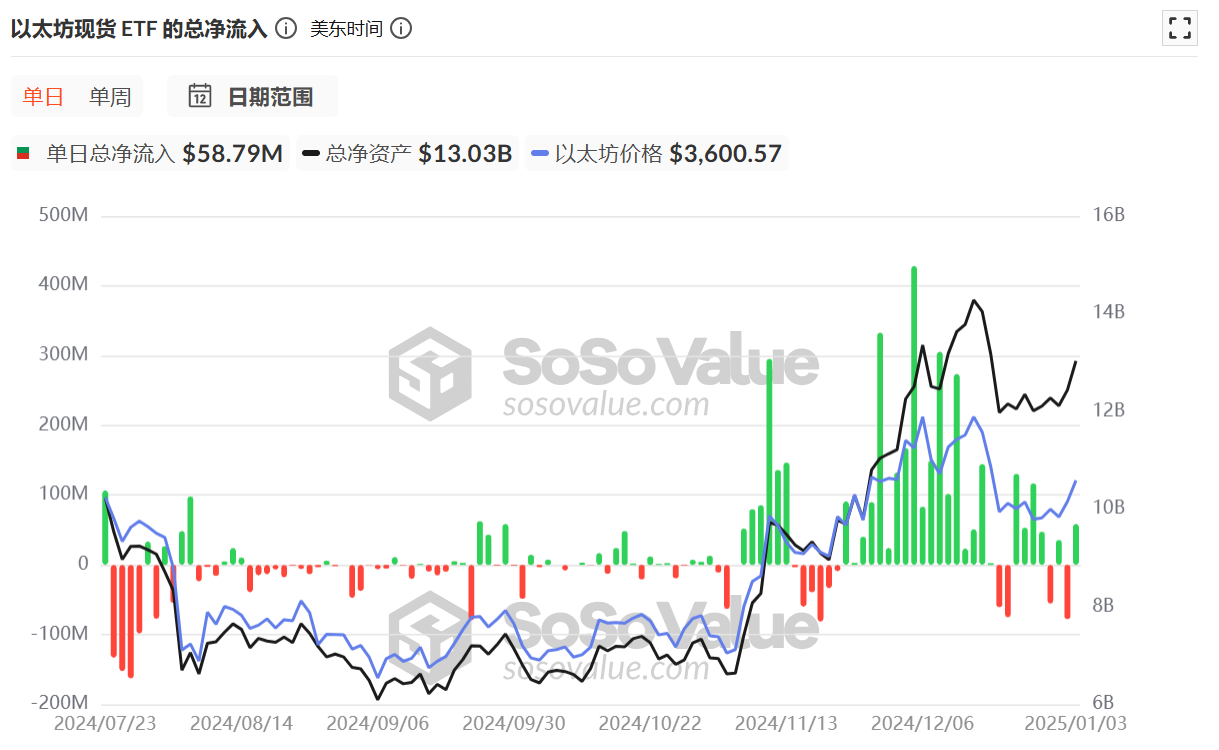
After three months of sluggish performance, Ethereum began seeing significant inflows starting in early November, driven by a broader market recovery. Since then, net inflows have consistently far exceeded net outflows.
By the end of November, Ethereum spot ETFs experienced a rare streak of 18 consecutive days of net inflows, with single-day highs exceeding $400 million in net inflow. Adjusted for market cap—since Ethereum’s market cap is roughly one-quarter of Bitcoin’s—this equates to nearly $1.2 billion in daily inflows for Bitcoin. This capital movement may reflect a strategic reallocation or expansion of investment focus, aligning with the start of the new fiscal year on December 1 for U.S. mutual funds, and signaling growing optimism toward 2025. If this demand persists, Ethereum’s price could see substantial gains in 2025.
At the time of writing, total net inflows into Ethereum spot ETFs have reached $2.64 billion.
Strong Historical Q1 Performance Over the Years
Over the past eight years, Ethereum has posted positive returns in six out of eight first quarters. Particularly following U.S. presidential elections, Ethereum delivered remarkable Q1 gains—rising 518.14% in 2017 and 160.7% in 2021.
The crypto market often exhibits self-fulfilling prophecies. If history repeats itself, Ethereum’s performance in Q1 2025 could once again capture significant market attention.
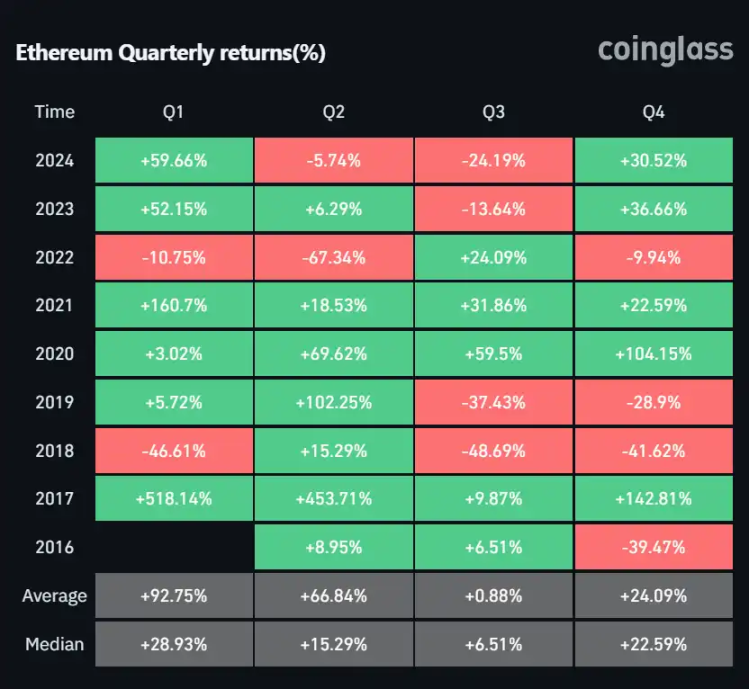
Ethereum’s price performance frequently correlates with broader market trends. During strong Q1 markets, Ethereum typically benefits from factors such as DeFi growth and liquidity expansion, driving upward momentum.
Long-Term Holders Continue Accumulating ETH
Monitoring long-term holder behavior is a valuable way to gauge market sentiment. Significant and sustained selling by long-term holders often signals that prices are nearing a top, whereas increased accumulation during downturns or periods of bullish outlook reflects confidence in future appreciation—a classic buy-low, sell-high pattern.
The chart below shows that long-term holders of BTC have been steadily reducing their positions, possibly indicating that some long-term investors have hit their profit-taking targets. In contrast, Ethereum’s data appears more optimistic. The proportion of ETH held by long-term holders rose from under 60% mid-year to over 80% at its peak, though it has since pulled back slightly.
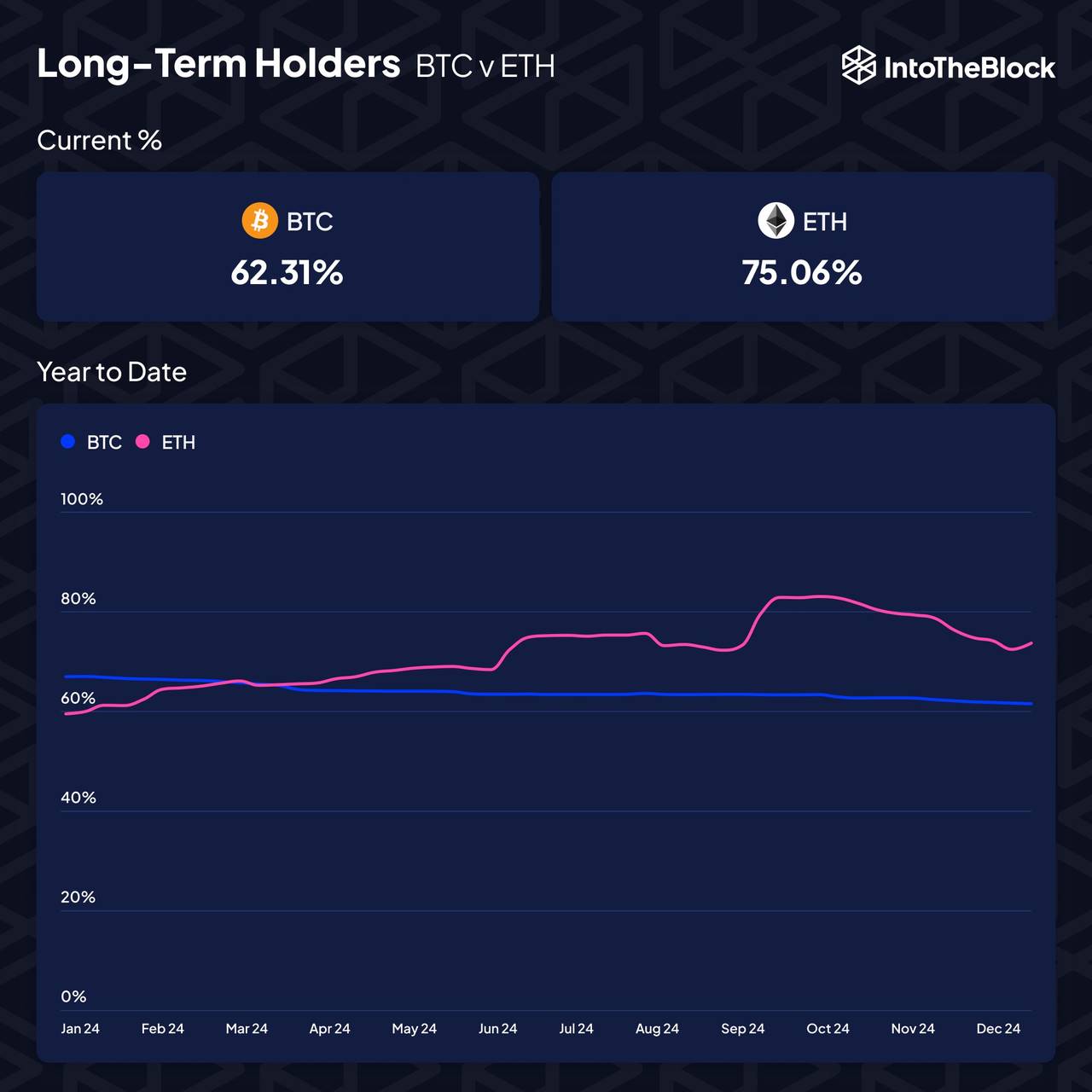
The data suggests that Bitcoin holdings above $100,000 no longer offer substantial upside potential, while long-term market participants still see promising opportunities in Ethereum next year.
Staking and Restaking Data Continue Upward Trend
Ethereum staking and restaking metrics can serve as indicators of market confidence.
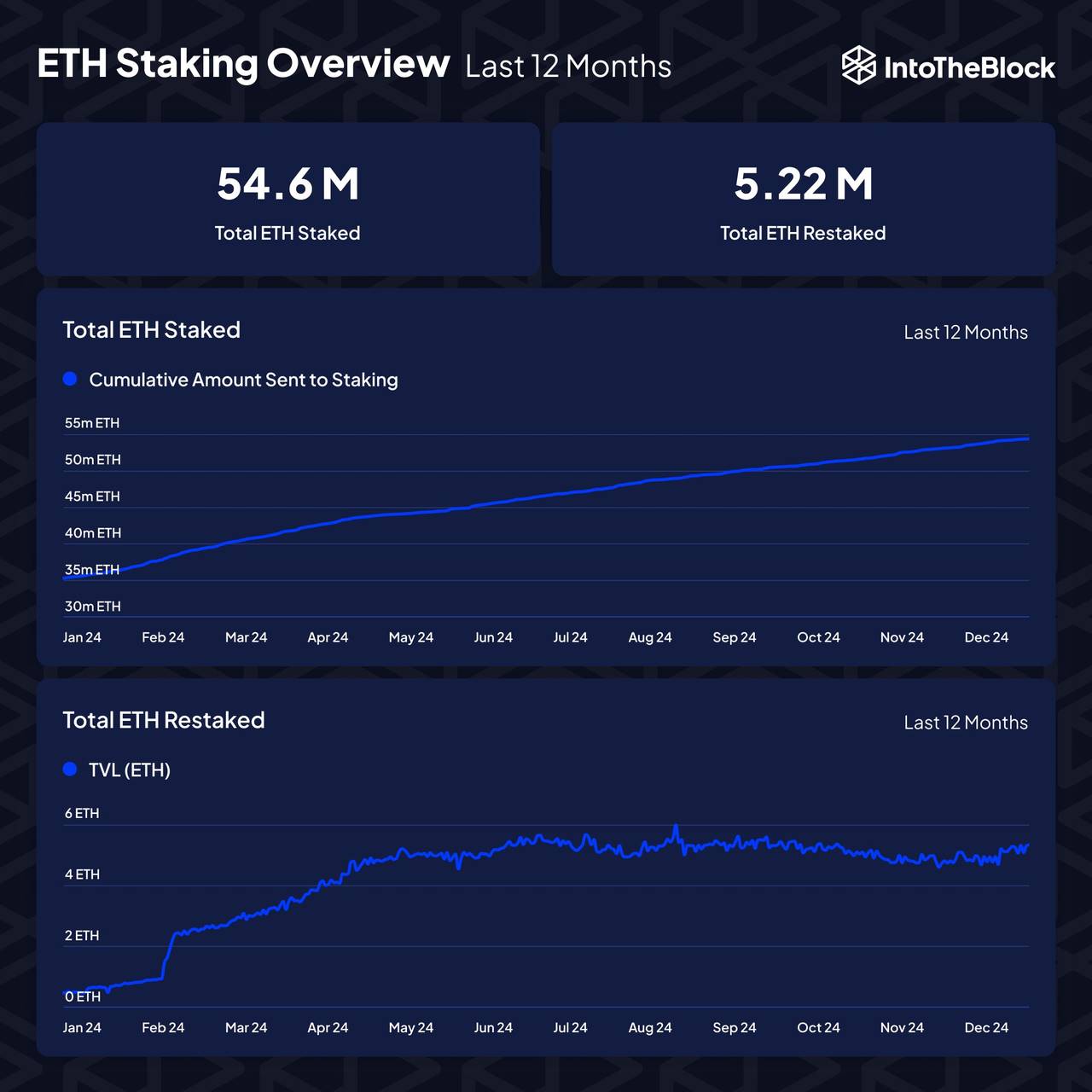
From the beginning of 2024, when less than 35 million ETH were staked, the staked amount rose to 55 million ETH by year-end. On the restaking front, after explosive growth early in the year, the figure stabilized and remained above 4 million ETH.
Ethereum Spot ETFs May Soon Support Staking
Currently, investors can only trade Ethereum through spot ETFs without earning staking yields. However, "Ethereum ETF staking" could become a reality in the future. At present, holding ETH via ETF means forgoing staking rewards while also paying management fees ranging from 0.15% to 2.5% to the ETF issuer.
SEC Commissioner Hester Peirce recently stated that physical redemption and enabling staking for Ethereum ETFs could be reconsidered. Unlike before, when these measures stood almost no chance under Chair Gary Gensler, Peirce expressed optimism about their feasibility under a new leadership team.
Cynthia Lo Bessette, head of Fidelity Digital Assets, also indicated in an interview that the introduction of Ethereum ETF staking is not a matter of if, but when.
It is foreseeable that once Ethereum spot ETFs support yield-generating staking, it would provide a meaningful boost to ETH's price.
Summary
While Ethereum remains promising, it still faces notable challenges. Gas fee data reveals low ecosystem activity throughout 2024, with transaction volumes stagnating. Meanwhile, strong competition from Solana and Sui continues to intensify. Ethereum must reassess whether its core narrative still resonates with users and maintains broad acceptance.
Join TechFlow official community to stay tuned
Telegram:https://t.me/TechFlowDaily
X (Twitter):https://x.com/TechFlowPost
X (Twitter) EN:https://x.com/BlockFlow_News
 Foresight News






