The World of Ethereum: What It Is and How It's Transforming Industries
TechFlow Selected TechFlow Selected
The World of Ethereum: What It Is and How It's Transforming Industries
As infrastructure for Web3, Ethereum firmly holds the leading position in blockchain technology.
 Navigating Web3 tides with focused insights
Ethereum is a groundbreaking blockchain platform whose influence has long extended beyond cryptocurrency itself. Today, it stands as the core pillar of decentralized computing, driving innovation in finance, gaming, supply chain management, governance, and emerging fields such as artificial intelligence (AI), decentralized science (DeSci), and real-world asset tokenization (RWA). As infrastructure for Web3, Ethereum firmly holds its position at the forefront of blockchain technology.
The key innovation of Ethereum lies in smart contracts—self-executing agreements that automatically run when predefined conditions are met. These contracts form the foundation for a thriving ecosystem of decentralized applications (dApps) on Ethereum. The network currently supports thousands of dApps spanning decentralized finance (DeFi), non-fungible tokens (NFTs), gaming, real estate, healthcare, and more. Ethereum’s powerful programmability has attracted a vast developer community, creating a vibrant ecosystem that continuously pushes the boundaries of blockchain technology.
Table of Contents
The Scalability Trilemma: Balancing Security, Decentralization, and Scalability
Ethereum's Evolution: From "The Merge" to the Present
Current State and Development of Layer-2 Solutions
Emerging Use Cases and Their Profound Implications
Looking Ahead
The Scalability Trilemma: Balancing Security, Decentralization, and Scalability
Ethereum has been striving to solve a fundamental challenge—how to balance the following three aspects:
- Security: Ensuring the network can withstand various attacks and remain robust.
- Decentralization: Distributing control widely across the network to avoid centralization risks.
- Scalability: Efficiently handling growing transaction demands.
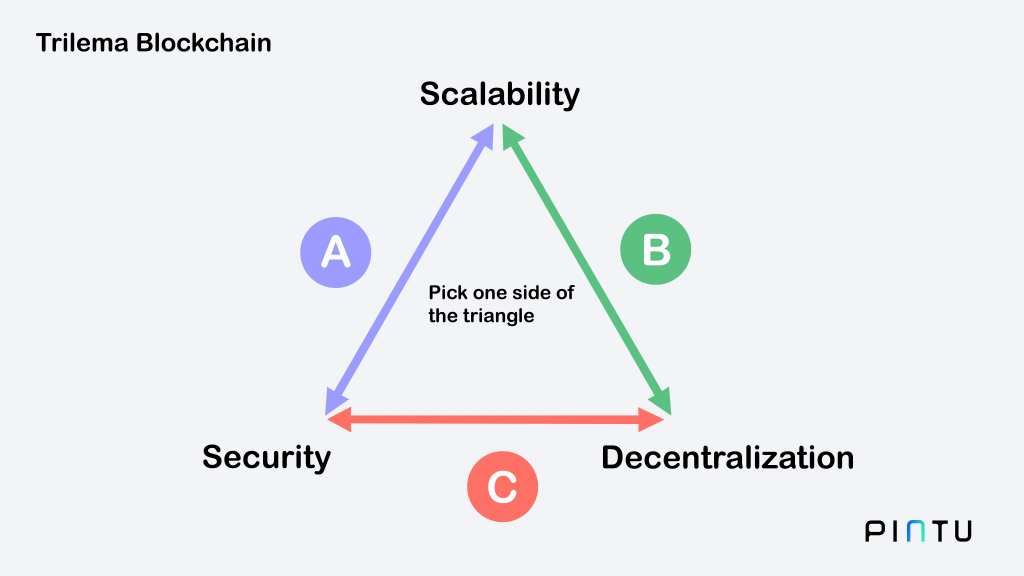
Image Credit: Pintu
Real-World Examples of the Trilemma
During the 2020 DeFi (decentralized finance) boom, Ethereum's network became severely congested. Popular protocols like Uniswap and Compound saw surging usage, but this led to skyrocketing gas fees—sometimes exceeding hundreds of dollars per transaction—making participation unaffordable for many small users.
The NFT craze of 2021 further strained Ethereum. High trading volumes on platforms like OpenSea caused NFT minting and transaction costs to spike while slowing down network processing speeds. These issues highlighted Ethereum’s scalability challenges amid strong commitments to security and decentralization.
To address these problems, Ethereum introduced Layer-2 scaling solutions and sharding technology. However, achieving true balance among all three factors remains a critical focus for Ethereum’s future development.
Ethereum's Evolution: From "The Merge" to the Present
"The Merge" (2022)
"The Merge" marked a pivotal moment in Ethereum’s history, transitioning the network from proof-of-work (PoW) to proof-of-stake (PoS). This upgrade reduced Ethereum’s energy consumption by over 99%, making it one of the most environmentally sustainable blockchains. With PoS, users can participate in securing the network by staking ETH, lowering entry barriers and enhancing decentralization.
Beyond improving energy efficiency, "The Merge" laid the groundwork for future scalability enhancements, including deeper integration with sharding and Layer-2 solutions. It represented Ethereum’s shift from an energy-intensive early model toward a more sustainable and efficient future.
EIP-1559 and ETH's Deflationary Nature (2021)
The EIP-1559 upgrade, part of the London hard fork, redesigned Ethereum’s fee mechanism. By introducing dynamically adjusted base fees and burning a portion of transaction fees, this change effectively reduced the total ETH supply. This deflationary feature strengthens ETH’s role as a store of value while making transaction costs more transparent and predictable.
Shanghai Upgrade (2024)
The Shanghai upgrade enabled Ethereum stakers to withdraw their staked ETH for the first time, significantly increasing liquidity across the ecosystem and encouraging broader participation in staking. By resolving a longstanding liquidity issue, this upgrade further demonstrated Ethereum’s commitment to user experience and decentralization.
Gas Fees Remain a Challenge
Despite significant technical progress, gas fees remain a major hurdle for Ethereum. During NFT booms or spikes in DeFi activity, network congestion drives up costs, often pricing out average users. These recurring issues underscore the necessity of Layer-2 scaling solutions and further optimizations to Ethereum’s core protocol.
Image Credit: Finshots
Current State and Development of Layer-2 Solutions
Layer-2 solutions have become essential to Ethereum’s strategy for addressing scalability. Operating atop Ethereum’s main chain, these technologies process transactions off-chain, dramatically increasing speed and reducing costs while preserving the security and decentralization of the underlying network. These innovations enable Ethereum to support more users and applications than ever before.
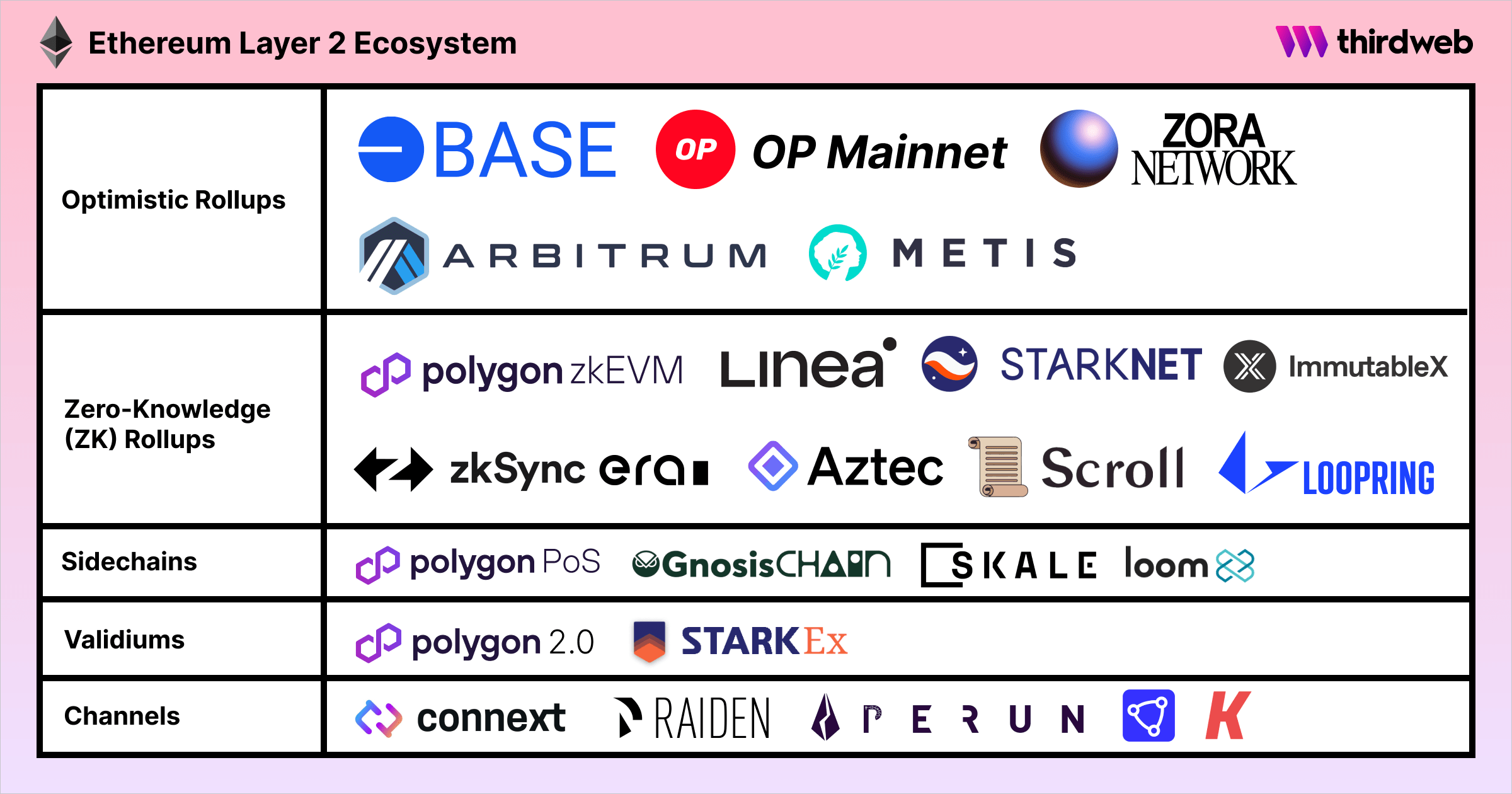
Image Credit: Thirdweb
Optimistic Rollups
Optimistic Rollups assume transactions are valid by default, only verifying them if challenged during a dispute period. This approach maintains security while greatly improving efficiency.
Optimism: Known for simplicity and developer-friendliness, Optimism has attracted numerous DeFi protocols and dApps, becoming a popular choice due to seamless compatibility with Ethereum.
Arbitrum: Recognized for its advanced fraud-proof mechanisms, Arbitrum is widely used in decentralized exchanges and gaming platforms.
zk-Rollups
zk-Rollups use zero-knowledge proofs to validate transactions securely and privately, making them ideal for high-throughput and privacy-sensitive applications.
StarkNet: Renowned for strong scalability and a rich ecosystem, StarkNet supports diverse financial and gaming applications.
zkSync: Focused on user experience, zkSync is a go-to option for developers aiming to rapidly attract new users.
Polygon
Polygon offers a comprehensive suite of Layer-2 scaling tools, including Plasma chains, sidechains, and zk-Rollups. Its ecosystem hosts thousands of dApps across NFTs, gaming, and DeFi. Known for flexibility and low cost, Polygon is a top choice for developers and users alike.
Base
Base is a Layer-2 solution launched by Coinbase, built on Optimistic Rollup technology with an emphasis on ease of use. Base focuses on helping Web2 companies quickly integrate into the Web3 ecosystem, extending Ethereum’s potential into traditional business domains.
Rapid Ecosystem Growth
Layer-2 networks like Polygon, Optimism, Arbitrum, and Base have evolved into thriving ecosystems hosting numerous dApps, DeFi platforms, and NFT marketplaces. These networks not only alleviate Ethereum’s scalability bottlenecks but also significantly reduce gas fees, making high-performance applications more accessible and attracting users worldwide.
Challenges and Future Directions
While Layer-2 solutions have greatly enhanced Ethereum’s scalability, several challenges remain:
- Interoperability: Seamless asset transfers between Layer-1 and Layer-2 still require further optimization.
- User Education: Greater efforts are needed to help users and developers understand and adopt Layer-2 technologies.
- zkEVM Integration: Emerging technologies like zero-knowledge Ethereum Virtual Machine (zkEVM) promise stronger synergy between Layer-1 and Layer-2, elevating Ethereum’s usability to new levels.
Layer-2 solutions are a cornerstone of Ethereum’s future, offering better balance among decentralization, security, and scalability.
Emerging Use Cases and Their Profound Implications
Ethereum’s programmability and flexibility are enabling unprecedented innovation across industries, laying the foundation for a decentralized future. By 2025, Ethereum’s impact extends deeply into the following areas:
Finance
Ethereum remains the leader in decentralized finance (DeFi). Protocols like Aave, Uniswap, and MakerDAO allow users to lend, borrow, trade, and earn interest without intermediaries. These platforms break down traditional financial barriers, providing greater access to underserved populations around the world.
Supply Chain
Projects like OriginTrail leverage Ethereum to provide transparent and traceable supply chain management. Through product tokenization and automated smart contracts, businesses can track goods in real time and reduce fraud risks. OriginTrail’s decentralized knowledge graph further enables seamless data interoperability across industries.
Healthcare
Ethereum-based solutions like Medicalchain are revolutionizing how medical data is stored and managed. Patients gain full control over their electronic health records, deciding who can access their information, while minimizing privacy breaches and data misuse.
Gaming
Blockchain games like Gods Unchained are leading the "play-to-earn" trend. With blockchain-backed card systems, players receive rewards of real-world value. Leveraging Ethereum’s Layer-2 solutions, these games run more smoothly and at much lower transaction costs.
Artificial Intelligence (AI)
Decentralized AI platforms like SingularityNET use Ethereum to assign value to machine learning algorithms and datasets. Developers can transparently share and monetize their models, fostering innovation and openness in the AI field.
Decentralized Physical Infrastructure Networks (DePIN)
Projects like EnergyWeb and Chorus Mobility tokenize physical infrastructure assets—such as renewable energy grids and autonomous transportation systems—using Ethereum. Through smart contracts and token incentives, they achieve efficient and fair resource allocation, shifting control from centralized entities to broader communities.
Decentralized Science (DeSci)
Initiatives like Molecule are reshaping how scientific research is funded and conducted. By tokenizing intellectual property, Molecule enables decentralized funding for medical research and promotes collaboration among scientists.
Real-World Assets (RWA)
Platforms like RealT make real-world assets accessible through tokenization. RealT allows global investors to purchase fractional ownership of U.S. real estate, lowering traditional investment barriers.
Looking Ahead
Ethereum’s ecosystem continues to evolve, guided by a clear roadmap that addresses current limitations while paving the way for future innovation. With scalability, decentralization, and user-friendliness as core goals, Ethereum is strengthening its leadership in the blockchain industry.
Image Credit: Cryptoast
Sharding
Sharding is one of Ethereum’s most anticipated upgrades. It divides the network into smaller, more manageable “shards,” each functioning as an independent chain. By enabling parallel transaction processing, sharding will drastically increase throughput, allowing Ethereum to support millions of users and dApps.
Danksharding
Building on sharding, Danksharding optimizes data storage and retrieval, reducing redundancy and improving communication efficiency between shards. This advancement will significantly boost Ethereum’s performance, making it competitive with high-speed blockchain platforms.
Verkle Trees
Ethereum plans to replace existing Merkle trees with Verkle trees—a new cryptographic structure that drastically reduces the data nodes must store. This improvement will allow more users to run full nodes easily, further enhancing network decentralization.
zkEVM Integration
Integrating the zero-knowledge Ethereum Virtual Machine (zkEVM) will enable seamless interaction between Layer-1 and Layer-2. zkEVM enhances dApp performance while maintaining Ethereum’s security and compatibility, further lowering transaction costs and improving user experience.
Pectra Upgrade
The upcoming Pectra upgrade, expected in early 2025, will introduce several key improvements to enhance transaction efficiency and user experience.
Account Abstraction: Users will be able to bundle multiple transactions and pay gas fees using any ERC-20 token.
Data Availability Improvements: Will effectively reduce Layer-2 transaction costs. These updates will simplify operations on Ethereum and lower barriers to entry.
Decentralized Governance
Ethereum is moving toward more decentralized governance, giving community members greater influence over network development. Through on-chain voting and decentralized autonomous organizations (DAOs), future decisions about Ethereum will increasingly reflect community input. This ensures the network evolves in alignment with its core principles of decentralization.
Challenges Ahead
Despite a clear roadmap and strong technical foundations, Ethereum faces several ongoing challenges:
- Competition: Blockchains like Solana and Avalanche continue innovating, attracting users with lower fees and faster speeds.
- Regulatory Compliance: As governments develop clearer regulatory frameworks for blockchain, Ethereum must balance compliance with its decentralized ethos.
- User Education: Educating mainstream users about Ethereum’s technical advantages remains a long-term endeavor.
By actively addressing these challenges and advancing along its defined technical path, Ethereum is solidifying its role as a leader in the blockchain industry. In the years ahead, Ethereum will continue to shape the future of decentralized technology.
About XT.COM
Founded in 2018, XT.COM now has over 7.8 million registered users, more than 1 million monthly active users, and an ecosystem reaching over 40 million users. We are a comprehensive exchange supporting 800+ quality cryptocurrencies and 1,000+ trading pairs. XT.COM offers diverse trading options including spot, margin, and futures trading. We also operate a secure and reliable NFT marketplace. Our mission is to provide users with the safest, most efficient, and professional digital asset investment services.
Join TechFlow official community to stay tuned
Telegram:https://t.me/TechFlowDaily
X (Twitter):https://x.com/TechFlowPost
X (Twitter) EN:https://x.com/BlockFlow_News
 @XTexchange