Interview with Bedrock Core Contributor: The Accelerated Arrival of BTCFi 2.0, A Panoramic Interpretation of Bedrock's Product Strategy
TechFlow Selected TechFlow Selected
Interview with Bedrock Core Contributor: The Accelerated Arrival of BTCFi 2.0, A Panoramic Interpretation of Bedrock's Product Strategy
Bedrock aims to integrate the three most promising asset classes in the blockchain space today—BTC, ETH, and DePIN (IOTEX)—by unlocking their intrinsic value through an innovative liquid staking mechanism.
 Navigating Web3 tides with focused insights
By: TechFlow
Recently, Messari, a leading crypto research institution, released its annual report "The Crypto Theses 2025," expressing an optimistic outlook on Bitcoin’s prospects in 2025: BTC is maturing into a global asset.
BTCFi has become the clear front-runner narrative for 2025.
When discussing today's BTCFi landscape, liquid staking—dedicated to delivering capital-efficient native yields for BTC holders—stands out as a critical and indispensable segment.
With the recent launch of the new BTC LRT product brBTC and its token TGE approaching, Bedrock, the multi-chain, multi-asset liquid staking protocol, is gaining broader public attention.
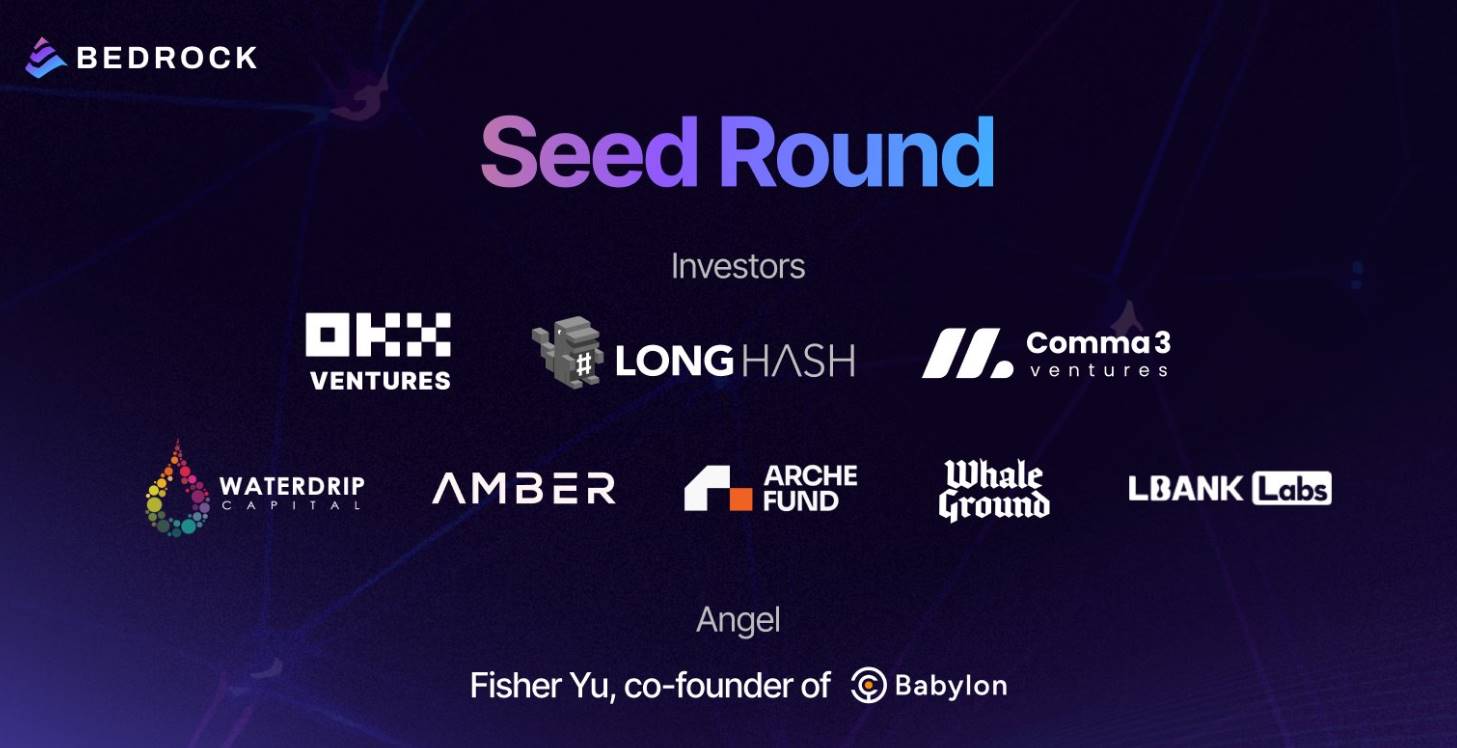
Notably, in its latest funding round this past May, Bedrock secured support from prominent institutions and industry leaders including OKX Ventures, LongHash Ventures, Comma3 Ventures, and Fisher Yu, co-founder of Babylon.
At this pivotal moment, we sat down for an in-depth conversation with Zhuling, core contributor at Bedrock.
In the dialogue, Zhuling—who excels at dissecting complex topics from a holistic perspective—shared Bedrock’s comprehensive product roadmap within the BTCFi space:
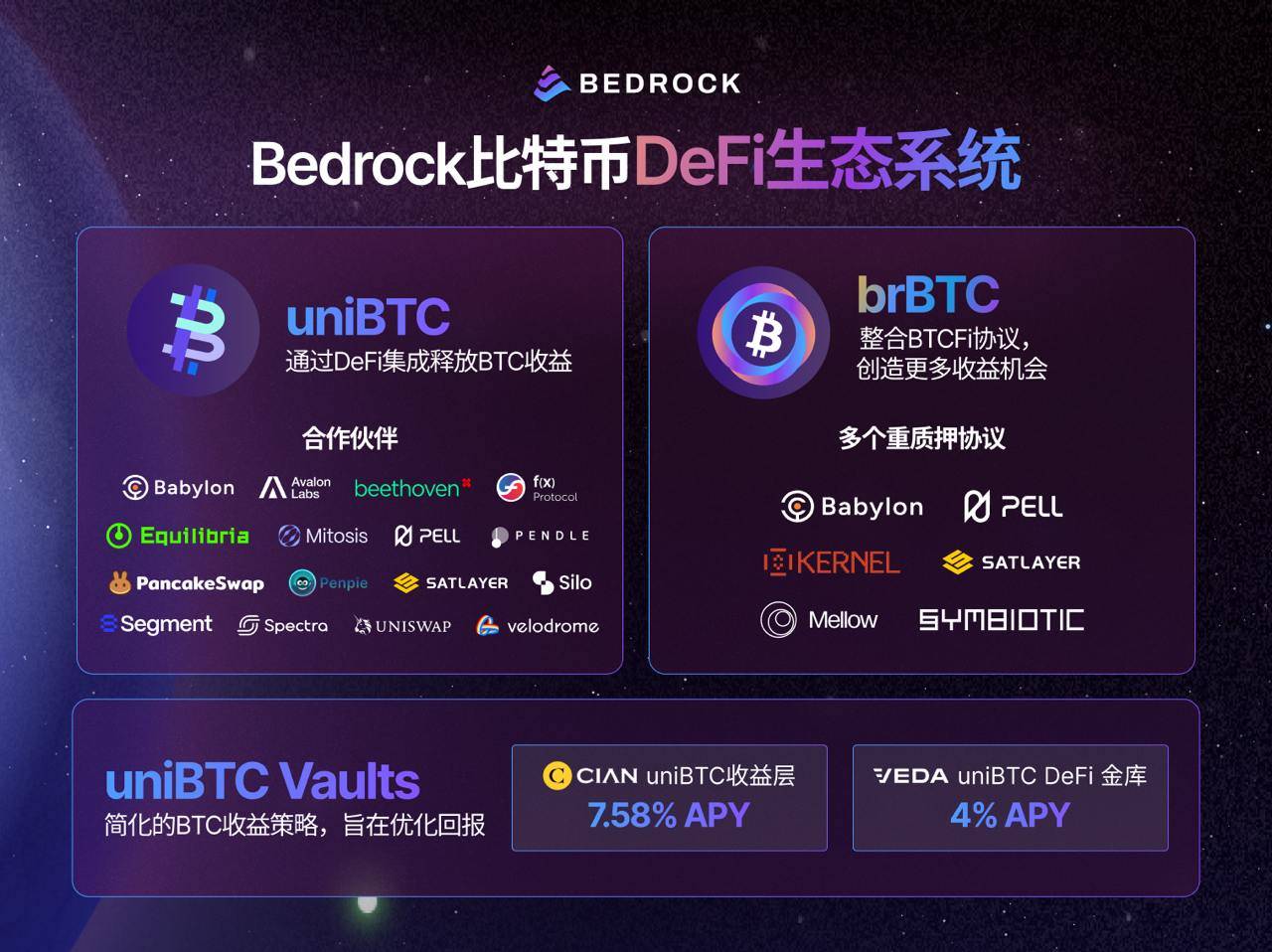
"uniBTC is our pioneering BTC LRT asset built upon the Babylon narrative during the BTCFi 1.0 era; uniBTC Vaults, designed to offer users simple and intuitive yield opportunities, represent our strategic upgrade to BTCFi 1.0; and the newly launched brBTC, as a groundbreaking product of the BTCFi 2.0 era, reflects our deep vision for the future of finance."
On expectations for 2025, Zhuling expressed unreserved optimism toward BTCFi:
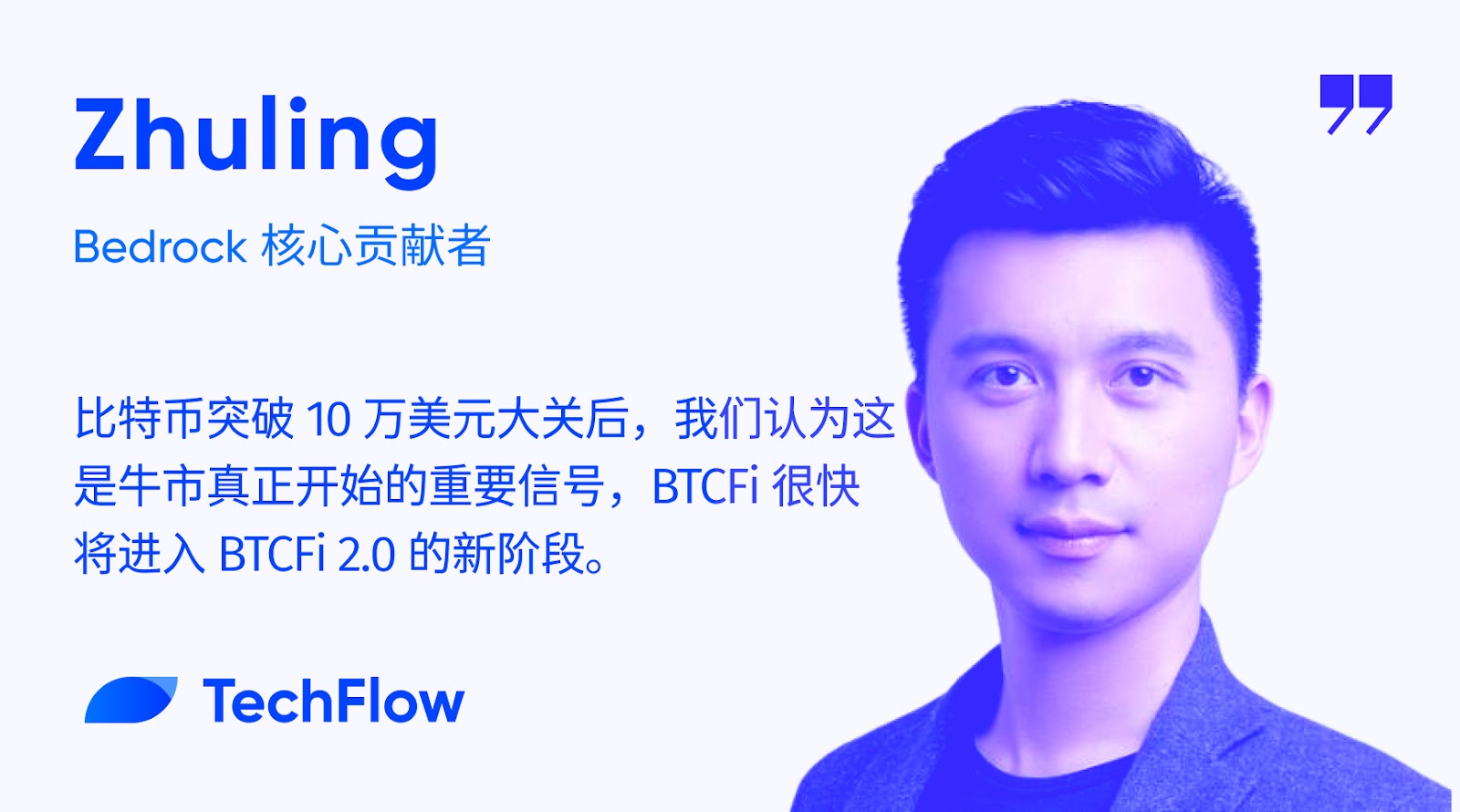
"After collectively witnessing Bitcoin surpass the $100,000 milestone, we believe this marks a key signal that the bull market has truly begun. BTCFi will soon enter a new phase—one we define as BTCFi 2.0."
Regarding brBTC, Zhuling also detailed its crucial role within Bedrock’s overall BTCFi 2.0 strategy:
"True yield diversification is brBTC’s core advantage. Through intelligent dynamic asset allocation strategies, it not only delivers superior returns but also lowers entry barriers, enabling BTCFi to scale sustainably."
Read on to discover more highlights from the full conversation.
BTCFi 2.0 Accelerates: The Core Advantages of Leading Liquid Staking Protocol Bedrock
TechFlow: We’re delighted to have this opportunity for an in-depth exchange. To begin, could you introduce yourself (feel free to share your educational background, professional/entrepreneurial experience, and how you came to join Bedrock)?
Zhuling:
Hello everyone, I’m Zhuling, a core contributor at Bedrock. I’m very excited to have this chance to engage deeply with all of you.
As a technical expert with an overseas engineering background, I previously served as a consultant deeply involved in innovation projects for multiple central banks and financial institutions. Driven by strong interest in cutting-edge technology and innovative business opportunities, I joined an international blockchain startup team and actively participated in the design and development of a hardcore public chain.
My first encounter with staking yields began with the emergence of the first-generation PoS blockchains, where I recognized a unique and innovative revenue model within blockchain. This staking yield model resembles government bonds and represents blockchain’s most native form of yield.
Over the past five years, I’ve been deeply involved in staking services on major public chains like Ethereum, personally experiencing Ethereum’s historic transition from PoW to PoS. In my view, within today’s blockchain ecosystem, financial applications dominate, and staking yield—the purest form of on-chain native return—has become a cornerstone of DeFi.
Therefore, earlier this year, I joined Bedrock as an early contributor. The project aims to integrate three of the most promising asset classes in blockchain today—Bitcoin (BTC), Ethereum (ETH), and DePIN (IOTEX)—unlocking their intrinsic value through innovative liquid staking mechanisms.
TechFlow: The liquid staking space is crowded, yet Bedrock remains at the forefront. Could you share some of Bedrock’s standout achievements and key metrics?
Zhuling:
Overall, Bedrock currently has a TVL of approximately $508 million and over 114,000 staking users. Specifically, as a multi-chain, multi-asset liquid staking protocol, Bedrock’s accomplishments can be reviewed across different ecosystem dimensions.
First, in the Ethereum ecosystem: A year ago, Bedrock launched uniETH, an institutional-grade liquidity restaking token based on EigenLayer. uniETH is the only ETH protocol that exclusively supports native ETH and operates entirely via smart contracts. From day one, uniETH supported unstaking, and all its smart contracts have undergone multiple security audits, aiming to help users select optimal validators and maximize yield. Currently, uniETH has over 29,010 ETH staked and nearly 10,000 stakers.
Following that, Bedrock launched uniIOTX, which rapidly became the largest staking gateway on IOTX. Today, uniIOTX has nearly 450 million IOTX staked and close to 15,000 staking users.
This past summer, the emergence of Babylon revealed the true potential of BTCFi, and uniBTC—the liquid staked Bitcoin developed in collaboration with Babylon—became Bedrock’s strategic focus within the Bitcoin ecosystem.
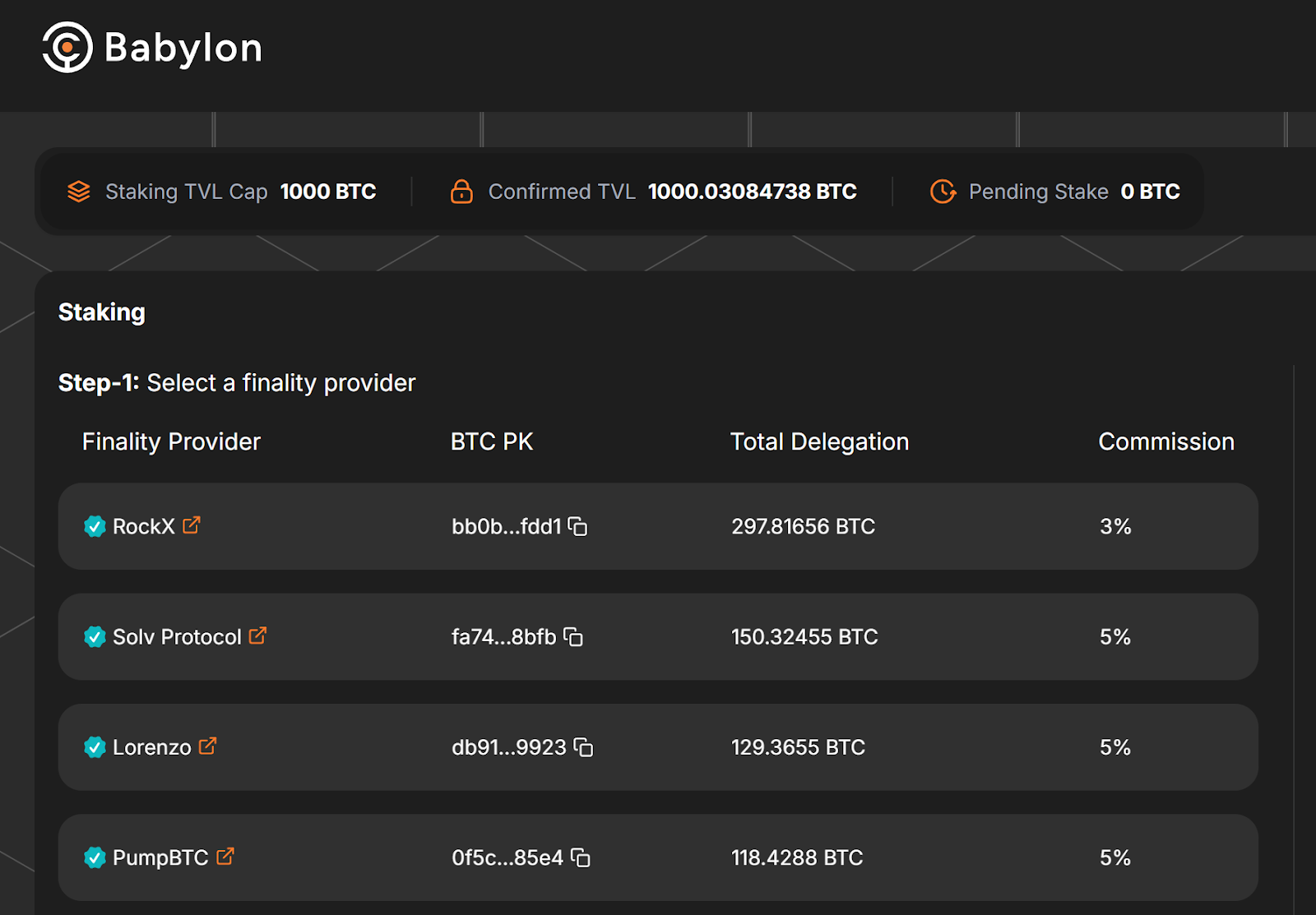
When discussing Bedrock’s standout achievements, its deep integration with the Babylon ecosystem is essential. Babylon conducted three phases of staking, and during Babylon’s Cap-1 phase, Bedrock (ROCKX) emerged as a dark horse, staking the most BTC and accounting for nearly 30% of Babylon’s initial total staked amount.
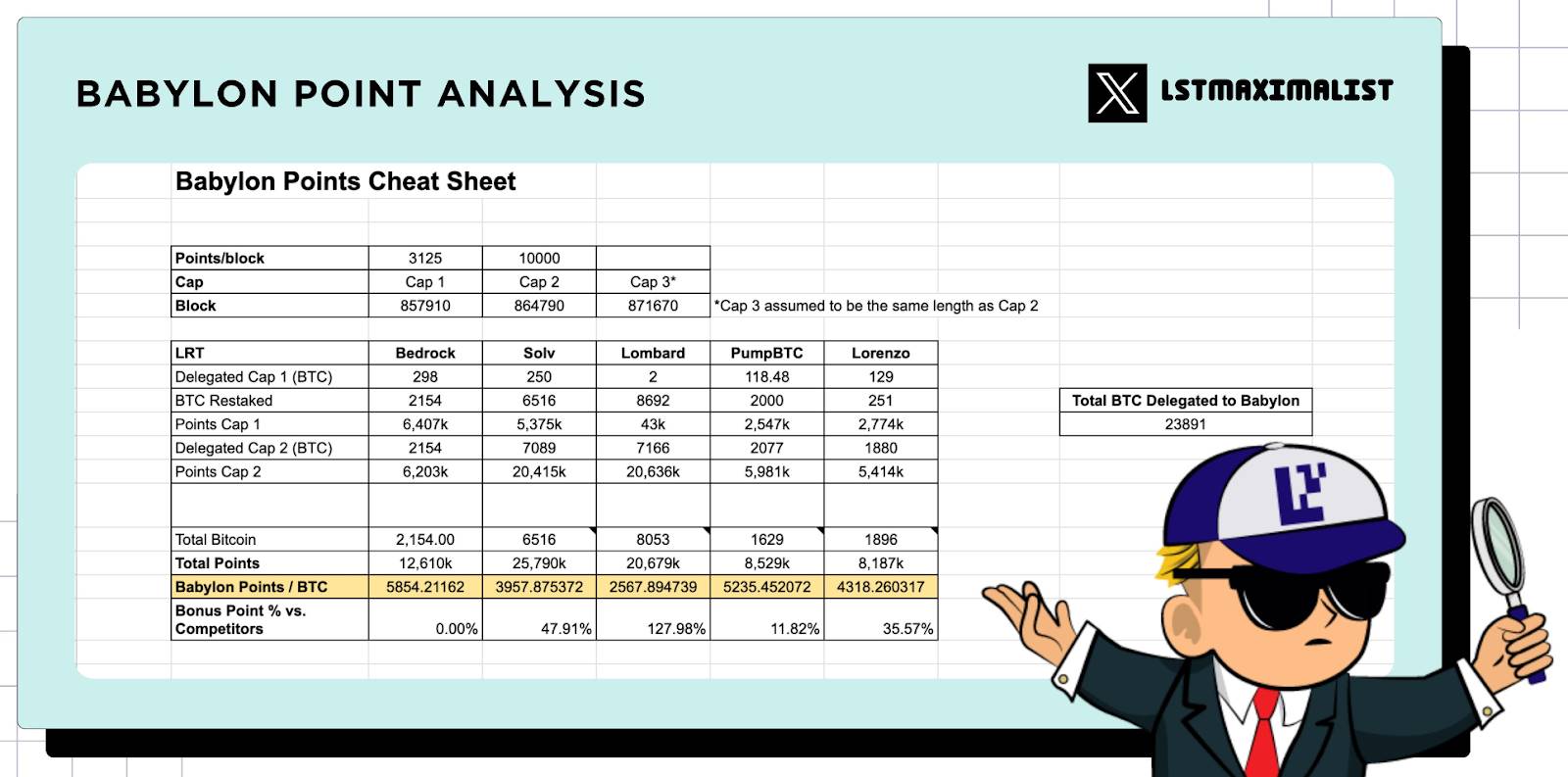
Cap-1’s success didn’t stop us from reflecting—we identified several user-level pain points, such as severely compressed Babylon point rewards for participants. Thus, during Babylon’s Cap-2 phase, Bedrock made significant efforts to ensure BTC stakers received the highest possible Babylon points, ultimately achieving excellent results: Bedrock stakers collectively earned and distributed 5,854 Babylon points, ranking #1 among Bitcoin staking protocols. This user-first strategy garnered widespread positive community feedback.
In the recently concluded Babylon Cap-3 phase, Bedrock continued to demonstrate strong performance in both TVL and holder numbers. However, as the Bitcoin ecosystem evolves, we’ve realized BTCFi holds far greater potential beyond Babylon. With catalysts like Bitcoin breaking the $100,000 mark, we sense BTCFi 2.0 is accelerating. There’s much more we can do—so while participating in Cap-3, Bedrock shifted focus toward launching our new LRT product brBTC, aiming to deliver better yield strategies for BTC users.
TechFlow: In your view, what unique advantages set Bedrock apart from competitors and contributed to its success?
Zhuling:
First, I believe Bedrock’s greatest differentiation lies in its unique positioning. As a leading multi-asset restaking protocol (Multi-asset Restaking Protocol), Bedrock offers comprehensive staking solutions, redefining the future of digital asset staking.
Second, Bedrock’s impressive metrics are inseparable from the resource backing provided by our project origins, particularly our deep collaborations with ROCKX and Babylon.
As many know, Bedrock originated from RockX. Since 2019, RockX has been deeply rooted in the staking space, with over $2 billion in total staked value and more than 150,000 registered users.
As one of the first projects entering the BTC restaking space and a pioneer in the Babylon ecosystem, Bedrock enjoys strong credibility and support. In May, Bedrock received investment from notable entities including OKX Ventures, LongHash Ventures, Comma3 Ventures, and Fisher Yu, co-founder of Babylon, and subsequently formed a technical partnership with Babylon, accelerating growth within its ecosystem.
Positioning and resources matter, but so does product strength. Bedrock’s product philosophy centers on putting users first—understanding their needs and iterating accordingly. We reject the notion that BTCFi is solely for whales and are committed to broadening access, driving mass adoption through easier entry points, diverse use cases, and simplified, optimized yield strategies. Take uniBTC, for example: it’s the most widely supported BTC LRT with the richest DeFi integrations, compatible with 13 chains and 30+ DeFi platforms, offering triple-digit APY and earning high praise from the community.
Lastly, and equally important, Bedrock is building a complete ecosystem through diversified products, including uniETH, uniIOTX, uniBTC, uniBTC Vaults, and brBTC—continuously constructing a more open and efficient digital asset staking ecosystem, delivering superior staking services and richer application scenarios.
From uniBTC to brBTC: A Holistic View of Bedrock’s BTCFi Strategy
TechFlow: Back in 2023, when Bitcoin ecosystem narratives were just emerging, Bedrock already began focusing on BTCFi. How did you and your team detect this trend so early? What are your personal views on the current state and future outlook of BTCFi?
Zhuling:
Although Bitcoin ecosystem narratives only started gaining traction in 2023, we believe 2024 was truly the inaugural year of BTFCi—this was when many Bitcoin ecosystem concepts began materializing, such as the Ordinals and Runes booms.
By the second half of 2024, BTCFi flourished comprehensively, with sub-narratives like restaking, lending, BTC L2s, and BTC-based stablecoins rising. The Babylon ecosystem led the way to BTCFi’s first-stage success. At this point, no one can claim Bitcoin doesn’t need an ecosystem anymore.
We also believe that after collectively witnessing Bitcoin surpass $100,000, we now see a definitive signal that the bull market has truly begun. BTCFi will quickly enter a new phase—one we define as BTCFi 2.0.
Moving into 2025, BTCFi will deliver even more exciting developments. Based on our observations, BTCFi trends are becoming increasingly clear:
On one hand, BTC holders will gain access to more sustainable, stable, and diverse yield strategies;
On the other hand, BTCFi’s entry barrier will lower significantly—not only simplifying participation but also increasing flexibility;
Most importantly, competition in the BTCFi space won’t rely on a single dominant player. Instead, players will further optimize their offerings while collaborating more closely and integrating resources.
These are our market insights, and Bedrock will continue advancing along these lines.
TechFlow: Based on your deep expertise in staking and observations of the Bitcoin ecosystem, what is Bedrock’s overarching vision and product roadmap for BTCFi?
Zhuling:
In the current market environment, we observe that user demands for BTCFi products are undergoing profound changes—from initially seeking simple yields to now evaluating products holistically on sustainability, innovation, and ecosystem value. This shift signifies the industry is entering a more mature developmental stage.
BTCFi is not merely an emerging sector—it’s an inevitable evolution of the Bitcoin ecosystem. It will serve as a vital bridge connecting traditional Bitcoin holders with next-generation financial innovations, ushering in a new era of Bitcoin value realization.
Looking ahead to 2025, we firmly believe BTCFi will undergo qualitative leaps, officially entering its 2.0 era. This will not only redefine the trajectory of BTC L2s but also inject revolutionary momentum into stablecoin systems and staking economies, ultimately building a more inclusive and scalable Bitcoin financial ecosystem.
As pioneers and trailblazers in BTCFi, Bedrock consistently upholds the core principles of “Connect, Innovate, Empower,” striving to build a bridge between Bitcoin’s native value and future financial innovation. We aim not only to precisely meet user needs but also to lead the direction of BTCFi from the industry’s vantage point.
Based on this vision, we’ve built a comprehensive product matrix:
-
uniBTC: As a pioneering BTC LRT asset built on the Babylon narrative, uniBTC redefines Bitcoin’s yield ecosystem. It’s not only Bedrock’s milestone product in the BTCFi 1.0 era but also our perfect answer during the Babylon era, earning broad recognition and trust from users.
-
uniBTC Vaults: Our strategic upgrade to BTCFi 1.0, transforming into a one-stop yield aggregation platform that enables intelligent liquidity optimization across ecosystems. This product disrupts traditional DeFi’s complex operations, offering users a simple and intuitive way to earn yields.
-
brBTC: A groundbreaking product of the BTCFi 2.0 era, representing our deep thinking about the future of finance. It integrates diverse Bitcoin derivative assets and restaking protocols, leveraging an innovative economic model to build a true cross-chain value network. Through dynamic asset allocation and diverse financial applications, brBTC is reshaping the future of Bitcoin finance.
In short, our strategic vision for BTCFi is now very clear. What remains is to deliver higher-quality products and continuously optimize them based on community feedback.
TechFlow: As you mentioned, brBTC is a key component of Bedrock’s BTCFi 2.0 strategy. Could you elaborate on brBTC—its features, roadmap, unique advantages, and how it will interconnect with uniBTC and the broader ecosystem?
Zhuling:
From a product evolution standpoint, uniBTC and uniBTC Vaults served as the core products of our BTCFi 1.0 era, successfully building the first bridge into the world of Bitcoin finance. The launch of brBTC marks our official entry into the BTCFi 2.0 era. Initially, brBTC will launch on Ethereum and BNB Chain, followed by expansion to additional chains to broaden its reach and accessibility.
True yield diversification is brBTC’s core advantage. Through intelligent dynamic asset allocation, it delivers superior returns while lowering entry barriers, enabling BTCFi to scale sustainably.
Specifically, brBTC’s yield structure consists of two core components.
First, a diversified restaking yield system:
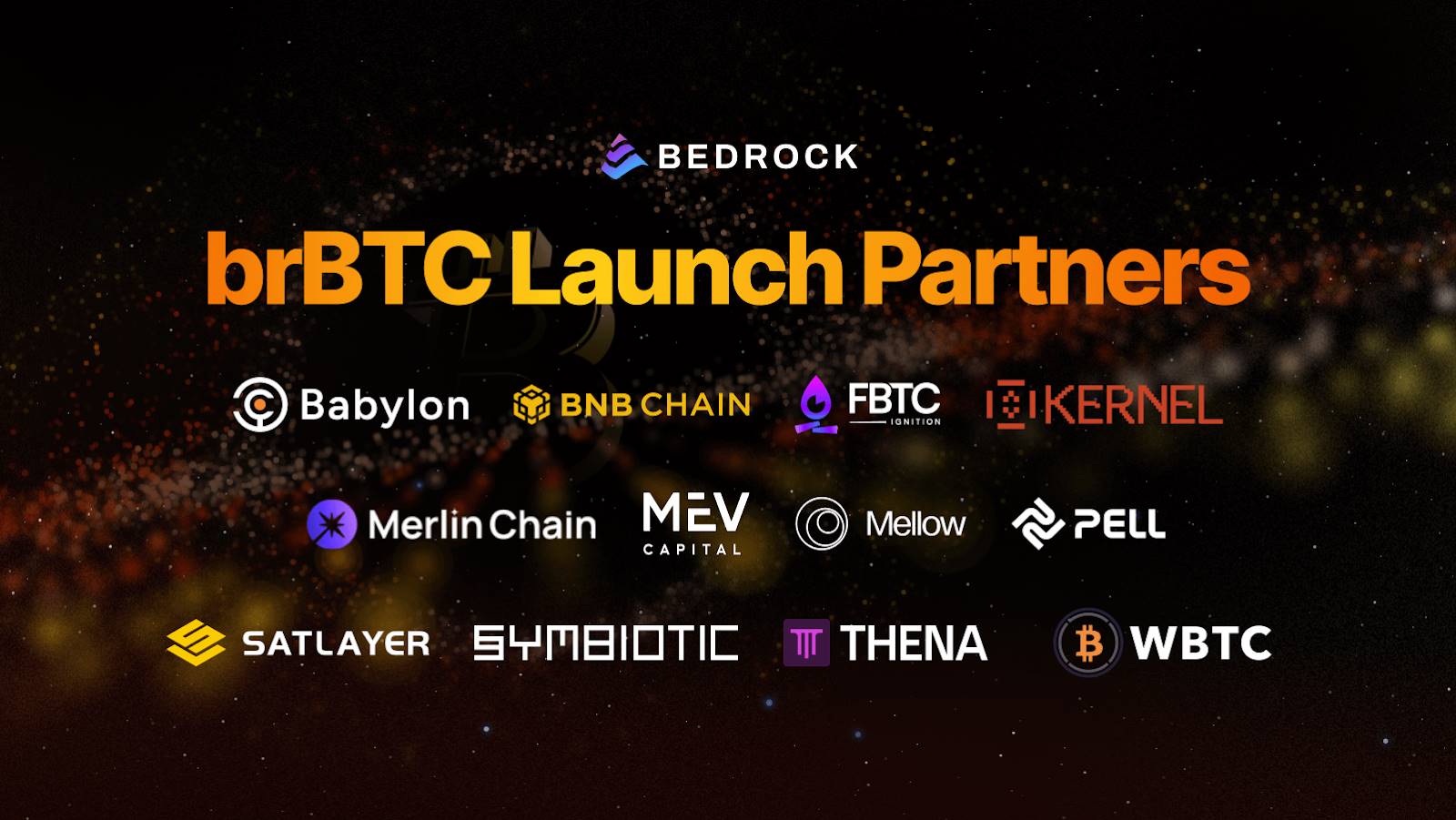
brBTC’s most distinctive yield source is its innovative multi-protocol restaking mechanism. We’ve formed strategic partnerships with leading restaking protocols including Babylon, Kernel, Symbiotic, Mellow, Pell, and SatLayer. This ensures yield diversity and stability while laying a solid foundation for integrating more high-quality restaking protocols, allowing brBTC holders to continuously benefit from ecosystem expansion.
Second, diversified yield from innovative DeFi strategies:
brBTC pioneers a flexible combinatorial approach to on-chain DeFi yields. Building on the proven yield logic of uniTokens, we’ve created a comprehensive DeFi ecosystem. Users can freely combine various DeFi protocols (e.g., DEXs, lending) based on their risk appetite, enabling personalized yield optimization. This innovative design secures baseline returns while unlocking greater upside for yield-seeking users.
Looking ahead, we’re actively expanding into off-chain yield opportunities, including partnerships with traditional financial institutions and developing novel yield models. These breakthrough initiatives will be unveiled to the community at the appropriate time, further enriching brBTC’s yield sources.
Of course, from a holistic perspective, brBTC is not a standalone product—it’s designed to synergize effectively with other components of Bedrock’s BTCFi product suite. brBTC will work alongside uniBTC and uniBTC Vaults to form a complete product matrix, meeting diverse user investment needs. Users can deposit uniBTC into brBTC, and the intelligent interplay among these three products will unlock the most comprehensive Bitcoin financial use cases. This innovative ecosystem synergy not only enhances liquidity across the decentralized Bitcoin ecosystem but also strengthens overall security.
TechFlow: From the user’s perspective, fund security is paramount. How does Bedrock ensure asset safety and protect user rights?
Zhuling:
Bedrock implements multiple measures to safeguard user assets and build a trustworthy blockchain ecosystem. In today’s complex blockchain landscape, security remains one of our top priorities. Thus, we’ve built a comprehensive security framework across multiple layers to provide maximum protection for user funds.
First, smart contract audit reports are foundational. Bedrock has partnered with several renowned auditing firms and has passed comprehensive audits by leading security firms including Peckshield and Blocksec, ensuring code-level fund protection.
Second, Bedrock has successfully integrated Chainlink, further enhancing data reliability and platform resilience. Additionally, we’ve implemented rigorous security measures, including 24/7 real-time monitoring to respond promptly to threats, a bug bounty program incentivizing global security experts to identify and fix vulnerabilities, and a dedicated security fund to swiftly address any emergent issues.
Through these multi-layered safeguards, Bedrock provides not only a feature-rich blockchain platform but also a robust defense for user assets. Going forward, we’ll continue investing in resources to refine our security strategies, ensuring users can confidently participate in blockchain innovation on the Bedrock platform.
TGE Approaches: Now Is the Golden Time to Join Bedrock and Accumulate Tokens
TechFlow: Community discussion around Bedrock’s TGE is intensifying. Can you share more details with us?
Zhuling:
First, thank you to the community for your ongoing interest in Bedrock’s TGE. Discussions around our Diamonds program and TGE are indeed heating up.
While we haven’t disclosed further TGE details yet, we can confirm that the Diamonds users accumulate today will be converted into BR tokens via a specific mechanism. Being community-centric is fundamental to Bedrock’s operations—we will never overlook the contributions of early supporters.
Bedrock’s TGE design will fully reflect the project’s long-term value. Our goal is to establish a sustainable token economy. In the future, BR tokens won’t just be a value carrier—they’ll also serve as a key governance tool. Token holders will have the opportunity to participate in major project decisions, jointly driving healthy ecosystem growth.
Specific conversion ratios and details will be announced to the community at the right time. Stay tuned.
TechFlow: For current users, what’s the best way to get involved with Bedrock?
Zhuling:
As promised earlier: the Diamonds accumulated today will be converted into BR tokens in the future. Therefore, now is the golden period for users to engage with unitoken activities, interact with Bedrock, and accumulate Diamonds.
Given our clear product roadmap, user participation pathways are straightforward:
First, users who stake to mint uniBTC receive multipliers on Diamonds rewards. Bedrock supports minting uniBTC using assets from Ethereum (wBTC/FBTC/cbBTC), Optimism (wBTC), Merlin (BTC/MBTC), Bitlayer (BTC/wBTC), and B² Network (BTC/wBTC). As our ecosystem partnerships expand, Bedrock will support even broader asset types. Meanwhile, users visiting Bedrock’s official website Discover page can participate in multiple ecosystem yield events to earn bonus Diamonds. Minting uniBTC unlocks multiple rewards, including Bedrock Diamonds, Babylon staking yields, Babylon points, and DeFi ecosystem participation rewards.
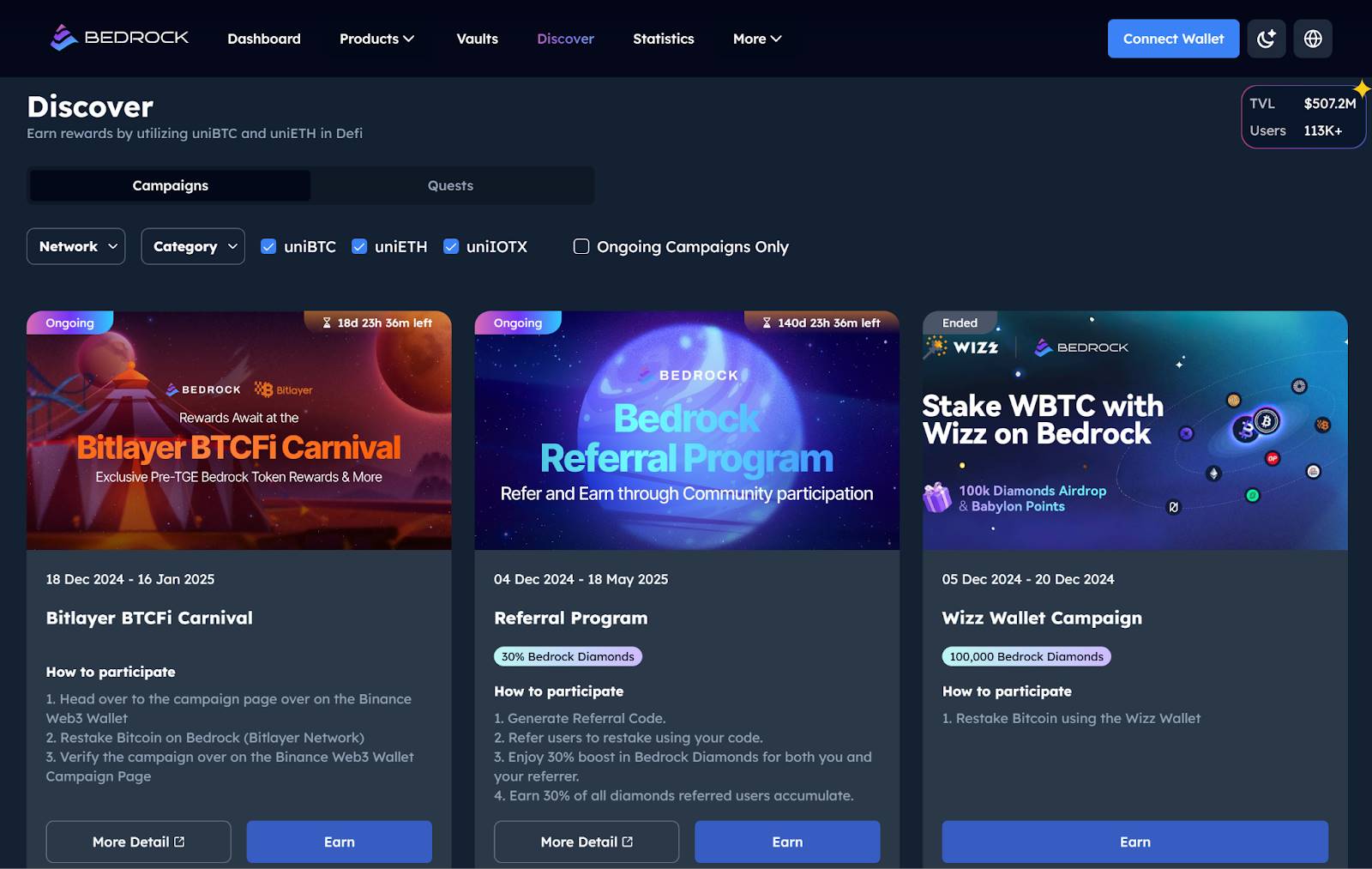
Second, participating in uniBTC Vaults is another efficient way to accumulate Diamonds and optimize yield: Bedrock has partnered with DeFi protocols CIAN and Veda to launch two Vault products—uniBTC Corn Vault and Cian uniBTC Yield Layer. By depositing assets like uniBTC, FBTC, cbBTC, or WBTC, users can instantly access optimized yield strategies while earning points rewards from CORN, BABYLON, CIAN, VEDA, and FBTC platforms.
Of course, brBTC—the flagship product focused on BTCFi 2.0—also offers substantial Diamonds rewards for early participants. To further unify BTC liquidity across different DeFi platforms, brBTC currently accepts WBTC, FBTC, mBTC, cbBTC, BTCB, and uniBTC as collateral, with more assets to be added as the ecosystem grows. We welcome everyone to try it out.
TechFlow: Final question—as the market heats up again, many anticipate innovation in staking and restaking. What do you see as the next trend in liquid staking? And what are Bedrock’s key focuses for 2025?
Zhuling:
We believe 2025 will be a year of flourishing growth for the crypto industry, and liquid staking will witness another wave of breakthrough innovations.
In terms of trends, the next phase of liquid staking may exhibit the following characteristics:
-
Further convergence of multi-chain ecosystems: As blockchain interoperability improves, liquid staking assets (like uniBTC and brBTC) will play larger roles across cross-chain ecosystems, helping users maximize returns across multiple networks.
-
Diversification of yield models: Beyond traditional on-chain staking yields, combining DeFi strategies, off-chain yields, and other innovative income streams will become mainstream.
-
Enhanced security and transparency: Growing user demand for fund safety and transparency will continue driving evolution in protocol design and operational models.
Facing these trends, Bedrock’s 2025 priorities will focus on the following areas.
First, Bedrock will continue deepening its core staking product ecosystem:
In 2024, we helped users earn yields on leading restaking protocols like EigenLayer and Babylon via core products uniETH and uniBTC, all while maintaining asset liquidity. Building on this, in 2025 we’ll further enhance the uniTokens suite, delivering more premium staking and liquidity management solutions.
Second, Bedrock will focus on BTCFi 2.0 and lead this narrative forward.
brBTC will serve as the core instrument of the BTCFi 2.0 narrative, delivering secure, efficient, and sustainable yields. We’ll expand brBTC’s ecosystem use cases, unlock Bitcoin’s value in DeFi and restaking, and ensure brBTC holders can seamlessly interact across multiple chains and protocols.
Most importantly, Bedrock will keep exploring new yield frontiers.
Beyond on-chain yields, we’ll explore off-chain opportunities—partnering with traditional finance, institutional investors, and innovative yield models—to further expand user earning potential.
Finally, Bedrock will push the industry toward standardization and enhanced security.
Amid rapid industry growth, Bedrock will continue strengthening protocol security, yield transparency, and user education—setting new benchmarks and promoting healthy development in the liquid staking space.
In summary, Bedrock will maintain its leadership in industry innovation throughout 2025—through core product refinement, multi-chain expansion, and BTCFi 2.0 narrative construction—creating greater value for users and elevating the liquid staking sector to new heights.
Join TechFlow official community to stay tuned
Telegram:https://t.me/TechFlowDaily
X (Twitter):https://x.com/TechFlowPost
X (Twitter) EN:https://x.com/BlockFlow_News
 深潮TechFlow