Buying Bitcoin on margin as stock surges 20x: Can MicroStrategy's wealth formula be replicated?
TechFlow Selected TechFlow Selected
Buying Bitcoin on margin as stock surges 20x: Can MicroStrategy's wealth formula be replicated?
Duplicating MicroStrategy's success is no easy feat.
 Navigating Web3 tides with focused insights
By: Attorney Liu Honglin
MicroStrategy, a U.S. company known for providing business intelligence and mobile software solutions, has attracted significant attention in recent years due to its aggressive investments in the Bitcoin market. Since it began purchasing large amounts of Bitcoin in 2020, its stock price has increased approximately 20-fold. On October 30, 2024, MicroStrategy announced its so-called "21/21 Plan," aiming to raise $21 billion through equity financing and another $21 billion via bond issuance over the next three years—totaling $42 billion—to acquire more Bitcoin. MicroStrategy’s strategy of raising capital to buy Bitcoin has not only elevated its profile within the cryptocurrency space but also sparked widespread discussion about its investment approach, risk management, and future prospects.
Image source: MicroStrategy official website
In this article, ManQin Law will dissect MicroStrategy’s wealth-generating strategy of financing to purchase Bitcoin and analyze from the perspective of Chinese enterprises listed both domestically and overseas whether an Asian version of MicroStrategy can be recreated.
MicroStrategy's "Wealth Code": A Complete Breakdown of Its Financing-to-Buy Strategy
Analysis of MicroStrategy’s Funding Channels
In August 2020, under the leadership of Chairman Michael Saylor, MicroStrategy boldly invested $250 million to purchase around 21,400 Bitcoins, becoming the first publicly traded company globally to include Bitcoin in its treasury strategy. Since then, MicroStrategy has surged forward amid the Bitcoin wave, continuously increasing its Bitcoin holdings using funds raised through debt financing and other means. It now holds over 420,000 Bitcoins. This strategy has enabled MicroStrategy to achieve substantial investment returns as Bitcoin prices have risen.
According to ManQin Law’s observation and analysis, MicroStrategy has adopted a “diversified” approach to fundraising—not only issuing bonds but also skillfully utilizing equity financing, bank loans, and other methods to support its Bitcoin investment plans.
Bond Financing
MicroStrategy primarily raises funds by issuing convertible bonds, convertible preferred notes, and senior secured bonds specifically for purchasing Bitcoin. Among these, convertible bonds are the most frequently used instrument. These debt instruments vary in interest rates and maturity dates, but their shared objective is to expand MicroStrategy’s Bitcoin holdings.
Convertible Bonds: A hybrid security allowing bondholders to convert their bonds into common shares of the company during a specified period. For example, in December 2020, MicroStrategy raised $650 million through convertible bonds, with all proceeds used to buy Bitcoin.
Convertible Preferred Notes: A special type of debt instrument granting holders the right to convert the notes into preferred shares at a future date. Preferred shares are a class of stock that receive priority over common shareholders in the event of corporate liquidation. For instance, in February 2021, MicroStrategy issued $900 million worth of convertible preferred notes, with proceeds allocated to Bitcoin purchases.
Senior Secured Notes: Backed by company assets and holding a high priority within the corporate debt structure. In the case of bankruptcy or liquidation, holders of senior secured notes are repaid before unsecured creditors. For example, in June 2021, MicroStrategy completed a $500 million senior secured note offering, with proceeds again directed toward Bitcoin acquisition.
Equity Financing
Equity financing—raising capital by issuing additional shares—is one of MicroStrategy’s key strategies. The company sells Class A ordinary shares, drawing continuous "fresh capital" from the financial markets, which it heavily deploys into Bitcoin purchases. For example, in August 2021, MicroStrategy raised $900 million by selling ordinary shares to fund further Bitcoin acquisitions.
This practice of selling equity to buy Bitcoin creates a unique logic of “value-accretive dilution.” Although existing shareholders’ ownership is diluted, the anticipated appreciation of Bitcoin leads the market to interpret this dilution as an increase in asset value, thereby driving up the company’s stock price.
Bank Loans
MicroStrategy has also actively engaged in lending, boldly borrowing funds from financial institutions by pledging its Bitcoin holdings as collateral. This “using borrowed capital to generate returns” strategy enables the company to seize every investment opportunity amid Bitcoin’s price volatility. When Bitcoin prices are favorable, timely borrowing allows MicroStrategy to purchase more Bitcoin—gaining a strategic advantage on the market’s “golden track” and further expanding its Bitcoin asset base. For example, in September 2021, MicroStrategy obtained a $205 million loan from Silvergate Bank, secured by part of its Bitcoin holdings, to finance additional Bitcoin purchases.
Synergy Between Stock, Bitcoin, and Debt & Performance Outcomes
Thanks to its aggressive Bitcoin-buying strategy over the years, MicroStrategy’s stock price has soared roughly 20 times from $20 in 2020 to its current level. MicroStrategy’s share price has become a magnifier of Bitcoin’s price, outperforming Bitcoin itself in terms of growth in recent years. Why has MicroStrategy’s financing-to-buy strategy been so effective? We believe there are two main reasons:
Stock–Bitcoin Synergy:
By issuing shares at a premium to buy Bitcoin, MicroStrategy helps drive up Bitcoin prices. As Bitcoin appreciates, the company’s net asset value per share and earnings rise accordingly, creating a positive feedback loop. Moreover, financing-driven Bitcoin purchases accelerate profit growth and expand valuation multiples, potentially transforming stock price growth from linear to exponential—leading to market capitalization and stock price increases exceeding Bitcoin’s own price gains.
Stock–Debt Synergy:
As MicroStrategy’s market cap grows, the company gains inclusion in more stock indices, increasing derivative trading volume and liquidity, which in turn lowers financing costs for both stocks and bonds. MicroStrategy’s convertible bonds are uniquely structured—the option to convert into shares or repay in cash lies solely with the company. This design avoids default risks associated with failed repayment upon maturity. Bondholders either retain principal plus interest or benefit from stock price appreciation if conversion occurs, making these bonds essentially a shareholder- and stock-price-friendly “bond-or-equity” instrument.
Recreating an Asian Version of MicroStrategy: Possibilities and Challenges
The prospect of a 20x stock surge simply from buying Bitcoin has drawn many companies to emulate MicroStrategy. Especially in the second half of this year, amid a rising crypto market, numerous public companies have begun large-scale Bitcoin purchases.
As a China-based Web3.0 law firm, ManQin Law aims to help Chinese-listed enterprises assess whether they can follow in MicroStrategy’s footsteps and recreate an Asian version of its success story.
For mainland Chinese listed companies, whether issuing bonds or conducting share placements, using raised funds to buy Bitcoin faces significant compliance hurdles. According to the *Securities Law of the People's Republic of China* and the *Measures for the Issuance and Trading of Corporate Bonds*, funds raised through bond issuance or share offerings must be used for projects aligned with national macroeconomic policies and industrial strategies, as well as for normal business operations, and cannot be directed toward non-productive expenditures. Therefore, regulatory approval for listed companies to raise capital for Bitcoin purchases would be extremely difficult to obtain.
If domestic-listed companies cannot pursue this path, what about Chinese firms listed overseas? Currently, Chinese companies such as Boyaa Interactive, Meitu, Bluehole Interactive, and Nano Labs—listed on the Hong Kong Stock Exchange or NASDAQ—have already made substantial Bitcoin purchases. Public data shows these companies used internal cash reserves rather than raising dedicated capital in financial markets for Bitcoin acquisitions. If they were to emulate MicroStrategy’s model of market financing to buy Bitcoin, would it be feasible? ManQin Law provides the following analysis:
1. Feasibility Analysis: Overseas-Listed Chinese Companies Issuing Bonds to Buy Bitcoin
Foreign Debt Review and Registration Is a Prerequisite
For Chinese enterprises seeking to issue bonds overseas, beyond meeting local securities market requirements, the primary consideration is the Foreign Debt Review and Registration process administered by China’s National Development and Reform Commission (NDRC). However, since 2023, the NDRC has tightened oversight on foreign debt registration. On January 10, 2023, the NDRC released the *Administrative Measures on Review and Registration of Enterprise Medium- and Long-Term Foreign Debt* (NDRC Order No. 56, hereinafter referred to as the “Foreign Debt Measures”), which took effect on February 10, replacing the previous primary regulatory document, *Circular 2044* (NDRC [2015] No. 2044). Under Circular 2044, the NDRC applied a pre-filing registration system for medium- and long-term foreign debt by Chinese enterprises. The new Foreign Debt Measures replaced this with a mandatory pre-review and registration regime—enterprises may not borrow foreign debt without prior approval.
This means that starting February 10, 2023, overseas-listed Chinese enterprises must first obtain review and registration approval from the NDRC before borrowing medium- or long-term foreign debt overseas.
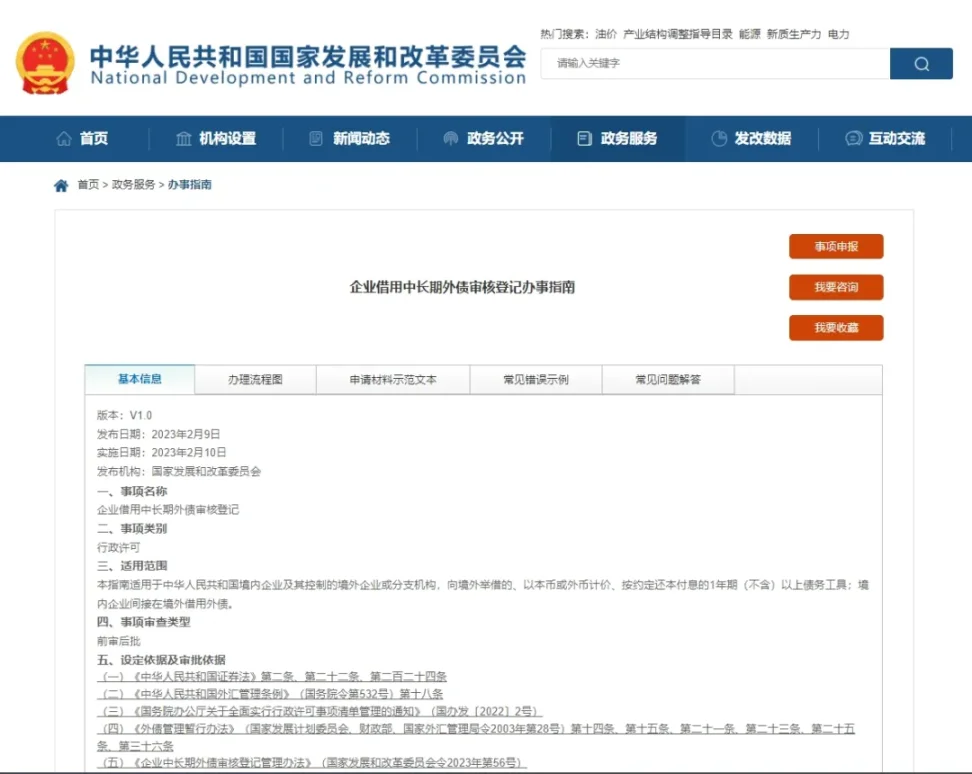
Image source: NDRC official website
Which Debts Qualify as Medium- and Long-Term Foreign Debt?
According to the Foreign Debt Measures, medium- and long-term foreign debt refers to debt instruments with maturities exceeding one year (excluding one year) that Chinese enterprises raise from overseas, including but not limited to senior bonds, perpetual bonds, capital bonds, medium-term notes, convertible bonds, exchangeable bonds, lease financing, and commercial loans. Therefore, any bond financing or bank loan adopted by overseas-listed Chinese enterprises modeled after MicroStrategy—provided the term exceeds one year—falls within the scope requiring NDRC review and registration.
What Are the Restrictions on Use of Foreign Debt Proceeds?
The Foreign Debt Measures impose the following restrictions on the use of foreign debt funds:
Article 7: Enterprise use of foreign debt funds should focus on core businesses and support implementation of major national strategies and real economic development.
Article 8: Enterprises may independently decide how to use foreign debt funds domestically or overseas based on their creditworthiness and actual needs, provided the use complies with the following conditions:
(1) Does not violate Chinese laws and regulations;
(2) Does not threaten or harm China’s national interests or economic, information, or data security;
(3) Does not contradict China’s macroeconomic policy goals;
(4) Does not violate national development plans or industrial policies, and does not create hidden local government debt;
(5) Cannot be used for speculation or speculative trading; except for banking financial institutions, funds cannot be lent to third parties unless explicitly stated and approved in the application materials.
Article 25: Actual use of foreign debt funds must align with the content of the *Review and Registration Certificate* and cannot be diverted for other purposes.
ManQin Law believes that using bond proceeds to purchase Bitcoin is unlikely to meet the requirements of the Foreign Debt Measures. On one hand, it is questionable whether buying Bitcoin qualifies as focusing on core operations or supporting real economic development. On the other hand, Chinese financial regulators have issued a series of strict controls on virtual currencies, such as the *Notice on Further Preventing and Addressing Risks of Cryptocurrency Trading and Speculation*, which clearly states that cryptocurrency-related business activities constitute illegal financial activities, carrying legal risks, and related civil acts are invalid. Given current regulatory attitudes toward Bitcoin, financing Bitcoin investments would likely be deemed contrary to China’s macroeconomic and industrial policy objectives by the NDRC.
Can Red-Chip or VIE Structures Exempt Foreign Debt Review and Registration?
At this point, many may wonder: Can special corporate structures circumvent foreign debt review and registration?
Based on ManQin Law’s experience, under the old Circular 2044 framework, there was internal divergence within the NDRC regarding whether red-chip or VIE-structured offshore entities needed to file for foreign debt registration. However, the introduction of the Foreign Debt Measures has closed this loophole. The new rules explicitly state that indirect foreign borrowing by domestic enterprises falls under the same regulatory scope. Indirect foreign borrowing refers to situations where businesses with primary operations in China raise debt overseas through offshore entities registered abroad, based on equity, assets, revenues, or similar rights derived from domestic operations—including bond issuances or commercial loans. Furthermore, the NDRC has clarified on its official website Q&A section that red-chip enterprises are included. With such a broad scope of application, structures that might previously have avoided registration now require case-by-case consultation with the NDRC to determine legality and compliance.
In summary, overseas-listed Chinese enterprises face significant challenges in obtaining NDRC review and registration approval for medium- and long-term foreign debt intended for Bitcoin purchases. A more viable alternative would be to issue short-term bonds with maturities under one year, which do not require NDRC registration.
2. Feasibility of Overseas-Listed Chinese Companies Conducting Equity Placements to Buy Bitcoin
Overseas-listed Chinese enterprises wishing to raise capital through share placements in overseas capital markets to buy Bitcoin must first satisfy local securities market issuance conditions and compliance requirements. According to ManQin Law’s analysis, the main regulatory basis for such enterprises is the *Provisional Measures for the Administration of Overseas Issuance and Listing of Securities by Domestic Enterprises* issued by the China Securities Regulatory Commission (CSRC) on February 17, 2023 (hereinafter referred to as the “Overseas Listing Measures”). Under these measures, if an issuer that is already listed overseas issues additional securities in the same overseas market, it must file a report with the CSRC within three working days after completion. This provision applies precisely to secondary share offerings by already overseas-listed Chinese companies, with the regulatory approach being post-issuance filing.
Unlike foreign debt regulation, the Overseas Listing Measures do not impose specific limitations or requirements on the use of proceeds from such share placements. Therefore, for already overseas-listed Chinese enterprises, raising capital through share placements to buy Bitcoin is significantly more feasible than issuing medium- and long-term foreign debt for the same purpose.
However, it should be noted that no such cases currently exist. It remains unclear how the CSRC would respond upon receiving such post-issuance filings. Therefore, we recommend maintaining full communication with regulators prior to implementation.
ManQin Law Conclusion
After thoroughly analyzing MicroStrategy’s strategy of financing to buy Bitcoin, it becomes clear that its success stems from sharp market insight, innovative financing tools, and a deep understanding of the cryptocurrency market. MicroStrategy’s story undoubtedly offers investors worldwide a vivid case study on identifying opportunities in emerging markets. However, replicating this success is far from straightforward for Chinese enterprises. China’s regulatory environment, foreign debt management policies, and cautious stance toward cryptocurrencies present notable challenges for Chinese firms seeking to finance Bitcoin purchases overseas.
While the path to replicating MicroStrategy’s success is fraught with obstacles, these very challenges push enterprises to place greater emphasis on compliance, innovation, and risk management. ManQin Law believes that with keen market insight, continuous innovation in financing mechanisms, and a profound respect for the dynamics of the cryptocurrency market, Chinese enterprises can leverage capital markets to amplify their investment returns in the digital asset space—and may even forge an entirely new path, writing their own success stories in the process.
Join TechFlow official community to stay tuned
Telegram:https://t.me/TechFlowDaily
X (Twitter):https://x.com/TechFlowPost
X (Twitter) EN:https://x.com/BlockFlow_News