Will Bitcoin, as it gets institutionalized, ultimately become another form of U.S. stock?
TechFlow Selected TechFlow Selected
Will Bitcoin, as it gets institutionalized, ultimately become another form of U.S. stock?
The correlation between Bitcoin and U.S. stocks is gradually increasing.
 Navigating Web3 tides with focused insights
Author: jk, Odaily Planet Daily
Bitcoin's price movements have long followed trends distinctly different from traditional financial markets, driven by two contrasting narratives. As a risk asset, during periods of elevated market sentiment and increased risk appetite, Bitcoin often moves in tandem with U.S. equities, showing high positive correlation. This is primarily due to greater institutional participation, aligning its capital flow patterns with other high-risk assets. However, during times of market panic or major risk events, Bitcoin can act as a safe-haven asset, decoupling from U.S. stocks and even exhibiting negative correlation—especially when investors lose confidence in the traditional financial system.
These dual narratives make Bitcoin’s role more complex: it can be both part of the risk-asset class and potentially serve as a hedge. Which role will prevail? Particularly at this juncture, with Donald Trump poised to return to office?
Price Correlation: More "Safe-Haven" Than U.S. Treasuries
According to TradingView data, over the past decade, Bitcoin’s correlation with the S&P 500 index has been 0.17—lower than that of other alternative assets. For example, the S&P Goldman Sachs Commodity Index showed a correlation of 0.42 with the S&P 500 during the same period. Although Bitcoin has historically had low correlation with equities, this relationship has increased in recent years, rising to 0.41 over the past five years.
However, Bitcoin’s high volatility makes correlation figures less reliable: its correlation with the S&P 500 reached -0.76 (strong negative) around November 11, 2023 (around the FTX collapse), but climbed to +0.57 (positive) by January 2024.
In contrast, the S&P 500 has remained relatively stable, delivering average annual returns of about 9% to 10%, serving as a benchmark for the U.S. economy. While its overall returns may lag behind Bitcoin’s, it excels in stability and lower volatility.
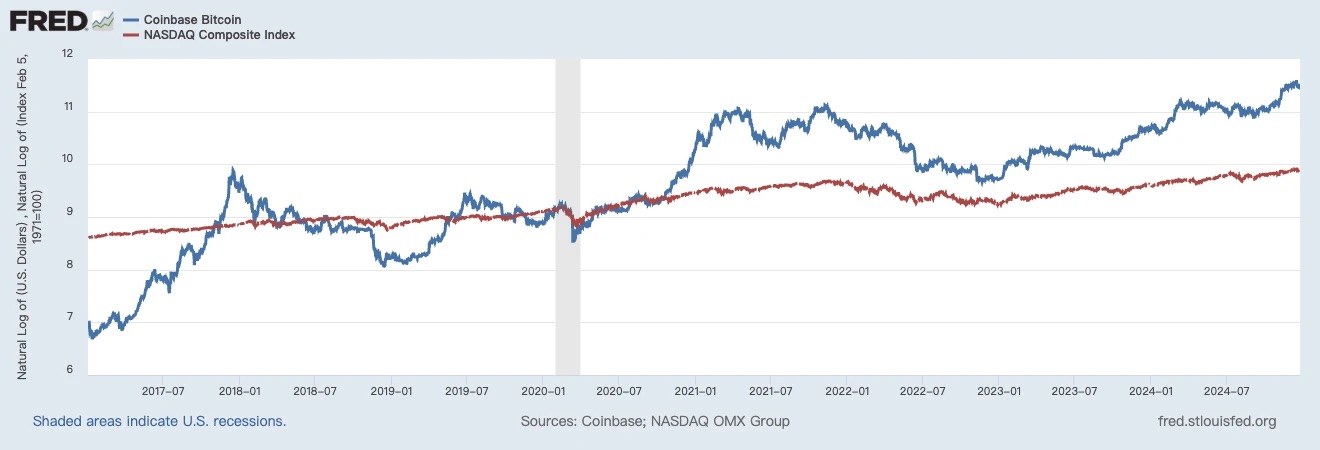
Log comparison of Bitcoin and the Nasdaq Index. Source: FRED
It is evident that during major macro events, the two often show strong correlation—for instance, during the post-pandemic market recovery in 2020, both exhibited significant upward momentum. This likely reflects heightened investor demand for risk assets amid loose monetary policy.
Yet in other periods—such as 2022—the trajectories of Bitcoin and the Nasdaq diverged significantly, indicating weakening correlation, especially during black swan events specific to the crypto market, when Bitcoin experienced sharp one-sided declines.
Certainly, in terms of cyclical returns, Bitcoin can outperform the Nasdaq by a wide margin. But purely from a price correlation standpoint, their co-movement has indeed been strengthening.
A report released by WisdomTree echoes this view: although Bitcoin’s absolute correlation with U.S. equities remains low, recently it has fallen below the return correlation between the S&P 500 and U.S. Treasury bonds.
The S&P 500 serves as a benchmark for trillions of dollars in global assets, making it one of the most watched indices worldwide. An asset with a -1.0 (perfectly inverse) and relatively stable return correlation to the S&P 500 would be highly sought after, as it could generate positive returns when the index falls—providing true hedging value.
While stocks are typically seen as risky, U.S. Treasuries are widely regarded as “risk-free” assets. The U.S. government can meet debt obligations through monetary printing, though long-term Treasuries still experience market value fluctuations. A key topic in 2024 is that the correlation coefficient between the S&P 500 and U.S. Treasuries is approaching 1.0 (perfectly positive). This means both asset classes may rise or fall simultaneously.
Simultaneous gains or losses across asset classes contradict the very purpose of hedging. This phenomenon mirrors 2022, when both stocks and bonds posted negative returns, defying many investors’ expectations of portfolio diversification.
Bitcoin currently does not exhibit strong hedging capabilities against S&P 500 returns. Data shows its correlation with the S&P 500 is not significant. Yet recently, Bitcoin’s return correlation with the S&P 500 has dropped below that of U.S. Treasuries. If this trend persists, Bitcoin will attract increasing attention from asset allocators and investors, gradually becoming a more compelling investment vehicle.
From this perspective, compared to the so-called risk-free U.S. Treasuries, Bitcoin only needs to become the safer haven that “runs faster than Treasuries,” and investors will naturally choose it as part of their portfolios.
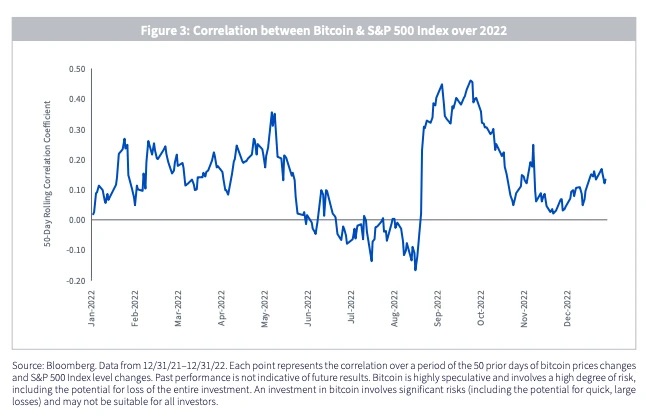
Chart shows the 50-day rolling correlation between Bitcoin price and the S&P 500 Index in 2022. On average, correlation hovers around 0.1, peaking above 0.4 and dipping below -0.1. Source: WisdomTree
Institutional Holdings: ETF Share Growing Larger
Institutional investors are playing an increasingly important role in the Bitcoin market. To date, Bitcoin’s ownership distribution reveals a marked increase in institutional influence—a concentration trend that could further strengthen Bitcoin’s alignment with U.S. equities. Below is a detailed analysis:
Data indicates that 19.9 million Bitcoins have been mined out of a total cap of 21 million, leaving 1.1 million yet to be mined.
Among the mined supply, dormant addresses inactive for over five years—top 1,000—hold 9.15%, equivalent to approximately 1.82 million BTC. These coins typically do not enter circulation, effectively reducing active market supply.
Additionally, according to Coingecko, the top 20 publicly listed companies—including MicroStrategy—collectively hold 2.63% (about 520,000 BTC), with MicroStrategy alone holding 2.12% (approximately 440,000 BTC) of the total supply.
On the other hand, per The Block’s data, as of the time of writing, institutional holdings via all ETFs amount to 1.17 million BTC.
-
Assuming dormant-address holdings, unmined supply, and corporate holdings remain constant, theoretical circulating supply = 19.9M - 1.82M - 520K = 17.56 million BTC
-
Institutional holding share: 6.67%
Thus, ETF-related institutions currently control 6.67% of Bitcoin’s circulating supply—a proportion likely to grow further as more institutions enter. From last year to this year, we’ve observed a notable compression in exchange-held shares, while ETF-held shares continue to expand.
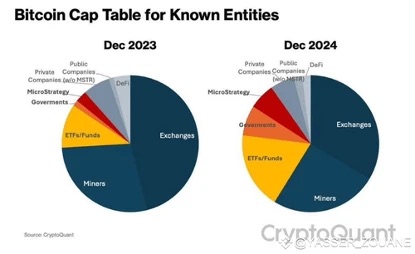
Bitcoin holdings breakdown. Source: CryptoQuant
Similar to U.S. equities, as institutional ownership rises, their investment behaviors—such as buying and selling—play an increasingly critical role in price fluctuations. This market concentration makes Bitcoin’s price trajectory more susceptible to U.S. equity market sentiment, particularly under macroeconomic-driven capital flows.
The "Americanization" Process
U.S. policy is exerting growing influence on the Bitcoin market. This issue remains largely uncertain: based on Trump’s current modus operandi, if pro-crypto figures occupy key decision-making roles at pivotal policy moments—such as pushing for looser regulation or approving more Bitcoin-linked financial products—Bitcoin adoption will inevitably accelerate. Such deeper adoption would not only solidify Bitcoin’s status as a mainstream asset but could also tighten the correlation between Bitcoin and U.S. equities—two asset classes reflecting the trajectory of the U.S. economy.
In summary, Bitcoin’s correlation with U.S. equities is gradually increasing, driven by shared reactions to macro events, significant institutional ownership impacts, and potential influences from U.S. policy trends. From this vantage point, we may indeed use U.S. stock market movements in the future to better anticipate Bitcoin’s directional trends.
Join TechFlow official community to stay tuned
Telegram:https://t.me/TechFlowDaily
X (Twitter):https://x.com/TechFlowPost
X (Twitter) EN:https://x.com/BlockFlow_News
 Odaily