
Mainland capital accelerates布局, Hong Kong adds 4 new virtual asset platforms, licensing speed draws attention
TechFlow Selected TechFlow Selected
Mainland capital accelerates布局, Hong Kong adds 4 new virtual asset platforms, licensing speed draws attention
What impact will the addition of these new platforms have on the development of Hong Kong's Web3 industry?
 Navigating Web3 tides with focused insights
By: ManQin Blockchain Legal Services
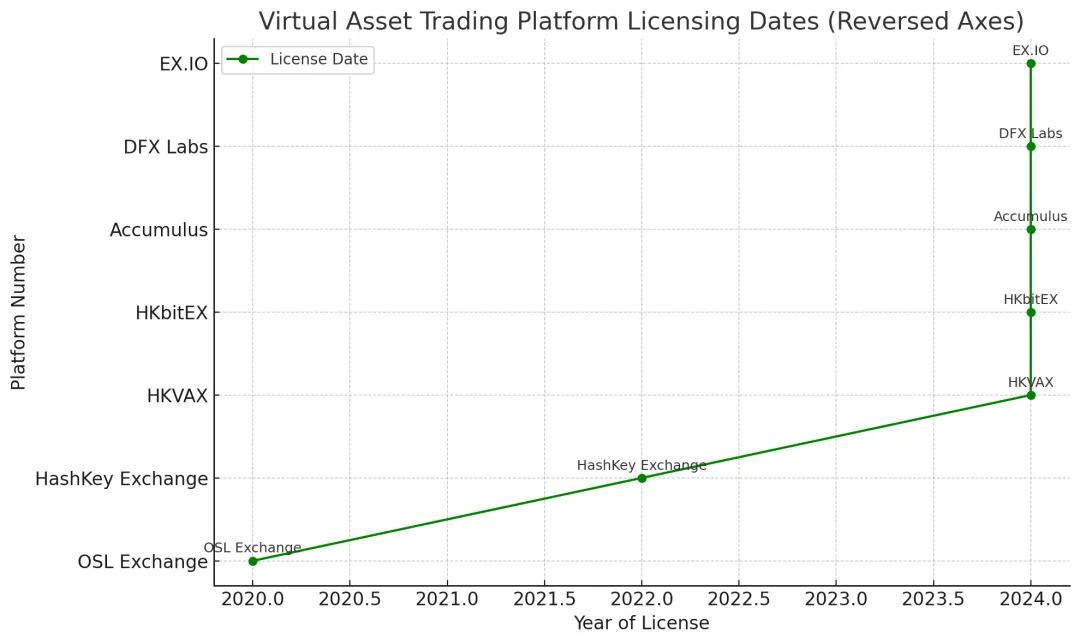
Recently, the Securities and Futures Commission (SFC) of Hong Kong updated its official website with a new list of licensed virtual asset trading platforms. Since 2020, Hong Kong has been issuing licenses for virtual asset trading platforms approximately every two years. However, just two months after HKVAX received its license, four additional platforms were granted licenses in one go. Who are these new entrants? And what impact will their arrival have on the development of Hong Kong's Web3 industry? Today, ManQin lawyers bring you an in-depth analysis.
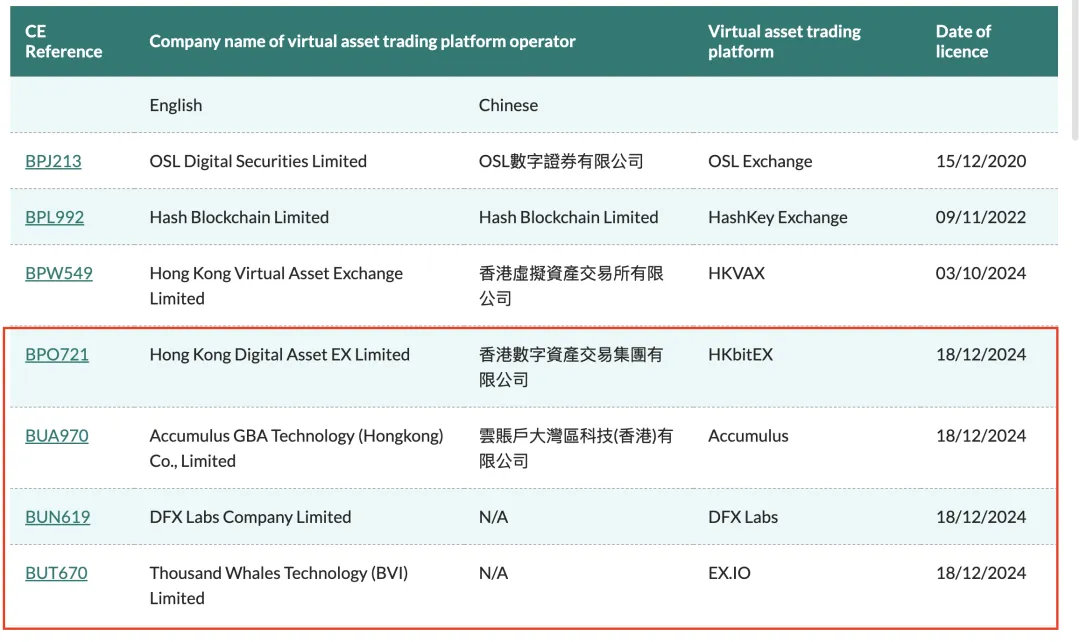
▲ Image source: SFC official website
What is a Virtual Asset Trading Platform Operator?
With the rapid global growth of virtual assets—especially amid continuous approvals of Bitcoin and Ethereum ETFs—the importance of virtual asset trading platforms as market "hubs" has become increasingly evident.
A Virtual Asset Trading Platform Operator (VATP) refers to a centralized virtual asset trading platform operating in Hong Kong or actively promoting its services to Hong Kong investors. Key characteristics include:
1. Centralized operation;
2. Operating in Hong Kong or marketing services to Hong Kong investors;
3. Providing virtual asset trading services.
Operators meeting these criteria must apply for relevant licenses from the Hong Kong SFC and submit to its regulatory oversight.
Under the Securities and Futures Ordinance (Cap. 571) and the Anti-Money Laundering and Counter-Terrorist Financing Ordinance (Cap. 615) (AMLO), compliant virtual asset trading platform operators typically require the following licenses:
1. Type 1 License (Securities Dealing);
2. Type 7 License (Providing Automated Trading Services);
3. AMLO License (Anti-Money Laundering Compliance).
Compared to entities that only need a Type 9 License ("Asset Management") to engage in virtual asset investment activities, the compliance threshold for VATPs is significantly higher. This difference stems from the SFC’s greater emphasis on market integrity, transaction security, and investor protection for VATPs, whereas the Type 9 License focuses more on fund management and operational compliance.
If you're interested in understanding the differences between VASP ("Virtual Asset Service Provider") and VATP licenses, please refer to ManQin Law Firm's previous research article (What Is the Difference Between VASP and VATP Licenses in Hong Kong? | ManQin Web3 Legal Education), where we provide a detailed comparison.
Overview of Newly Licensed Platforms
HKbitEX
Background: Hong Kong Digital Asset Exchange (HKbitEX) is a subsidiary of Tai Chi Capital Group Limited, holding SFC-issued Type 1, Type 7, and AMLO licenses.
Business Scope: Headquartered in Hong Kong, operations span multiple regions across Asia.
Parent Company Overview: Founded in 2018, Tai Chi Capital specializes in developing a digital financial ecosystem by integrating blockchain technology and compliant Web3 solutions to support real-economy development. Its group includes four wholly owned subsidiaries: HKbitEX, Pioneer, O’Hash, and ON1ON Limited.
Accumulus
Background: Operated by Cloud Account Greater Bay Area Technology (Hong Kong) Co., Ltd., Accumulus serves as the overseas headquarters of Cloud Account Technology (Tianjin) Co., Ltd., a China Top 500 enterprise.
Platform Positioning: Focused on providing long-term, stable cryptocurrency trading services to Hong Kong users.
Parent Company Overview: Cloud Account is China’s largest online human resources service provider, generating RMB 108.4 billion in revenue in 2023, paying RMB 7 billion in taxes, with projected revenue of RMB 120 billion in 2024. The company is headquartered in Tianjin, China.
DFX Labs
Background: A subsidiary of Lianlian Digital (Stock Code: 02598.HK), DFX Labs holds SFC-issued Type 1, Type 7, and AMLO licenses.
Core Business: Specializing in offering compliant virtual asset trading services.
Parent Company Overview: Since its founding in 2009, Lianlian Digital has processed over RMB 2 trillion in total payment volume (TPV), serving more than 100 countries and regions globally. The company is based in Hangzhou, Zhejiang Province, China.
EX.IO
Background: Operated by Thousand Whales Technology (BVI) Limited, with major investors including Wasung Capital, a subsidiary of Sina Corporation.
Platform Features: EX.IO claims to be the first licensed institution in Hong Kong with a securities brokerage background.
Investor Overview: Backed by Sina Group, Longling Capital, and WeCredit Tech (HKG:2003). Sina Group made a strategic investment in Wasung Capital in 2017. Wasung Capital is headquartered in Hong Kong, China.
Why Is Hong Kong Accelerating Its Licensing Process?
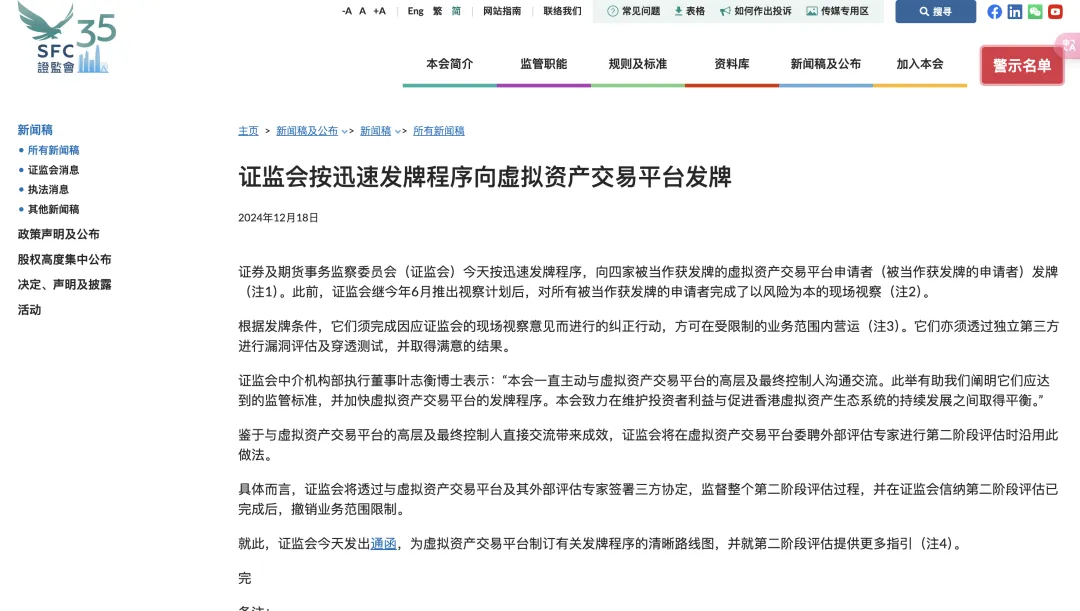
This latest move demonstrates Hong Kong’s determination to establish itself as a leading hub for Web3 in Asia. These four newly licensed virtual asset trading platforms went through an expedited licensing procedure. Dr. Yip Chi-heng, Executive Director of Intermediaries at the SFC, stated that the commission would “accelerate the licensing process for virtual asset trading platforms.” It appears likely that going forward, both VATP and other virtual asset-related licensing procedures may be further streamlined, with shorter processing times.
Why has the SFC suddenly accelerated licensing? Several key reasons:
1. Rapid Global Growth of the Virtual Asset Market
Recently, the global virtual asset market has experienced high-speed growth, particularly with the successive approvals of spot Bitcoin ETFs and increasing participation by traditional financial institutions in the crypto space. This surge in interest pressures Hong Kong to speed up licensing to seize early-mover advantages and attract more investors and businesses to operate locally.
2. Regional Competitive Pressure
Singapore, Dubai, and other jurisdictions have actively advanced their regulatory frameworks for virtual assets and Web3, competing fiercely to attract global blockchain enterprises and investors. As one of Asia’s premier financial centers, Hong Kong must accelerate licensing to demonstrate its support for innovative finance and maintain competitiveness.
3. Trend of Mainland Chinese Capital Entering Web3
Looking at the backgrounds of the newly licensed platforms, many parent companies or major investors originate from mainland China. This indicates that mainland enterprises are leveraging Hong Kong to expand into Web3. By speeding up licensing, Hong Kong aligns with this trend and strengthens its role as a gateway for mainland capital expansion overseas.
In summary, the SFC’s accelerated licensing reflects not only market demand but also a proactive strategic decision aimed at laying a stronger foundation for Hong Kong’s virtual asset industry and reinforcing its position as a global virtual asset center.
Impacts of Hong Kong’s Accelerated Licensing
1. For the Industry Overall
The increase in licensed virtual asset trading platforms is undoubtedly good news—for both Hong Kong’s Web3 sector and the global virtual asset market. First, new licensed players intensify competition, pushing platforms to reduce costs and improve efficiency and service quality. Second, bringing more platforms under regulation enhances industry transparency and boosts market confidence. Finally, by introducing more licensed platforms, Hong Kong reinforces its status as an international hub for virtual assets.
2. For Licensed Institutions
New licenses may dilute the advantages of existing license holders. A license serves both as official endorsement and as a barrier to entry for unlicensed competitors.
Without license expansion, early recipients could enjoy near-monopolistic positions and significant competitive advantages. However, as the number of licensed platforms grows, in the short term, this weakens the dominance of earlier licensees. In the long run, however, whether early or late entrants, a highly competitive environment will drive all platforms to cut costs, lower fees, and enhance services—ultimately strengthening the international competitiveness of Hong Kong’s virtual asset exchanges.
3. For Traders
For the broader community of virtual asset traders, the addition of licensed exchanges is a clear benefit. It means potentially lower trading fees, improved trading efficiency, more choices among platforms, and the ability to diversify trading or investment activities—effectively hedging against internal and external risks associated with centralized virtual asset platforms.
4. For Web3 Practitioners
First, the Hong Kong government’s actions signal strong support for Web3 development, boosting industry confidence. Second, with more licensed entities and a maturing ecosystem, innovative projects and business models will find greater opportunities to launch and grow in Hong Kong.
Overall, while this round of licensing may cause short-term shifts in market dynamics, in the long term, it will strengthen competition and regulatory standards, enhancing Hong Kong’s appeal and standing in the global virtual asset market—and creating more opportunities and value for all stakeholders.
ManQin Lawyers’ Summary
Hong Kong’s SFC swiftly issuing new virtual asset trading platform licenses not only highlights its ambition to build an Asian Web3 powerhouse but also injects fresh momentum into the market. The newly licensed platforms will foster intense market competition, driving cost reduction, efficiency gains, and service improvements—offering investors more options and elevating Hong Kong’s influence in the global virtual asset industry.
In this context, we also observe mainland Chinese enterprises increasingly turning their attention to Web3, using Hong Kong as a strategic springboard for global expansion. This reflects growing recognition of Web3 by mainland capital and underscores Hong Kong’s strategic importance as a key hub for virtual asset development.
As a professional legal service provider in the Web3 space, ManQin Law Firm remains committed to supporting virtual asset trading platforms and Web3 entrepreneurs with comprehensive legal assistance.
The Web3 wave is upon us, and Hong Kong is entering a new phase of industry opportunity. ManQin Law Firm looks forward to collaborating with more industry partners to advance the prosperity of the Web3 ecosystem and help clients gain a competitive edge through compliance and innovation.
Join TechFlow official community to stay tuned
Telegram:https://t.me/TechFlowDaily
X (Twitter):https://x.com/TechFlowPost
X (Twitter) EN:https://x.com/BlockFlow_News