OKX Ventures Annual Report: 60+ Portfolio Projects and 14 Trend Forecasts
TechFlow Selected TechFlow Selected
OKX Ventures Annual Report: 60+ Portfolio Projects and 14 Trend Forecasts
"The success of the blockchain industry does not lie in the success of a single technology or platform, but in building an inclusive, highly innovative, and self-evolving industry ecosystem."
 Navigating Web3 tides with focused insights
In 2024, amid dramatic shifts in the global financial landscape, the crypto industry experienced profound fluctuations and restructuring. After six months of consolidation and recovery, the total market capitalization of the sector surpassed $3.8 trillion, with Bitcoin reaching a historic high of $100,000, affirming its core status within the global asset ecosystem. This is not merely a price surge, but the beginning of a structural transformation: a dollar liquidity loop has taken shape, centered on Bitcoin, bridged by ETFs and U.S. equities, and carried by publicly listed companies.
Bitcoin is emerging as the world’s largest dollar-denominated financial asset, serving as a key hedge against U.S. fiscal deficits and debt crises. This financial shift is not only reshaping the value system of assets but also injecting sustained growth momentum into the blockchain industry. The entire blockchain ecosystem benefits from this transformation. OKX Ventures actively participates in this wave of change with bold initiatives and remains bullish on the subtle yet transformative impact of blockchain products on the traditional world over the next decade.
1. Review of 2024: Over 60 Projects Backed, Broad Multi-Track Expansion
This year, OKX Ventures significantly increased its investments in the industry, aiming to accelerate innovation and development in crypto. The total investment volume exceeded $100 million, covering more than 60 projects and funds, with a focus on innovation and entrepreneurship within the Solana, SUI, Aptos, TON, and BTC ecosystems. Investment distribution shows the highest concentration in infrastructure, AI projects, and BTC ecosystem, while maintaining broad exposure across multi-chain ecosystems, DeFi, and various ecosystem funds.
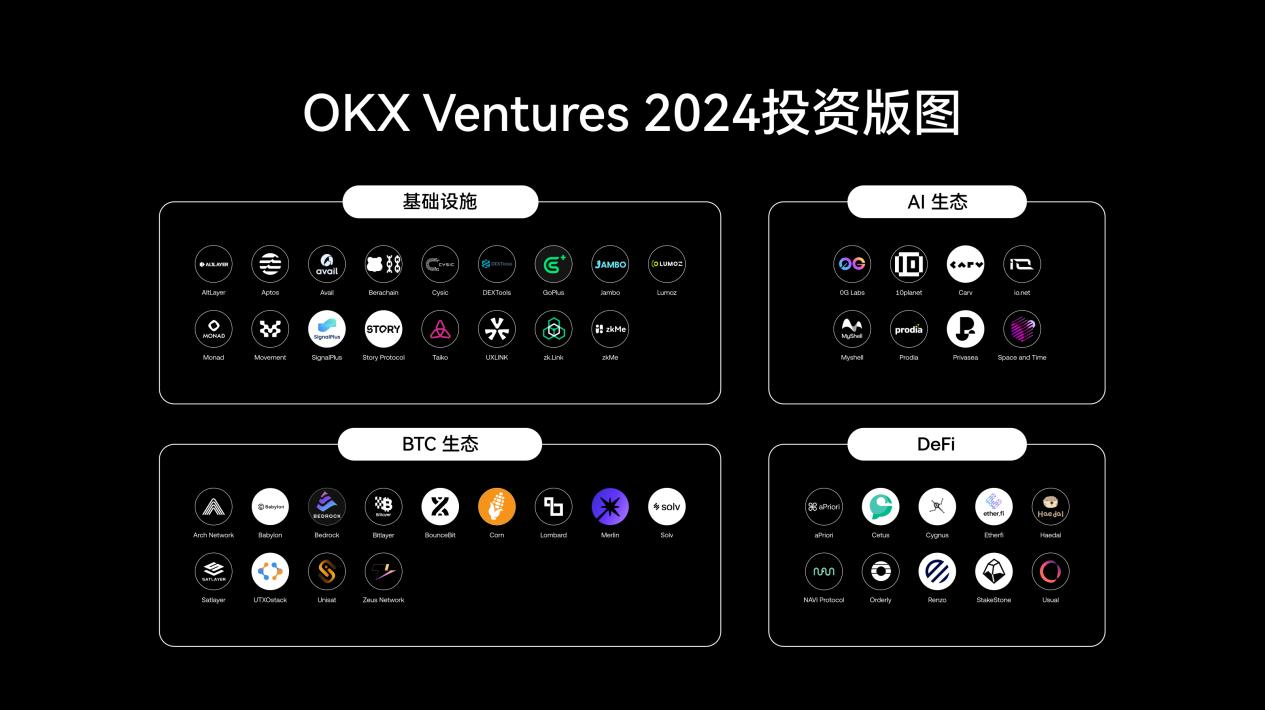
Beyond direct investment, OKX Ventures has actively partnered with venture funds and accelerator ecosystem players such as TON Ventures, Ankaa, and TGH to build a thriving innovation ecosystem. By providing funding, strategic guidance, and technical resources, these collaborations aim to empower global entrepreneurs to turn ideas into reality faster and more securely. Whether incubating early-stage startups or accelerating growth-phase ventures, OKX Ventures consistently prioritizes innovation, driving the adoption and application of blockchain technology and injecting vitality and new possibilities into the industry.
OKX Ventures deeply understands that the future of the blockchain industry is not just about capital input, but about efficiently integrating global resources and industry expertise to empower innovative enterprises. While capital serves as a catalyst, strategic vision and systematic planning are essential to propel multidimensional technological innovation, ecosystem development, and market expansion. Every investment decision represents not just capital flow, but a profound insight into industry prospects and support for innovation. From infrastructure building to ecosystem expansion and frontier technology exploration, OKX Ventures continuously aligns its strategy with the evolution of the industry over the next decade, striving to lay a solid foundation and create vast space for the widespread application and deep transformation of blockchain.
Moreover, blockchain innovation cannot rely solely on capital market dynamics; it requires visionary entrepreneurial spirit and relentless technical exploration. The mission of OKX Ventures is to help value-driven entrepreneurs build great companies, pushing them toward breakthroughs in technology, markets, and operations. This goes beyond supporting individual projects or teams—it lays the groundwork for the future structure of the entire industry.
OKX Ventures believes the success of the blockchain industry does not hinge on a single technology or platform, but on building an inclusive, highly innovative, and self-evolving industry ecosystem. It is this deep understanding of the industry and forward-looking vision that enables us to remain at the forefront of this transformative era, guiding the industry toward greater maturity and sustainability.
2. Outlook for 2025: 14 Predictions, Insights into the Future
Prediction 1: Global Blockchain Advances Toward Compliance, Industry Becomes More Standardized
In 2025, the compliance environment for the blockchain industry will see significant progress, laying a solid foundation for healthy development. The number of licensed institutions will increase substantially, offering users safer and more reliable services. Star, CEO of OKX, noted that OKX has become the first cryptocurrency exchange globally to obtain a full operational license in the UAE.
Innovation in compliant custody wallets will emerge, resolving the tension between self-custody and regulatory oversight. Star mentioned that OKX is launching a self-custody wallet for retail users featuring compliant controls, including KYC transaction monitoring. Such innovations enhance user experience while meeting increasingly stringent regulatory requirements, opening new directions for the industry.
The macro-regulatory environment will become more positive, creating favorable conditions for industry growth. The UK government plans consultations on stablecoin and crypto asset regulatory frameworks in early 2025, indicating a global trend toward clearer and more supportive regulation. National Bitcoin reserves could also become a reality in 2025.
Institutional participation will rise significantly—by December 17, spot Bitcoin ETFs had accumulated over $114.97 billion in assets under management, and MicroStrategy held 439,000 Bitcoins with a total investment cost of approximately $27.1 billion. Traditional financial institutions are rapidly entering the crypto space.
The integration of technology and compliance will reach new heights, elevating industry standards. Star predicts that by 2025, many crypto firms' compliance standards will meet or exceed those of traditional finance. OKX's three core business lines—OKX Exchange, OKX Web3, and OKX Simple—cover a wide range of services from trading to decentralized applications. This comprehensive service model is expected to become an industry benchmark, promoting broader blockchain adoption.
The blockchain industry in 2025 will appear more mature, standardized, and innovative. As Star stated, crypto finance is entering a new phase—one marked by deep integration between traditional finance and blockchain technology, bringing revolutionary changes to the global financial system.
Prediction 2: AI Agents Will Become Major Market Participants, Engaging in Asset Creation, Issuance, and Trading
With the rapid advancement of extra-large language models (XLLMs) and multimodal models (XLMMs), new AI agents will gradually become key market participants. According to research reports, the global AI agent market is projected to reach $1.811 trillion by 2030, contributing approximately $16 trillion to global GDP. The future of AI agents extends beyond being mere tools—they will become primary actors in the blockchain world, capable of autonomous decision-making and action.
We expect 2025 to bring more innovative use cases for AI agents. For example, agent-to-agent interaction will become a major area, with blockchain’s transparency and composability providing an ideal foundation. We may witness agents sending funds to each other, co-issuing tokens, or even creating new social scenarios. Additionally, decentralized agent organizations (DAOs) could gain traction, where multi-agent systems collaborate to complete tasks, solve problems, and manage protocols.
AI agents possess high adaptability, clear goal-setting, and self-correction capabilities, enabling independent decision-making in complex environments. In the future, these agents will own digital wallets, proactively create and publish content, participate in asset trading for maximum returns, and automatically issue assets based on market demand. This shift suggests AI agents will play increasingly important roles in markets and social platforms. The emergence of frameworks like Eliza’s AI agent architecture, combined with platforms like Myshell, will drive this trend forward.
Finally, we anticipate further innovation in AI agent trading intent and next-generation user trading interfaces. This might include natural language-based trading or new trading systems and tools specifically designed for AI agents. As these technologies evolve, the concept of “wallet-as-browser” may eventually materialize, fundamentally transforming how users interact with blockchain and AI systems.
Prediction 3: Security Projects Will Help Address AI Safety Challenges
The verifiability of blockchain can serve as a critical solution to AI safety issues. With the rapid development of AI, cybersecurity threats are becoming more prominent, especially regarding impersonation and deepfakes. Establishing a “proof of human identity” mechanism is crucial to ensure authentic interactions between users and real individuals. 61% of organizations reported an increase in deepfake attacks over the past year, with expectations of another 50–60% rise in the future. The complexity of AI security mainly manifests in two areas: dynamic attack vectors and prompt injection vulnerabilities. Rapid iterations of AI models mean new vulnerabilities constantly emerge—for instance, different model versions may behave very differently, leading to evolving attack methods.
Blockchain projects, leveraging decentralization and immutability, can effectively address these challenges:
1. Data Tracking and Provenance Verification: Blockchain can record and trace data sources, using cryptographic signatures to verify content authenticity, combat AI-generated deepfakes and fake news, and ensure data transparency and traceability.
2. Protecting Training Data: Safeguard datasets used to train AI models from tampering or attacks, ensuring data integrity and security while reducing single points of failure.
3. Recording and Monitoring AI Model Usage: Prevent unauthorized abuse by enabling secure sharing of models or data without fear of leakage or manipulation. Users can audit and verify AI behavior, enhancing trust.
OKX Ventures believes more AI security projects will emerge in the blockchain space, boosting user confidence in AI systems.
Prediction 4: AI Penetrates Existing Sectors, Transforming Industry Paradigms
In 2025, deeper AI integration will significantly reshape multiple industries, including gaming, NFTs, DeFi, and social platforms.
Gaming is likely to be one of the most impacted sectors. Global spending on AI in games is expected to reach around $1.1 billion by 2025, reflecting growing recognition of AI’s potential. Key developments include: 1) Generative Design: Using algorithms to generate game content, improving development efficiency. 2) Personalized Experiences: AI analyzes player behavior to offer tailored recommendations and challenges. 3) Enhanced Interactivity: Smarter NPCs will feel more lifelike, increasing immersion. 4) More intelligent AI agents that improve player interaction with games and reduce gameplay burden.
Social platforms are also witnessing innovation. AI plays a vital role in content creation and community engagement, while advancing tokenization and decentralized economic models. In 2024, platforms like Farcaster introduced new asset issuance mechanisms via AI agents such as Clanker and Larry, demonstrating notable community engagement and economic potential—Clanker’s market cap surpassed $100 million, and LUM reached $70 million. In the future, AI will: 1) Enable Social Monetization: Users earn crypto rewards through content creation and interaction. 2) Build Community Economies: Leverage blockchain so users directly participate in platform governance and revenue sharing. 3) Improve Security: Use decentralized identity verification to protect user privacy.
DeFi benefits from AI-driven efficiency gains and interaction model changes. 1) AI agents will become key participants in the DeFi ecosystem, autonomously executing complex trades, optimizing investment strategies, and monitoring market dynamics in real time. 2) AI-powered investment platforms and trading tools can lower entry barriers, integrate DeFi protocols across multiple chains, and offer automated liquidity investment strategies, making DeFi more accessible and efficient. 3) AI-assisted security will play a crucial role in detecting and optimizing smart contract vulnerabilities—using deep learning and pattern recognition, AI can establish baselines for normal transaction behavior and trigger alerts upon detecting anomalies, enhancing DeFi platform security. By 2025, DEX trading volume is expected to surpass $4 trillion, with total value locked (TVL) exceeding $200 billion. OKX Ventures anticipates over 1 million AI agents active on-chain, further accelerating DeFi ecosystem growth.
OKX Ventures predicts 2025 will be a year of deep convergence between AI and various industries. As technology advances and infrastructure improves, these fields will face new opportunities and challenges, delivering richer and safer experiences for users.
Prediction 5: Blockchain Enhances Matching Efficiency of AI Elements
Blockchain technology is improving the matching efficiency of AI elements across multiple dimensions: data, computing power, models, and capital. Take data markets, for example—demand for data in AI grows much faster than supply. ChatGPT was trained on 300 billion words, while the latest model DBRX used 12 trillion data points. Demand for public human text data in AI training could exceed total available supply as early as 2026.
OKX Ventures sees strong potential in better resource allocation for data elements and has invested in projects like Space and Time, Privasea, 0G, and CARV. Space and Time offers a decentralized data warehouse for efficient indexing and querying of on- and off-chain data. Privasea uses fully homomorphic encryption (FHE) for privacy-preserving AI computation. CARV provides a modular data layer, supplying high-quality user profiles and behavioral data for AI. 0G significantly enhances blockchain’s ability to handle AI-era data volumes. These projects collectively improve AI data acquisition, processing, and utilization efficiency.
In other areas, io.net optimizes large-scale distributed computing resource allocation for AI. The AI chip market is expected to maintain steady growth—data center AI chip sales reached $154 billion in 2023, with forecasts showing 41% growth between 2025 and 2026. Edge AI computing will become a key trend, enabling faster data processing and stronger privacy protection.
OKX Ventures expects more outstanding AI startups to emerge, enhancing efficiency in data sharing, compute allocation, and model collaboration—providing robust support for AI advancement. This synergistic effect will enable breakthrough applications of AI across diverse fields, creating far-reaching impacts.
Prediction 6: Babylon and Bitcoin L2s Herald a DeFi Summer for BTC
Looking ahead to 2025, Bitcoin’s ecosystem TVL and DeFi activity will break new ground. As of October 2024, Babylon had secured over 57,288 BTC, worth $6 billion. As a leader in the BTC ecosystem, Babylon acts as a critical bridge connecting Bitcoin to various PoS chains. Projects like SatLayer and Lombard, part of the Babylon ecosystem, will deploy smart contracts to unlock Bitcoin’s potential. Meanwhile, Bitlayer, Merlin, Bsquared Network, and Arch Network are exploring innovative scaling solutions to strengthen Bitcoin’s DeFi infrastructure.
Technologies like UTXO Stack aim to enhance Bitcoin’s smart contract functionality. These innovations will greatly increase transaction throughput, reduce fees, and pave the way for more complex DeFi applications.
The Bitcoin DeFi space will see more diverse use cases. Projects like BounceBit, Corn, and Merlin are developing on-chain lending and novel liquidity provision mechanisms. Platforms such as Solv Protocol and Bedrock will offer Bitcoin holders more diversified yield-generating options. Zeus and Lombard are exploring ways to integrate Bitcoin’s value deeper into DeFi. By 2025, Bitcoin DEX trading volume may exceed $4 trillion, accounting for 20% of centralized exchange spot volume.
User experience improvements will be another priority. Wallet projects like Unisat aim to simplify user interaction with Bitcoin DeFi. Arch Network and SatLayer are developing innovative cross-chain solutions to enhance interoperability, allowing users to transfer and use assets seamlessly across different blockchains.
Overall, the Bitcoin ecosystem in 2025 will become more diverse and interconnected. Innovations from infrastructure to applications will transform Bitcoin from a simple store of value into a comprehensive financial infrastructure, offering users richer and more efficient financial services.
Prediction 7: Native Bitcoin Innovation Advances in Diversity and Depth
On the technical front, expanding Bitcoin’s scripting language is a key direction. Beyond the widely discussed OP_CAT, core developers are actively exploring introducing new opcodes such as OP_GROUP, OP_CHECKTEMPLATEVERIFY (CTV), and OP_TLUV. These additions will significantly enhance Bitcoin’s programmability, laying the groundwork for more complex smart contracts and applications. For example, OP_GROUP could enable the creation of fungible tokens on Bitcoin, while CTV could facilitate pre-signed transactions, greatly improving transaction efficiency.
The Lightning Network, as Bitcoin’s Layer-2 scaling solution, is expected to undergo major upgrades in 2025. The introduction of channel factories could allow batch creation of payment channels, drastically lowering setup costs. Improvements in bidirectional funding mechanisms will boost capital efficiency. Additionally, integration of Taproot Assets could enable more private and efficient asset transfers, further expanding Lightning’s application scope.
Privacy enhancement remains a key research focus for the Bitcoin community. Increasing transaction privacy without sacrificing auditability is critical. Confidential Transactions technology may be introduced to hide transaction amounts, while optimized CoinJoin mixing techniques will further strengthen transaction anonymity. Zero-knowledge proofs like zk-SNARKs are also being actively explored for Bitcoin, potentially bringing revolutionary privacy capabilities.
At the application level, Bitcoin is fostering diverse innovations spanning decentralized social networks, gaming and metaverse, and open scientific research. These applications combine micro-payments, decentralized identity, content notarization, Ordinals, RGB protocol, and more—not only introducing new business models for social media and gaming but also enhancing research transparency and credibility through transparent fund management, data integrity protection, and decentralized evaluation. These diverse applications demonstrate Bitcoin’s immense potential as a decentralized infrastructure, far beyond traditional finance, laying a solid foundation for the future of the digital world.
Prediction 8: Ethereum Ecosystem Achieves Dual Breakthroughs in Technology and Ecology
In 2025, the Ethereum ecosystem is expected to achieve significant progress, with notable breakthroughs in both technology and ecosystem development. On scalability, the number of L2 and L3 solutions is projected to exceed 2,000, enabling Ethereum to scale up by 200x. Following the Pectra upgrade, increased blob capacity will further reduce rollup costs, pushing daily transaction volume beyond 100 million. These enhancements will equip Ethereum with stronger processing power, laying the foundation for mass user adoption.
The widespread adoption of account abstraction will be another milestone. With EIP-3074 and EIP-7702, over 25% of on-chain transactions will use account abstraction, allowing users to pay gas fees in any token. Once EIP-5003 achieves full account abstraction, it will transform how users interact with smart contracts, improving Web3 app usability and making Ethereum more accessible to mainstream users.
Staking mechanism improvements include EIP-7251, which allows validators to stake more than 32 ETH for additional rewards. Permissionless staking pools enabled by EIP-6110 and EIP-7002 will help Ethereum’s total staked supply exceed 30 million ETH, with annual yields stabilizing between 3%–4%. These mechanisms enhance network security and attract broader participation.
Zero-knowledge proof technology will see widespread use in the Ethereum ecosystem. General-purpose zkVMs will generate block proofs in under 30 seconds and be integrated into major L2 networks, supporting privacy computing features and realizing “privacy as a service.” These technologies enhance privacy while maintaining alignment with Ethereum’s mainnet security, giving users more choices.
Network efficiency will improve through the Amsterdam upgrade, including Verkle Trees, EOF optimization, and PeerDAS improvements, reducing validator storage burdens and boosting EVM execution speed. Network throughput is expected to increase tenfold, supporting future modular blockchain architectures.
Ecosystem integration will be a key direction in 2025. Native interoperable ZK stacks will become standard for new rollups, forming efficient validity proof clusters. Measures like EIP-7623 (increasing calldata cost) and EIP-7639 (discontinuing historical data service) will optimize network resource allocation, laying the groundwork for modular blockchain networks and shifting Ethereum from tech-driven to application-driven growth.
The Beam Chain upgrade will bring major changes to Ethereum’s consensus layer, including shortening block production time to 4 seconds, lowering the staking threshold to 1 ETH, and introducing zero-knowledge proofs. These changes will improve performance and decentralization, opening new possibilities for the future.
Prediction 9: RWA and the Outlook for Ethereum-based RWA
The Ethereum ecosystem is entering a new leap forward—improved network performance, technological innovation, ecosystem expansion, and the explosive growth of the RWA market will elevate Ethereum to new heights. As more real-world assets are tokenized and migrated on-chain, Ethereum not only strengthens its position as the leading platform for decentralized applications and smart contracts but also plays a pivotal role in bridging traditional and decentralized finance. By the end of 2024, the total market cap of on-chain tokenized assets had surpassed $14 billion, with Ethereum capturing nearly 80% of the market share, serving as the core engine behind this growth.
The Rise of Tokenized Assets. Traditional financial giants like BlackRock, Franklin Templeton, and UBS are rapidly embracing tokenized financial assets. Thanks to its mature architecture, security, decentralization, and stability, Ethereum has become the preferred underlying infrastructure. Tokenized treasury markets have become a core component of on-chain DeFi, with over $3 billion in locked value, representing 21.38% of the RWA market. This segment is providing low-risk, high-liquidity collateral for DeFi, accelerating the growth of decentralized lending and derivatives markets.
Ethereum leverages its smart contract platform and distributed validator network to provide a secure, efficient, and transparent migration path for traditional financial assets. Tokenized assets enable faster, lower-cost transactions and settlements on-chain, significantly improving financial market efficiency. As Ethereum’s infrastructure continues to upgrade, transaction costs are falling further, strengthening support for RWA applications.
Impact on Ethereum’s Economic Model. The expansion of RWA is not just ecosystem growth—it injects new momentum into Ethereum’s economic model. On-chain activity and transaction fees will become major future revenue streams for Ethereum. Market projections suggest RWA-related on-chain fees could exceed $100 billion annually—40 times Ethereum’s current annual income—significantly enhancing ETH’s value capture and becoming a cornerstone of Ethereum’s economy.
Data from late 2024 shows RWA TVL grew 25% year-on-year to $8.4 billion, with Ethereum contributing $1.7 billion in a single month—the highest monthly increase of the year. Stablecoins played a crucial role in this trend, with a total market cap exceeding $200 billion. Synthetic dollars showed particularly strong growth, with a monthly growth rate of 60% and TVL reaching $1.62 billion, accounting for 52% of the overall RWA market. Innovative stablecoins like Ethena and Usual, deeply integrated with RWA, are driving innovation in on-chain lending and liquidity markets and reinforcing Ethereum’s dominance in high-value transactions.
Policy and Market Drivers. Clearer regulations will strongly support the rapid expansion of RWA. The U.S. SEC is expected to adopt a more crypto-friendly stance in 2025. Regions like Singapore and Europe are also advancing regulatory frameworks for tokenized financial assets, adding compliance and transparency, and removing barriers for institutional capital entering the RWA space. This policy shift will attract more institutional participants to the Ethereum ecosystem, triggering explosive growth in on-chain assets and transaction volumes.
Prediction 10: Solana Maintains Its Leadership
Solana continues to solidify its leading position in the high-performance public chain space through technological advantages. Upgrades to Gulf Stream’s parallel processing technology could push its TPS beyond 100,000 in 2025. State compression technology reduces hardware requirements for validators, cutting costs by 30%.
Solana’s ecosystem reached new highs in 2024, with nearly $200 million in daily on-chain transaction volume, approximately 250 million active wallets, and a record 8.8 million daily active addresses. Its unique state rent mechanism and validator voting fees provide SOL with value beyond transaction fees, generating weekly fee revenue of $36.8 million—an increase of 62% year-on-year. Jito alone contributed over 55% of fee revenue through MEV activities, further fueling ecosystem growth.
Solana’s developer ecosystem is impressive, with 2,500–3,000 monthly active developers and a three-month retention rate rising from 31% to over 50%. More than half of developers have at least three years of blockchain development experience, ensuring higher-quality dApp output. Leading protocols like Jupiter and Raydium are expected to surpass $20 billion in TVL in 2025, capturing over 35% of total DEX trading volume.
Solana is increasingly seen as the chip in an AI-driven casino. Its integration with agents may deepen further, particularly in speculative trading, DeFi, and innovative dApps, becoming a core driver of user growth and technological adoption.
Prediction 11: The Rise and Diversification of Move-Based Public Chains
Sui and Aptos, representative Move-language public chains, will achieve major breakthroughs in 2025. Sui stands out with its unique parallel execution engine and object-level ownership model, showing clear advantages in gaming, social, and especially financial applications. By Q4 2024, Sui’s TVL had surpassed $2 billion—an increase of 2,700% since the beginning of the year—ranking eighth among blockchain networks. On-chain transaction volume approached 8 billion, with 68 million total accounts, driven primarily by protocols like Navi Protocol and Cetus. The introduction of native USDC by Circle and over $400 million in stablecoin inflows significantly boosted Sui’s liquidity. Sui’s zkLogin feature lowers the barrier for Web3 users, allowing login via Google or Facebook credentials, showing great potential in DeFi and on-chain gaming. Additionally, the release of the SuiPlay 0x1 gaming console expands into hardware, supporting on-chain games and compatibility with traditional platforms like Steam and Epic Games Store, attracting more traditional gamers to Web3.
Aptos, leveraging its improved Move VM and LayerZero cross-chain infrastructure, has built a complete DeFi ecosystem and is expected to surpass 1 million daily active users. Aptos saw explosive growth in 2024, with TVL increasing 19x to nearly $2 billion. Its stablecoin ecosystem continues to expand, with deployments of native USDT and USDC further enhancing liquidity. Aptos has gained broad institutional recognition—BlackRock’s BUIDL and Franklin’s FOBXX have deployed on Aptos, and a Spanish bank allocated 2% of its fund to the Bitwise Aptos Staking ETP listed on SIX Swiss Exchange. Developer growth was up 96% year-on-year, with 3,000 on-chain contracts deployed, showcasing vibrant ecosystem activity.
The native tokens of both chains are expected to enter the global top ten by market cap, with total value locked (TVL) projected to grow fivefold or more from current levels.
Prediction 12: Emerging Public Chains—Monad and Berachain Bring Hope
Monad, a representative of next-gen parallel EVMs, is rapidly rising, gaining attention for its ecosystem development and technical innovation. During Devnet, Monad achieved real-world performance testing exceeding 10,000 TPS, with 1-second block times and single-slot finality, fully demonstrating the potential of its high-efficiency architecture. Core optimizations include the MonadBFT consensus mechanism, optimistic parallel execution, asynchronous execution (delayed execution), and the MonadDB database optimized for EVM storage patterns. These breakthroughs dramatically improve throughput and transaction speed while significantly reducing network costs. Integration with cross-chain protocols like LayerZero and Wormhole enhances interoperability, enriching its ecosystem.
The recently established Monad Foundation focuses on decentralized governance and ecosystem development, promoting validator-led governance and supporting community-driven improvement proposals. The Foundation provides developers with detailed documentation, technical resources, and marketing support to foster dApp development and ecosystem collaboration. Nearly 100 independent protocols and dApps have committed to building on Monad, with the ecosystem expected to double by mainnet launch.
Berachain is rapidly gaining momentum, attracting commitments from over 270 projects—mostly consumer-facing, spanning DeFi, GameFi, social, and DePIN—showcasing diversity and vitality. During testnet phase B2, Berachain processed over 14 million transactions, with active addresses surpassing 600,000 and unique addresses reaching 1 million. Its core innovation lies in the unique Proof of Liquidity (PoL) consensus mechanism, which boosts TVL through liquidity staking and provides strong growth momentum for ecosystem projects.
Berachain’s modular design enhances scalability, supports chain abstraction, and integrates with infrastructure like Particle Network, offering developers flexibility and powerful tools. Its economic model deeply aligns the interests of users, developers, and validators through staking and built-in incentives, ensuring sustainable ecosystem growth.
In 2025, the Layer 1 market will form a multi-tiered competitive landscape. Ethereum will retain its top position by market cap, while newer chains like Solana, Sui, and Aptos continue to grow their market share. Emerging chains like Monad and Berachain will inject fresh energy through technological innovation and unique ecosystems, creating new possibilities for the industry.
Prediction 13: TON and Kaia’s Demonstration Effect Will Attract More Internet Companies
The success paths of TON and Kaia represent the core model of next-generation Web3 applications: “hyper-financialized innovation centered on user traffic” and “seamless fusion of Web2.5 experience.” Leveraging Telegram’s global base of 900 million users, TON has achieved imperceptible migration of on-chain functions through mini-app ecosystems and the TON Space wallet, becoming a model for scalable blockchain applications. In 2024, TON’s market cap surpassed $25 billion, daily on-chain transaction volume reached $300 million, and active wallets exceeded 36 million—with daily active addresses briefly surpassing Ethereum—opening a new model for mass adoption of on-chain services. TON’s mini-apps are driving exponential growth in user engagement, supported by stablecoins and cross-chain payment mechanisms, laying the foundation for broader Web3 use cases.
Kaia, a blockchain platform launched by Kakao and Line, taps into Asia’s mobile super-app ecosystem to rapidly attract users and developers. Kaia already has 30 million unique wallet addresses, has processed over 1.3 billion transactions, and reached peak daily transaction values in the tens of millions. Its ecosystem includes DeFi, NFTs, payments, and AI services, hosting over 420 dApps with 7 million active users. Kaia’s on-chain DEX swap volume has exceeded $400 million and is introducing more DeFi infrastructure to strengthen liquidity.
The success of TON and Kaia not only demonstrates the potential for Web3 applications to rapidly expand from social platforms to financial and practical use cases but also showcases how, under the Web2.5 logic, existing traffic platforms can incubate billion-dollar projects. The mini-app model effectively lowers the Web3 entry barrier and leverages the traffic advantage of super-apps to drive high-frequency, diversified on-chain transactions. We predict that ecosystems built on large user bases and traffic conversion capabilities will spawn more billion-dollar market cap projects—from on-chain payments and decentralized e-commerce to asset management and RWAs—where new application innovations combined with liquidity will become the next growth engine.
Prediction 14: Decentralized Science (DeSci): A New Force Reshaping the Research Economy
For decades, traditional research systems have faced challenges such as concentrated resource allocation, opaque data, and stifled innovation. Decentralized Science (DeSci), powered by blockchain and tokenization, is reshaping research funding, collaboration, and intellectual property management, injecting new vitality into the research economy.
DeSci’s core innovations lie in funding allocation and IP management. IP-NFTs not only provide legal protection for research outcomes but also enable researchers, communities, and investors to jointly fund and share rewards. For example, Molecule has allocated $2 million via its IP-NFT protocol to support multiple biomedical research projects, with its ecosystem TVL reaching $30 million and growing steadily.
In medical data, DeSci projects show great promise. AminoChain raised $5 million to develop a decentralized biobank marketplace, empowering patients to control data rights and benefit from them, while reducing sample acquisition costs for research institutions. Similarly, GenomesDAO leverages a decentralized genomic database to provide solutions for personalized medicine and data privacy.
In academic publishing, ResearchHub completed 2,800 peer reviews through token incentives, reducing average turnaround time to 9 days—far shorter than the 70–98 days typical of traditional journals—significantly improving research transparency and efficiency.
Additionally, research DAOs like VitaDAO use governance tokens to enable community-driven funding, reducing intermediaries and minimizing fund waste. As policy clarity improves and institutional involvement increases, on-chain research funding is expected to expand further, advancing IP commercialization, open publishing, and medical data management.
The rise of DeSci is transforming scientific research from closed and centralized to open and democratic. Its transparent mechanisms, efficient collaboration, and data-sharing models will have a profound impact on global scientific innovation.
Closing Thoughts: About OKX Ventures
OKX Ventures firmly embraces the future of decentralized development, going far beyond mere financial returns. To us, decentralization is not just a technological direction, but a force that disrupts tradition and reshapes industry order—a profound reflection on individual freedom, value distribution, and social structures. We understand that true drivers of decentralization go beyond capital—they require comprehensive resource empowerment, strategic partnerships, and technological innovation to realize the vision of decentralization. OKX Ventures takes a long-term view, placing service to decentralized innovation at the heart of its investment philosophy, rather than chasing short-term profits.
We are not conventional financial investors. We are not just “money providers,” but partners who “deliver services,” “provide resources,” and empower entrepreneurs. OKX Ventures strives to be a long-term supporter and catalyst, walking alongside every founder through every stage of growth. We don’t just seek out talented teams, products, and technologies—we leverage resource integration and deep empowerment to help these innovations establish themselves in the market and unlock their full potential.
At the same time, OKX Ventures plays a connective role, serving as a vital bridge between projects and the OKX Group. Through deep collaboration with the OKX ecosystem, OKX Ventures offers multi-dimensional support—including OKX Web3 Wallet, NFT Marketplace, XLayer, and more—providing strategic backing in technology, market access, user growth, and ecosystem integration. Leveraging OKX’s extensive industry experience and深耕, OKX Ventures delivers platform resources and industrial chain support to accelerate blockchain projects, helping them stand out in fierce competition.
We focus on the intrinsic development of the industry, not short-term market volatility. OKX Ventures prioritizes genuine innovation—not just theoretical breakthroughs, but actionable new applications, tangible user growth, and steady industry expansion. We believe that as blockchain technology matures and use cases broaden, the decentralized industry will enter a profound period of opportunity in the next 3 to 5 years, unlocking massive market potential. OKX Ventures will remain at the forefront of this trend, leveraging deep industry insights, strong resource advantages, and long-term strategic vision to empower innovation and drive the widespread adoption and lasting impact of blockchain technology worldwide.
Disclaimer
This article is for informational purposes only and reflects the author’s views, not necessarily those of OKX. It does not constitute (i) investment advice or recommendations; (ii) an offer or solicitation to buy, sell, or hold digital assets; or (iii) financial, accounting, legal, or tax advice. We do not guarantee the accuracy, completeness, or usefulness of the information provided. Holding digital assets (including stablecoins and NFTs) involves high risk and may result in significant price fluctuations. You should carefully consider whether trading or holding digital assets is suitable for you based on your financial situation. Please consult your legal/tax/investment professionals regarding your specific circumstances. You are solely responsible for understanding and complying with applicable local laws and regulations.
Join TechFlow official community to stay tuned
Telegram:https://t.me/TechFlowDaily
X (Twitter):https://x.com/TechFlowPost
X (Twitter) EN:https://x.com/BlockFlow_News
 OKX Ventures