








Crypto This Year, My Perspective
TechFlow Selected TechFlow Selected
Crypto This Year, My Perspective
2024 Crypto Asset Structure and 2025 Value Flow Forecast.
 Navigating Web3 tides with focused insights
Author: Hao Fangzhou, Odaily Planet Daily
Year-end reviews in past years tended to be comprehensive and exhaustive—listing numerous sectors, systematically analyzing data, events, developments, and trends. While aiming for objectivity, they often buried the author's personal insights. And given how daily work is consumed by short-term hot topics, there’s rarely time to step back and reflect on long-term industry shifts. So this year, I’m taking a different approach: directly extracting from my subjective impressions the people, events, and things that mattered most in Web3 in 2024. The unremarkable ones I’ll skip; the memorable ones I’ll touch upon briefly. Then I’ll string together these distilled observations into a cohesive summary—not just to clarify my own thoughts, but also to refine my understanding. If it resonates with or offers value to readers, even better.
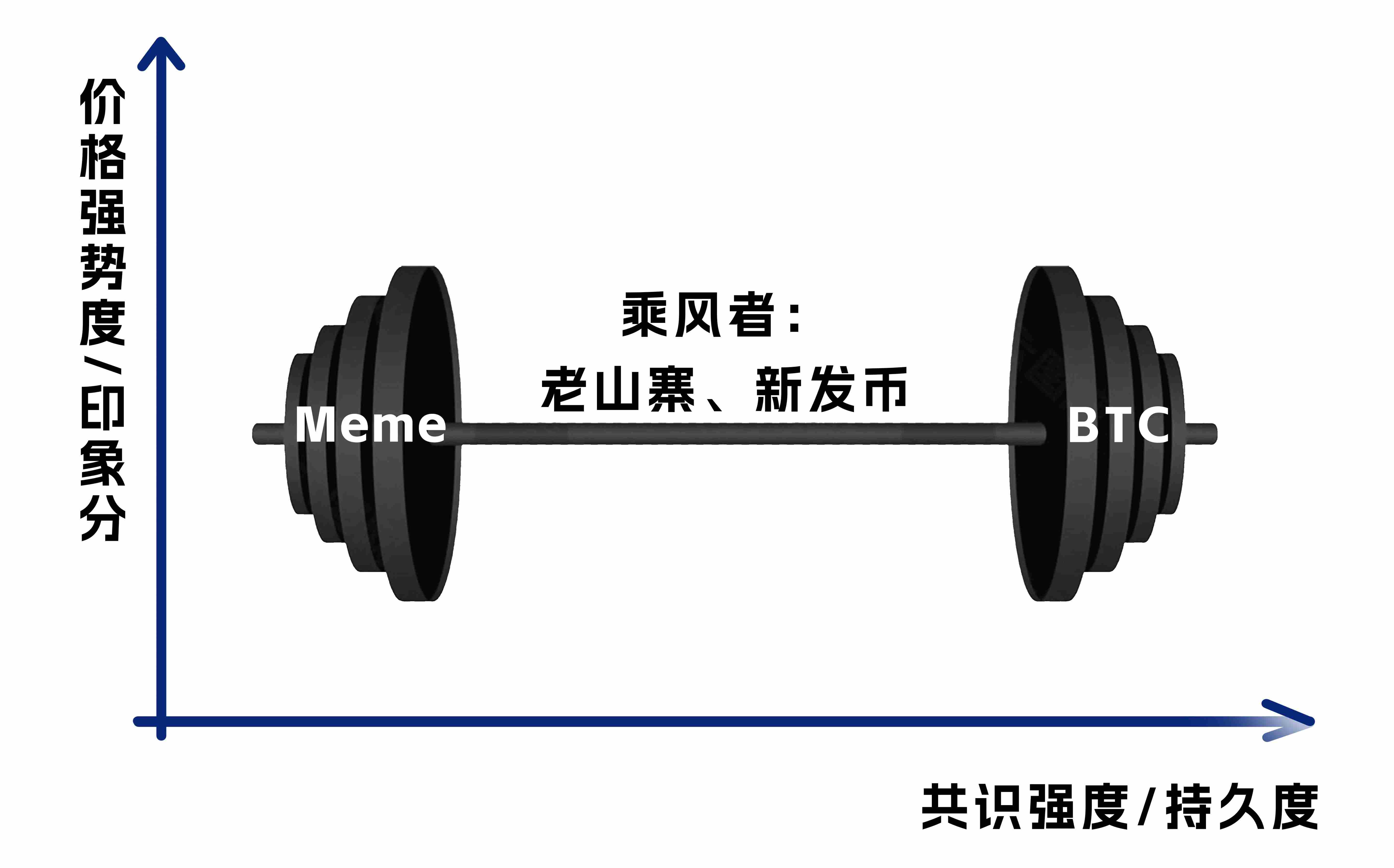
Let’s start with this image.
2024 Crypto Market Structure
From an asset performance standpoint, the biggest highlights of 2024 were clearly BTC and Meme coins. In between, there were some new and old projects I personally invested emotional energy into—but honestly, they were neither satisfying nor worth abandoning entirely. I plan to cut them loose in 2025.
BTC: New Highs, New Cycle, New Attributes, New Narratives
In 2024, U.S. elections and crypto policy reinforced each other. Trump’s decree—“List Bitcoin as a strategic reserve asset for the United States”—elevated Bitcoin to a key resource in a new era of financial cold war, pushing traditionally hesitant or superficial institutional players deeper into crypto.
The entry of old-money capital has long been part of the bullish narrative around BTC—or at least a stabilizing tendon of consensus. This massive tailwind injected confidence into BTC’s value proposition, but also set clear ceilings for future price growth and momentum.
As institutional holdings increase, CeFi product lines like ETFs expand, and Macrostrategy-style “equity-crypto联动” strategies gain traction, BTC’s correlation with traditional markets—U.S. equities, Treasuries, and the dollar index—has thickened. Its asset character will inevitably shift toward a “digital universe version of gold,” shedding its punk roots. With prices entering uncharted territory, profit expectations become hazy, and estimates of demand saturation, past cycle theories, and pricing models all break down.
I predict this bull run marks BTC’s final high-slope cycle. From now on, its explosive power, volatility, and drawdown depth won’t compare to before.
So is crypto investing no longer attractive? No—Alpha is simply shifting away from BTC.
Policy Coins, Business Coins: Which Major Altcoins Can Capture the Overflow?
If BTC’s price trajectory increasingly resembles late-stage gold, ETH behaves more like a stable, infrastructure-grade tech stock (the way Ethereum talks less about price and more about value? Very tech-stock-like, right?).
2024 was also a landmark year for crypto ETFs. Regulatory winds first favored BTC and ETH, revealing institutional preferences: proven security and stability of product technology; solid business fundamentals compatible with traditional valuation methods; decent trading volume, broad holder distribution, and transparent token cost structures… XRP, SOL, DeFi leaders—the relics of previous cycles—are now stepping up.
But since the source of liquidity lies above, and considering regulators’ long-term caution and institutions’ slow productization pace, gains for such assets are generally modest. From investors’ perspective, despite desperate PR efforts and progress announcements from legacy projects, their sky-high previous peaks, historical baggage, and heavy baggage trains mean they won’t replicate past golden eras where altseasons erupted violently, outperforming major coins.
What about new projects launching tokens during this bull market?
New Structural Opportunities: BTCFi, Regional Regulatory Arbitrage
This year, while alts underperformed in price, remember: price and value constantly validate each other. The stellar price performances of BTC and new Meme kings naturally accelerated mass adoption—USDT issuance and active wallet counts both hit record highs, as both old money and new retail rushed in.
When steps (investment decision speed) are too big, misalignment emerges between capital (price) and cognition (value), creating gaps (time lags for value reversion)—and through those cracks, light (structural opportunities) shines through.
This section focuses on two structural opportunities from the industry and builder perspectives (I’ll discuss broader investor-level opportunities later, from internal and external angles):
1. Broad BTCFi, including CeFi directions—represented by MSTR, Coinbase, Bitdeer, ETFs—and native directions—assets like Runes, ORDI; scaling solutions like L2s, sidechains, Lightning Network; and DeFi applications like restaking and lending.
The former group shined brightly; the latter failed to fully ride the wave, which I deeply regret.
The “Bitcoin ecosystem” had everything going for it: strongest tailwinds for the base token, lessons learned from predecessors—it was standing on giants’ shoulders, yet still fell off the stool. You talk about cross-protocol assets not recognizing each other, a $10 million suicide bet not being enough motivation, exchanges and VCs already heavily invested,腾飞 just around the corner…
I say, the fundamental product-market mismatch remains unsolved: BTC has entered the whale era, where large funds have strict safety margins and procedural norms—this is the demand reality. But on the supply side, we see developers treating BTC natively via chain operations, trying to support massive institutional capital with tiny liquidity pools, asking whales to swap precious BTC for “high-potential” derivative assets, and entrusting security to pirated VMs—pure fantasy.
BTC ecosystem projects don’t need to hastily copy air-drop golden-age tactics from other ecosystems. Recognize your audience, shift who you’re telling stories to, serve institutional needs well—and you can still sit at the table and share the BTC CeFi cake.
2. Regulatory Clarity, BTC strategic reserves, expansion of legacy finance channels to include crypto, pre-election policy promises being priced in… These “pioneer moves” by the U.S. were quickly followed globally. Russian lawmakers proposed similar measures, South Korea delayed virtual asset taxation, Hong Kong ramped up frequent actions and statements on exchange licenses and stablecoins… Clearly, no one wants to end up like Germany’s government—the mid-year selloff villain mocked by both sides.
Attitudes toward the crypto industry operate on four levels: Dao (principle)—driven by policymakers’ vision and mindset; Fa (law)—led by large traditional financial institutions and tech companies; Shu (tactics)—implemented through RWA and CeFi products; Qi (tools)—concrete crypto derivatives like stablecoins, ETPs, and indices.
The latter three offer opportunities accessible to practitioners from diverse backgrounds.
The Biggest Alpha: Meme, New Token Distribution Mechanisms
Now let me switch gears and talk about a grassroots highlight of the year—the Meme.
Nihilistic? Abstract? Edgy? Remix culture? Memes went straight for the jugular of New Money (what I call tomorrow’s money). Most of Web3’s fun and buzz this year came from Memes.
Memes are built on a foundation of “flexible, tradable attention economies,” reinforcing users’ habit of “buying new, not old.” Capital rapidly shifts with attention, making old-project consensus fragile and new projects increasingly short-lived. This is the inevitable result of lowered barriers to asset issuance. Just as TikTok lowered content creation barriers, flooding the space with content that diluted quality ratios and raised the bar for identifying and retaining standout content.
During early Meme surges, repeated high-multiplier wealth effects created illusions on both buyers and sellers. Observational bias led investors and eager token issuers to whisper: “Can I win too?”
Unfortunately, in this high-speed era, the window for newcomers (retail) is brief. As both sides of the Meme market professionalize, win rates for investors and issuers quickly revert to the mean—competition intensifies over tools, narratives, and asymmetric information. When exhausted, red-eyed gamblers force casinos to change rules, Memes will reach their economic “adverse selection” inflection point.
Interestingly, “launching a Meme” is now pulling serious projects and earnest founders into the game.
Side story: Lily Allen, a British singer with nearly 8 million monthly listeners on Spotify, joined OnlyFans in October, offering foot photos to her 1,000 fans: “Music platforms exploit artists terribly—selling feet pays way better than streaming. The entire music industry needs to reflect on this… Don't hate the player, hate the game.”
Should Web3 reflect too? Or embrace nihilism—Why serious?
Perhaps we don’t need to artificially elevate Memes into cultural phenomena. Even emotionally, they reveal something. Do you recall how market sentiment was overwhelmingly focused on “airdrops” before Memes? First half of the year, endless discussions about VC tokens and exchange listings, institutions and KOLs unlocking tokens underwater, retail feeling manipulated by point systems, dissatisfaction with token allocations. The rise of Memes—and their more democratized token distribution—tapped directly into disenfranchised collective emotions. Iteration in token distribution mechanisms has always been one of crypto’s core evolutionary threads.
Take inspiration and reflection from this Alpha. Exposing problems is always the first step toward solving them. Value dilution is merely the prelude to value discovery.
Three Products That Impressed Me in 2024
We’ve covered verticals enough. Let’s relax a bit and revisit three products that surprised me: Polymarket, Macrostrategy, and pump.fun—each corresponding to the business, BTCFi, and Meme categories mentioned earlier, and representing small, medium, and large opportunities in this year’s venture landscape.
Polymarket: Right Audience, Right Timing
-
A gem of the Ethereum ecosystem, embodying V-values (building meaningful applications);
-
The 128 million wallets holding ETH mostly prioritize financial use cases;
-
Anyone familiar with gambling knows how real this demand is;
-
Guessing coin flips or answering multiple-choice questions is far easier than writing a coherent investment memo;
-
Riding the waves of the Olympics and the U.S. election…
This combination made breakout success almost inevitable.
Macrostrategy: CeFi Standout, Master of Open Game Theory
Once, I thought only the three Greek gods of blockchain—Ethereum, Binance, and USDT—could trigger nuclear-level industry disasters. Now, congratulations—BTC has a heavyweight contender.
Given BTC holdings will likely keep concentrating, and major whales face shared exposure to macro risks (U.S. economy), in 2025 I’ll gradually reduce BTC positions and closely monitor early warning signs of Macrostrategy model collapse.
pump.fun: Demand-Driven, Sustained Revenue
Is there potential in Meme × infrastructure tools? pump.fun says yes—with over $100 million in monthly revenue.
pump.fun, TikTok of crypto, enables issuance of assets and narratives, has real business, real product, sustainable protocol income, and even offers referenceable valuation metrics—all while cleverly leveraging Solana’s strengths. How could it possibly lose?
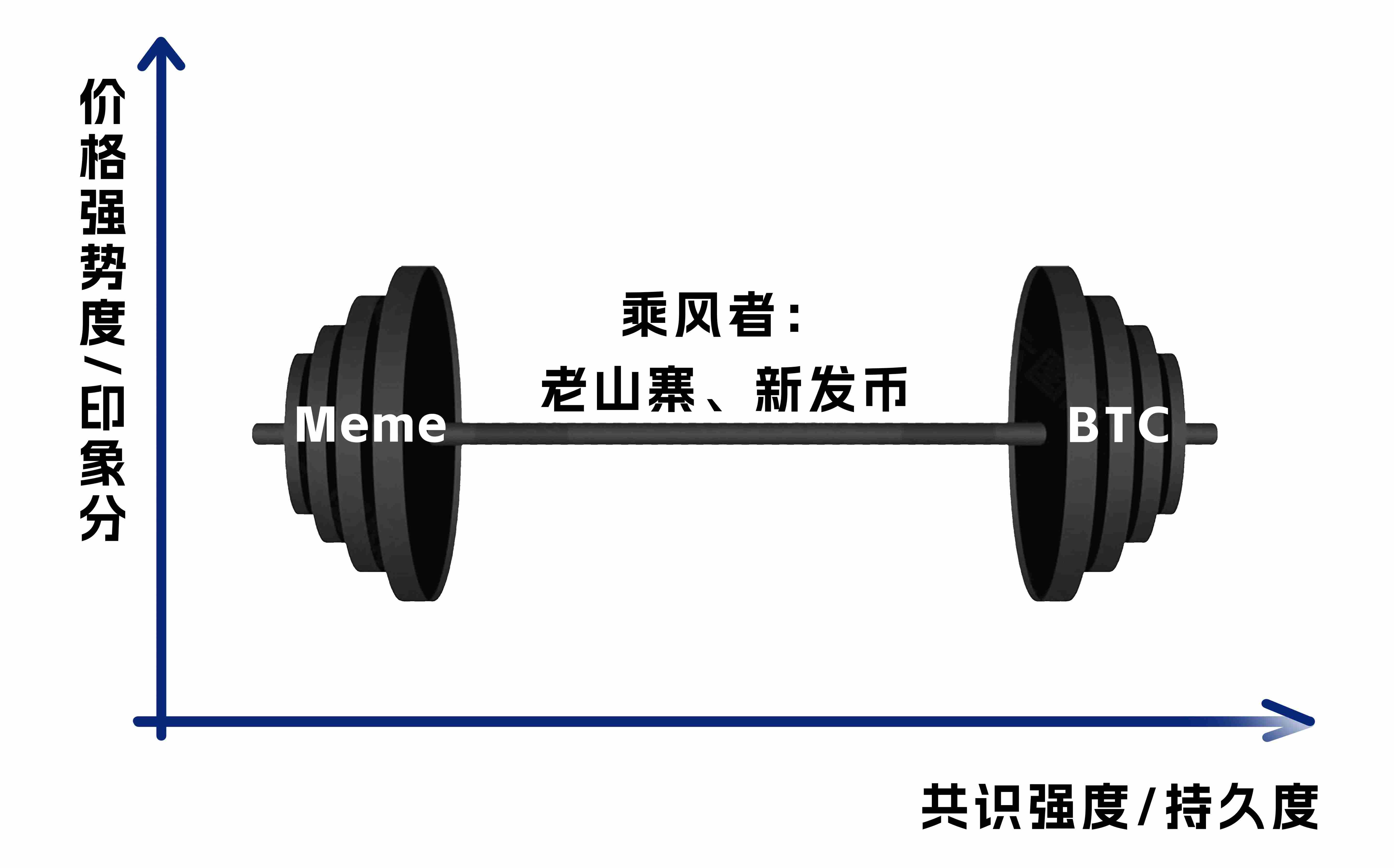
Reposting the image from the beginning
Looking back, at one end of the barbell, innovative assets mature amid native infrastructure development—before it fully becomes a robot-only game, I still have room to participate. At the other end, core assets go mainstream thanks to external policy boosts and traditional institutional allocation—I’ll opportunistically rotate BTC exposure into adjacent overflow sectors.
In terms of assets, direct beneficiaries were BTC and Meme coins. For model innovation, top honors go to Macrostrategy and pump.fun.
Additionally, I liked Ethena, Pendle, Jupiter, Hyperliquid, OKX Web3 Wallet—these also performed strongly this year. To avoid the trap of “saying everything means saying nothing,” I won’t elaborate here.
2025: Cherish the Brief Good Times
Today’s tech and finance landscapes evolve such that major innovations usually involve A building on B’s shoulders, while minor ones are combinations like A×B, B×C… These hybrids and permutations are perfectly suited to AI’s associative capabilities. With the next two years shaping up to be peak AI years, Web3 innovation and investing should align accordingly.
Looking ahead to 2025, the biggest external driver may be AI permeating every layer of Web3 tools and services; the most promising internal surprise might be MemeFi. As for mid-tier homogeneous altcoins (e.g., copy-pasted business models across different layers, negligible differences in base layers), I struggle to imagine much—though perhaps traditional capital will pick some, letting them grow alongside CeFi.
My boss often reminds me: feeling repetitive is a sign of arrogant fatigue, a loss of sharpness. I think it depends on how we choose to view this spiraling industry—if I place myself atop as a veteran looking down, these concentric circles are just dust beneath history’s wheels. But if I position myself sideways, wow—user (speculator) bases are growing, tech (applications) are advancing!

I’m proud that crypto remains the fastest-evolving industry—period. However you look at it, what matters more is doing. Dive in, ride the waves, and revel in the joy.
Finally, my New Year’s resolution: purge outdated experiences, update investment frameworks, build a learning system for new assets, rebalance and focus my portfolio—striving to upgrade my collection of “SB money” wallets into Smart Money addresses.
Join TechFlow official community to stay tuned
Telegram:https://t.me/TechFlowDaily
X (Twitter):https://x.com/TechFlowPost
X (Twitter) EN:https://x.com/BlockFlow_News
 Odaily










