What "business secrets" are revealed by the Trump family's crypto project and the assets configured on its blockchain?
TechFlow Selected TechFlow Selected
What "business secrets" are revealed by the Trump family's crypto project and the assets configured on its blockchain?
The ongoing Trump effect.
 Navigating Web3 tides with focused insights
Author: Huo Huo, Baishala Blockchain
Donald Trump's victory in the U.S. presidential election pushed Bitcoin past the $100,000 mark, accelerating this bull market cycle. It’s not just Bitcoin—projects associated with the Trump team are also taking off.
Recently, World Liberty Financial (hereinafter "WLFI"), closely linked to the Trump family, has been actively purchasing ETH, LINK, AAVE, ENA, and others, triggering a wave of market speculation and emerging as a notable trendsetter in the crypto investment space.
So what exactly is WLFI, and what market-moving moves might it make in the future?
01 What Is WLFI?
WLFI is a DeFi project backed by Donald Trump and his family—including his eldest son Donald Trump Jr., third son Eric Trump, and youngest son Barron Trump—that officially launched on September 2023 on Ethereum’s mainnet via Aave V3.
At its core, WLFI is a decentralized finance (DeFi) platform enabling users to borrow, lend, and invest cryptocurrencies. The founders envision it as a tool for achieving financial independence, allowing private peer-to-peer transactions without reliance on traditional financial intermediaries, thereby advancing global DeFi adoption—especially for those underserved by conventional banking systems. The Trump family has referred to it as the “future of crypto DeFi.”
WLFI is the governance token of World Liberty Financial, granting each holder one vote in community proposals on the governance platform. However, its initial distribution plan was revised—from allocating over half through sales to shifting focus toward community and creator rewards—reflecting changes in incentives and early supporter allocations.
Unlike other governance tokens such as UNI or MKR, WLFI does not confer economic rights; once claimed, tokens cannot be transferred, meaning holders cannot trade, exchange, or sell WLFI. While future governance proposals may change this, currently the token remains non-transferable for the foreseeable future.
Possibly due to its non-transferability and lack of short-term profit opportunities for investors, WLFI has seen low liquidity since its launch on October 15.
Additionally, WLFI is only available to users outside the United States and is not registered with any financial regulatory authority. This means U.S. residents are prohibited from participating in these tokens, likely an effort to avoid scrutiny from U.S. regulators.
Considering its marketing approach more directly, WLFI is essentially a project driven by Trump’s influence aimed at promoting dollar-pegged stablecoins and DeFi applications, seeking to strengthen the U.S. dollar’s dominance within the DeFi ecosystem.
Therefore, it’s necessary to examine how the Trump family supports this initiative.
1) Team Overview
According to official WLFI materials, the project describes itself as inspired by Trump, aiming to drive mass adoption of stablecoins and DeFi—particularly USD-pegged stablecoins—to ensure the continued dominance of the U.S. dollar.
Donald Trump serves as the project's "Chief Crypto Advocate," while his sons Eric Trump, Donald Trump Jr., and Barron Trump act as Web3 Ambassadors to promote the platform and attract mainstream users.
In this context, according to the whitepaper, DT Marks DEFI LLC—a company under Trump’s umbrella—agreed to promote WLFI and granted the right to use the names and likenesses of Trump family members for promotional purposes. In return, WLFI pays tokens to DT Marks DEFI LLC and shares approximately 75% of protocol net revenue.
However, legally, the Trump family has distanced itself entirely from WLFI. Although WLFI calls itself the “only DeFi platform inspired by Trump,” roles like “crypto advocate” and “Web3 ambassador” do not constitute actual management positions. Moreover, a disclaimer at the bottom of the website states:
“Neither Donald J. Trump, any member of his family, nor Trump Organization, DT Marks DEFI LLC, or any of their respective affiliates’ directors, officers, or employees, are officers, directors, founders, or employees of WLFI or its affiliated companies... World Liberty Financial and its WLFI Token are not political in nature and are not part of any political campaign.”
Critics argue that WLFI is deeply tied to the Trump family—a branded product where unknown operators leverage the Trump name, while the family licenses their brand and collects profits. Such business models are common for the Trumps—for example, numerous Trump-named hotels and towers around the world operate through licensing and branding partnerships.
Overall, despite extensive marketing suggesting close ties between WLFI and the Trump family, there is no legal connection. This may partly explain why WLFI hasn’t gained strong traction among users.
Besides Trump family support, the WLFI team consists of experienced crypto professionals.
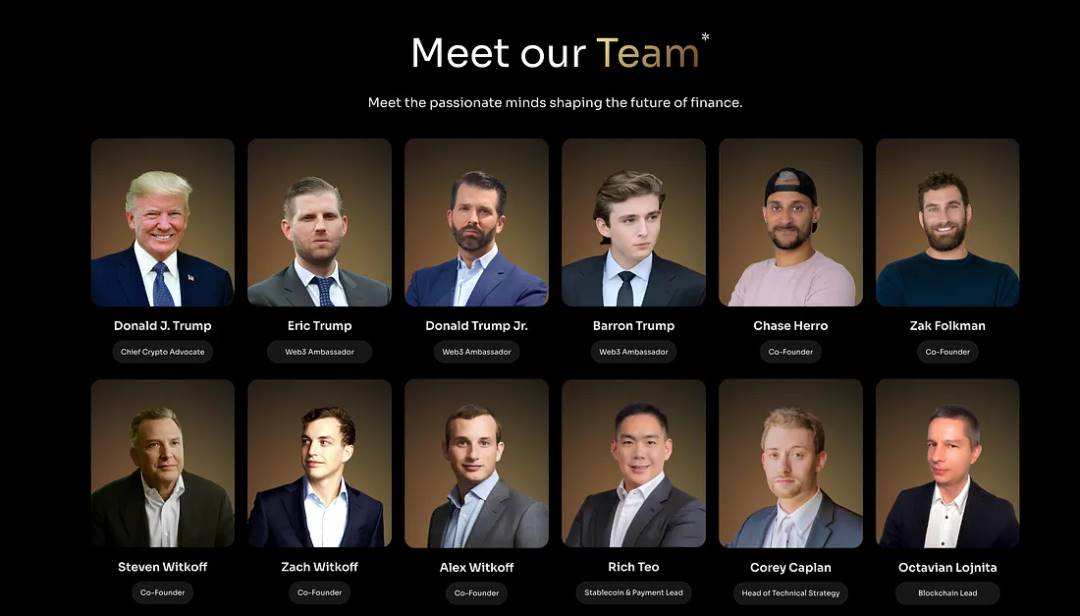
The official site lists five co-founders. Chase Herro and Zak Folkman have relatively unimpressive industry backgrounds. According to CoinDesk, they previously launched Dough Finance, a lukewarm DeFi project that suffered a hack in summer 2024, losing $2 million. Additionally, Octavian Lojnita, WLFI’s blockchain lead, and an anonymous developer also came from Dough Finance. Reports indicate that early code repositories published by WLFI were direct copies of Dough Finance’s code, later deleted.
Nonetheless, WLFI claims its code has been audited by multiple firms—including BlockSec, Fuzzland, PeckShield, and Zokyo—to ensure security.
Besides Chase Herro and Zak Folkman, the other three co-founders are members of the Steven Witkoff family—Steven Witkoff, Zach Witkoff, and Alex Witkoff. Steven Witkoff is a prominent U.S. real estate developer and a friend of Trump.
Furthermore, WLFI boasts an advisory team comprising venture capitalists, lawyers, and blockchain engineers. Notable advisors include Sandy Peng, co-founder of Scroll (an Ethereum Layer 2 blockchain), and Luke Pearson, general partner at Polychain Capital.
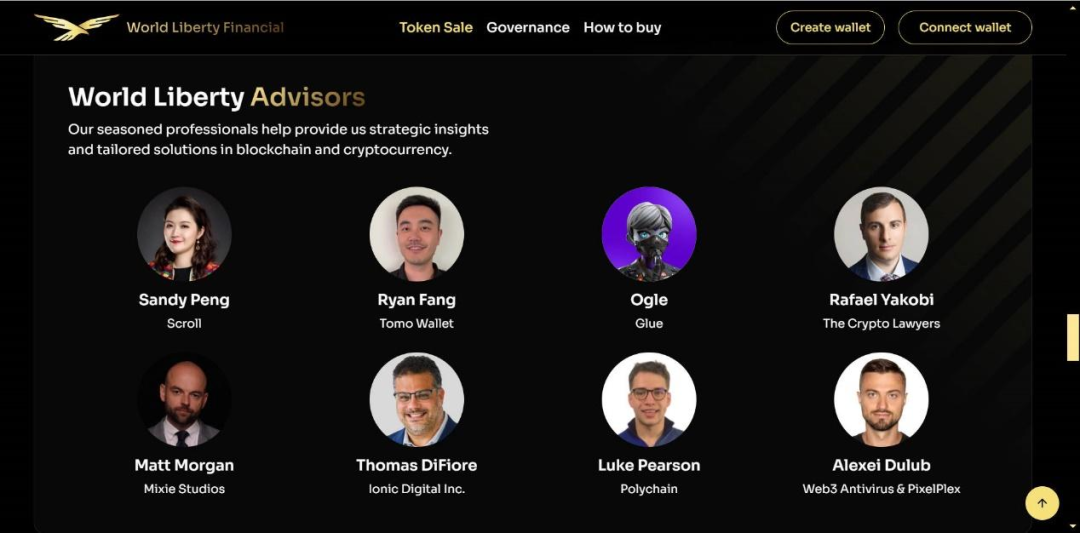
These advisors bring specific technical expertise and market experience, helping WLFI achieve long-term goals, particularly in promoting USD-pegged stablecoins and expanding DeFi applications.
2) Recent Developments
While the broader altcoin market recovers alongside Bitcoin, WLFI’s token sales remain sluggish, having sold only about a quarter of its supply since launch.
However, two developments stand out. First, in late November, Justin Sun, founder of TRON, allocated $30 million to purchase WLFI tokens in a show of support, becoming the project’s largest publicly known investor. Then on November 26, Justin Sun was appointed as a WLFI advisor.
Following the announcement of Sun’s appointment, on December 18, WLFI announced a partnership with Ethena Labs, initiating a long-term collaboration starting with Ethena’s yield-bearing token sUSDe.
Beyond that, the most watched aspect has been WLFI’s purchases of various altcoins—each move sparking immediate trading surges.
02 WLFI’s On-Chain Activity
According to monitoring by Spot On Chain, since November 2024, WLFI has accumulated a range of major and emerging crypto assets through a primary wallet address, spending nearly $45 million in December alone. Purchases include ETH, cbBTC, LINK, AAVE, ENA, and the newly added ONDO, bringing total holdings value beyond $84.8 million.
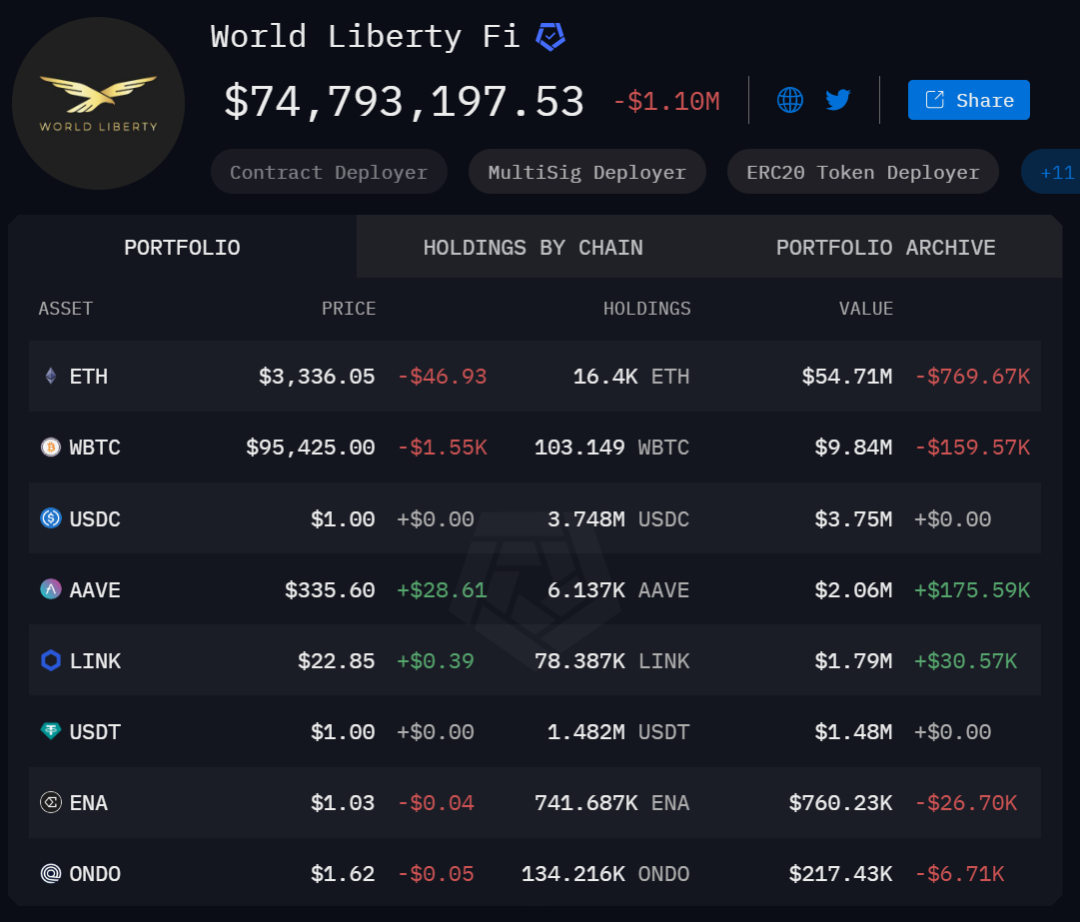
Source: https://intel.arkm.com/explorer/entity/worldlibertyfi
Based on incomplete statistics, the crypto assets held include:
1) ETH
Ethereum, the world’s second-largest cryptocurrency platform, needs no introduction regarding its status and influence in the industry.
WLFI has made multiple ETH purchases, spending the most on ETH. Earlier reports indicated a $30 million allocation to acquire 8,105 ETH at an average price of ~$3,700. Most recently, on December 20, WLFI bought 722.213 ETH for $2.5 million via Cow Protocol. After this transaction, WLFI’s total ETH holdings reached 16,400 ETH.
2) cbBTC
cbBTC (Coinbase Wrapped Bitcoin) is an ERC-20 token launched by Coinbase to bring Bitcoin (BTC) value onto Ethereum and other blockchains. WLFI spent $10 million to acquire approximately 103 cbBTC at an average price of $97,181 per unit; afterward, converted all cbBTC into WBTC.
This move coincided with Coinbase announcing the delisting of WBTC for failing CEX compliance standards. As such, WLFI’s action was seen as a show of support for WBTC.
Choosing to convert cbBTC into WBTC may reflect WBTC’s maturity and infrastructure advantages in the market—or possibly the influence of advisor Justin Sun.
Sun’s custodian firm BiT Global partnered with BitGo—the company behind WBTC—in August this year, transferring WBTC operations to BiT Global and Sun.
3) AAVE
AAVE is an Ethereum-based decentralized lending protocol allowing users to deposit funds to earn interest or borrow crypto assets—the same protocol WLFI leveraged for its launch.
WLFI has been active in investing in AAVE tokens, making multiple allocations. It exchanged $246,000 for AAVE at $360 per token, $1.25 million at $308.4, and $1 million at $297.8. Currently, WLFI holds a total of 6.137 million AAVE.
4) LINK
The project behind LINK is Chainlink, a decentralized oracle network providing reliable off-chain data to smart contracts on blockchains. In simple terms, Chainlink helps blockchains access and use external data.
WLFI has frequently invested in LINK, acquiring it at prices including $34.2, $25.5, and $27, totaling around $8 million spent. Currently, WLFI holds 78,300 LINK tokens.
Rumors suggest WLFI plans to integrate Chainlink oracles to accelerate DeFi adoption. As the leading oracle solution, Chainlink could help WLFI ensure accuracy and security for its financial products. Thus, buying LINK may be intended to utilize Chainlink’s services and enhance platform functionality and credibility.
5) ENA
Ethena (ENA) is a decentralized finance platform using an algorithmic stablecoin mechanism to maintain asset stability. ENA can be used for staking, trading, and governance. The platform offers efficient trading, liquidity mining, and DeFi integration, aiming to provide stable and transparent financial services for crypto assets.
WLFI spent $750,000 to acquire 741,687 ENA at an average price of $1.011 per token, and another $500,000 to buy 509,954 ENA at ~$0.98 USDT each, currently holding about 741,000 ENA.
However, a WLFI spokesperson stated that the ENA purchase has no direct link to the partnership with Ethena Labs, merely reflecting confidence in Ethena’s long-term viability and success.
6) ONDO
Ondo Finance, the project behind ONDO, is an Ethereum-based DeFi protocol transforming traditional liquidity services into tokenized real-world assets (RWA), bridging crypto and the real economy. Its flagship offerings are bond-based RWAs. Ondo already has four products listed on Binance Futures: OMMF (U.S. money market fund), OUSG (BlackRock short-term U.S. Treasury ETF), USDY (tokenized bill), and Flux Finance (supporting tokenized securities as collateral).
For ONDO, WLFI made only one purchase, spending $250,000 to acquire 134,000 ONDO tokens at an average price of $1.86 per token.
03 What Else Do These Activities Reveal?
Clearly, WLFI has conducted numerous on-chain activities recently. The tokens it has acquired—including stablecoins (USDT), lending/borrowing protocols, RWA, oracles, and wrapped Bitcoin—essentially cover all major categories within DeFi. Beyond obvious DeFi asset accumulation, we can infer several additional insights from WLFI’s on-chain behavior:
1) Use of Safe Multisig Wallets
A Safe multisig wallet is a smart contract-based digital asset management tool that enhances security through multi-signature mechanisms requiring multiple accounts to jointly authorize transactions. Users can set flexible signing rules—such as single-sign (1/1) or multi-sign (e.g., 2/3 or 3/5)—where a predefined number of signers must approve before execution. Compatible across multiple blockchains and token types, Safe wallets are widely used for team treasury management, DAO finances, personal asset protection, and custody services, valued in Web3 for high security and transparency.
The Safe multisig wallet used by WLFI has seven signers, one of which belongs to an active DeFi user.
2) Conducting Token Swaps via Built-in Cowswap in Safe Wallet
On-chain data shows WLFI has executed over 150 trades via decentralized exchange CowSwap in less than two months. CoW Swap is the frontend of CoW Protocol—an aggregator DEX featuring batch auctions, trade intents, and MEV protection—deployed on Ethereum and Gnosis, and now one of the most popular DEXs.
Due to WLFI’s extensive swap activity, the native token of CoW Protocol, COW, surged over 30% in 24 hours and rose more than 80% within seven days.
3) Strategic Considerations Behind Token Selection
Diversified Portfolio: By investing across different sectors, WLFI reduces exposure to volatility from any single asset, captures broader market growth, and amplifies capital efficiency through market momentum.
Expanding DeFi Ecosystem Influence: Most acquired tokens are core DeFi assets, helping WLFI expand its footprint and influence within the DeFi landscape.
Strategic Partnership Opportunities: Certain targeted investments (e.g., ENA and ONDO) may stem from potential collaborations, enhancing WLFI’s brand value and market positioning.
Overall, these actions align well with WLFI’s strategic goals—increasing influence through various means to build a comprehensive on-chain lending and trading platform.
04 Summary
If earlier BTC prices climbed from $70,000 to over $100,000 due to the 'Trump effect,' then the tokens held by WLFI have similarly benefited from this phenomenon. For instance, after WLFI purchased LINK and AAVE on December 14, it realized unrealized gains of $299,000 on LINK and $338,000 on AAVE. On December 16, news of WLFI’s activity spread, pushing ONDO above 2.1 USDT—a new all-time high—with a 24-hour surge of 16.33%.
Hence, rumors circulate that WLFI’s portfolio could become a bellwether for established DeFi projects, prompting speculation: What crypto assets will WLFI accumulate next?
Some believe teams backed by investment advisors deserve attention; others think top-tier projects with high asset and brand value may be targeted, while some argue quality DeFi assets within the top 100 market caps should not be overlooked.
Whatever the case, we’ll have to wait and see what moves WLFI makes next.
Join TechFlow official community to stay tuned
Telegram:https://t.me/TechFlowDaily
X (Twitter):https://x.com/TechFlowPost
X (Twitter) EN:https://x.com/BlockFlow_News
 白话区块链
白话区块链