Decoding RISC Zero's Product Matrix: How to Empower Ethereum's Journey Toward a ZK Future?
TechFlow Selected TechFlow Selected
Decoding RISC Zero's Product Matrix: How to Empower Ethereum's Journey Toward a ZK Future?
Recently, RISC Zero zkVM released version 1.2, introducing a completely new precompile method that allows developers to deploy precompile logic alongside their applications, without requiring it to be built into the zkVM itself.
 Navigating Web3 tides with focused insights
By LINDABELL
At the recent Devcon conference, Ethereum Foundation core member Justin Drake introduced the Beam Chain proposal—a plan to upgrade Ethereum's consensus layer using zkSNARKs and zkVM technologies to enhance scalability, security, and efficiency. This vision has once again highlighted the importance of zkVMs. As a general-purpose zero-knowledge virtual machine, zkVM enables more flexible and efficient processing of complex computations while reducing reliance on traditional smart contract logic.
Driven by this trend, projects such as RISC Zero, Succinct, and Cysic have emerged as key innovators in the space. Among them, RISC Zero stands out with its RISC-V-based zkVM, developing an open-source toolkit including Zeth, Kailua, and Bonsai. These tools not only improve block validation and Rollup performance but also provide technical support for Ethereum’s journey toward full ZK integration.
RISC Zero’s zkVM Ecosystem: From Core Technology to Real-World Applications
RISC Zero is a zkVM implementation based on the RISC-V instruction set architecture. As a general-purpose zero-knowledge computing platform, it supports mainstream programming languages like Rust and C++, enabling execution of nearly any computational task. Compared to other zero-knowledge platforms, RISC Zero offers fully open-source prover and verifier components, allowing developers to generate and verify proofs locally. Additionally, its verifier is compatible across multiple platforms and blockchain ecosystems, streamlining the development of decentralized applications.
In June this year, RISC Zero launched zkVM 1.0. This version supports multiple programming languages and complex workloads, leveraging Continuations technology to split large-scale computations into smaller segments for efficient parallel processing and verification. According to its roadmap, RISC Zero aims to achieve a 20x improvement in zkVM performance and cost efficiency by the end of 2024. Key optimizations include migrating proof generation entirely to GPUs (currently 80% complete), introducing a new RISC-V v2 circuit design, and specialized recursive circuit enhancements. The team is also integrating acceleration modules for cryptographic algorithms such as RSA, Keccak, and ECDSA to boost performance for Ethereum-related operations and cryptographic tasks.
Built around the core capabilities of zkVM, RISC Zero has developed a suite of open-source tools and products. For example, the Bonsai network provides remote proving services, enabling developers to generate zero-knowledge proofs without dedicated hardware. The Steel tool allows complex EVM computations to be executed off-chain while maintaining verifiable results, significantly reducing on-chain execution costs. Blobstream Zero bridges Celestia’s data availability layer, expanding possibilities for data sharing and verification within modular blockchain ecosystems.
Zeth: Proving Correct Construction of Entire Ethereum Blocks
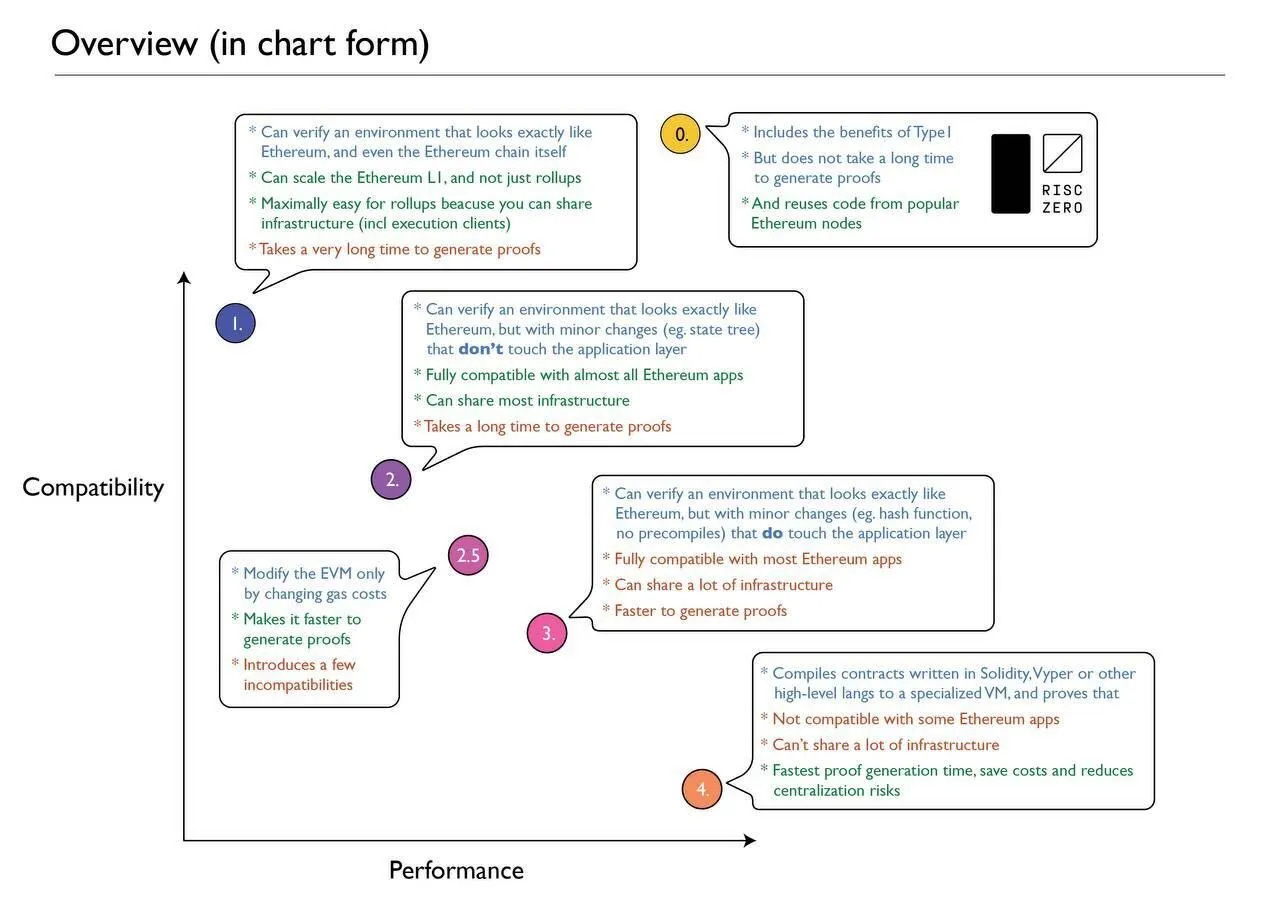
Zeth is an open-source zero-knowledge Ethereum block prover built by RISC Zero using its zkVM technology. It verifies the validity of Ethereum blocks via zero-knowledge proofs without relying on traditional validators or sync committees. RISC Zero defines Zeth as a Type-0 zkEVM—fully compatible with the Ethereum protocol—that achieves higher development efficiency through code reuse.
Ethereum co-founder Vitalik Buterin categorized zkEVMs into four types in his article "Different types of zk-EVMs": Type-1 seeks full and uncompromising equivalence to Ethereum; Type-2 aims for full EVM equivalence but not full Ethereum equivalence; Type-3 is almost equivalent to EVM; and Type-4 is fully incompatible with Ethereum.
Leveraging the high performance of RISC Zero's zkVM, Zeth can validate Ethereum blocks within minutes. Test data shows that Zeth generates block proofs at speeds up to 1.1 MHz, and with "continuations" enabling GPU cluster scaling, throughput increases to between 4.7 MHz and 6.3 MHz. This optimization reduces proof generation costs significantly—for a block containing 182 transactions, the total cost is just $21.72, averaging about $0.11 per transaction.
During Zeth’s development, the RISC Zero team made extensive use of components from the Rust ecosystem, such as revm, ethers, and alloy, enabling developers to quickly implement block proving functionality for various use cases. This design offers greater flexibility, allowing customization of block construction logic and adaptability to future Ethereum improvement proposals.
On the application side, Zeth delivers efficient solutions for zk Rollups, light clients, and cross-chain bridges. Traditional zk Rollups and zkEVMs require substantial time and capital investment, often deterring small teams. However, Zeth’s modular zkVM architecture allows developers to easily customize block validation logic. For instance:
-
zk Rollups: Zeth accelerates block proving, shortening development cycles and lowering financial barriers.
-
Light Clients: Enables block validity verification without re-executing the entire block, reducing operational costs.
-
Cross-chain Bridges: Using ZKPs, Zeth verifies cross-chain data correctness without revealing sensitive on-chain information, minimizing trust in third parties and reducing risks of cross-chain attacks.
In May, Zeth successfully expanded to extract Optimism block data from the Ethereum mainnet and generate ZKPs to verify their correctness, with on-chain verification capability. This means Optimism can now leverage Zeth for faster transaction validation and dispute resolution.
Bonsai: Enabling Proof Generation Without Dedicated Hardware
Bonsai is a remote proving service designed specifically for zkVM applications, eliminating the need for developers to use their own hardware for proof generation—resolving the tension between limited on-chain resources and high computational costs. With Bonsai, developers simply define the zkVM application and input data, and Bonsai runs the computation in the background and produces the corresponding zero-knowledge proof—all without requiring additional hardware deployment. Bonsai leverages large GPU clusters to enable parallel processing of multiple tasks. It also provides simple APIs and SDKs, making integration into existing systems seamless and lowering the barrier to entry.
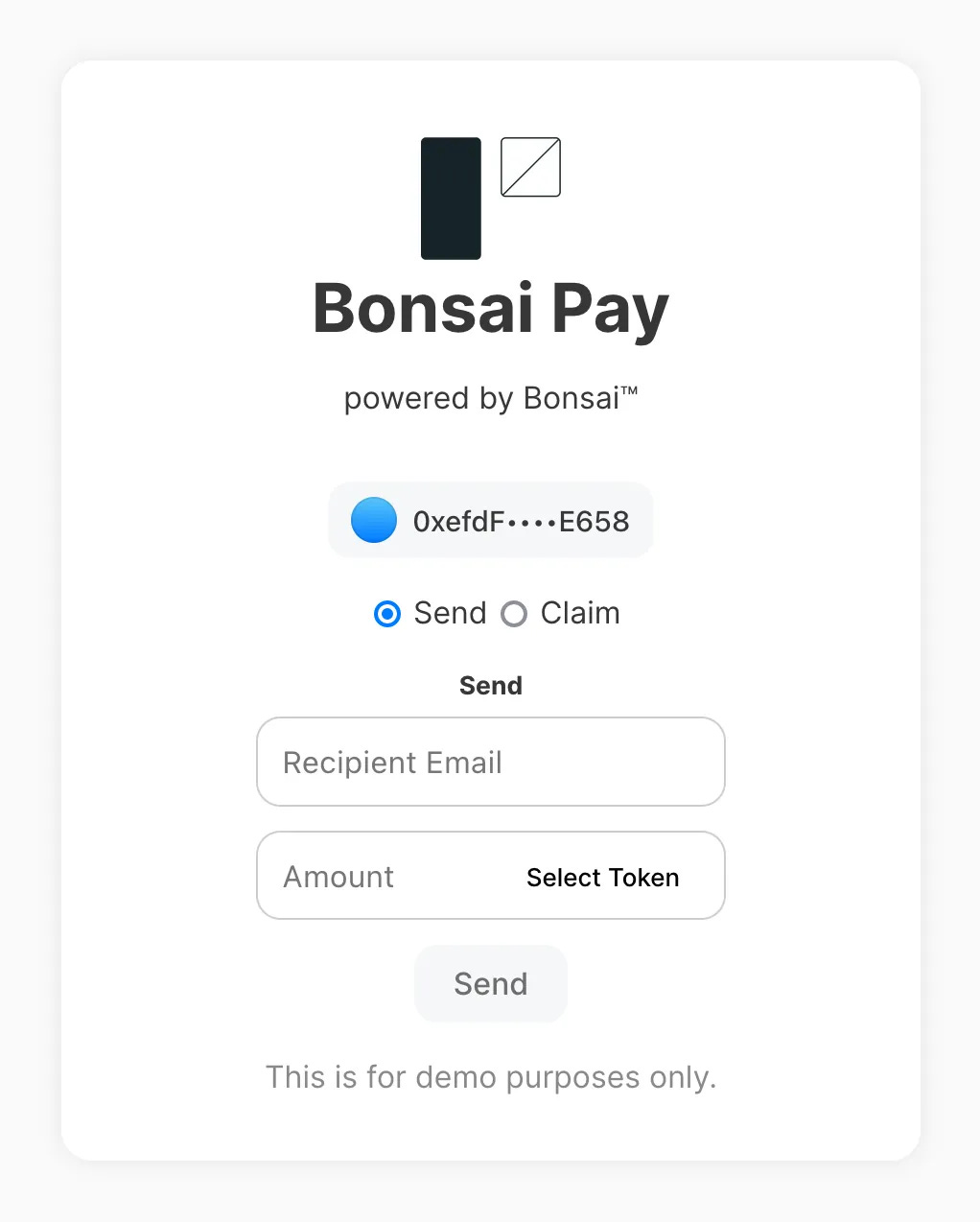
Building on this remote proving infrastructure, RISC Zero released Bonsai Pay—an open-source tool combining OAuth2.0 identity authentication with ZKP technology—allowing users to send and receive tokens on Ethereum using their Google accounts. For example, when Alice wants to transfer funds to Bob, she inputs Bob’s Google email and the amount via Bonsai Pay. Bob then logs in, enters his email, and completes Google account authentication. Bonsai Pay uses OAuth 2.0 to generate an authorization token proving Bob owns the email. Then, it invokes the Bonsai proving service to create a zero-knowledge proof linking Bob’s Google account to his wallet address. Once the smart contract verifies the proof, it unlocks and transfers the funds to Bob’s wallet.
Throughout this process, Bonsai Pay proves the statement “Bob’s Google account is linked to his wallet address” using ZKPs, without exposing any specific details about the Google account.
Another major application of Bonsai is the Bonsai ZK Co-processor. It offloads complex computations from on-chain to off-chain environments using zero-knowledge proofs, generating tamper-proof proofs to ensure result integrity. Deployment is straightforward: developers write a zkVM app to handle the logic and call Bonsai via a simple Solidity contract to run the computation and verify the outcome. During this process, Bonsai’s proving service generates the off-chain ZK proof, which can be verified on-chain.
The Bonsai ZK Co-processor benefits applications requiring high performance and low cost. In DAO governance, for example, it moves complex voting calculations off-chain, drastically cutting Gas fees. The Bonsai DAO Governor cuts per-vote Gas costs by over 50%, improving governance efficiency and accessibility.
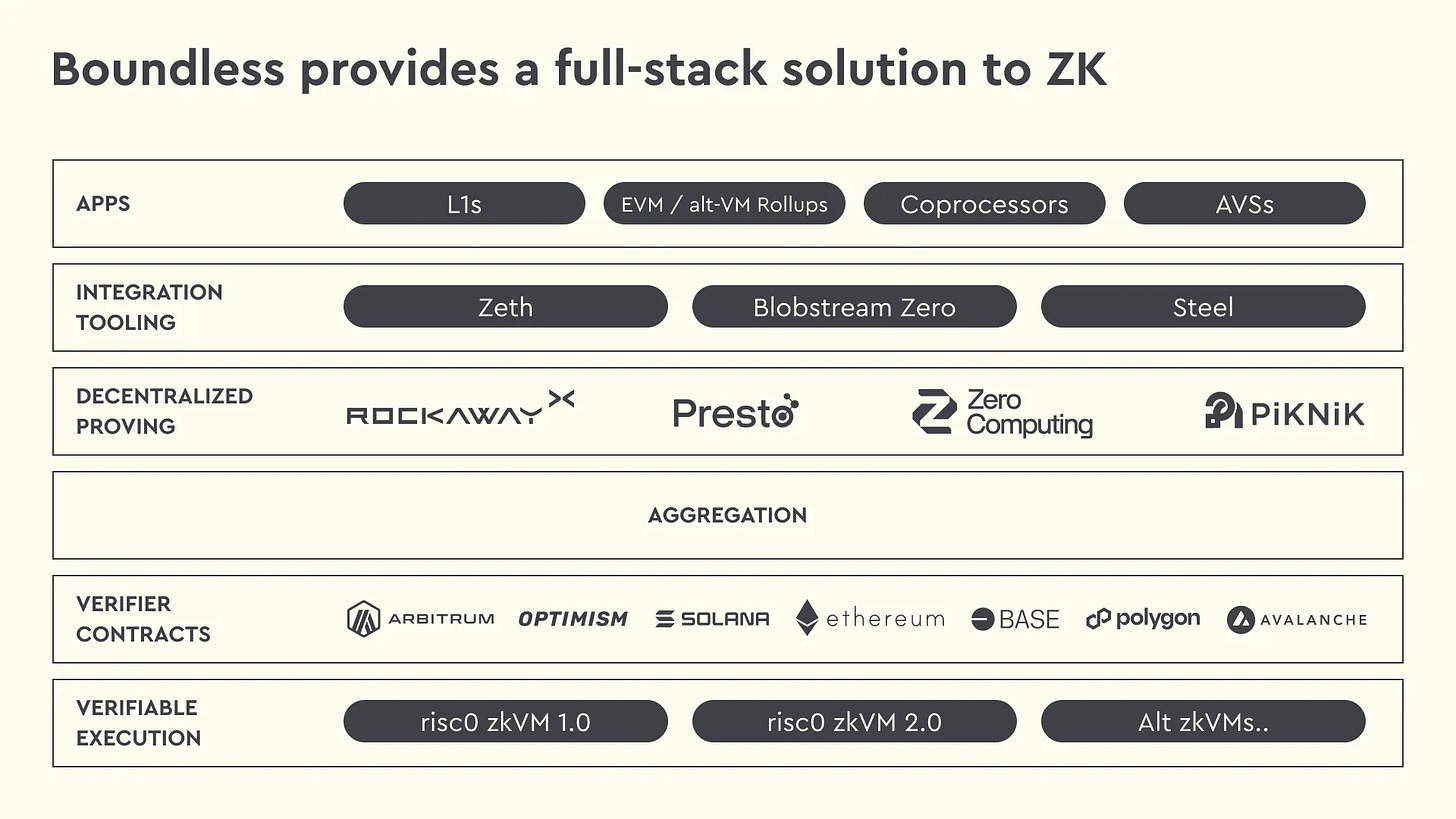
Boundless: A Verifiable Computation Layer
In traditional blockchain architectures, every node must re-execute all transaction computations to ensure validity—a model known as “global re-execution.” While secure and consistent, this approach incurs extremely high computational overhead. To address this, RISC Zero introduced Boundless, which allows a single node to perform the computation and generate a verifiable zero-knowledge proof. Other nodes can then confirm the result by verifying the proof instead of re-executing the computation.
Boundless simplifies verification using recursive composition techniques, merging multiple small ZK proofs into one aggregate proof so that verifiers only need to check a single final proof rather than each individual step. To further optimize proof generation efficiency, Boundless includes dedicated cryptographic acceleration circuits that enhance performance for common tasks like hashing and digital signature verification.
Importantly, developers do not need deep expertise in zero-knowledge cryptography to use Boundless. They can write applications in familiar languages like Rust or Solidity. Currently, Boundless is freely accessible to developers, who can leverage its proving services to rapidly build and deploy ZK applications on any blockchain without migrating existing systems or updating verification contracts.
Blobstream Zero: A zkVM-Powered Cross-Chain Bridge Simplifying Data Validation
Blobstream Zero is a zkVM-based cross-chain bridge developed jointly by RISC Zero and Celestia, aiming to seamlessly connect Celestia’s data availability layer to the broader modular blockchain ecosystem. By enabling shared access and verification of data stored on Celestia, Blobstream Zero facilitates easier and more secure data transfer across chains.
As a fully open-source public good, Blobstream Zero allows any project or developer to run local instances and generate zero-knowledge proofs. Moreover, it supports ZK co-processors—off-chain compute engines that rely on trusted data sources. Blobstream Zero retrieves data from blockchains like Celestia and generates ZK proofs to certify its authenticity, providing reliable inputs for off-chain computation.
Steel: A New Paradigm for Smart Contracts—Off-Chain Execution with On-Chain Verification
Steel is an open-source tool from RISC Zero that leverages zkVM technology to enable verifiable off-chain execution of smart contracts. With Steel, developers can move EVM operations off-chain while generating zero-knowledge proofs to guarantee the truthfulness and verifiability of the results.
Traditional smart contracts execute all logic on-chain, leading to high Gas costs and limiting the complexity of feasible applications. Steel addresses this by shifting computation off-chain and only performing lightweight proof verification on-chain. For example, consider a simple contract that checks whether an account’s ERC20 balance exceeds 1 and increments a counter. The conventional method requires full on-chain execution, whereas Steel performs the computation off-chain and generates a ZK proof, with only the proof being verified on-chain—no re-execution needed.
RISC Zero has already released Steel 1.0, and partners have successfully built applications with it. In one case involving a contract call with approximately 400,000 SLOAD operations, Steel moved the computation off-chain and generated a ZK proof verified on-chain. The proof generation cost was under $10, and on-chain verification required less than 300,000 Gas.
Kailua: Advancing Rollup Innovation Through Hybrid ZK Architecture
Following the release of Zeth, RISC Zero introduced Kailua—a hybrid ZK solution designed to upgrade optimistic Rollups. Traditional optimistic Rollups suffer from slow finality due to a typical 7-day challenge period, while ZK Rollups offer fast finality but incur high ongoing proof generation costs. Kailua combines the strengths of both approaches, achieving a balanced trade-off between cost and efficiency. As an extension of the Optimism Kona framework, Kailua supports unmodified Kona running on zkVM and introduces an innovative dispute resolution mechanism that lowers staking requirements and reduces finality delays, enhancing system efficiency and usability.
Kailua features a novel dispute resolution design. Its mechanism removes fixed time limits, giving validators ample time to generate proofs even during network disruptions, thereby increasing system resilience. Even under extreme conditions, RISC Zero’s zkVM extended architecture can produce a proof within an hour. Furthermore, Kailua’s on-demand verification feature allows developers to flexibly configure verification frequency, enabling a gradual, cost-effective transition toward fully verified Rollup modes.
Unlike ZK Rollups, Kailua does not require continuous proof generation. For low-frequency empty blocks or Rollups with special contract needs, Kailua offers a more cost-effective alternative. It also dramatically reduces staking requirements. In traditional optimistic Rollups, staked amounts grow linearly with long finality periods, but Kailua’s optimized design fixes staking demands, enabling lower-cost maintenance of security and liveness even over extended periods.
Kailua is now fully open-source. Developers can use its command-line tools to deploy a local Optimism testnet and quickly upgrade it to support ZK fault proofs. It also supports simulating fault challenges, helping developers understand how validators contest incorrect states via zkVM and gain deeper insight into its dispute resolution mechanics. Going forward, Kailua will continue optimizing cost and performance and expand support to additional Rollup frameworks.
Conclusion
As illustrated above, RISC Zero’s zkVM product suite is driving advancements in zero-knowledge proof technology across multiple domains. Zeth and Kailua focus on Rollup architecture improvements, boosting block validation speed and dispute resolution efficiency. Bonsai provides remote proving services that reduce hardware dependency and operating costs, empowering developers to build applications more efficiently. Blobstream Zero enhances cross-chain data validation, offering robust support for modular blockchain ecosystems. Meanwhile, Steel lowers Gas costs for smart contract execution through its off-chain computation and on-chain verification model.
Beyond refining its product matrix, RISC Zero continues advancing the underlying zkVM technology. Recently, RISC Zero released zkVM 1.2, introducing a new precompile deployment method that allows developers to bundle custom precompile logic with their applications without embedding it directly into the zkVM itself. This means developers can add new precompiles without modifying on-chain verification contracts, coordinating prover configurations, or forking the zkVM—enabling performance optimizations with minimal disruption. Application-defined precompiles also reduce proof generation costs. For example, after Automata integrated RSA precompiles, execution cycles dropped from 39 million to 217,000, cutting costs by approximately 180x.
As zkVM technology continues to evolve, its potential will unfold across diverse applications. However, unlocking this full potential will ultimately depend on ecosystem collaboration and real-world adoption.
Join TechFlow official community to stay tuned
Telegram:https://t.me/TechFlowDaily
X (Twitter):https://x.com/TechFlowPost
X (Twitter) EN:https://x.com/BlockFlow_News
 @ChainFeedsxyz