ZEN Rises for 3 Consecutive Days; Should You Follow Grayscale's Trust Holdings?
TechFlow Selected TechFlow Selected
ZEN Rises for 3 Consecutive Days; Should You Follow Grayscale's Trust Holdings?
ZEN Breaks 30 USDT, How Are Grayscale's Other Holdings Performing?
 Navigating Web3 tides with focused insights
By shaofaye123, Foresight News
Recently, Grayscale has launched trust funds for Optimism and Lido one after another. Among its trust offerings, SUI and ZEN have maintained upward momentum despite market pullbacks. Are Grayscale's trust funds truly a collection of blue-chip tokens? And are they profitable over the long term? This article provides an overview of Grayscale’s 26 current crypto trusts and their investment returns.
Overview of Grayscale Crypto Trusts
Grayscale is a digital asset management company founded in 2013, primarily offering various cryptocurrency trust funds designed to provide investors with legal and regulated access to digital assets. As one of the world’s largest crypto asset managers, it oversees billions of dollars in assets. To date, Grayscale has launched 26 crypto trusts.
Grayscale Trust Funds are investment products that allow investors to gain indirect exposure to cryptocurrencies such as Bitcoin and Ethereum without directly purchasing or managing the underlying assets. Each trust corresponds to a specific digital asset—for example, the Grayscale Bitcoin Trust (GBTC) and the Grayscale Ethereum Trust (ETHE). Through these trusts, investors can buy and sell shares on public markets much like traditional equities.
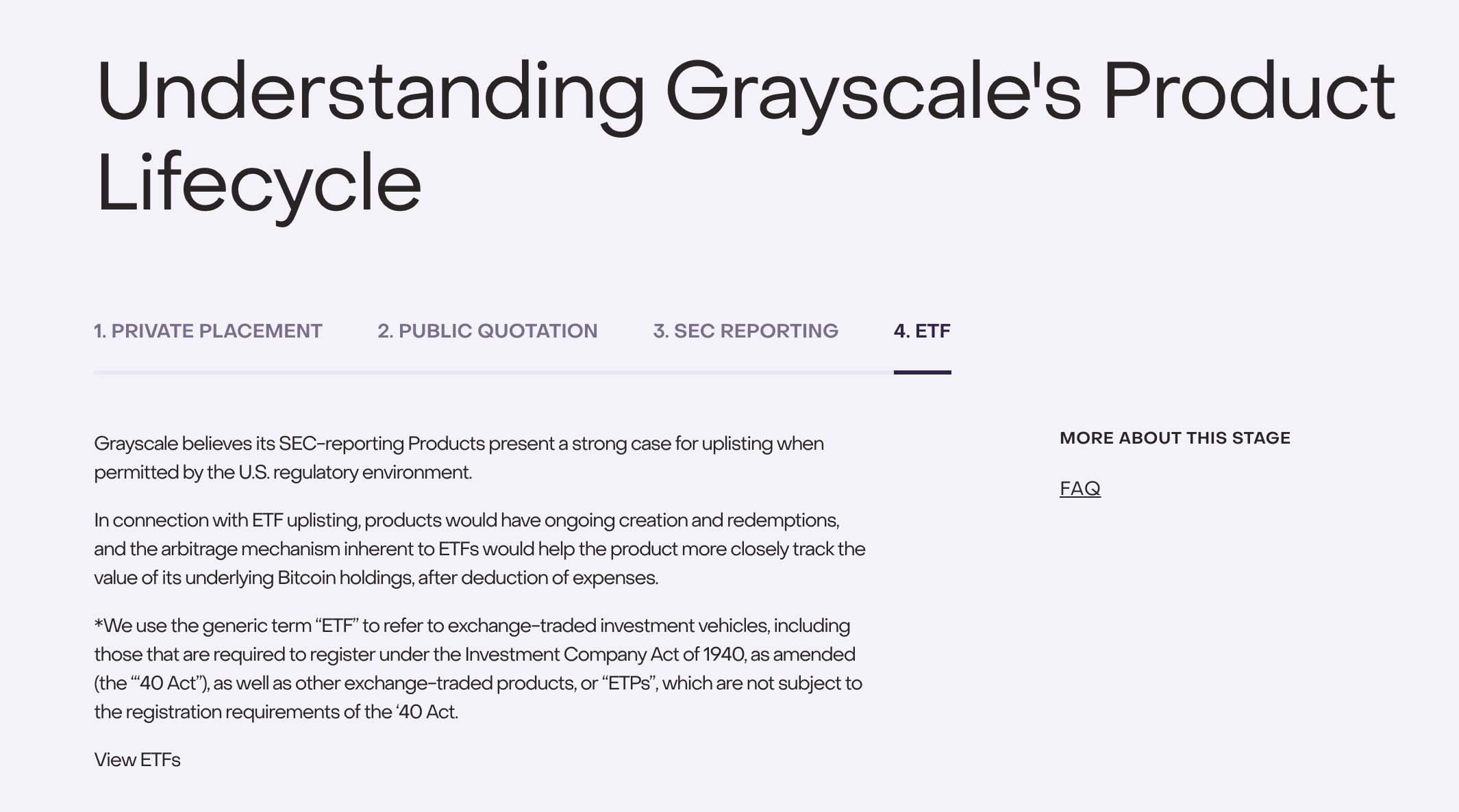
In addition to single-asset trusts, Grayscale also offers diversified basket funds that hold multiple cryptocurrencies, which serve as valuable references for investment analysis. Apart from ETFs, Grayscale’s trust products currently go through three main phases:
-
PRIVATE PLACEMENT: Products are initially launched via private placement, available only to qualified investors. Shares purchased privately are subject to a one-year lock-up period. Currently, the Grayscale Sui Trust and Grayscale Lido DAO Trust fall into this category.
-
PUBLIC QUOTATION: In this phase, shares are publicly quoted and accessible to all investors. However, due to the absence of an ongoing share redemption program, trading prices may deviate—either at a premium or discount—to the net asset value of the underlying holdings. MANA, GLNK, DEFG, and others are currently in this stage.
-
SEC REPORTING: These products are filed with the U.S. Securities and Exchange Commission (SEC), marking Grayscale as the first firm to do so. SEC reporting enhances transparency, increases disclosure requirements, and subjects the products to additional regulatory oversight. ETCG, ZCSH, HZEN, and others belong to this group.
Long-Term Performance Lags Behind BTC
According to reports, Grayscale had a significant impact during the 2020–2021 bull market, substantially growing assets under management in its Bitcoin Trust and attracting many institutional investors into the crypto space. However, while other tokens included in Grayscale trusts showed varied short-term performance during that period, none outperformed BTC over the long run.
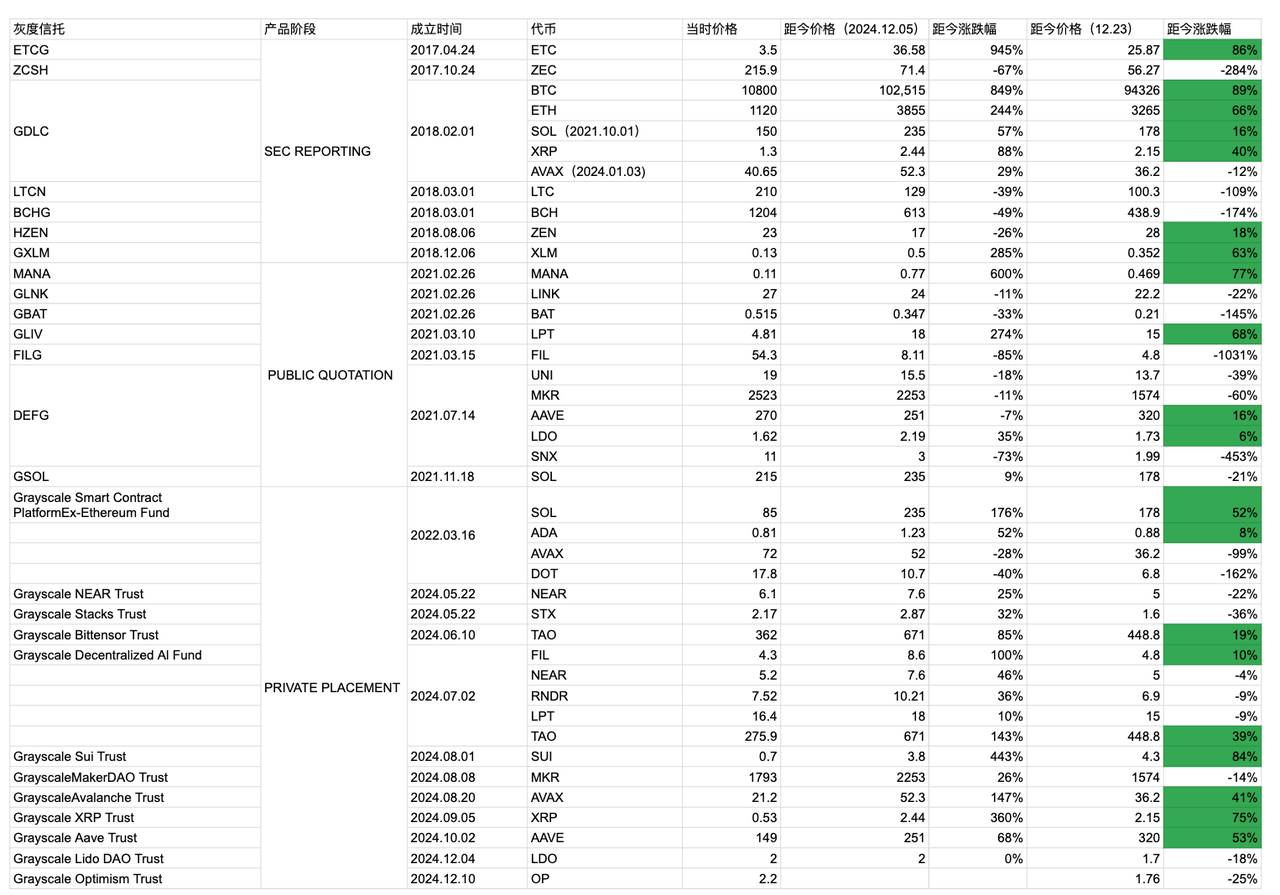
To evaluate fund returns, we compiled token prices at the time each Grayscale trust was launched and compared them with prices on December 23, producing the chart above. Historically, most Grayscale trusts were introduced in 2018 and 2021—periods that coincided with peak or late-stage bull markets. This timing may be attributed to the lengthy product development cycle and the need for market maturity before launch. Now in December of this year, Grayscale has begun launching new trusts again—will this break the pattern of entering at cyclical highs?
In terms of investment returns, only about 48% of Grayscale’s trusts—including BTC and ETH—have delivered positive long-term returns, slightly below a random coin toss. Moreover, their overall return significantly trails BTC, resulting in negative expected value (EV) over time.
In the short term, some tokens did experience strong rallies following trust announcements—but most of their gains occurred prior to the official launch. Even after a recent rebound, XRP has not surpassed its previous all-time high. After three consecutive days of gains, ZEN barely maintains an 18% return. While certain star tokens reached new peaks post-launch, their annualized returns over extended holding periods—such as seven years—are often below 10%. That said, entry timing plays a crucial role: if "Grayscale概念股" (tokens anticipated for inclusion) are accumulated during bear markets, nearly all outperform average bull market gains. Keeping an eye on currently dormant assets may reveal promising opportunities for next year.
Grayscale-held tokens carry different implications across market cycles. In this sense, there is indeed merit to the so-called “Grayscale effect.”
Join TechFlow official community to stay tuned
Telegram:https://t.me/TechFlowDaily
X (Twitter):https://x.com/TechFlowPost
X (Twitter) EN:https://x.com/BlockFlow_News
 Foresight News