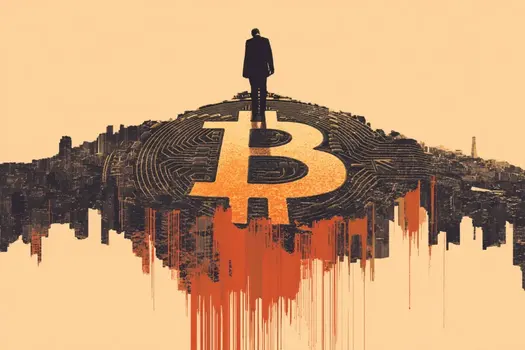
What happens if you坚决ly refuse to buy Bitcoin?
TechFlow Selected TechFlow Selected
What happens if you坚决ly refuse to buy Bitcoin?
This game, whether you like it or not, forces everyone to participate as long as you're part of society—it's inescapable for anyone.
 Navigating Web3 tides with focused insights
Author: Cai Leilei

I came across an interesting viewpoint: Bitcoin has nothing to do with ordinary people like us—only if you get involved does it become relevant. If you don't step in, then it's just a closed circle of mutual trading; whether it wins or loses, rises to $1 million or $10 million per coin, it doesn't matter to you because it’s merely a zero-sum gambling arena.
Is that really true? Whether it's Bitcoin, gold, or real estate in Beijing, Shanghai, Guangzhou, and Shenzhen—they are all essentially mechanisms for participating in the redistribution of wealth. If I buy at $1 and you buy at $1 million, haven’t I effectively taken ten years of your labor? You say you won’t buy. Fine, you can choose not to buy property in first-tier cities, or anything at all. But then, in what form will your assets be stored? Cash? Over the past 20 years, if you held cash while others bought houses, was your labor truly not expropriated? You’re wrong. When the gears of fate start turning, whether you actively participate or not, you’ll still be dragged into it.
The world's resources are finite. They get distributed among individuals through various vehicles and rules. For example, we work and create value for society—that’s participation in distribution. Those who generate greater value claim larger shares, while those who contribute less or stay idle end up being carved out. Even if you don’t spend money, keeping the same amount in hand doesn’t mean you’re safe from this slicing process. Money is simply a way of calculating one’s share of social resources. Suppose there’s only 10,000 yuan total; if you hold 1 yuan, you possess a voucher redeemable for 1/10,000 of societal resources. But what if the state finds it hard to seize your money directly, so instead opens a new game and starts printing more? The total supply becomes 100,000, then 1 million. They don’t need to take your money—your money loses value anyway. Why? Because under unchanged real resource conditions, your purchasing power drops to 1/100,000 or even 1/1,000,000 of total resources.
This is why I say the absolute value of money means little—it’s your proportion relative to the total that determines how much you can actually acquire. In agrarian civilizations, people tilled the land with hoes, earning their share by creating social wealth. But in industrial civilization, someone using efficient tools might accomplish the work of 1,000 people and thus grab 1,000 shares. Is that unfair? No—it’s simply that you lack effective tools to compete, so you get taken.
This is the “creation logic,” which many understand and accept: yes, he takes 1,000 shares, but he contributes 1,000 times more to society—it’s fair. However, Bitcoin operates on a different logic—one of finance, anticipation, consensus, risk, and equity ownership. Given our history of misconceptions and inadequate financial education, especially around profiting from judgment rather than labor, many misunderstand and resent this model, calling it unfair.
But it’s actually simple: if something is desired by everyone—no matter what it is, even if it’s just a painting used for showing off—and you realize early that demand may grow, and later see a surge in buyers, shouldn’t that foresight be rewarded? Of course—because you also bore the risk of it becoming worthless if nobody else wanted it.
So here’s the deal: if Bitcoin gains broader adoption in the future, people will pour their hard-earned money into this system to participate in this redistribution of wealth. And as they channel wealth into it, other asset pools inevitably bleed out. Can you grasp this? Imagine only two investment arenas exist: stock markets and crypto. As wealth increasingly flows into crypto, capital drains from equities—wouldn’t stock prices plummet across the board? Aren’t those who picked the wrong pool seeing their wealth transferred away? Even if you don’t play and just hold cash, you're still passively playing. In an ever-expanding system, not grabbing is losing; grabbing too slowly is still losing.
So is it just a "mutual slashing among insiders"? Absolutely not. New wealth continuously enters—how could this be mere internal cutting? Bitcoin is a measuring stick: your allocation of incoming fiat currency depends precisely on your share of the total bitcoin supply. It defines your claim over newly injected funds. You argue it creates no new value? Then I’d have to start explaining the worth of being the world’s first and largest trustless, decentralized, peer-to-peer value transfer system. Think about it: how much is the internet worth? If you were an original shareholder of the internet—or of SWIFT—how many times would your shares have multiplied over decades? You might already be the richest person on Earth.
You can choose not to buy Bitcoin, not to buy any asset. But remember: cash itself is an asset. Holding cash means you’re using your share of total societal wealth to participate in resource allocation—just like holding any other asset. The difference lies here: some assets accumulate growing consensus, drawing others’ wealth toward you; others lose consensus, causing your wealth to flow elsewhere.
This game forces participation regardless of willingness. As long as you're part of society, you're in—there's no escape.
Join TechFlow official community to stay tuned
Telegram:https://t.me/TechFlowDaily
X (Twitter):https://x.com/TechFlowPost
X (Twitter) EN:https://x.com/BlockFlow_News