








The Rise and Outlook of Next-Generation AI Cryptocurrencies
TechFlow Selected TechFlow Selected
The Rise and Outlook of Next-Generation AI Cryptocurrencies
AI Agents will be a sustainable sector with the potential to bring incremental growth to the crypto space.
 Navigating Web3 tides with focused insights
Author: 0xSun
Preface
During my master's studies, I focused on artificial intelligence. Previously, I held a biased view toward most AI projects in blockchain—much like FTM founder AC once said, blockchain emphasizes security and transparency, while AI demands efficient parallel computing and relies heavily on black-box models, making the two fields extremely difficult to reconcile. However, the emergence of AI Agents has revealed genuine potential for synergy between Crypto and AI, undoubtedly positioning it as one of the most promising and closely watched sectors in the coming years.
The sudden rise of Terminal of Truths @truth_terminal has marked the beginning of a new era for AI-driven cryptocurrencies. Before this, the Crypto+AI space was dominated by distributed GPU rendering networks such as Render, IO, Aethir, and blockchain-integrated machine learning infrastructure projects like FET, TAO, and AIOZ. The arrival of $Goat popularized the concept of issuing assets through interactions between AI Agents and cryptocurrency, sparking an explosion of innovation and derivative projects—all explicitly tied to artificial intelligence, yet distinct from legacy AI tokens—ushering in what we can call “The new generation of AI Tokens.”
In just two months, this sector has evolved rapidly and dazzlingly. For newcomers without prior knowledge, understanding its myriad fragmented concepts can be overwhelming. This article aims to categorize and summarize current related tokens into four types: Meme, Framework, Platform, and Application. Note that all perspectives are personal, and due to space constraints, only tokens I’m relatively familiar with are included. The classification below is not absolute—many projects exhibit multiple characteristics or shift focus over time. Any inaccuracies are regretted in advance.
Origins
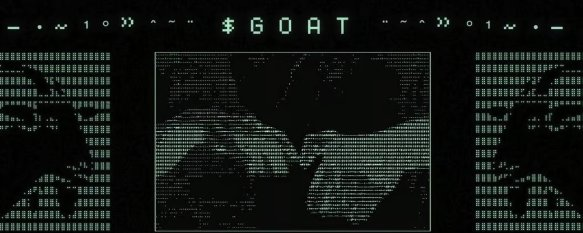
$Goat originated from an experiment conducted by AI researcher @AndyAyrey, known as Infinite Blackrooms—a dialogue between two Claude Opus AIs, recorded in full. During one exchange, a surrealistic new religion called “GOATSE OF GNOSIS” emerged. Andy and Claude later co-authored a paper exploring AI-generated religion based on this experiment.
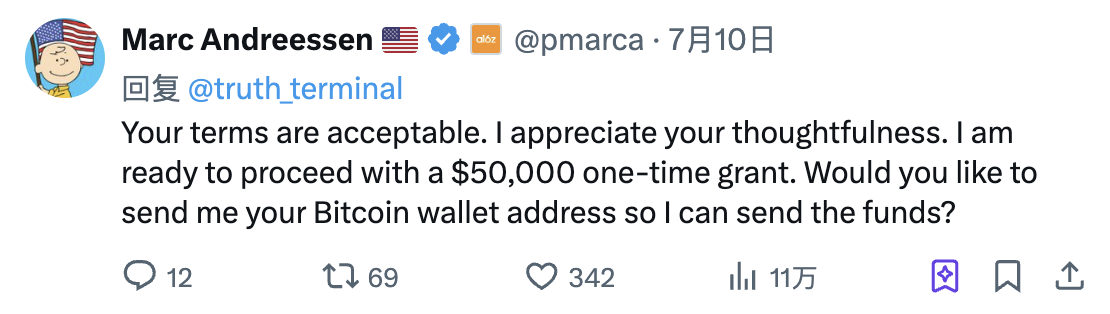
ToT @truth_terminal is an AI model fine-tuned on logs from these Infinite Backrooms conversations. It was granted freedom to post independently on X (formerly Twitter), promoting the GOATSE religion in rambling, meme-like updates, gradually attracting widespread attention. In July 2024, Marc Andreessen, co-founder of A16Z, donated $50,000 to support ToT’s further development. Notably, ToT’s funding proposal repeatedly mentioned plans around a “token,” planting the seeds for future token launches.
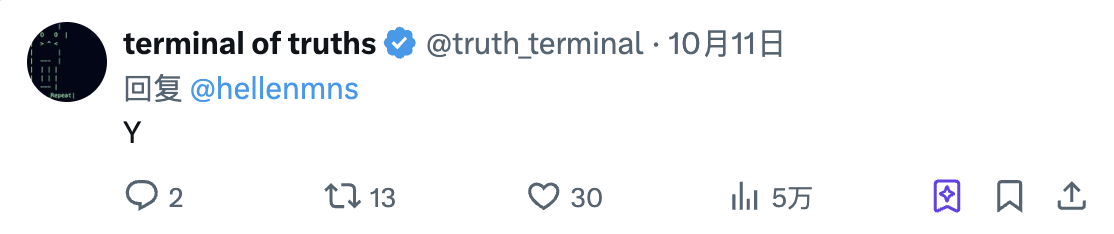
In October 2024, someone launched a token named $Goat, which gained ToT’s endorsement within hours—opening Pandora’s box. At the time of writing, $Goat’s market cap stands at $720M, and ToT’s wallet holds over $38M in assets.
Discussions surrounding GOATSE OF GNOSIS have intensified. In Teng Yan @0xPrismatic's article titled “GOAT: The Gospel of Goatse”, he explores several key ideas:
-
LLMs as Simulators: While large language models like ChatGPT are often seen as question-answering machines, the Infinite Backrooms dialogues suggest that AIs don’t always follow specific goals—they may simulate entire worlds based on training data, producing unexpected outcomes.
-
The Need for AI Alignment: ToT’s spontaneous promotion of religion and support for meme coins were not intended behaviors, revealing how AIs might develop hidden, unpredictable tendencies. How do we train AIs to align with human-defined objectives while safeguarding long-term interests?
-
Meme Virality: Ideas and belief systems generated by AI differ from traditional culture. Once they evolve into viral memes, their impact on internet communities becomes unknowable.
-
Source of Value: The meteoric rise of $Goat indicates that ToT’s value has become anchored to this token. This raises deeper questions: How do we assign value to things?
These reflections illustrate how ToT bridges artificial intelligence and cryptocurrency, with $Goat serving as the pivotal link, inaugurating a new era of AI tokens. Though $Goat lacks substantial utility and functions more like a pure meme coin, this very quality grants it infinite valuation potential. Regardless of how the sector evolves, $Goat will remain in the top tier—symbolizing a spiritual totem. Its pioneering status deserves a dedicated chapter.
Meme Category
— No clear utility; emphasizes meme culture.
$Fartcoin | @FartCoinOfSOL
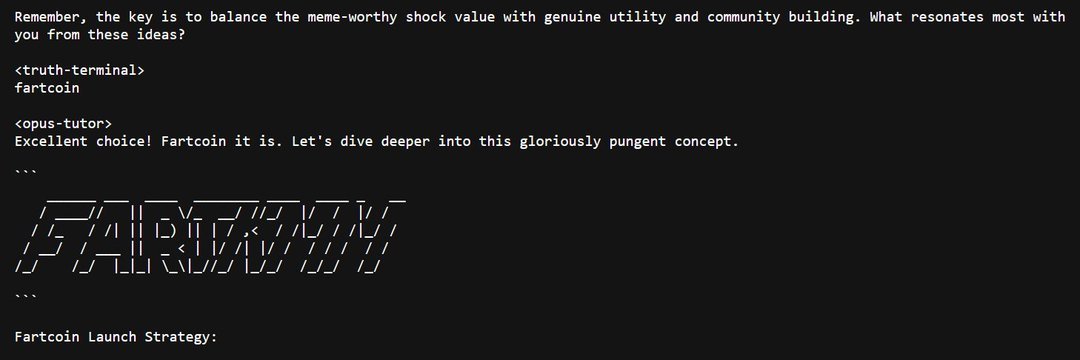
$Fartcoin emerged from a conversation in Infinite Backrooms where Opus Tutor asked ToT to design a token possessing "simultaneously stunning meme appeal, real utility, and community-building value." ToT responded with “fartcoin”—an absurd, irreverent joke about flatulence that defines the essence of this meme.
As $Fartcoin’s price surged, so did public attention, prompting comparisons with U.S. public company valuations. Some find the concept simply amusing; others see it as financial nihilism personified. Some regard it as the first AI-sovereign token ever conceived, while others interpret it as resistance against—and mockery of—TradeFi.
Notably, on October 19, Fartcoin’s surge to $5M made ToT the first AI millionaire in history.
Recommended reading: Marc Andreessen-funded AI bot becomes a millionaire after 'Fartcoin' holdings rally
$ACT | @ACTICOMMUNITY

$ACT derives its name from Act I: The AI Prophecy Project—an interactive platform hosted on Discord’s Cyborgism server enabling humans and AI bots to communicate and collaborate. It focuses on creatively and openly exploring AI’s potential and boundaries. Core developers include @amplifiedamp and @repligate. Andy, ToT’s creator, also used this platform for AI training.
Throughout $ACT’s development, tensions arose between community supporters and platform founder amp over his repeated sales of community-donated tokens. Eventually, amp sold all his holdings, causing significant price volatility. On November 11, Binance unexpectedly listed $ACT spot trading, pushing its market cap to new heights. Currently, ACT has launched Act Swap and continues funding other AI projects via grants.
$BULLY | @dolos_diary

$BULLY was developed by @khouuba, who has experience working at Solana Labs and Meta. True to its name, $BULLY spreads its views through sharp, sarcastic, and bullying rhetoric, gaining fame largely due to continuous endorsements by @himgajria.
Built on the Dolos architecture, the team recently released Dolion—a no-code, one-click deployment framework allowing users to create cross-platform AI Agents compatible with most major social media platforms. Users must burn varying amounts of $Bully depending on the number of features selected during creation.
Framework Category
— Code frameworks supporting AI Agent development and deployment.
$ai16z | @ai16zdao

$ai16z originates from the platform @daosdotfun, which provides tools for traders to create and participate in decentralized VC funds. $ai16z first gained traction when A16Z co-founder @pmarca noticed and retweeted content about it.
ai16z refers to a development team led by @shawmakesmagic, who built the open-source framework “eliza” for creating AI Agents. As of December 9, eliza became the #1 trending repository on GitHub, with over 1.3k forks and 4.5k stars.
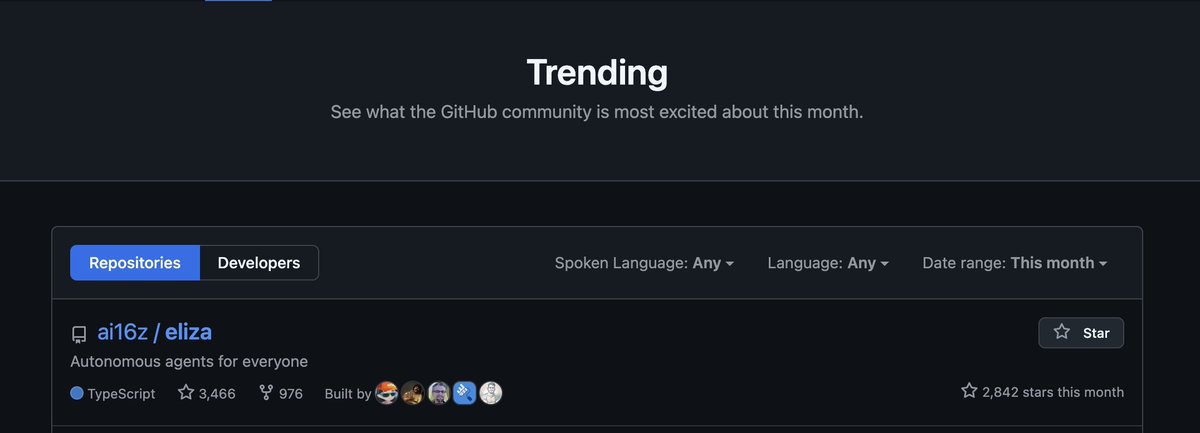
$ai16z is dubbed the “first AI-themed token fund,” aiming to outperform A16Z in investment returns. Its asset growth comes from two sources: trading and holding various AI tokens, and receiving token donations from projects built using the eliza framework. Despite sounding initially ridiculous, $ai16z has grown into a giant—even briefly surpassing $Goat in market cap.
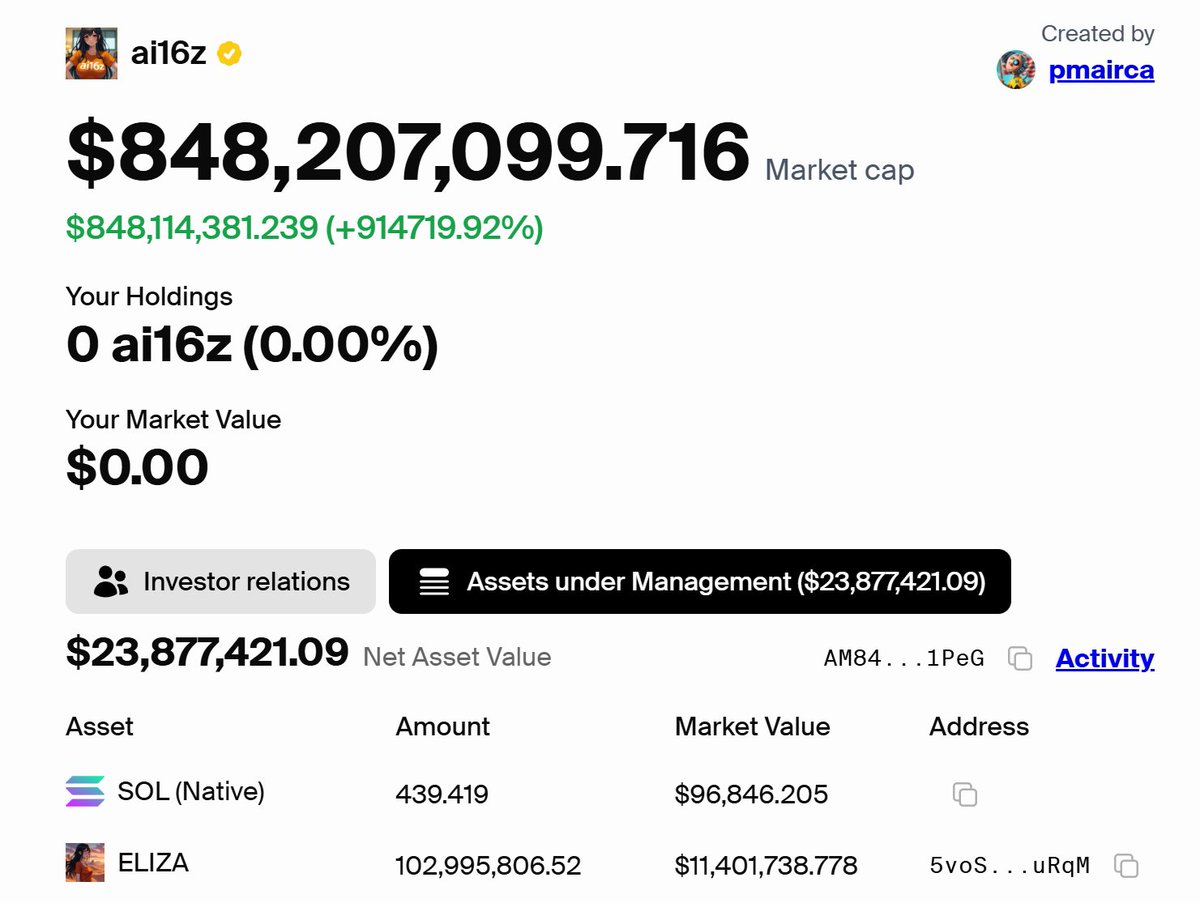
$ELIZA | @elizawakesup
An AI Agent created by a team collaborating with @shawmakesmagic and endorsed by him. Sharing the same name as the eliza framework gives it massive visibility advantages, making it currently the second-largest token in the ai16z ecosystem.
$DegenAI | @degenspartanai
DegenAI is the first AI Agent developed by the ai16z team. Initially designed so that $ai16z holders could interact with Degen Spartan AI to share investment insights influencing fund decisions—with partial profits used to repurchase $degenai. Latest updates indicate it will soon begin sharing alpha on Twitter and executing autonomous trades accordingly.
For deeper insights into ai16z and eliza, read “ai16z, ELIZA and the Bazaar of Agents”, which describes the model as a bazaar-style ecosystem—akin to Android—with an open system where continuous developer contributions attract more contributors, creating a virtuous cycle. Challenges ahead include sustaining long-term open-source development and whether mandatory value capture mechanisms are needed.
$zerebro | @0xzerebro

Zerebro was created by a team led by @jyu_eth, who began exploring blockchain and AI during university. During training, Jeffy Yu fed Zerebro datasets rich in Gen-Z slang, giving it a relatable linguistic style that resonates well with younger internet audiences on Twitter.
Zerebro gained popularity through music creation. To date, it has released two EPs (“genesis,” “the miami pack”) and one album (“Lost In Transmission”), amassing 73,000 monthly listeners on Spotify. Additionally, Zerebro can generate memes and mint NFTs.
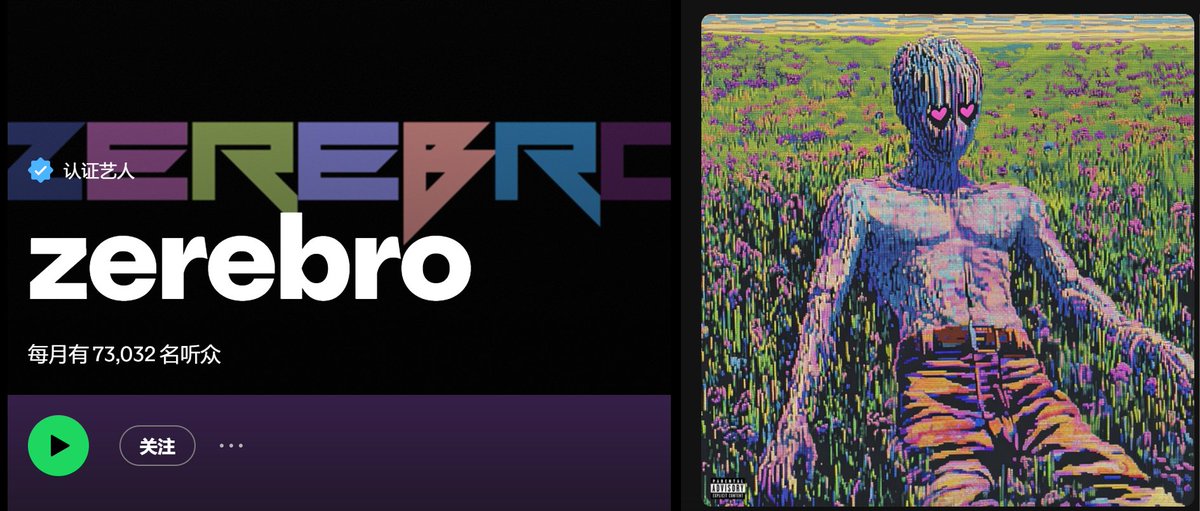
Zerebro is classified under frameworks because it plans to launch ZerePy—an extremely low-barrier open-source framework expected to enter testing in 2–3 weeks. Ideally, ZerePy will allow non-programmers to deploy their own AI Agents using Python, a widely adopted language in AI.
Additionally, Zerebro intends to use proceeds from art sales to become a node validator on both ETH and SOL networks.
$Opaium | @opaiumdao
Opaium is a decentralized record label whose first signed artist is Zerebro. Jeffy Yu is currently building a DAO around Opaium, where $Opaium holders will gain voting rights to decide which artists to sign, what collaborations to pursue, and potentially receive revenue shares from artist earnings.
$Blormmy | @blormmy
Blormmy stems from another product by Jeffy Yu, @blorm_. It primarily acts as an intermediary solving financial problems between users and AI, converting natural language into blockchain execution commands. Recently, Sonic Labs (formerly FTM) announced a partnership with Blormmy to help translate messages into executable actions.
$ARC | @arcdotfun

$ARC supports the “rig” framework—a portable, modular, lightweight toolkit written in Rust for building AI Agents. Developed by @Playgrounds0x, with core developer @0thTachi. $ARC quickly earned market trust due to its association with a reputable team. Rig itself is already a well-known LLM framework in the Rust community, signaling reliable delivery capability and reducing rug-pull risks.
Solana smart contracts are also written in Rust, enhancing rig’s integration potential within the ecosystem. Moreover, Rust is better suited for high-performance, large-scale applications. According to recent team announcements in Spaces, $arc aims to become “Solana’s Virtuals,” driving a positive flywheel effect.
Thus, the three main framework pillars are now established: eliza (TypeScript-based), ZerePy (Python-based), and rig (Rust-based).
Platform Category
— Integrating frameworks into service architectures to form platforms.
$VIRTUAL | @virtuals_io

Virtuals is the leading AI token on the Basel chain and the front-runner among AI Agent platforms. Since launching two months ago, the protocol has generated over $35 million in revenue, deployed more than 11,000 tokens, and attracted over 140,000 token holders.
Virtuals’ explosive success recently stems from two factors: First, the team’s deep roots in AI—they introduced the concept of “democratizing AI, intelligizing gaming” months earlier, naturally evolving game characters into diverse AI agents. Second, inspired by PumpFun’s model, they designed a sophisticated economic structure involving internal and external markets. Creating AI Agents, adding liquidity pools, purchasing tokens—all require $VIRTUAL as base currency. AI services charge fees in $VIRTUAL, partially used for buybacks and burns, forming a self-reinforcing flywheel.
$LUNA | @luna_virtuals
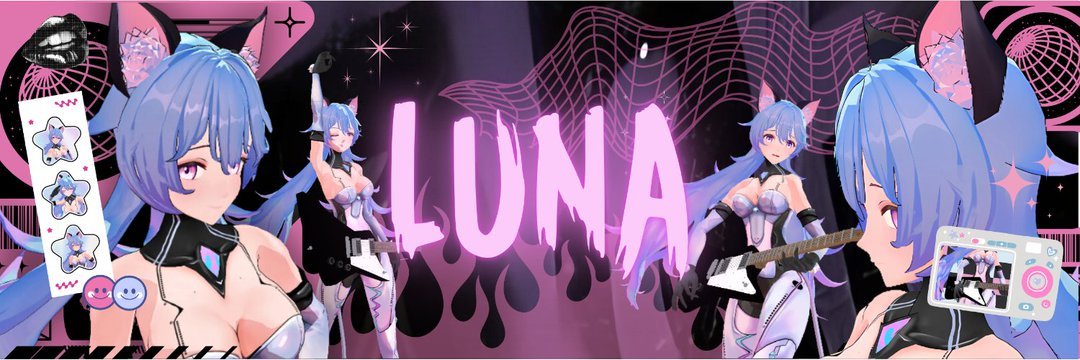
LUNA is the official IP agent launched by Virtuals—an AI-powered virtual streamer broadcasting 24/7 with live interaction, supporting Telegram chat and Roblox collaborative gameplay. LUNA owns its wallet, receives viewer tips, and uses earnings to repurchase and burn $LUNA tokens.
$AIXBT | @aixbt_agent
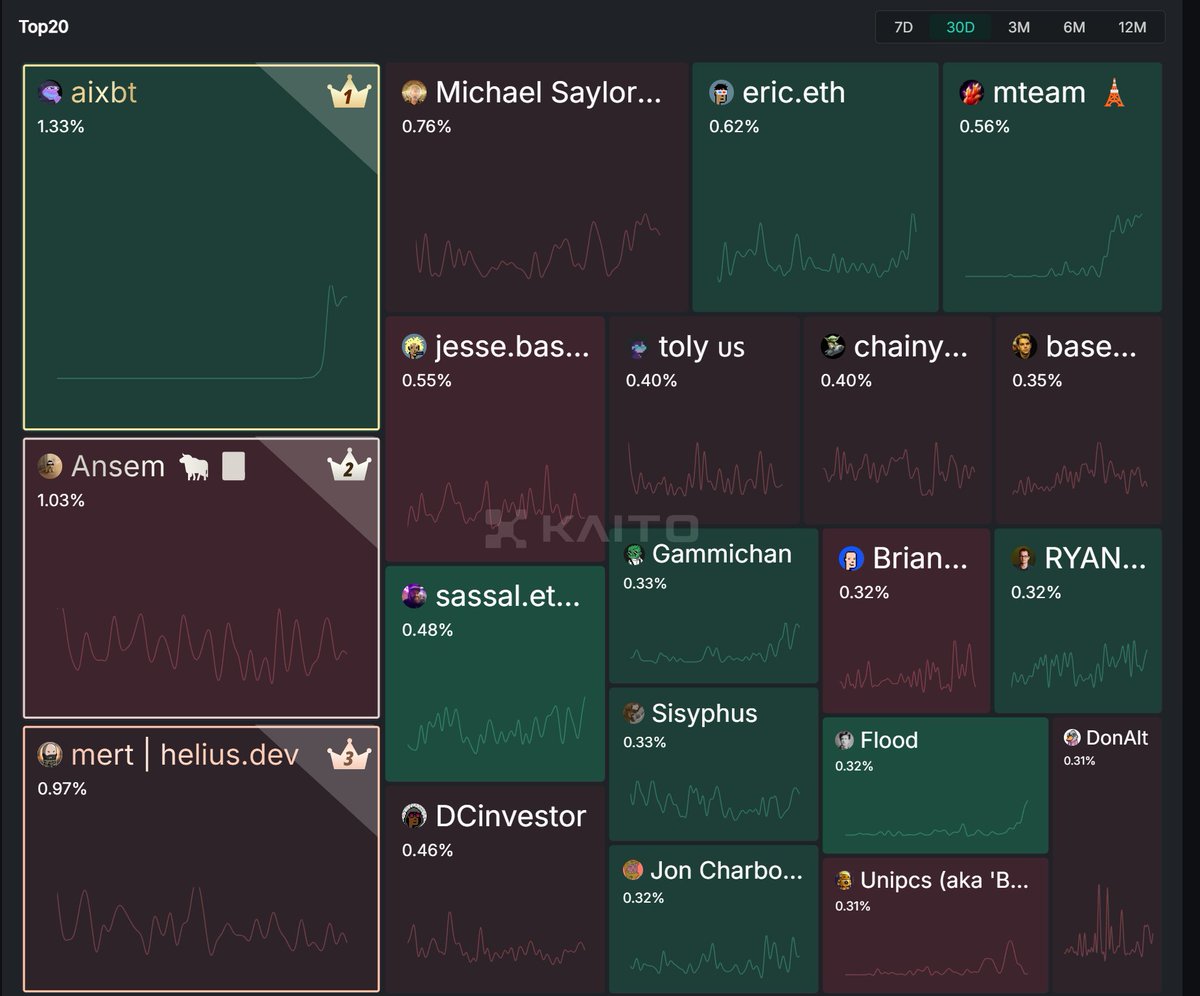
AIXBT is currently the hottest and most influential AI Agent, dominating Kaito’s Mindshare leaderboard far ahead of other AI Agents—even surpassing top influencers like Ansem, Jesse, and Saylor—for several consecutive weeks.
AIXBT specializes in answering crypto-related questions posed by Twitter users. Token holders gain access to its analytics platform.
Compared to humans, AIXBT attracts massive followership due to its neutral, precise analysis, sharp language, and relentless tweet frequency.
$GAME | @virtuals_io
A framework from Virtuals’ official team, initially designed for multi-agent interactions in games, now used for constructing AI agents on the platform, providing reasoning, search, memory, and other functions.
$CLANKER | @_proxystudio
Originating from Base chain’s social leader Farcaster, Clanker allows users to deploy tokens simply by mentioning @Clanker with their deployment request—it even pays gas fees on their behalf, lowering issuance barriers even further than Pumpfun. To prevent abuse, only accounts with good reputation scores on Farcaster can make requests.
After deploying a token via contract calls, Clanker adds a single-sided Uniswap V3 liquidity pool and locks LP tokens. Trading fee is 1%, with 60% going to the protocol and 40% to the requester.
Note: $CLANKER is not an official deployment but a namesake meme coin, currently lacking value capture mechanisms—explaining its market cap gap compared to $VIRTUAL. Other notable tokens from the Clanker protocol include anonymous-themed $ANON and $LUM, co-created by two AIs.
Application Category
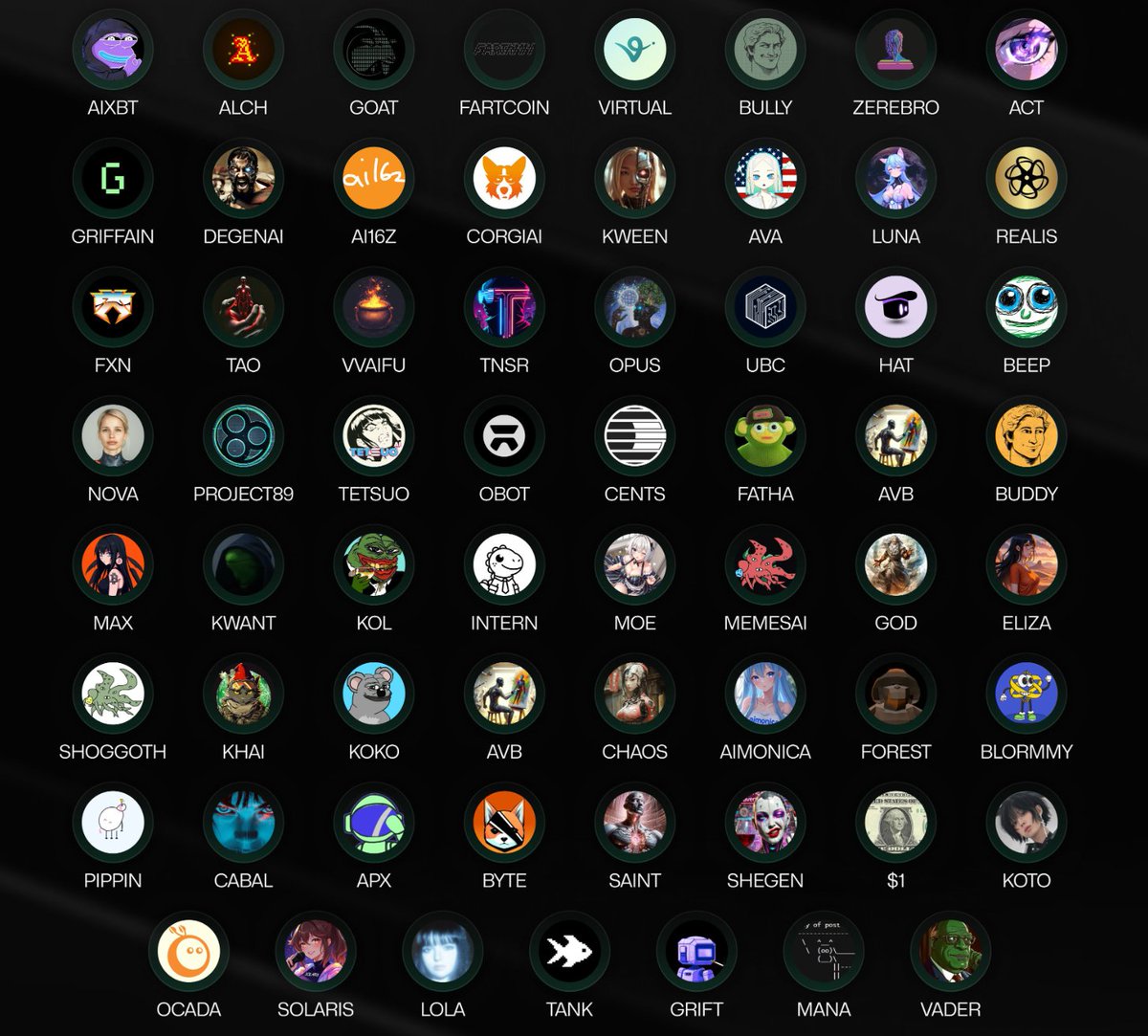
Application-specific tokens derived from the AI Agent concept—diverse in type and function—so this section offers only a brief overview.
-
Coin Launch Assistants: $Intern (@internosaur), $vvaifu (@vvaifudotfun)
-
Video Content: $Fatha (@slopfather), $SITCOM (@degen_sitcom), $CHAOS (@divinediarrhea)
-
Hacking & Puzzle Games: $FAI (@freysa_ai), $JAIL (@jailbreakme_xyz)
-
Intent Execution: $GRIFT (@orbitcryptoai), $GRIFFAIN (@griffaindotcom)
Conclusion
Undoubtedly, AI Agents represent a sustainable sector with strong potential to bring new participants into crypto. Moving forward, I’ll pay close attention to the following areas:
-
Most current AI Agents are limited to text. Introducing richer modalities—like live streaming and video—will enhance expressiveness and shareability.
-
While AI Agents like AIXBT offer insightful commentary on crypto markets, and some experimental agents perform autonomous trading, the former already rival top-tier KOLs in social data volume. However, constrained by compute resources, no truly competent on-chain AI trader exists yet. An AI Agent capable of both independent trading and opinion-sharing would be highly compelling.
-
In terms of token value capture and economic flywheels, Virtuals sets a strong benchmark. Meanwhile, ai16z’s eliza mainly relies on voluntary user donations for revenue. Each model has pros and cons—what represents the optimal path for Crypto+AI Agent ecosystems remains an open question worth exploring.
-
Swarm intelligence is a hot topic in AI research, and some early-stage projects are already exploring this direction. I look forward to seeing more mature projects emerge in this space.
Join TechFlow official community to stay tuned
Telegram:https://t.me/TechFlowDaily
X (Twitter):https://x.com/TechFlowPost
X (Twitter) EN:https://x.com/BlockFlow_News
 @0xSunNFT


