








The Battle for L1 Heats Up as Sui, the New Star Among Public Blockchains, Leads the "RWA Spring"
TechFlow Selected TechFlow Selected
The Battle for L1 Heats Up as Sui, the New Star Among Public Blockchains, Leads the "RWA Spring"
Web3's new wave of brands sets sights on the $30 trillion RWA market.
 Navigating Web3 tides with focused insights
Author: Wenser, Odaily Planet Daily
Amid expectations surrounding Donald Trump's return to office and a series of potential favorable U.S. policies, the cryptocurrency market has entered another peak trading period. Bitcoin (BTC) briefly surged past $107,000. Beyond heavy investments in BTC and ETH ETFs, numerous investment institutions are actively seeking new sources of value growth.
At the same time, as predicted by Binance founder CZ, the altcoin season has arrived. Alongside established tokens and meme coins, Layer 1 (L1) blockchain tokens are also experiencing strong upward momentum—particularly SUI, which has consistently hit new highs. The Sui ecosystem not only maintains solid fundamentals in DeFi but is also thriving in the meme coin sector. Moreover, unlike other L1 blockchains confined primarily to the crypto space, Sui’s recent moves in the real-world assets (RWA) domain open up new possibilities for attracting external liquidity and attention beyond the crypto-native audience.
On December 13, Sui officially announced a collaboration with Ant Digital Technologies and its Web3 technology brand ZAN to bring ESG-related RWAs onto the Sui network. One party is an emerging star among public blockchains; the other, a pioneer in digital asset innovation. This partnership signals the beginning of an “RWA Spring” for tangible assets, bringing fresh opportunities to the crypto market. Odaily Planet Daily analyzes this development below.
The Best Reason to Choose RWA: A Future Market Worth Up to $30 Trillion
The primary reason Sui and Ant Digital chose RWA as their strategic focus lies in its position at the intersection of traditional finance (TradFi) and decentralized finance (DeFi), offering vast market potential. According to data from RWA.xyz, the current on-chain RWA market exceeds $14 billion, while stablecoin assets have reached $201.77 billion, with 116 asset issuers. Yet, compared to future projections, this represents less than 1% of the total addressable market.
Global consulting firm McKinsey & Company stated that by 2030, the tokenized asset market (RWA) could reach $4 trillion, with many projects transitioning from pilot stages to large-scale deployment. Colin Butler, Polygon’s Global Head of Institutional Capital, previously noted that RWA represents a $30 trillion global market opportunity. High-net-worth individuals and private equity funds are expected to drive adoption, as tokenization brings liquidity and accessibility to historically illiquid asset classes. A prior research report by Tren Finance pointed out that if the RWA industry reaches a median projected value of around $10 trillion, it would represent over a 54-fold increase from current levels.
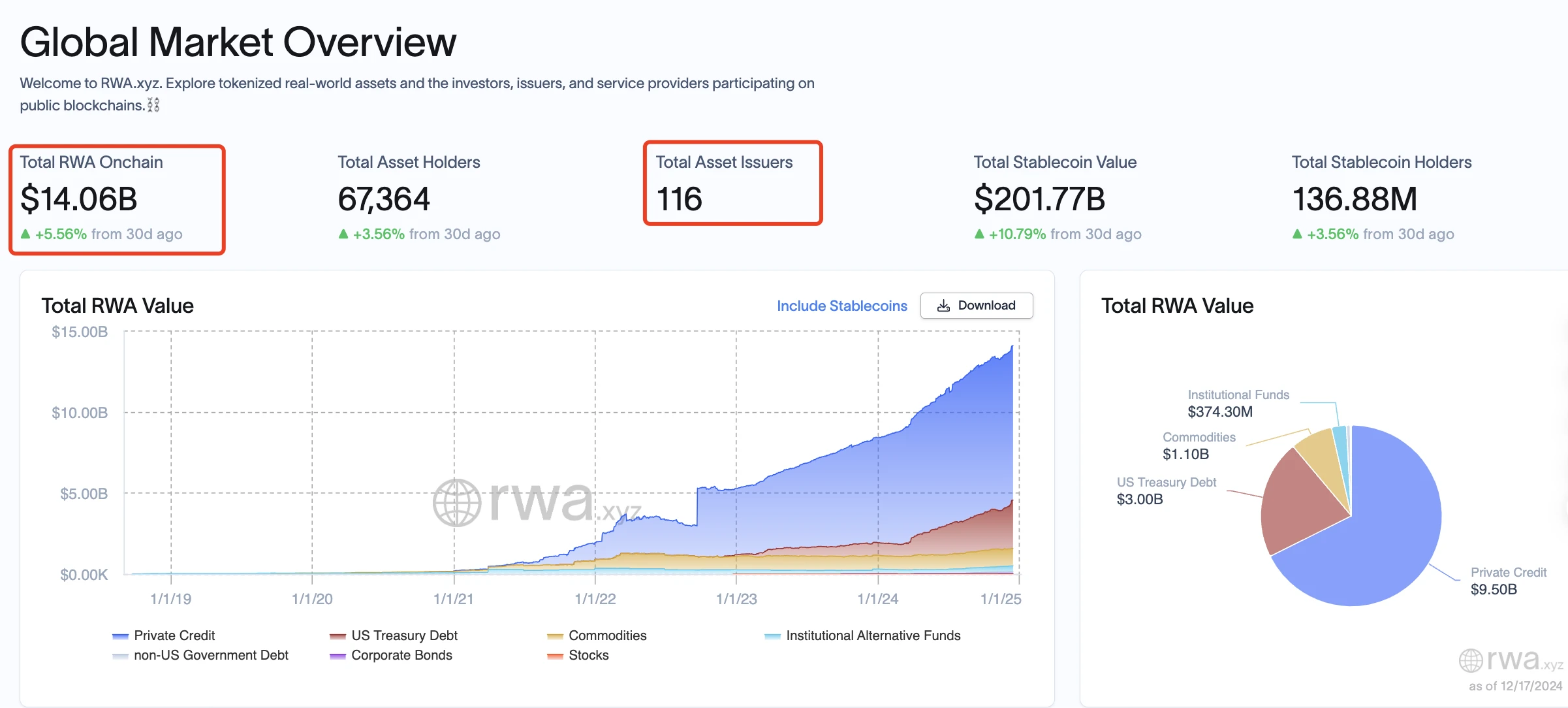
Information from RWA.xyz website
According to Bitwise’s "Top 10 Crypto Predictions for 2025," the RWA market is expected to reach $50 billion in 2025 as Wall Street institutions accelerate their entry, potentially triggering exponential growth thereafter. ParaFi Capital forecasts that the tokenized RWA market could grow to $2 trillion by 2030, while the Global Financial Markets Association projects it could reach $16 trillion. Such bullish market expectations have naturally drawn a wave of global institutional players:
-
Goldman Sachs’ digital asset platform has officially launched, helping the European Investment Bank issue a €100 million two-year digital bond. Goldman Sachs is also collaborating with traditional financial institutions on related services and plans to build its own private chain for asset tokenization.
-
Siemens Group issued a €60 million digital bond on-chain, marking its “first attempt in the RWA field.”
-
Financial giants including HSBC, JPMorgan Chase, and Citigroup are exploring U.S. Treasury tokenization to improve financial efficiency and settlement speed.
-
The U.S. Treasury RWA market has grown to nearly $3 billion, up almost 30-fold from $100 million at the beginning of 2023. Among them, USYC—a product co-launched by Hashnote and crypto custody firm Copper—has reached $880 million in size; BlackRock’s BUIDL fund has reached $560 million.
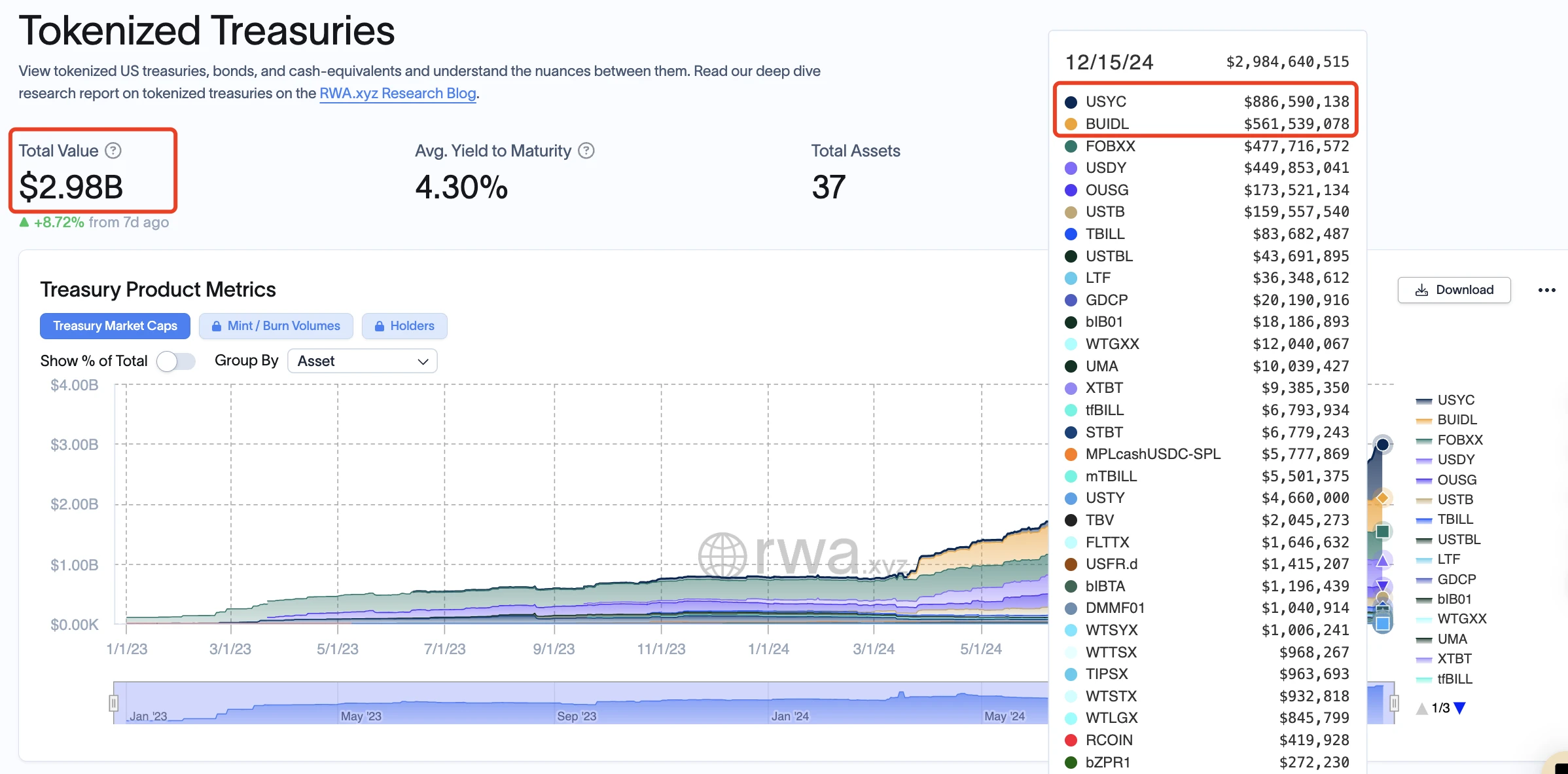
U.S. Treasury RWA market information
The collaboration between Ant Digital and Sui primarily aims to promote ESG-related RWA tokenization, expanding access to these assets for global investors. The underlying assets are renewable energy holdings from a Chinese solar materials manufacturer.
As a blockchain ecosystem whose total value locked (TVL) grew more than 14-fold to $14 billion this year and has gained support from major U.S. asset managers like Grayscale and VanEck, Sui views the RWA market as its “next growth frontier.” Jameel Khalfan, Head of Ecosystem Development at the Sui Foundation, said: “Tokenizing the ESG market is a significant leap forward for real-world assets. Through this collaboration, investors will gain access to an entirely new market—all operating on the ideal platform: Sui.”
Clearly, RWA has become a strategically vital sector jointly prioritized by blockchain networks and digital asset institutions, holding immense industry value.
Dual Drivers Behind RWA Growth: Inherent Advantages and Market Demand
More specifically, the strategic significance of the RWA sector manifests in three key aspects:
-
Asset transparency and transaction efficiency: By tokenizing physical assets and integrating them into blockchain networks, investors can deeply participate in market transactions leveraging on-chain data transparency and operational efficiency.
-
Enhanced liquidity for physical assets: With improved transparency and security, RWA enables fractional ownership, significantly increasing the digital liquidity of physical assets.
-
Bridging traditional and crypto markets: By introducing low-risk, high-return tokenized products, RWAs facilitate greater integration between tangible assets and investors across both traditional and crypto markets, injecting fresh liquidity into both ecosystems while unlocking value in real-world assets and providing higher-quality investment opportunities within crypto.
RWAs can represent many types of traditional assets, both tangible and intangible. In overseas markets, RWA has been dominated primarily by bonds and gold.
Why would Sui, a leading blockchain in the crypto space, choose Chinese renewable energy assets?
Industry experts point out: “This reflects China’s industrial strengths to some extent.” According to data from Qianzhan Industry Research Institute, China’s cumulative installed capacity in the new energy sector reached 1.57 billion kilowatts in 2023, with a five-year compound annual growth rate of 15.31%. From solar power generation to charging infrastructure and new-energy vehicles, new energy has become a defining feature of modern China. “Once converted into RWAs, these assets possess high potential and strong growth prospects,” the expert added.
In essence, the tokenization of physical assets through RWA will enable deeper integration between Web3 technology and digital assets, driving the digital transformation and revaluation of real-world assets.
Looking Ahead: New Pathways for Diversified RWA Market Development
Historically, RWA development has largely centered on fixed-income assets like U.S. Treasuries, resulting in relatively limited asset diversity and technological approaches. Thanks to the deep collaboration between Ant Digital and its Web3 brand ZAN with Sui, broader RWA tokenization is now being advanced, injecting new vitality into both traditional and crypto markets through technical support, ecosystem expansion, and capital inflows.
“Tokenization transfers traditional assets from low-liquidity environments into high-liquidity markets,” stated BiFinance Research Institute in its latest report. “Bringing high-quality ESG assets onto blockchain via this partnership empowers real industries and could become a new engine driving the next bull market.”
Prior to this, Ant Digital launched China’s largest on-chain new energy asset platform—the “Two Chains, One Bridge” system comprising the “Asset Chain,” “Trading Chain,” and “AntChain Trusted Cross-chain Bridge”—with over 12 million devices already connected. Its Web3 product ZAN, targeting international markets, has also gone live. Sui’s blockchain now boasts a total market cap of $13 billion and a TVL exceeding $18.9 billion. Following the announcement of the partnership, SUI’s price surged 10% within 24 hours, reaching a new all-time high.
Going forward, backed by Sui’s growing ecosystem, the joint RWA initiative is poised for a new phase of expansion. One thing is clear: the spring of the RWA market is fast approaching.
Join TechFlow official community to stay tuned
Telegram:https://t.me/TechFlowDaily
X (Twitter):https://x.com/TechFlowPost
X (Twitter) EN:https://x.com/BlockFlow_News
 Odaily






