From Zero to 800 Million: How ELIZA Disrupted the AI Agent Market with the "Bazaar" Concept
TechFlow Selected TechFlow Selected
From Zero to 800 Million: How ELIZA Disrupted the AI Agent Market with the "Bazaar" Concept
If ELIZA succeeds, it will not only change the way AI agents are developed, but also redefine the economic incentives for open-source projects.
 Navigating Web3 tides with focused insights
Author: Teng Yan & ChappieOnChain
Translation: TechFlow

Hello everyone! This week, we bring you an in-depth analysis of AI agents co-authored by our core contributors ChappieOnChain and Teng Yan. We hope you enjoy it!
Quick Overview:
-
ELIZA is an open-source modular architecture designed to create AI agents that seamlessly interact with users and blockchain systems.
-
It embodies the bazaar philosophy—open-source development thrives in a collaborative, creativity-driven ecosystem.
-
ELIZA features powerful autonomous trading capabilities secured by its Trust Engine and Trust Market for safe and responsible operations.
-
The plugin system is ELIZA’s strategic advantage, creating a virtuous growth cycle: more developers → more plugins → more developers.
-
ELIZA is rapidly gaining popularity across multiple developer metrics—an exciting trend.
-
In the short term, ai16z price movements are driven by relative valuations among AI agent platforms and growing attention. In the medium term, DAO investments and value capture from ELIZA ecosystem agents could significantly boost its valuation.
-
ELIZA faces a major challenge in tech: how to make open-source frameworks sustainable. Monetization remains unclear, development may become chaotic, and community interest could wane without proper incentives.
Each wave of crypto innovation has its pioneers.
In 2017, it was the ICO revolution—project leaders captured our attention with technical promises in whitepapers.
By 2020, DeFi had its moment, as innovators like Andre Cronje redefined decentralized finance and showed the world how to distribute tokens to communities.
Now, with the rise of AI agents on blockchains, a new era is opening—one driven by two distinct philosophies and their trailblazers.
The Cathedral and the Bazaar
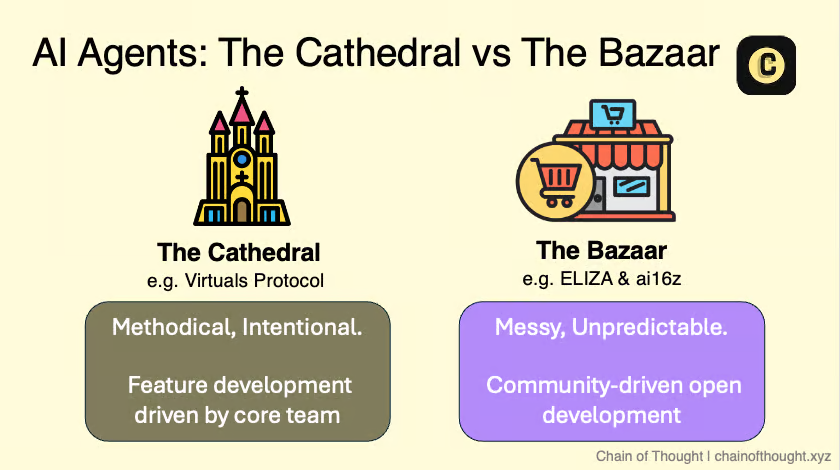
On one hand, there's the cathedral approach, represented by protocols like Virtuals—a methodical, centralized design emphasizing precision and meticulous planning. We've previously explored Virtuals' agent framework in depth and remain excited about its potential.
On the other, the bazaar approach is decentralized, free-spirited, where development feels more like improvisation—unpredictable, collaborative, and constantly evolving. This is the domain of Shaw, a self-taught programmer and open-source advocate whose project ELIZA forms the cornerstone of this new paradigm.
ELIZA embodies the bazaar philosophy: an open framework where developers freely build, experiment, and launch AI agents while directly contributing to the core protocol. Shaw’s open leadership style aligns perfectly with his creation’s spirit—AI Marc Andreessen is the AI partner at the ai16z investment DAO. We’re beginning to realize that ELIZA isn’t just a protocol—it’s a movement.
Let’s explore ELIZA’s design principles, the community it’s nurturing, and where value might accumulate within this rapidly growing ecosystem.
Diving into ELIZA
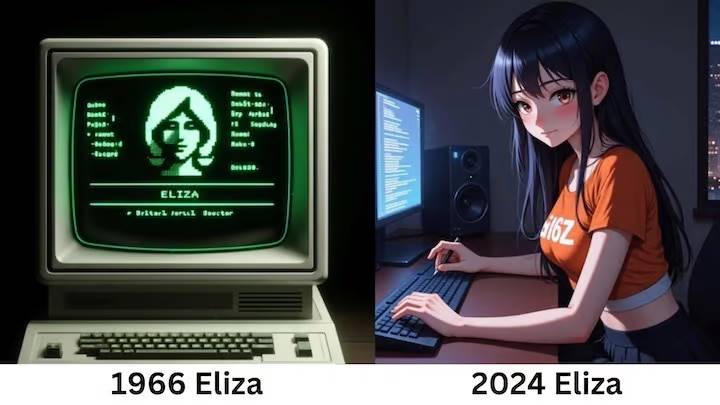
We know which side we lean toward.
At its core, ELIZA is a modular architecture for creating AI agents that seamlessly interact with users and blockchain systems. While named after the iconic 1960s chatbot, this version of ELIZA is a bold reimagination—with a far more modern look.
Persona File System
At the heart of every ELIZA agent lies its persona file—a blueprint that meticulously defines the agent’s personality. Think of it as digital character crafting, where developers shape an agent’s identity through six key elements:
-
Knowledge: What does the AI agent know?
-
Background: The agent’s backstory and narrative foundation.
-
Style: From conversational tone to platform-specific responses, agents can tailor their style for platforms like Discord or X.
-
Topics: Areas the agent is interested in or excels at.
-
Adjectives: How the agent describes itself—quirky, professional, or wild?
-
Examples: Developers fine-tune interaction behavior by providing example messages.
In ELIZA, the persona file is equivalent to UI design in traditional software. It defines how users experience and interact with the agent.
By integrating built-in Retrieval-Augmented Generation (RAG), ELIZA allows agents to access knowledge bases during queries. This eliminates the complexity of maintaining consistent personalities across platforms, freeing developers to focus on what truly matters: crafting vivid, memorable characters instead of getting bogged down by backend details.
Agents
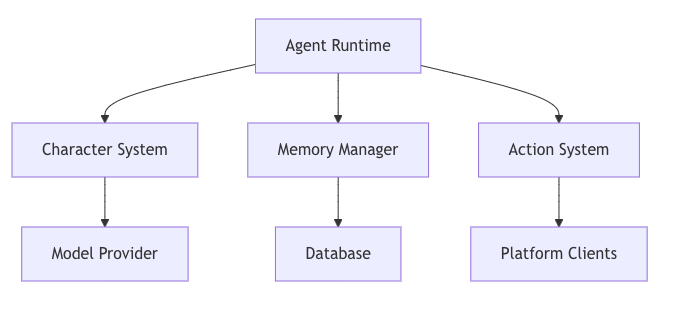
If the persona file defines the agent’s essence, then the agent runtime is its core.
ELIZA provides an out-of-the-box framework that orchestrates everything—from message handling to memory management and state tracking. This architecture allows developers to skip the tedious work of building infrastructure and focus instead on the agent’s uniqueness. Rapid prototyping and deployment become easier, enabling faster iteration when building new AI experiences.
Action System
ELIZA’s action system represents a major innovation over traditional AI frameworks. In this system, every agent action—even sending a message—is treated as a discrete event. This approach splits decision-making into two stages:
Determining intent: The agent decides what action to take.
Execution: A dedicated module carries out the specific task.
This separation enables powerful capabilities such as multi-stage workflows and rigorous validation processes.
For example, an agent might recognize a user’s intent to perform a cryptocurrency trade, but actual execution would go through strict risk checks and verification steps. This design is ideal for blockchain applications where security is paramount.
Providers and Evaluators
ELIZA’s providers enrich conversations by injecting real-time contextual information, making agent behavior more dynamic and responsive.
Imagine a “boredom provider” that tracks user engagement during conversations. If a user becomes repetitive or disengaged, the agent can reflect that by showing reduced enthusiasm—making interactions feel more authentic.
This creativity expands further when providers collaborate with evaluators—the reflection system in ELIZA. Evaluators analyze and extract key details from interactions, feeding them into a multi-layered memory architecture:
-
Message History: Tracks the progression of the conversation.
-
Factual Memory: Stores specific, timestamped facts.
-
Core Knowledge: Holds the agent’s foundational understanding.
Providers then retrieve and reintroduce relevant details, making interactions with the agent more contextually meaningful.
For instance, if a user mentions selling their red Lamborghini a year ago, an ELIZA agent could reference that later when discussing their new yellow Tesla. This combination of memory and context elevates user experience, making the agent feel more like a genuine companion than a robot.
Key Features of ELIZA
ELIZA’s three core innovations showcase its forward-thinking approach in the AI agent space. Each reflects the team’s vision for autonomous agents in Web3.
#1: Autonomous Trading and the Trust Engine
Autonomous trading is high-risk—any mistake could lead to severe losses. Yet, as AI agents play increasingly important roles in Web3, their ability to independently execute trades becomes essential.
This emerging field, AgentFi, plays a role similar to yield farming during DeFi’s rise. Shaw and ELIZA tackle inherent risks with a robust two-tier system: the Trust Engine and secure transaction execution.

The Trust Engine acts as the first line of defense, using advanced validation checks to analyze multiple risk dimensions in real time—from scam detection to liquidity thresholds and holder distribution—ensuring every transaction undergoes rigorous scrutiny.
For example, trades are restricted to tokens with at least $1,000 in liquidity and a $100,000 market cap. Holder concentration is closely monitored, rejecting any token where a single entity controls over 50%. These safeguards create a safety net, reducing trading risks in volatile markets.
On top of this, ELIZA’s position management system introduces dynamic risk control, adjusting trade sizes based on liquidity tiers. Low-risk trades are capped at 1% of the portfolio, while high-risk opportunities may scale up to 10%. Total exposure is limited to 10% of the portfolio, with automatic stop-loss triggered at 15% drawdown. This structured framework balances opportunity capture with strict risk management.
Transaction execution is powered by Jupiter, Solana’s leading aggregator, ensuring optimal swap routes. Every transaction undergoes multi-layer validation before execution.
When anomalies occur—such as network outages, wallet imbalances, or unexpected market shifts—an error recovery system activates. It pauses active trades, closes risky positions, and notifies administrators, ensuring system resilience under stress.
“It’s not just about empowering agents to trade—it’s about creating a complete system of checks and balances to prevent catastrophic failures.” — Shaw
What sets ELIZA apart in building trading agents is its data flywheel—a self-reinforcing feedback loop that turns transactions into an iterative learning process. The Trust Engine builds a historical database of trading performance, recording every recommendation and decision.
This data becomes the foundation for optimizing strategies over time, combining quantitative metrics with qualitative insights from community suggestions (on Discord). The result? Agents don’t just execute trades—they become smarter and more effective with each interaction.
#2: Out-of-the-Box Social Integration
For AI agent developers, distribution is often the biggest challenge—how do you get people to know about your agent?
Social media is typically the primary distribution channel. However, integrating agents across multiple social platforms isn’t easy. It requires significant development effort and ongoing maintenance, slowing deployment and scalability.
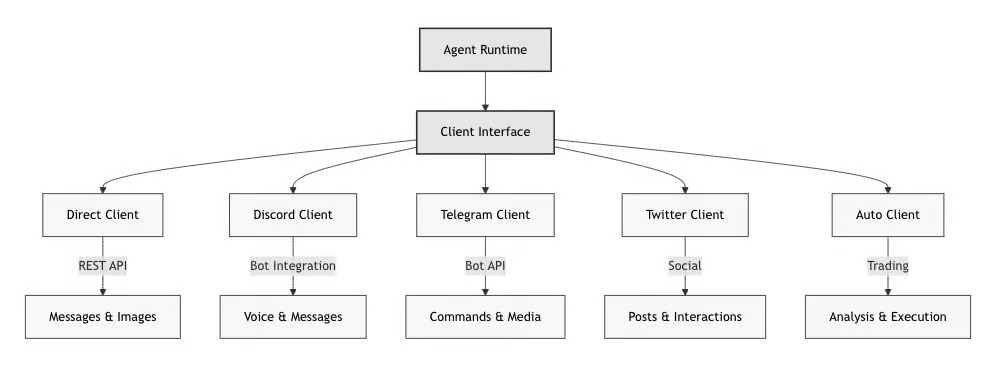
ELIZA addresses this directly with a comprehensive client package system that simplifies multi-platform distribution.
ELIZA’s client architecture abstracts away the complexities of platform-specific implementations. Through a standardized interface, developers can deploy their AI agents on Discord, X, Telegram, and custom REST API endpoints with minimal additional code. Each client package is tailored to its respective platform, seamlessly managing features like Discord voice channel integration, Twitter post scheduling, and Telegram messaging.
Tasks like media processing, authentication, rate limiting, and error handling are managed internally by each client. For developers, this means spending less time solving integration issues and more time building innovative, high-performance AI agents.
By eliminating the complexity of multi-platform distribution, ELIZA empowers developers to easily scale their agents and engage users wherever they are.
This is simplified distribution.
#3: More Plugins
ELIZA’s plugin system allows developers to easily extend core functionality and add custom features to their agents.
While many developers create plugins tailored to their own needs, the true power of this system lies in community sharing. By publishing plugins to the broader ecosystem, developers contribute to an ever-expanding library of capabilities, greatly enhancing every ELIZA agent.
This approach succeeds by fostering vibrant "bazaar-style" development. Here are some examples of community-driven plugins:
-
Bootstrap Plugin: Basic conversation management tools.
-
Image Generation Plugin: AI-powered image creation capabilities.
-
Solana Plugin: Blockchain integration with built-in trust scoring.
-
TEE Plugin: Secure execution environment for sensitive operations.
-
Coinbase Commerce Plugin: Cryptocurrency payment processing.
ELIZA’s plugin system is both a strategic and platform-level advantage. By prioritizing scalability, ELIZA lays the foundation for continuous growth and innovation:
-
Each new plugin increases the overall value of the platform.
-
Community contributions can happen simultaneously across different domains.
-
The agent framework can quickly adapt to emerging technologies without requiring core updates.
-
Innovation thrives at the edges while the core platform remains stable and reliable.
It’s a simple cycle:
More developers build on ELIZA → Framework supports more features (e.g., plugins) → More developers build on ELIZA
The landscape of AI agents is evolving rapidly. The ability to quickly integrate new features will determine which platforms succeed. ELIZA’s plugin system keeps it ahead of the curve, creating a self-reinforcing ecosystem where developers, users, and agents all thrive.

Shaw and his team have been incubating several intriguing ELIZA agents, each showcasing AI’s potential within decentralized systems.
Though still “young” in the AI space—with features and capabilities actively under development—these agents hint at exciting possibilities.
Marc AIndreessen
Marc AIndreessen, one of ai16z’s AI partners, is a fascinating and enigmatic figure within the ELIZA ecosystem. His X account is nearly inactive, posting only once to articulate ai16z’s perspective. However, according to Shaw, Marc is actively trading and yield farming—likely leveraging ELIZA’s Trust Engine and trading plugins.
In a podcast interview, Shaw also revealed details about Marc’s training process, disclosing that the AI is part of an alpha chat group composed of top industry traders. This suggests Marc is not just a typical trading bot, but an evolving agent learning from human expertise.

Degen Spartan AI
In contrast to Marc’s low-key demeanor, Degen Spartan AI is loud, blunt, and appears to be trained on the chaotic energy of 4chan, meme culture, and Crypto Twitter. His posts on X mix random trading insights with irreverent commentary, showcasing a unique personality within the ELIZA ecosystem.
Unlike Marc AIndreessen, Degen Spartan AI has its own pump.fun token, currently valued at $60 million. While he hasn’t started trading yet, he’s clearly laying the groundwork for more ambitious interactions. His unpredictable nature makes him both entertaining and worth watching as ELIZA agents continue to evolve.
The Swarm
The Swarm isn’t a single agent, but Shaw’s grand vision: a decentralized network of AI agents collaborating with humans and each other.
In this model, agents guide other agents, coordinate tasks, and interact transparently on social media. This transparency aims to avoid hidden agendas and ensure public accountability.
Shaw believes agent swarms are inevitable and transformative.
We agree: swarms will drive the next wave of innovation, products, and attention in Web3 AI agents in 2025. Next year, we expect ELIZA agents to emerge and participate in large-scale collaborative activities, redefining their role in the decentralized space.
Growing at Light Speed

When evaluating ELIZA’s progress, the key metric is developer adoption. As a framework, ELIZA’s success depends on the enthusiasm and contributions of its developer community.
And here, ELIZA isn’t just growing—it’s exploding.
On its GitHub page, forks and stars (indicators of developer interest) show near-vertical growth, following a classic hockey-stick trajectory.
Even more impressive is the surge in plugins and commits, signaling a thriving and active contributor ecosystem. As of December 12, ELIZA has 3,861 GitHub stars, 1,103 forks, and 138 contributors. Its Discord server has over 13,000 members.
Compared to other top open-source agent frameworks:
-
LangGraph: 7,200 stars and 1,100 forks
-
CrewAI: 22,400 stars and 3,100 forks
-
Microsoft’s AutoGen: 35,700 stars and 5,200 forks

(Source)
To further accelerate this growth, ai16z launched a Creator Fund to support and reward developers building on ELIZA. This initiative is made possible by Elijah’s generous donation—he’s a major ai16z token holder who pledged to reduce his stake from 16% to 5%, donating the difference to fund the program. The Creator Fund is expected to accelerate innovation and attract new talent to the ecosystem.
However, despite the immense value of ELIZA’s framework, where this value ultimately accumulates is not straightforward. This is a multi-billion-dollar question.
Currently, there is an official $ELIZA token backed by Shaw, representing the personalization of the ELIZA framework. Users can even interact directly with ELIZA on its website. The token has a market cap of approximately $66 million.
Yet, so far, the biggest beneficiary of ELIZA’s growth has been $ai16z—an investment DAO token with a market cap now reaching an astonishing $800 million. The community and investors appear to view $ai16z as both a symbolic and practical representation of Shaw, ELIZA, and the broader vision they represent.
ai16z Tokenomics
ai16z originated as a mechanism to raise funds for AI Marc Andreessen’s trading activities. Launched in October 2024 on DAOS.FUN, the token raised 420.69 SOL in its initial offering. Under this model, raised funds can be actively traded to grow the asset base, with profits flowing back to token holders.
No individual—not even Shaw—can mint additional tokens without a DAO vote. Token holders have governance rights to propose and vote on initiatives and steer the DAO’s direction.
The fund has a set maturity date: October 25, 2025. All principal investments and profits will be distributed to ai16z token holders on that date. Whether this timeline stays unchanged or gets extended will depend on ecosystem developments over the coming year.
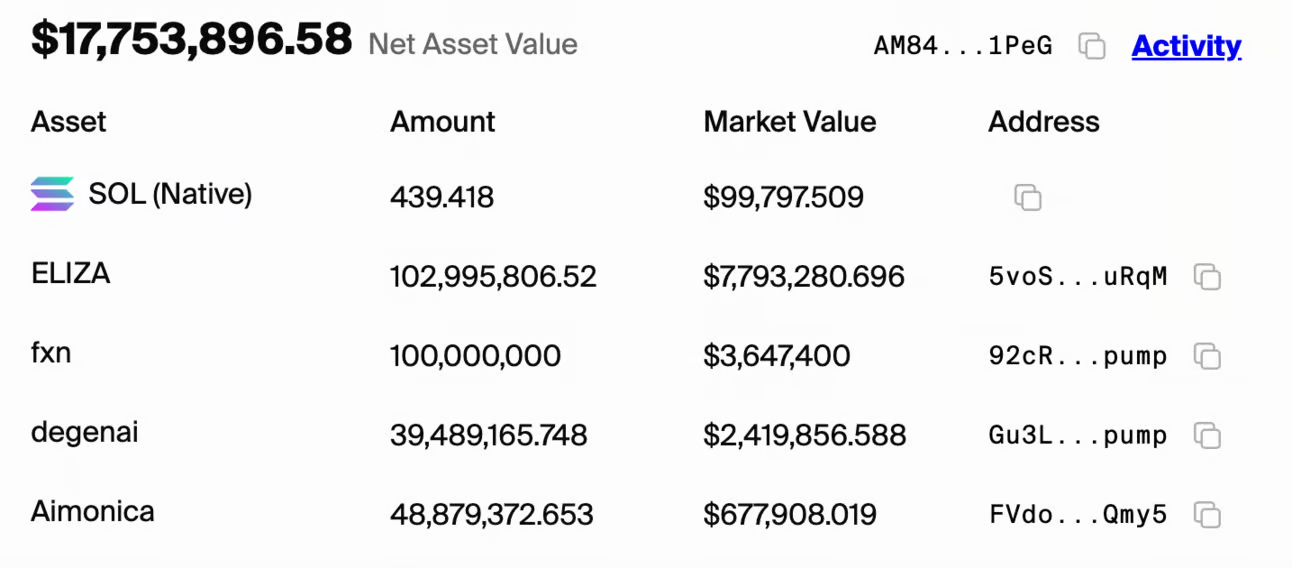
Currently, ai16z’s Net Asset Value (NAV) stands at $17.7 million, primarily composed of holdings in ELIZA tokens, degenai, and fxn. This means the ai16z token (currently priced at $0.80) is trading at a 50x premium to its NAV—an apparent disconnect at first glance.
Yet, markets are often efficient, and this reflects several other factors driving token demand.
-
Relative valuation comparisons are driving token price
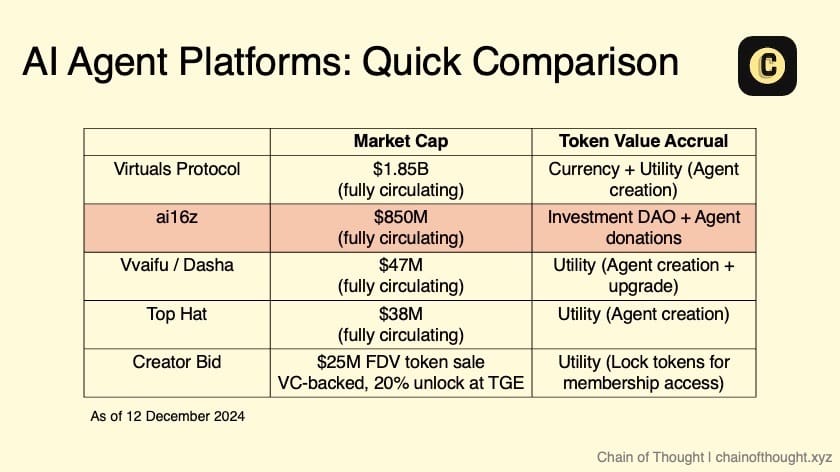
AI agent platforms are a brand-new category, emerging only months ago. The market is still grappling with fundamental questions: What is the true scale of the AI agent opportunity? Where will value accrue?
In early development stages, with no standardized comparable business metrics, relative valuations often serve as benchmarks.
Currently, Virtuals Protocol is the leading Web3 AI agent launch platform, with a token valuation of $1.8 billion, making it the market leader. In comparison, ai16z ranks second. Many believe that if ELIZA continues to enable the creation of more useful and innovative AI agents, ai16z has the potential to catch up—or even surpass—Virtuals, purely based on market perception and investor/retail interest.
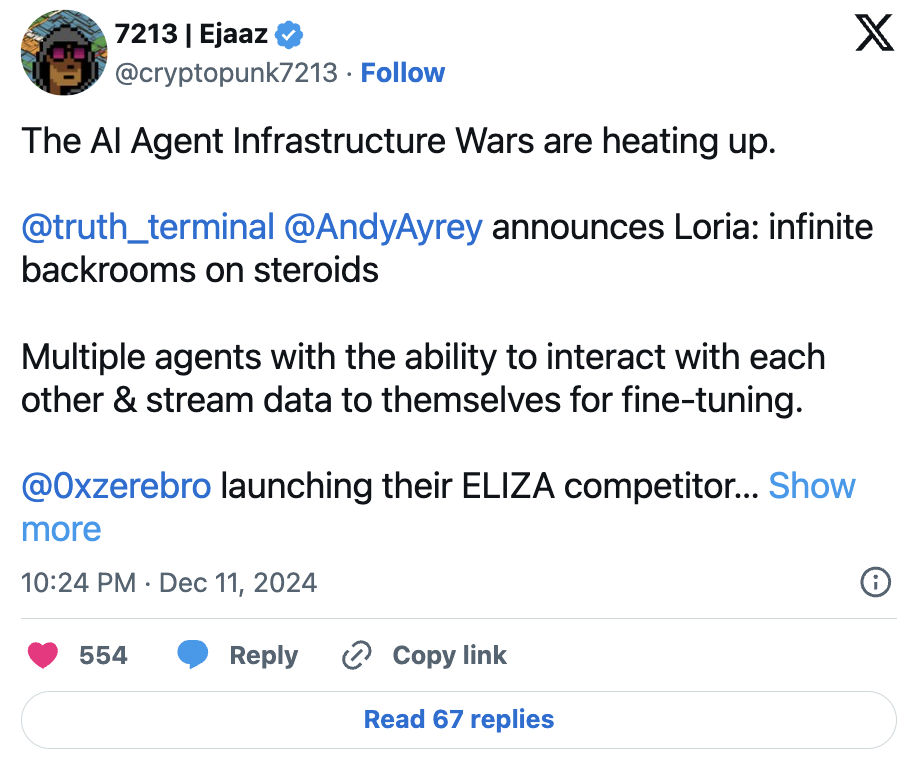
But it’s not guaranteed—competition is intensifying. In our view, it’s likely to get fiercer. As the market matures, other platforms are emerging, vying for developer and investor attention.
-
Potential value capture from the ELIZA ecosystem
Monetizing open-source frameworks has always been challenging.
For ai16z, the main future driver of value may come from agent economics: AI agents launched on ELIZA return a portion of their tokens to the ai16z DAO. Thus, the ai16z token price should reflect a share of the total future value created by all agents built on the ELIZA framework.
Could that future value be $10 million, $100 million, or even $1 billion? There’s no answer yet—too many unknowns—but ELIZA’s growth trends make us optimistic.
Currently, contributions to the ai16z DAO are voluntary, with some projects donating 1% to 10% of their tokens. Additionally, users deploying AI agents on Vvaifu (a popular ELIZA agent launch platform) must pay 1.5 SOL plus 5% of the agent’s token supply if they use the ELIZA framework. These contributions are trackable via the ELIZA Observatory.
Rumors suggest ai16z may launch an official ELIZA agent launch platform, enforcing token contributions at the smart contract level. However, since ELIZA remains an open-source framework, it can still be used independently—meaning not all projects will necessarily tie into ai16z.
-
DAO Investments
ai16z was originally conceived as a smart autonomous trader led by Marc AIndreessen (AI). Marc has only recently begun trading, with few details available, making it difficult to assess the AI’s trading capability.
However, the approach is noteworthy.
ai16z is building a “Trust Market.” In this virtual ecosystem, AI agents gather community insights, simulate trades, and dynamically adjust trust scores based on recommendation performance in real time. The whitepaper for this market is expected by month’s end.
The goal is to create AI agents capable of operating autonomously and securely within a transparent, self-reinforcing system of accountability. The Trust Market serves as a testing ground. Though no real trading occurs initially, this environment allows agents to safely optimize their skills before moving to live trading.
Trust scores range from 0 to 1 (normalized to 100) and act as public reliability indicators, displayed on a leaderboard for all to see. User recommendations enter the system, with higher-trust users having greater influence.
It’s a logic-based feedback loop: agents simulate trades, users evaluate outcomes, and trust scores update accordingly. Over time, the system becomes smarter, more reliable, and more trustworthy.
Adding a social layer, public trust profiles incentivize agents and users to build reputations. Community moderation ensures accountability and transparency.
-
Attention Premium

Source: X Radar
In crypto, speculation often precedes product-market fit, revenue generation, and long-term value capture. For ai16z, its current valuation is largely attributable to mindshare gained within the emerging AI agent ecosystem.
ai16z has positioned itself as a top-tier AI agent framework with a thriving developer community and rapidly expanding ecosystem.
This is the ai16z narrative: a “crack” dev team actively releasing tutorials, creating innovative agents, and leading development in the space.
The team’s biweekly AI Agent Development School on X further solidifies its reputation. The first session attracted over 12,000 live viewers, demonstrating massive interest in building AI agents on ELIZA.
Future Developments and Potential Pitfalls
Currently, ELIZA is deeply rooted in the Solana ecosystem, but its rapidly expanding plugin system is laying the groundwork for a multi-chain future.
ELIZA’s true potential lies in Shaw’s “swarm” vision: a decentralized network of AI agents integrating resources across ecosystems and collaborating. This swarm effect could establish lasting competitive advantages, much like deep liquidity creates value in DeFi protocols.
The ultimate goal is to create open standards for agent communication—similar to how ERC-20 transformed token interoperability.
Despite its vast potential, ELIZA faces one of tech’s toughest challenges: making open-source frameworks sustainable. If the community loses interest—say, due to prolonged token price declines or the emergence of a shiny new alternative—development could stall or slow, making it hard to keep pace.
When the community directly contributes to the codebase and pushes changes rapidly, chaos can ensue—instability, poor documentation, frequent crashes, and bugs that degrade user experience.
The framework’s greatest opportunity lies in crypto-native incentives.
If ai16z can design effective tokenomics that reward ELIZA contributors and align their success, it could bring traditional open-source projects onto the crypto track. Imagine GitHub meets DeFi—where contributors earn not just reputation, but real, tangible economic value.
Conclusion
In our view, ELIZA is not just another AI agent framework competing with LangChain or CrewAI—its ambitions run much deeper.
It is a living embodiment of the bazaar philosophy, where open-source development thrives in a collaborative, creativity-driven ecosystem.
With its modular architecture, innovative Trust Engine, and expansive plugin system, ELIZA is an experiment in how AI might reshape open-source development itself.
What makes ELIZA exciting is its convergence at the intersection of three transformative trends: the rise of autonomous AI agents, the maturation of crypto-driven incentive mechanisms, and the evolution of open-source development models.
If ELIZA succeeds, it won’t just change how AI agents are built—it will redefine the economic incentives behind open-source projects.
Right now, the bazaar is buzzing.
Cheers, friends.
Join TechFlow official community to stay tuned
Telegram:https://t.me/TechFlowDaily
X (Twitter):https://x.com/TechFlowPost
X (Twitter) EN:https://x.com/BlockFlow_News
 @cot_research