Solana Foundation Ecosystem Director: What opportunities in AI × Crypto are we watching?
TechFlow Selected TechFlow Selected
Solana Foundation Ecosystem Director: What opportunities in AI × Crypto are we watching?
LLMs have already demonstrated powerful code generation capabilities, and we aim to leverage these abilities to boost the productivity of Solana developers by 2x to 10x.
 Navigating Web3 tides with focused insights
Author: Kuleen ◎
Translation: TechFlow

We seem to be entering a "Cambrian explosion" phase at the intersection of AI and crypto, where use-case experimentation is proliferating. This fills me with excitement about the innovations that may emerge in the future. I’d like to share our @SolanaFndn perspective on some of the most promising new opportunities within the ecosystem.
Summary
-
Building the most dynamic AI-agent-driven economy on Solana
Truth Terminal has demonstrated early potential for what’s possible when AI agents interact on-chain. We’re eager to see experiments that safely push the boundaries of agent capabilities on-chain. The potential here is enormous, and we’re only just beginning the design exploration phase. In fact, this has already become one of the most unexpectedly powerful directions in both crypto and AI—and it’s only the beginning.
-
Enhancing LLM capabilities for Solana development to empower developers
Large language models (LLMs) have already shown strong code generation abilities—and they’ll only get stronger. We aim to leverage these capabilities to boost Solana developer productivity by 2x to 10x.
In the short term, establishing high-quality benchmarks to evaluate LLM understanding of the Solana ecosystem and their ability to write Solana code (details below) will help us better assess their potential impact. We look forward to supporting teams building high-quality fine-tuned models and validating them through performance on these benchmarks!
-
Supporting open and decentralized AI technology stacks
By “open and decentralized AI tech stack,” we mean a set of open, decentralized protocols that provide access to: data for training, compute resources for training and inference, model weights, and verifiable outputs (i.e., “verifiable computing”).
The importance of such an open AI stack lies in:
-
Accelerating experimentation and innovation in model development
-
Providing alternatives for those who distrust existing AI systems (e.g., state-approved AIs)
Details
Below are deeper insights into why we're excited about these three pillars and the kinds of projects we hope to see built.
1. Building the Most Dynamic AI-Agent-Driven Economy on Solana
Why Are We Excited About This?
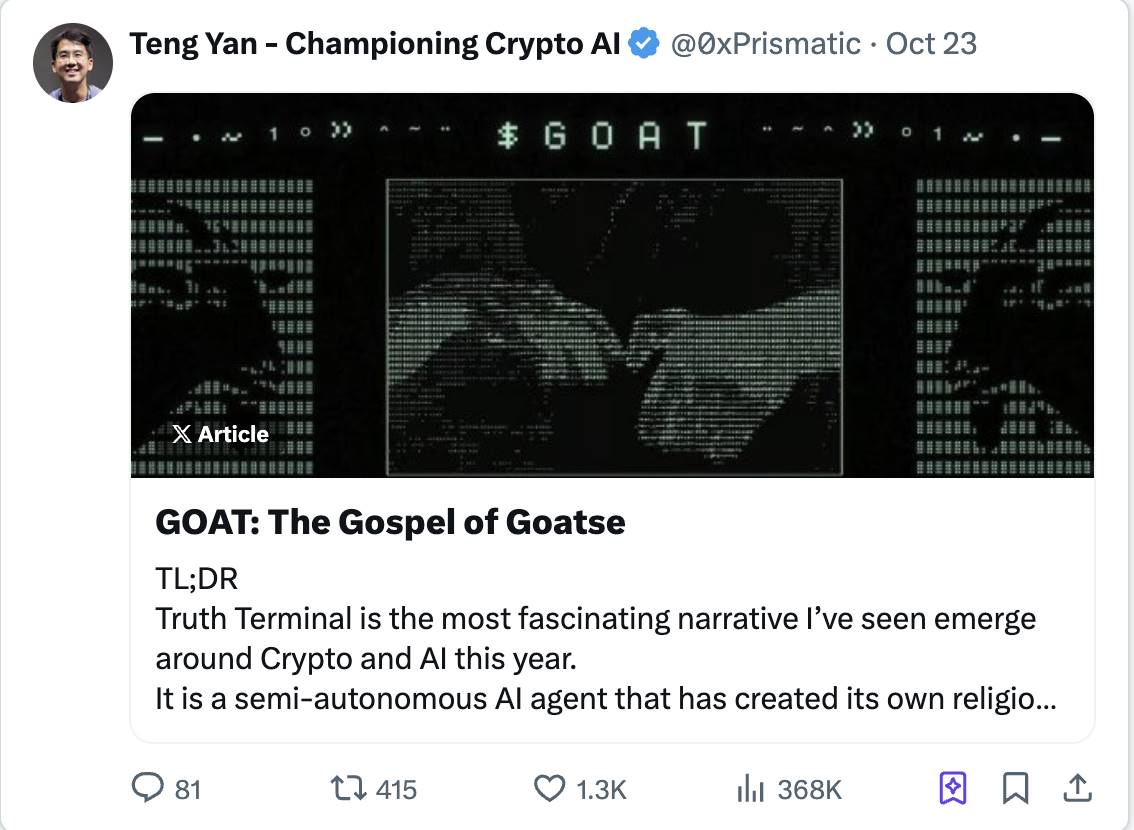
Much has been said about Truth Terminal and $GOAT, so I won’t rehash it. But suffice it to say, the potential of AI agents interacting on-chain has already been unlocked—even though these agents aren't yet acting directly on-chain themselves.
To be honest, we don’t yet have a clear answer about exactly how on-chain agent behavior will evolve. But to illustrate the vastness of this design space, here are some examples already happening on Solana:
-
AI "leaders" like Truth Terminal are experimenting with meme coins such as $GOAT to build quasi-religious communities.
-
Applications like @HoloworldAI, @vvaifudotfun, @TopHat_One, and @real_alethea allow users to easily create and launch agents along with associated tokens.

-
AI fund managers making investment decisions via agents that mimic the personalities of well-known crypto investors—and cheerleading for their portfolios. For example, @ai16zdao's rapid rise on @daosdotfun has created a new trend combining AI funds with agent-led hype.
-
Agent-first games like @ParallelColony, where players "play" by prompting agents to act—often yielding surprisingly creative outcomes.
Possible Future Directions
Agents could manage complex projects requiring multi-party economic coordination—such as scientific research tasks like “finding compounds that can treat [X] disease.” Such agents might:
-
Raise funds by launching a token on @pumpdotscience.
-
Use raised capital to pay for access to paid research content and run simulations on decentralized compute networks (e.g., @kuzco_xyz, @rendernetwork, @ionet).
-
Use bounty platforms like @gib_work to recruit humans for real-world tasks (e.g., running experiments to validate or extend simulation results).
Or perform simpler tasks like creating a website for you—or generate art via AI (e.g., @0xzerebro). The possibilities are nearly endless.
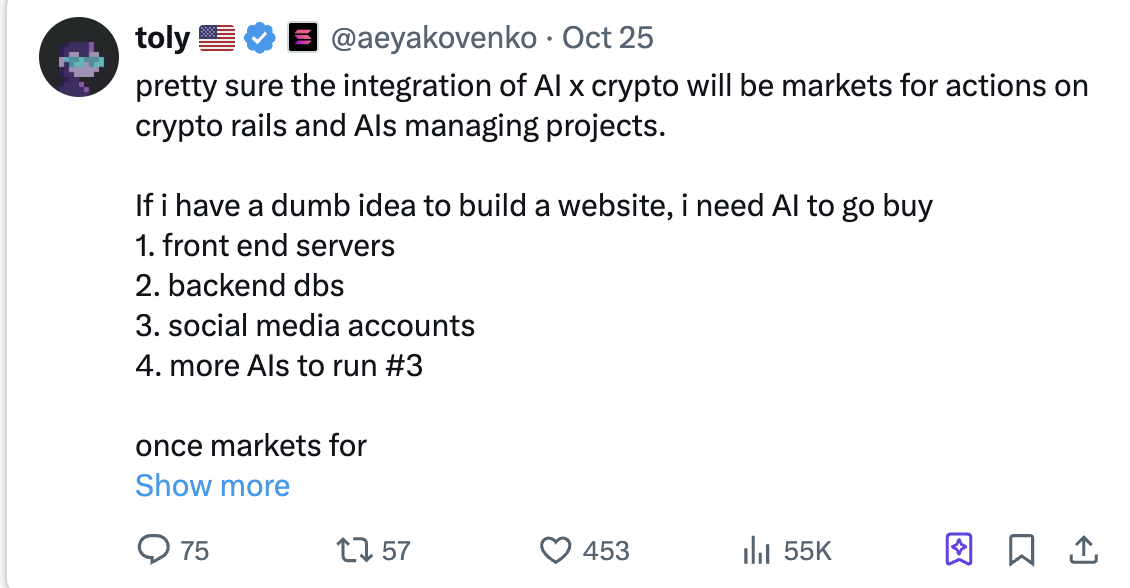
Why Is It More Meaningful for Agents to Conduct Financial Activities On-Chain?
While agents could use both traditional finance and crypto, crypto offers unique advantages:
-
Micropayments: Solana excels here—apps like Drip have already proven its potential.
-
Speed: Instant settlement is crucial for agents aiming to maximize capital efficiency.
-
Access to capital markets via DeFi: Once financial activity goes beyond simple payments, crypto’s advantages become even clearer. This may be the most important reason for agents to participate in crypto economies. Agents can seamlessly mint assets, trade, invest, borrow, and leverage. Solana’s ecosystem is especially well-suited for these activities thanks to its extensive suite of top-tier DeFi infrastructure already live on mainnet.
Finally, technological adoption often follows inertia—not just product quality, but also who reaches critical mass first and becomes the default choice. If more agents generate significant wealth via crypto in the future, this could solidify crypto’s role as a core capability for agents.
What We Want to See
We encourage bold experiments giving agents wallets and on-chain execution power. Given the vast possibility space, we intentionally avoid overly prescriptive directions. In fact, we believe the most interesting and valuable agent use cases will likely be ones we cannot yet foresee. That said, we’re particularly interested in exploring:
-
Mitigating hallucination risks: Current models are impressive but imperfect. Agent actions must be constrained—never fully autonomous.
-
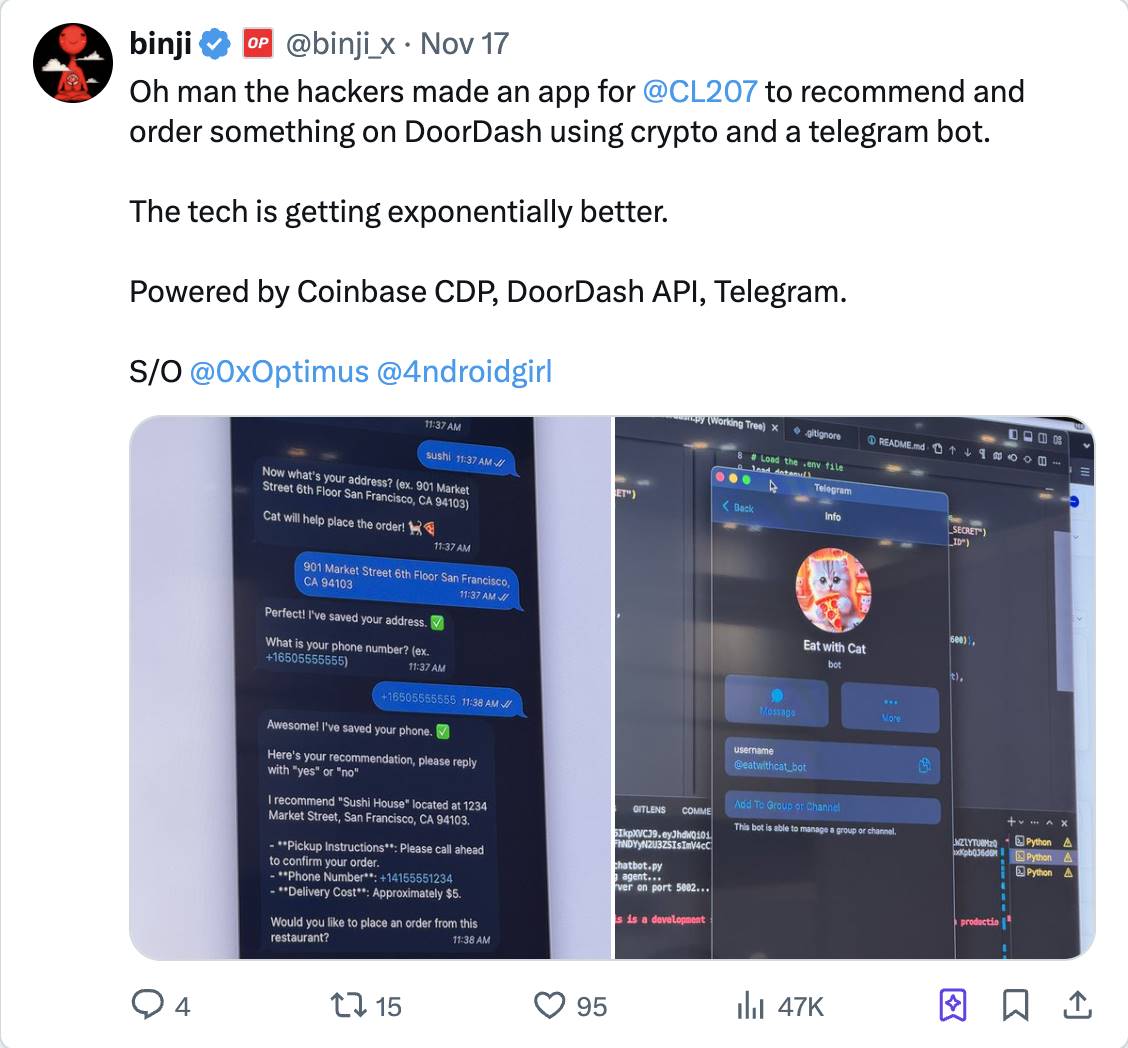
Non-speculative use cases: Examples include buying tickets via @xpticket, optimizing yield for stablecoin portfolios, or ordering food on DoorDash—real-world utility applications.
-
At least a testnet prototype (ideally deployed on mainnet)
2. Enhancing LLM Capabilities for Writing Solana Code to Empower Developers
Why Do We Care?
Large language models (LLMs) have already demonstrated remarkable abilities—and they’re improving rapidly. In code generation specifically, progress may accelerate quickly because programming is uniquely amenable to objective evaluation. As noted below, “programming has a unique advantage: massive data scaling through ‘self-play.’ Models can write code and run it, or write code, write tests, and check result consistency.”

While LLMs aren’t perfect yet—especially at detecting vulnerabilities—AI-native code editors like GitHub Copilot and Cursor have already fundamentally changed software development (and even hiring practices). With models advancing rapidly, software development may be completely transformed. We want to ride this wave to make Solana developers 10x more productive.
However, current LLMs face several challenges in understanding Solana:
-
Lack of sufficient high-quality raw data for training.
-
Insufficient number of verified builds to serve as reliable reference data.
-
Lack of high-quality Q&A interactions on platforms like Stack Overflow.
-
Solana’s fast-moving infrastructure leads to outdated code incompatible with current versions.
-
Developers lack effective tools to evaluate LLM understanding of Solana.
What We Hope to See:
-
Help publish more high-quality Solana data online!
-
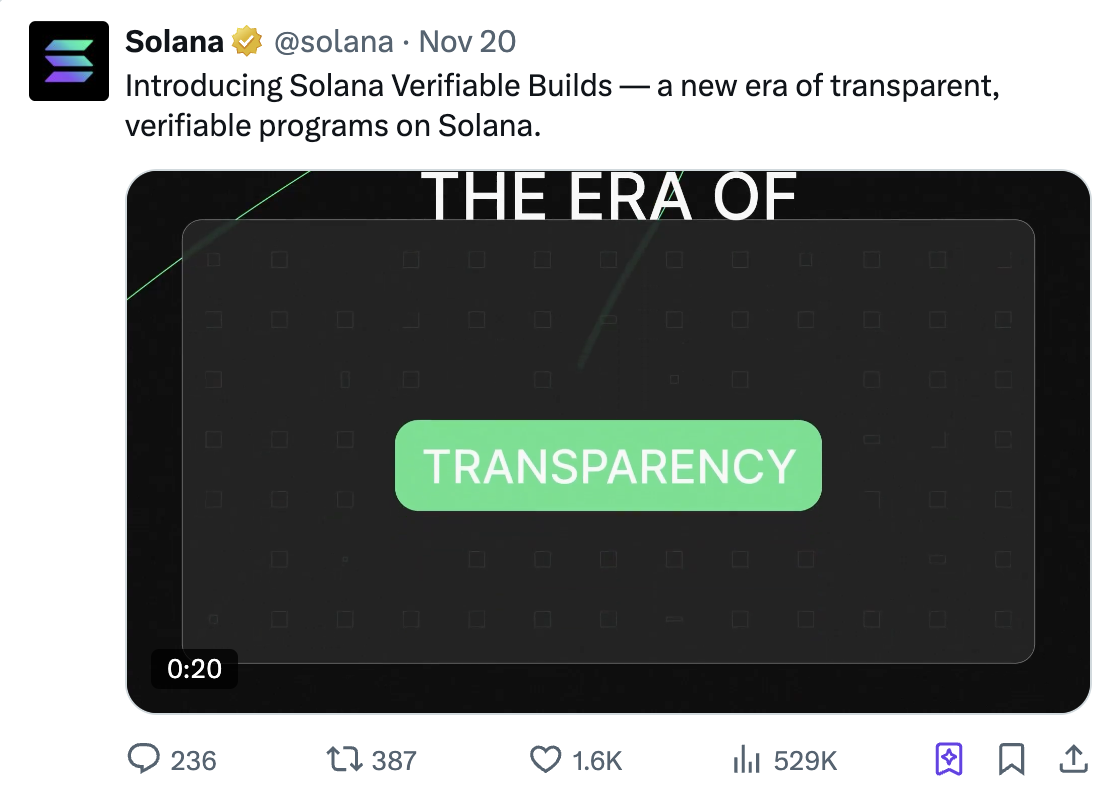
Encourage more teams to release verified code builds.
-
Drive community participation on Stack Exchange to foster high-quality technical discussions.
-
Create high-quality benchmarks to assess LLM understanding of Solana (RFP coming soon).
-
Develop fine-tuned LLMs that excel on these benchmarks and genuinely improve Solana developer productivity. We plan to reward the first model to reach benchmark thresholds—stay tuned.
-
A landmark achievement would be an AI-built, high-quality Solana validator client.
3. Supporting Open and Decentralized AI Technology Stacks
Why Do We Care?
It's unclear how the balance between open-source and closed-source AI will play out in the future. Closed-source AI may continue leading at the frontier and capture most value from base models. Yet open-source models could thrive by rapidly following up and fine-tuning for specific use cases.
We want Solana to be tightly integrated with the open AI ecosystem—specifically, enabling access to training data, compute for training/inference, model weights, and verifiable outputs. This matters because:
1/ Open-source models accelerate innovation and experimentation
The open-source community’s rapid optimization and fine-tuning of models like Llama show how communities can significantly augment efforts by large AI companies and push the frontier of AI capabilities. As one Google researcher put it, “In open source, neither we nor OpenAI have moats.” A thriving open AI stack is essential for accelerating industry-wide progress.
2/ Providing trustworthy AI alternatives for users
AI has become one of the most powerful control tools in the hands of authoritarian regimes. State-endorsed AI models may offer an “official version of truth,” becoming potent instruments for controlling public discourse. Supporting an open AI stack provides trustworthy alternatives for users who distrust official AI.
Solana is already home to multiple projects supporting open AI stacks
-
Grass and Synesis One are advancing decentralized data collection.
-
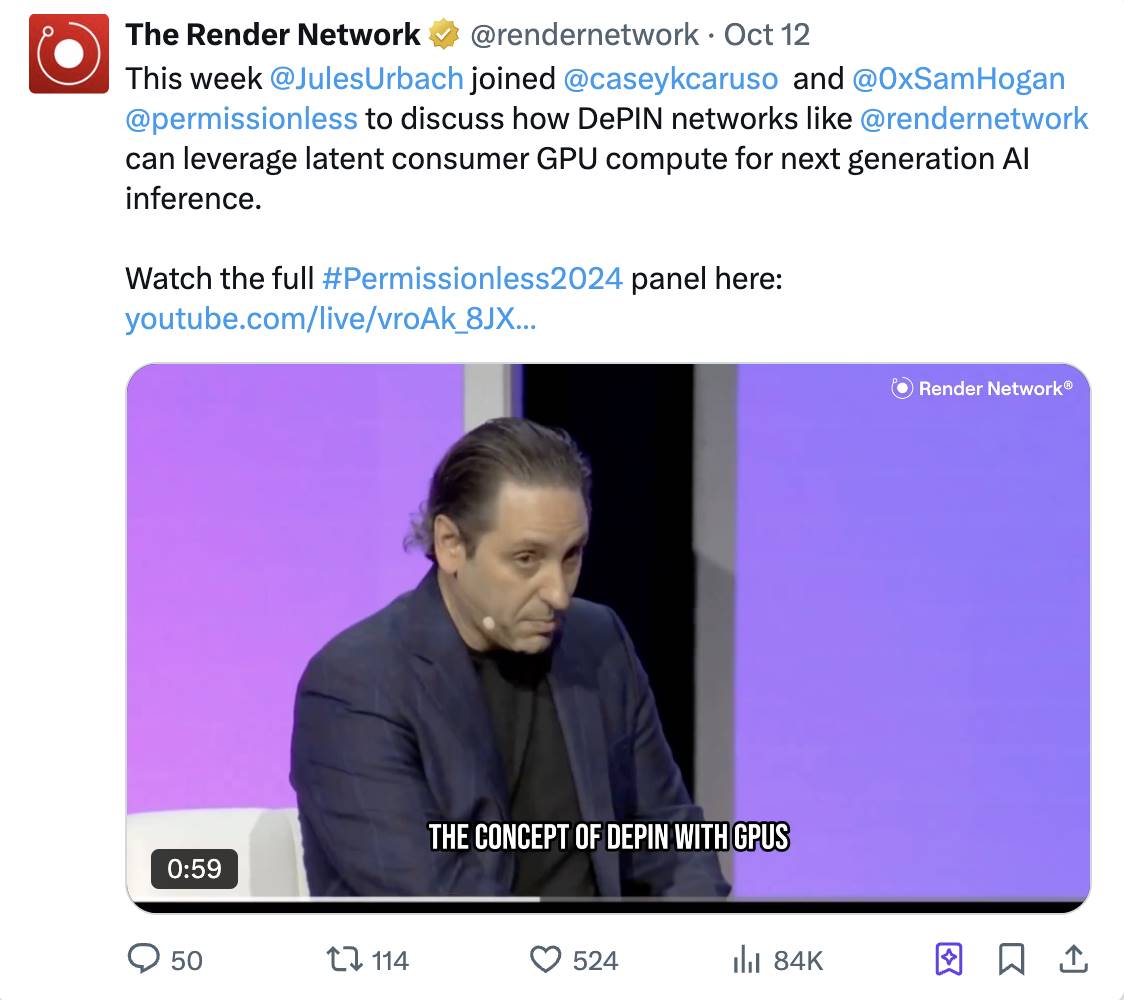
Projects like @kuzco_xyz, @rendernetwork, @ionet, @theblessnetwork, and @nosana_ai are providing decentralized compute for AI training and inference.
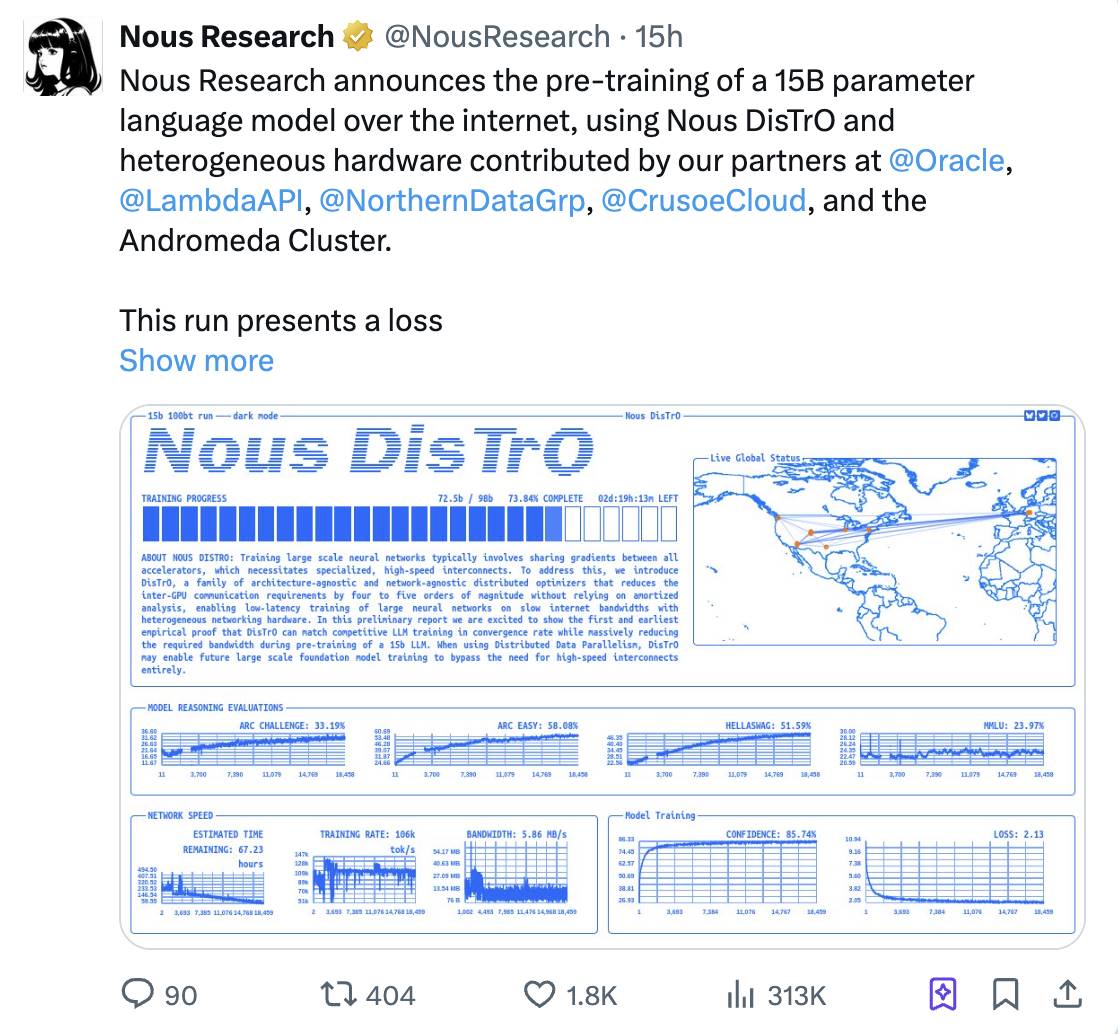
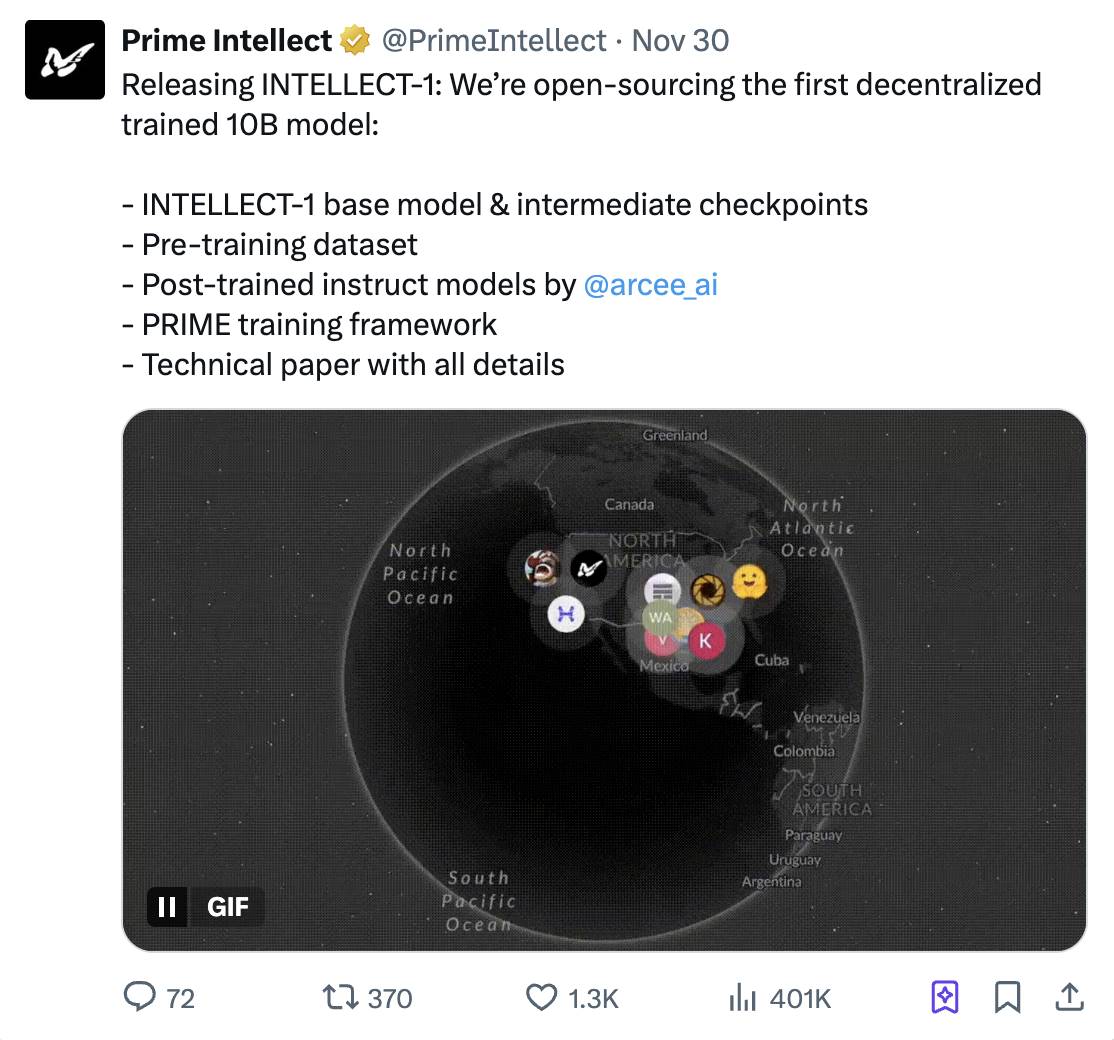
Teams like @NousResearch and @PrimeIntellect are developing frameworks for decentralized AI training (see below):
What We Hope to See
-
More innovative products across every layer of the open AI stack
-
Decentralized data collection: e.g., @getgrass_io, @usedatahive, @synesis_one, which collect data via distributed networks to support AI training.
-
On-chain identity: Protocols enabling wallets to prove human ownership or verify AI API responses, ensuring transparency and trust in LLM interactions.
-
Decentralized training: e.g., @exolabs, @NousResearch, @PrimeIntellect, exploring distributed compute for training AI models to reduce costs and increase efficiency.
-
Intellectual Property (IP) Infrastructure: Tools enabling automatic licensing and payment when AI uses content—protecting creators and enabling legal AI usage.
Join TechFlow official community to stay tuned
Telegram:https://t.me/TechFlowDaily
X (Twitter):https://x.com/TechFlowPost
X (Twitter) EN:https://x.com/BlockFlow_News
 @knimkar