









WOO X Research: Can RWA Become the Next Wave of Wealth Growth?
TechFlow Selected TechFlow Selected
WOO X Research: Can RWA Become the Next Wave of Wealth Growth?
RWA will most likely continue its trend, and the integration of RWA with the DeFi sector may attract growing investor attention.
 Navigating Web3 tides with focused insights
Author: WOO
Narrative
RWA (Real World Assets), literally translated as real-world assets, lies in its ability to bridge traditional assets with the Web3 world, enabling digital representation of physical assets. This allows for more effective utilization or allocation of real-world assets—such as real estate and artwork—and significantly improves asset liquidity. By combining RWA with blockchain technology, these assets can transcend geographical boundaries. Regardless of location, currency systems, or other influencing factors, users can conveniently conduct transactions or utilize assets through this integration. When discussing RWA, people often think of real estate, stocks, and similar assets. However, from the fundamental characteristics of RWA tokenization, stablecoins also fall within the scope of RWA products. This makes RWA feel closer to everyday users. This forms another layer of RWA’s narrative—“financial inclusion.” It enables investors who lack sufficient capital to access high-value markets by investing in tokenized versions of those high-value RWA assets, thereby gaining indirect exposure to premium markets.
What Lies Ahead?
Over the past year, the total value locked (TVL) in the RWA sector has shown a fluctuating upward trend. In this current cycle, RWA, AI, and MEME have emerged as particularly popular sectors, with RWA consistently remaining one of the most watched areas.
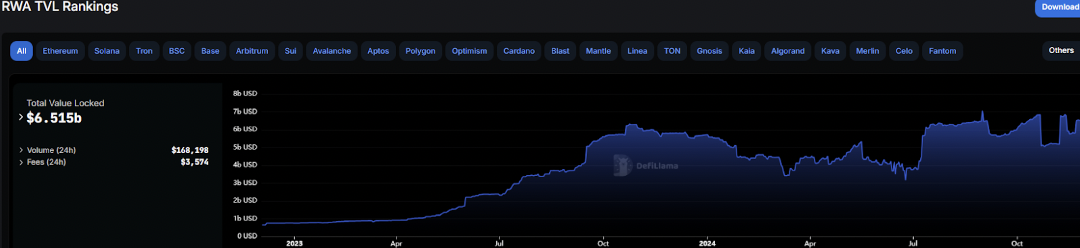
Image Source: https://defillama.com/protocols/RWA
Looking ahead, it is highly likely that this trend will continue. The integration of RWA with the DeFi sector may attract increasing investor interest. In reality, high-value assets such as real estate and commodities face significant settlement challenges, compounded by differing national laws and regulations. Projects related to such assets are therefore likely to be constrained by implementation and regulatory hurdles. For RWA projects in this category to achieve meaningful growth, substantial progress must first occur in areas such as PayFi, cross-border settlement regulation, and RWA asset verification—moving beyond the current reliance on third-party entities across jurisdictions for clearing or validation. On the other hand, stablecoin-related RWA projects tend to be relatively more stable. The mainstream market will likely remain dominated by the U.S. dollar, followed by the euro and others. However, future developments may lead to regional or national fragmentation—where investors in specific countries or regions predominantly adopt certain stablecoins. In such scenarios, stablecoins securing local regulatory licenses could gain early market advantages. Another major future trend could be the emergence of more stablecoins pegged not just to cash equivalents but to bonds, securities, stocks, or funds. The rationale behind this lies in the fact that settlement and regulatory frameworks for these financial instruments are generally more favorable compared to real estate or physical commodities. In the near term, however, only institutions with strong influence in traditional finance—such as BlackRock—may drive projects capable of generating significant economic returns. Later, projects led by influential Web3 organizations may give rise to RWA initiatives with stronger community-driven cultural characteristics.
Projects
Below is an overview of recently funded projects, presented objectively for discussion purposes.
OpenTrade
Founded at the end of 2022 and headquartered in London, UK, OpenTrade has raised a total of $8.7 million to date. Its investors include a16z CSX, Circle, Draper Dragon, CMCC Global, Ryze Labs, Polygon, and Kronos Ventures.
The platform currently offers four products:
-
U.S. Treasury Bill Vaults: Fixed-term; fixed-duration, fixed-yield USDC returns backed by U.S. Treasury bills;
-
USDC Vault: Flexible-term; variable-yield USDC backed by short-term U.S. Treasury bills, money market funds, and other cash equivalents;
-
EURC Vault: Flexible-term; variable-yield EURC backed by euros, short-term euro-denominated bonds, money market funds, and other cash equivalents;
-
Yield+ Vault: Fixed-term; backed by investment-grade corporate bonds, commercial paper, emerging market bonds, and similar instruments.
Vault tokens serve as the unit of account for operations and settlements.
USUAL – Government Bonds
To date, USUAL has raised $8.5 million and is featured as a Binance Launchpool project.
The ecosystem revolves around three core tokens:
-
USD0: A permissionless, fully compliant stablecoin backed 1:1 by real-world assets (RWA), aggregating various U.S. Treasury tokenized assets;
-
USD0++: An enhanced treasury product where USD0 locks principal as collateral, with USUAL providing incentives;
-
USUAL: The protocol's governance token.
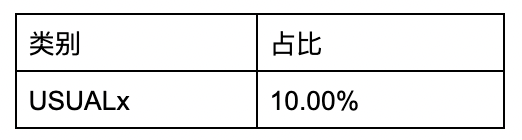
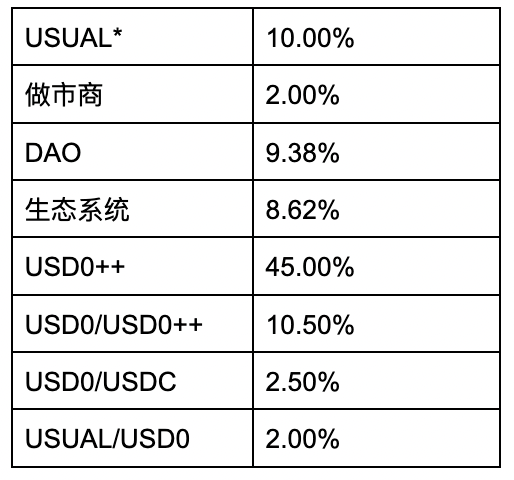
Tokenomics: Total supply of 4 billion, with an initial circulating supply of 12.37%.

Image Source:
https://docs.usual.money/usual-products/usual-governance-token/usual-tokenomics/distribution-model
Token distribution:
Huma Finance
Huma Finance has raised a total of $46.3 million to date, with a Chinese co-founder among its leadership team. Overall, it operates as a PayFi lending platform. Its latest funding round included $10 million in equity investment and $28 million in real-world asset investments into the Huma platform. The round was led by Distributed Global, with participation from Hashkey Capital, Folius Ventures, Stellar Development Foundation, and others. On April 17, 2024, Huma merged with Arf to focus exclusively on PayFi solutions tied to real-world asset tokenization.
The platform uses Huma Points to track contributors’ activities. It currently offers cross-border payment financing and credit cards backed by digital assets. Through various pools—including the Arf Cross-Border Payment Financing Pool (enabling instant USDC-based settlement to streamline international payments), the Rain Accounts Receivable Pool (assisting DAOs and other entities in managing expenses via wage cards), and the Jia Pioneer Fund Pool (providing decentralized financing for small businesses, rewarding borrowers who repay via equity shares, i.e., "small business credit")—Huma facilitates cross-border financial services.
Join TechFlow official community to stay tuned
Telegram:https://t.me/TechFlowDaily
X (Twitter):https://x.com/TechFlowPost
X (Twitter) EN:https://x.com/BlockFlow_News
 @WOOXResearch






