








From $1.8 Billion to $111 Billion: The Logic Behind MicroStrategy's Market Cap Surge, Bitcoin-Driven Growth, and Capital Leverage Analysis
TechFlow Selected TechFlow Selected
From $1.8 Billion to $111 Billion: The Logic Behind MicroStrategy's Market Cap Surge, Bitcoin-Driven Growth, and Capital Leverage Analysis
MicroStrategy has almost unhesitatingly pushed Bitcoin to the center of traditional capital markets.
 Navigating Web3 tides with focused insights
Author: AY FundInsight

In 2023, MicroStrategy's story unfolded in financial markets like a labyrinthine capital adventure, filled with risk and ambitious calculations. Its market capitalization surged from $1.8 billion at the beginning of the year to today’s $111 billion—a remarkable trajectory driven by intricate logic and strategic foresight. As a company whose core strategy centers on Bitcoin, MicroStrategy has not only bridged traditional finance and cryptocurrency markets but also exerted profound influence over the future of the web3 industry. Aiying FundInsight will delve into the strategic logic behind MicroStrategy’s Bitcoin-driven growth, leveraged capital operations, and governance transformation—and explore what this means for the broader web3 financial ecosystem.
1. Bitcoin-Driven Strategy: From Marginal Asset to Core Foundation
MicroStrategy’s rise is inseparable from its aggressive Bitcoin positioning. At the start of 2023, the company’s market cap was significantly lower than the value of its Bitcoin holdings. Yet through large-scale fundraising and high-risk capital maneuvers, its current market cap now stands at 3.55 times the value of its Bitcoin stash—equivalent to 5.9% of Bitcoin’s total market cap.
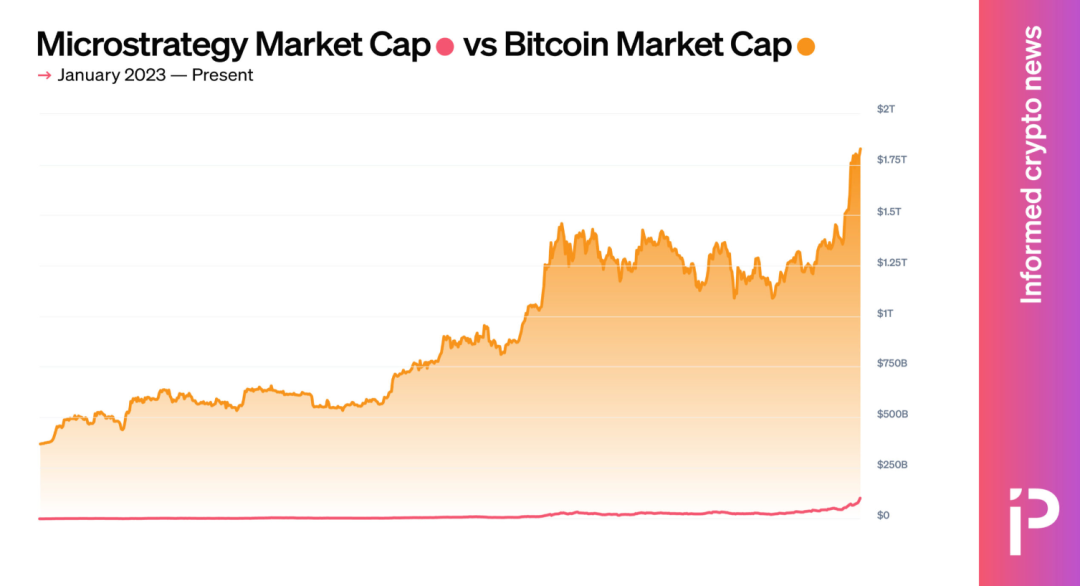
Michael Saylor views Bitcoin as digital gold surpassing traditional currencies, forming the bedrock of MicroStrategy’s growth strategy. Within the context of web3, MicroStrategy represents a new type of enterprise—one that uses digital assets as foundational collateral, leveraging expectations of Bitcoin’s long-term appreciation to inspire confidence in traditional capital markets. As Bitcoin’s price rises, so too does MicroStrategy’s valuation, receiving strong premium support from investors who trust in its Bitcoin-backed narrative.
However, market sentiment toward this “digital gold standard” strategy remains divided. While some investors express unwavering faith in MicroStrategy’s future—some even speculating its market cap could one day exceed that of Bitcoin itself—not all rational investors share this view. The decentralized ethos of web3 and Bitcoin’s inherent volatility introduce significant uncertainty. After all, market confidence is anything but static.
2. Leveraged Capital Operations: An Innovative Mix of Dilution and Zero-Coupon Bonds
MicroStrategy’s success lies not just in choosing Bitcoin as a frontier asset, but in how skillfully it employs traditional capital market tools to achieve unprecedented leverage.
1. Equity Dilution: The Strategy of Value-Enhancing Dilution
Aiying FundInsight observes that MicroStrategy primarily raises capital through two methods: equity dilution and zero-coupon bonds.
(1) The Process and Logic of Equity Dilution
-
MicroStrategy issues new shares to raise funds, allocating nearly all proceeds directly to purchasing Bitcoin.
-
This creates a unique concept known as "value-enhancing dilution"—while existing shareholders’ ownership stakes are diluted, the market interprets this action positively due to expected Bitcoin appreciation. Consequently, the dilution paradoxically drives up the stock price.
-
Aligning shareholder interests: By immediately reinvesting raised capital into Bitcoin after each share issuance, MicroStrategy tightly links shareholder returns to Bitcoin’s long-term performance. This immediate reinvestment reinforces investor confidence through financial signaling. Many investors now see MSTR stock as an indirect way to gain exposure to Bitcoin, willingly paying a premium for this asset allocation model.
2. Zero-Coupon Convertible Bonds: A Gamble on Future Returns
(1) Strategy Behind Issuing Zero-Coupon Convertible Bonds:
-
Another key financing method is issuing zero-coupon bonds. In its latest round, MicroStrategy expanded its bond offering from $175 million to $2.6 billion—all at zero interest rate.
-
Returns tied to stock performance: Bondholders receive no periodic interest payments. Instead, their return is linked entirely to future increases in MSTR’s stock price. These bonds can be converted into common shares at a later date, meaning investors’ profits depend solely on MicroStrategy’s stock appreciation—similar in structure to employee stock options, and ultimately tied to the value of the company’s Bitcoin holdings.
(2) High-Stakes Wager by Investors:
-
Investors take on substantial risk. They forgo fixed income in exchange for belief in MicroStrategy’s future growth—particularly its deep integration with Bitcoin.
-
Nature of long-dated call options: These bonds effectively function as long-dated call options. Profitability hinges on a significant rise in MicroStrategy’s share price—an outcome largely dependent on Bitcoin’s price trajectory and sustained market confidence in MicroStrategy’s governance.
(3) Ripple Effects Across Capital Markets:
-
This financing mechanism goes beyond mere capital injection—it resembles a bet against future market conditions. Such bets trigger powerful ripple effects, where each stage fuels further expansion, creating a delicate balance between high risk and high reward.
-
Synergy with equity dilution: MicroStrategy’s bond financing complements its equity dilution strategy, forming a distinctive capital operation model. This synergy resonates across financial markets, driving continuous capital inflows fueled by collective belief in Bitcoin and optimism about the future of digital assets.
3. Governance Transformation: From Saylor’s Control to Institutional Oversight
Alongside capital expansion, MicroStrategy has undergone significant changes in corporate governance. Michael Saylor’s decline from absolute voting control marks a pivotal shift—from a "controlled company" to a more market-oriented, institutionalized governance framework.
Previously, Saylor held final decision-making power via his control of Class B common stock, leading NASDAQ to classify MicroStrategy as a “controlled company.” However, the massive issuance of Class A common stock diluted the voting advantage of Class B shares, reducing Saylor’s voting power below 50%. As a result, the company was required to establish an independent nominating committee, shifting board decisions toward a more collective process. This transition not only demands greater transparency under market scrutiny but may also introduce new uncertainties into future strategic planning.
Within the web3 ecosystem, such governance shifts often signal a company’s evolution from a phase of aggressive startup growth to a more stable and sustainable development stage. MicroStrategy exemplifies this pattern: rapid expansion under individual leadership followed by gradual institutionalization and standardization. For the web3 industry, which champions decentralization, this shift reflects an inevitable trend toward internal checks and balances.
4. Aiying FundInsight’s Deep Reflections
MicroStrategy’s capital strategy prompts profound reflection from Aiying FundInsight. Can this model be sustained? And how might it reshape the entire web3 financial landscape? Under Michael Saylor’s leadership, MicroStrategy has boldly placed Bitcoin at the heart of traditional capital markets. Through a combination of equity dilution and zero-coupon bonds, the company has aggressively pursued its vision, staking everything on Bitcoin’s long-term value. But is this a reckless gamble—or a forward-looking insight into the future of asset architecture?
From a deeper perspective, MicroStrategy has transformed itself into a structured vehicle for indirect Bitcoin ownership by harnessing investor and bondholder faith in Bitcoin. It leverages market perceptions of Bitcoin while linking traditional financial instruments to digital assets, carving out a novel path in finance. Yet this path brims with risks and uncertainties—especially given Bitcoin’s extreme price volatility, which can dramatically amplify MicroStrategy’s leverage risk.
More importantly, the示范effect (demonstration effect) of this capital model on the broader web3 industry warrants serious consideration. Many companies may follow suit, structuring themselves around crypto assets as primary holdings and using similar financing mechanisms. However, without hedging tools or diversified risk management frameworks, such strategies could lead to systemic market risks. Although MicroStrategy’s debt and equity dilution tactics appear successful today, their underlying logic depends entirely on the assumption of continuously rising Bitcoin prices. Should this premise falter, the foundation of its entire growth engine would come crashing down.
Aiying FundInsight believes MicroStrategy’s case is both a profound experiment in novel capital engineering and a high-stakes market gamble. It demonstrates how web3 firms can tap into traditional capital markets to scale their digital asset positions—but also exposes the severe risks embedded in such strategies. If the crypto market ecosystem continues to mature, MicroStrategy might emerge as a pioneer of a new corporate paradigm. But if market sentiment turns bearish, these highly leveraged operations could become major sources of financial instability. In our next analysis, Aiying FundInsight will dissect MicroStrategy’s debt structure and potential risks in detail—stay tuned.
Join TechFlow official community to stay tuned
Telegram:https://t.me/TechFlowDaily
X (Twitter):https://x.com/TechFlowPost
X (Twitter) EN:https://x.com/BlockFlow_News
 Aiying Compliance






