








Interpreting Global Cryptocurrency Taxation: Asia Moves Slowly, While Europe's Top Rate Reaches 52%
TechFlow Selected TechFlow Selected
Interpreting Global Cryptocurrency Taxation: Asia Moves Slowly, While Europe's Top Rate Reaches 52%
The taxation of cryptocurrency transactions has become a focal point for countries around the world in recent years.
 Navigating Web3 tides with focused insights
By Chloe, PANews
Following Donald Trump's re-election and return to the White House, along with pro-crypto candidates entering the U.S. Congress, expectations are rising for a favorable regulatory environment for cryptocurrencies—fueling Bitcoin’s price surge past $90,000. According to a CNA report on November 18, Taiwan’s legislators recently raised concerns during an inquiry about cryptocurrency taxation, questioning whether individual crypto traders should be taxed.
During the hearing, lawmakers criticized the Ministry of Finance's current tax policy on individual crypto trading gains, noting that only exchanges are currently subject to business tax and corporate income tax. There remains no clear regulation regarding taxation on profits individuals or legal entities make from trading. Legislators urged the Ministry of Finance to take proactive steps to improve Taiwan’s crypto tax framework.
To date, 26 virtual asset operators in Taiwan have completed anti-money laundering compliance declarations with the Financial Supervisory Commission (FSC) and registered for tax purposes, paying both business tax and corporate income tax. However, legislators emphasized that while institutional players are regulated, mechanisms for taxing and auditing individual crypto transactions remain inadequate.
Sung Hsiu-ling, Commissioner of the Directorate-General of Taxes, stated that under existing tax laws, cryptocurrencies are not considered legal tender but digital assets. Any profit derived from buying and selling such assets is taxable. Since reporting is self-declared, enhanced audit measures are necessary. The Ministry will also align with the FSC once dedicated virtual asset legislation is enacted, introducing new audit protocols. "The tax authority already has tools to monitor digital goods transactions," Sung said, adding that the Ministry would propose detailed regulations on taxing crypto trading gains within three months.
The Ministry concluded by affirming its commitment to monitoring global trends in cryptocurrency and digital services taxation, adjusting Taiwan’s tax policies accordingly based on international developments and domestic realities.
Taxation of cryptocurrency transactions has become a focal point worldwide. Below, PANews summarizes how various countries and regions handle crypto taxation.
Globally, Cryptocurrency Transaction Tax Transparency Is Increasing
In 2023, the United States, the European Union, and other jurisdictions began implementing new tax information reporting requirements for crypto asset brokers and other intermediaries to enhance transaction transparency. In June last year, the Organisation for Economic Co-operation and Development (OECD) released the Crypto-Asset Reporting Framework (CARF) and updated the Common Reporting Standard (CRS) for financial institutions, expanding the scope to include new types of financial products.
An increasing number of countries are adopting crypto tax reporting rules to prevent misuse as tax avoidance vehicles. According to PwC’s “2024 Global Crypto Tax Survey,” as of December 1, 2023, 54 major crypto-market jurisdictions have committed to swiftly implement the OECD’s CARF, aiming to establish automatic exchange of crypto transaction data by 2027. Reportable transactions include: exchanges between crypto assets, conversions between crypto and fiat currencies, and transfers of crypto assets used as payment exceeding USD 50,000 for goods or services.
In Taiwan, recent legislative inquiries focused on crypto taxation. Currently, Taiwan primarily regulates KYC and anti-money laundering (AML) compliance—requiring crypto service providers to collect customer data and report large withdrawals (over NT$500,000). Aside from AML regulations, there is no specific income tax law or guidance directly applicable to cryptocurrencies.
For individual users, there is no transaction tax when buying or selling crypto. Profits are treated similarly to foreign exchange trading gains and must be declared as property transaction income, included in personal comprehensive income tax filings.
In simple terms, Taiwan’s current principle is “tax upon realization.” As long as investors do not withdraw their profits into bank accounts, no actual taxable gain occurs. Only when profits are withdrawn—and exceed certain thresholds—do they become subject to taxation.
Additionally, crypto traders whose primary business involves frequent trading must register for tax purposes and pay business tax and corporate income tax if their monthly revenue exceeds NT$40,000.
U.S.: Cryptocurrencies Treated as Taxable Property; State-Level Rules Vary
The U.S. government defines virtual currency as any digital representation of value recorded on a cryptographically secured distributed ledger. Digital assets are not recognized as legal tender because they are neither U.S. coins or paper money nor issued by any national central bank.
The Internal Revenue Service (IRS) treats cryptocurrencies as taxable property. If the market value of a cryptocurrency rises above the original purchase price, capital gains or losses occur upon disposal. Any profit realized through selling or exchanging crypto must be reported and taxed. Additionally, businesses receiving crypto as payment must treat it as ordinary income and pay taxes accordingly.
For example, if Person A buys 1 BTC for $5,000 and sells it three months later for $7,000, they must pay short-term capital gains tax on the $2,000 profit. For assets held less than one year, the 2023 U.S. tax rate ranges from 0% to 37%, depending on total taxable income.
Beyond trading profits, other forms of crypto income are also taxable. Mining rewards, staking yields, and interest earned via lending platforms are typically classified as ordinary income and taxed at regular income tax rates. In 2023, the IRS introduced new guidelines clarifying the timing of income recognition for staking rewards and categorized NFTs as collectibles, subjecting them to special tax treatment.
This year, mid-year, the IRS released final draft guidance on crypto taxation. Starting in 2025, crypto brokers will be required to file Form 1099-DA with the IRS, reporting clients’ transaction details. This new system is expected to significantly boost tax compliance while imposing additional regulatory obligations on market participants.
At the state level, tax calculation methods vary. However, there is currently no consensus among U.S. states regarding the classification and taxation of NFTs.
Wide Tax Rate Disparities Across EU Countries—Up to 52% in Denmark?
In Europe, EU member states continue updating their crypto tax regimes. For those seeking to minimize tax burdens, Slovakia, Luxembourg, Bulgaria, Greece, Hungary, and Lithuania offer relatively favorable conditions, currently having the lowest tax rates for crypto holders within the EU.
In contrast, Denmark, Finland, the Netherlands, Germany, and Ireland maintain less favorable environments for crypto trading. Denmark classifies crypto gains as personal income, imposing high tax rates ranging from 37% to 52%. Below is an overview of tax types and rates across EU countries. Capital Gains Tax (CGT) generally applies to investment profits and often features fixed rates, whereas Personal Income Tax uses progressive rates tied to overall taxpayer income.
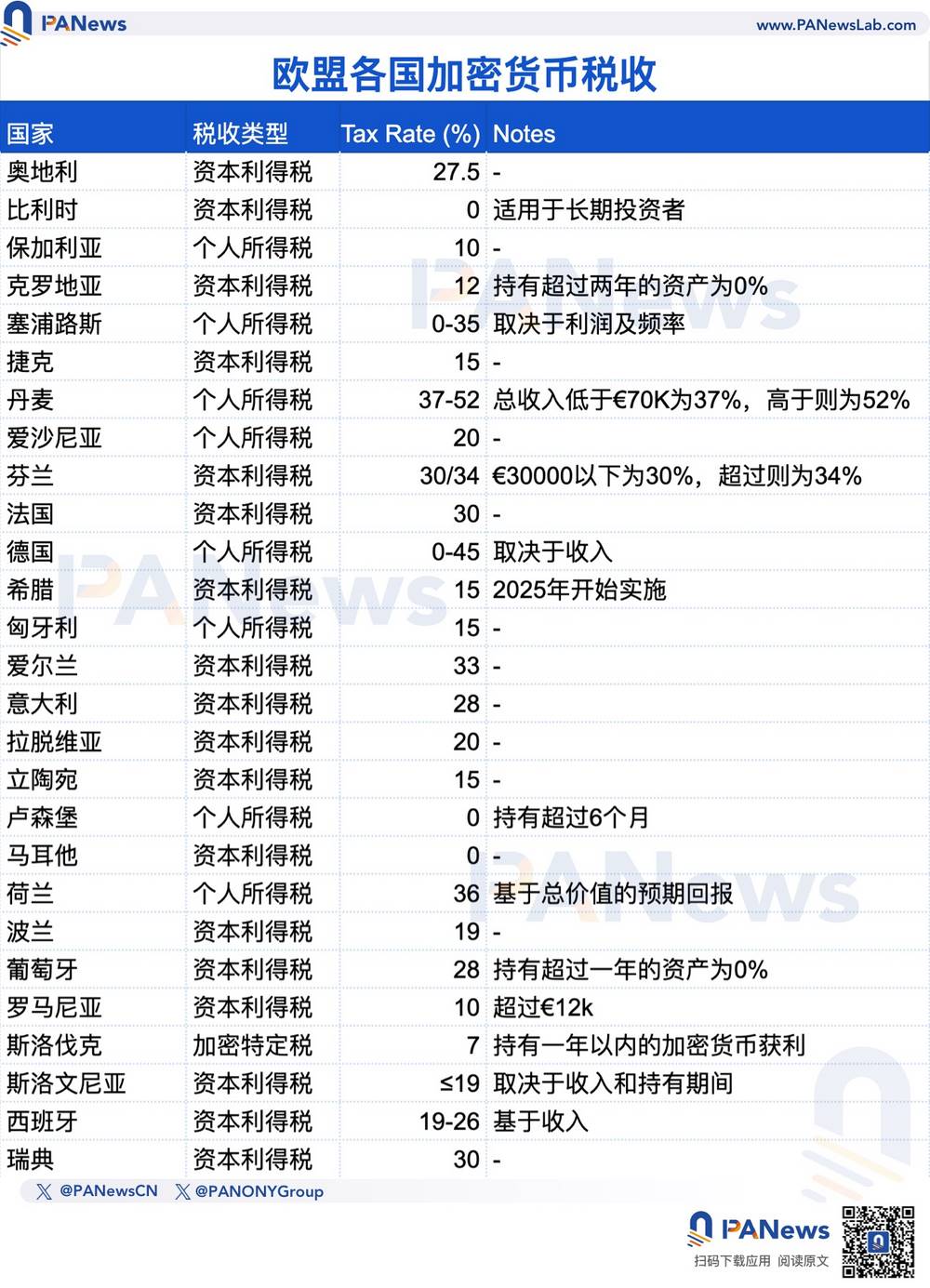
Hong Kong and Singapore Do Not Levy Taxes on Individual Capital Gains
In Asia, Japan classifies crypto trading profits as “miscellaneous income” and subjects them to progressive income tax rates ranging from 5% to 45%. For instance, individuals earning over JPY 40 million annually (approximately USD 276,000) face a top rate of 45%. Notably, Japan does not allow taxpayers to offset crypto losses against other income or asset gains. Only losses from real estate, business, or forestry activities can be deducted—crypto losses do not qualify.
In South Korea, a 20% tax on crypto profits exceeding KRW 2.5 million (about USD 1,800) was initially planned for implementation after 2023, then delayed to 2025, and now further postponed to 2028. The delay stems from concerns over market volatility and insufficient tax infrastructure, with officials wary of negatively impacting investor sentiment if implemented prematurely.
Hong Kong and Singapore currently do not impose capital gains tax on individuals. Hong Kong lacks specific legislation targeting digital assets, but the Inland Revenue Department updated its Departmental Interpretation and Practice Notes (DIPN) No. 39 in March 2020 to include guidance on taxing digital assets.
However, this guidance does not yet cover staking, DeFi, or Web3-related areas such as NFTs and tokenized real-world assets. Hong Kong follows a territorial tax system, levying a 16.5% profits tax only on income sourced from trades, professions, or businesses conducted in Hong Kong. Capital gains are generally exempt. Whether crypto trading profits are considered revenue or capital in nature depends on the specific facts and circumstances of each case.
Singapore’s Inland Revenue Authority (IRAS) does not levy capital gains tax on individual crypto transactions. Long-term investment gains are tax-free. However, individuals who trade frequently or operate crypto-related businesses may have their earnings classified as trading income, which is subject to progressive income tax up to a maximum rate of 22%.
Tax policies significantly influence crypto investment strategies globally. Low-tax jurisdictions attract multinational enterprises and investors, while high-tax regimes in countries like the U.S., Japan, France, and Spain may deter some investors. According to a Coincub report, the U.S. alone collected approximately USD 1.87 billion in crypto-related taxes last year.
The situation across Europe is mixed—some countries offer favorable conditions for long-term holders, while others maintain high tax rates, potentially influencing investor behavior. Overall, European crypto tax rates tend to be above the global average, reflecting broader fiscal structures within the EU.
Join TechFlow official community to stay tuned
Telegram:https://t.me/TechFlowDaily
X (Twitter):https://x.com/TechFlowPost
X (Twitter) EN:https://x.com/BlockFlow_News
 PANews






