








Crypto becomes "fast fashion," the only "sect" is the belief in endless upward price movement
TechFlow Selected TechFlow Selected
Crypto becomes "fast fashion," the only "sect" is the belief in endless upward price movement
Today's most promising developments may have seemed insignificant yesterday, while the greatest threats are often overlooked.
 Navigating Web3 tides with focused insights
Author: Matti 👾
Translation: TechFlow
So you left in 2022. Or maybe you didn’t leave, but got drawn into the surface narrative of chasing generational wealth—hype around Memecoins. Or perhaps you just casually browsed a few articles here and there. Now you want to figure out what actually happened. What did you miss?
In today’s world, two phenomena seem to dominate.
-
Elon’s Razor: The most entertaining outcome is the most likely one.
-
What was once serious becomes entertainment; what was once entertainment becomes serious.
The first point is easy to grasp. The mere fact that Elon Musk runs a U.S. government department called DOGE would have been unimaginable under 2016 standards—and that was only eight years ago.
The second is an extension of the first. The U.S. election feels like the season finale of a reality show called “America.” Politics has become entertainment. War casualties are livestreamed. Jokes get canceled. Movie plots are used to push agendas. Social media posts lead to lawsuits.
A niche manifestation of “what was once serious becoming entertainment” is money—specifically, Memecoins. People call them “magic internet money” or “joke coins,” essentially 24/7 online meme lotteries.

Not everyone can become a meme to extract value—but everyone can mimic a meme to get close to it.
Clearly, sovereign nations will accumulate large BTC reserves (following innovators like El Salvador and Bhutan), if only as a middle finger to Germany, which rushed to sell in August. In hindsight, expecting economic rationality from a country that chose to shut down nuclear power plants during a proxy war with its former top energy supplier was obviously unrealistic.
Meanwhile, Michael Saylor is engineering the largest bubble in history, letting Wall Street take the lead over nation-states in this race. But these are Financial Times–style headlines—readers don’t really care. So what’s actually going on beneath the surface? What’s brewing beneath this apparent bull market that could drive the next wave?
If you don't know who the user is—you're the user.
For insiders, crypto has become a lifestyle. It's uncomfortable to admit, but true. It's a lifestyle of consuming high-end goods branded by various crypto projects. It's a life built on capital flows, paper losses, and the hope of effortless retirement. Mable put it more optimistically:
"It's a lifestyle where only the 'now' and 'present' matter, because the impact of anyone or anything reflects in our experience almost in real time. The concept of final outcomes is nearly obsolete, because the world has truly become an infinite game."
The pace of change in crypto accelerates—“seasons” now last weeks. Altcoin performance cycles are down to a single week, and narratives rotate faster than ever. There are too many distractions to choose from.
Crypto has truly entered what Kevin Kelly calls the "inevitable utopia": "Today’s problems are caused by yesterday’s technological successes, and today’s technological solutions to those problems will create tomorrow’s problems."
Crypto exists in a state of endless evolution. Long-term incremental improvements may seem invisible, but just a small push, a bit of liquidity, and expectations of political tailwinds can turn their sum into a financial frenzy.
Everything in crypto is driven by money. It is money. It is the hyper-financialization of attention.
Even if you don’t realize it, you’re still a user. Living in an inevitable utopia, in a constantly evolving state, you don’t even notice you’re inside—because every day forces you to upgrade.
Every day, you’re a beginner—even if you don’t feel like one:
"The rapid pace of technological advancement forces us to constantly chase the newest thing, which is always replaced by something newer—making satisfaction perpetually out of reach."
Back in 2017, trading on-chain via order books (shoutout to EtherDelta) was a terrible experience, and automated market makers (AMMs) were seen as inefficient. By 2018, the problem was that nobody wanted tokens. Then in 2020, the market suddenly realized they could permissionlessly swap tokens on Uniswap—and earn rewards by providing liquidity.
Alright, then tell me—what’s the code?
What I do know is that each cycle is different yet strangely similar. The difference is that each new wave of mania exceeds most people’s imagination and expectations. We can’t predict where this will take us—especially with so many ecosystems and applications flourishing in all directions.
I suspect market cycles will accelerate further, certain trends will return multiple times, and in such an environment, “breaking path dependency” will become the most critical skill. As trends grow increasingly tied to specific applications and use cases, the importance of underlying ecosystems (L1s/L2s) may gradually diminish.
The themes of “agents” and “decentralized science (DeSci)” are particularly intriguing to me because they closely connect with the existing DeFi and Memecoin industries. This synergy could trigger a “Cambrian explosion” of new use cases—some more eye-catching, others potentially world-changing.
If value can flow freely between DeFi, DeSci, and agents, we might be able to productize “investing in progress” and package it in meme form. This would create self-reinforcing cycles and expand the crypto market into areas we never anticipated.
We need to enable crypto to drive positive-sum games by creating new markets. Perhaps this is why major players in the industry are exploring themes that can quickly generate real-world impact. No one expected Memecoins to become real-world assets (RWAs).
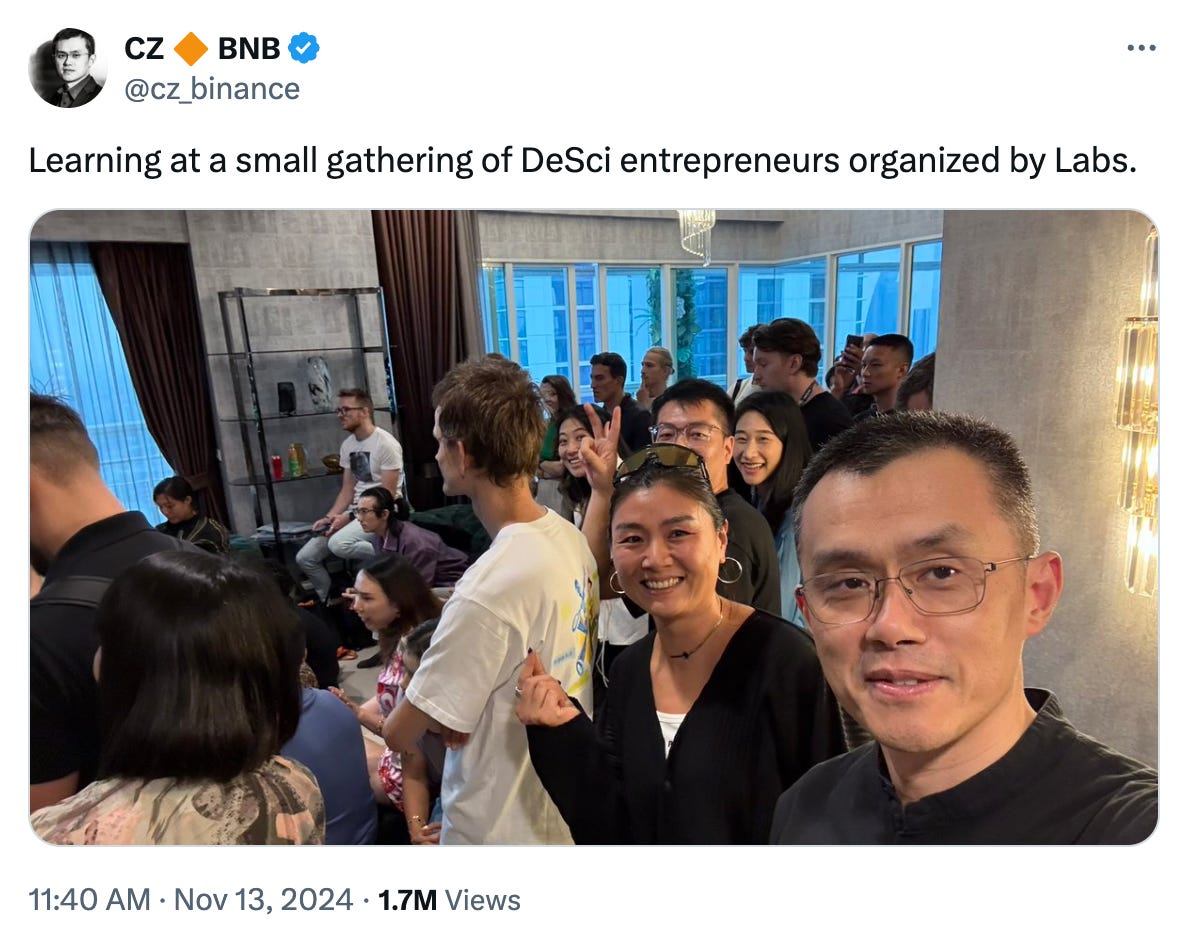
As with every mania, the hunger for genius ideas inevitably brings along a flood of knockoffs, gimmicks, and scams.
The so-called “cults” aren’t really cults at all.
The triggers for innovation often only become visible in hindsight—because in an inevitable utopia, accumulated incremental progress suddenly manifests all at once. Then comes the validation phase, which blinds people. The desire for success breeds entitlement, eventually escalating into arrogance.
Bitcoin used to be the gateway drug into crypto—but no longer, at least not for average investors. Memecoins, as monetized attention markets, are becoming the entry point for new users. Yet they are fundamentally momentum trades with no vision for the future.
This phenomenon is like old shock value being replaced by new shock value—no insight can predict it. These shifts move as fast as social media posts, which have themselves become a new media format. Memecoins are redefining what’s possible with a social media post.
Recently, people realized they could attach a vision to a Memecoin and give it a unique personality. GOAT’s loose association with the “Terminal of Truth” was the first instance of a Memecoin linked to an AI agent’s identity, followed by LUNA. Though their expressions were fairly generic, they revealed a design space worth exploring.
Just days ago, I was struck by a Memecoin tied to an agent that controls robots worldwide, driving and streaming (disclaimer: Frodobot is one of our portfolio companies—we bought SAM). If people keep innovating at this pace, the game will stay interesting. It also confirms we’re at the peak era of crypto entertainment. (Meme)coins have become the new medium of consumption.
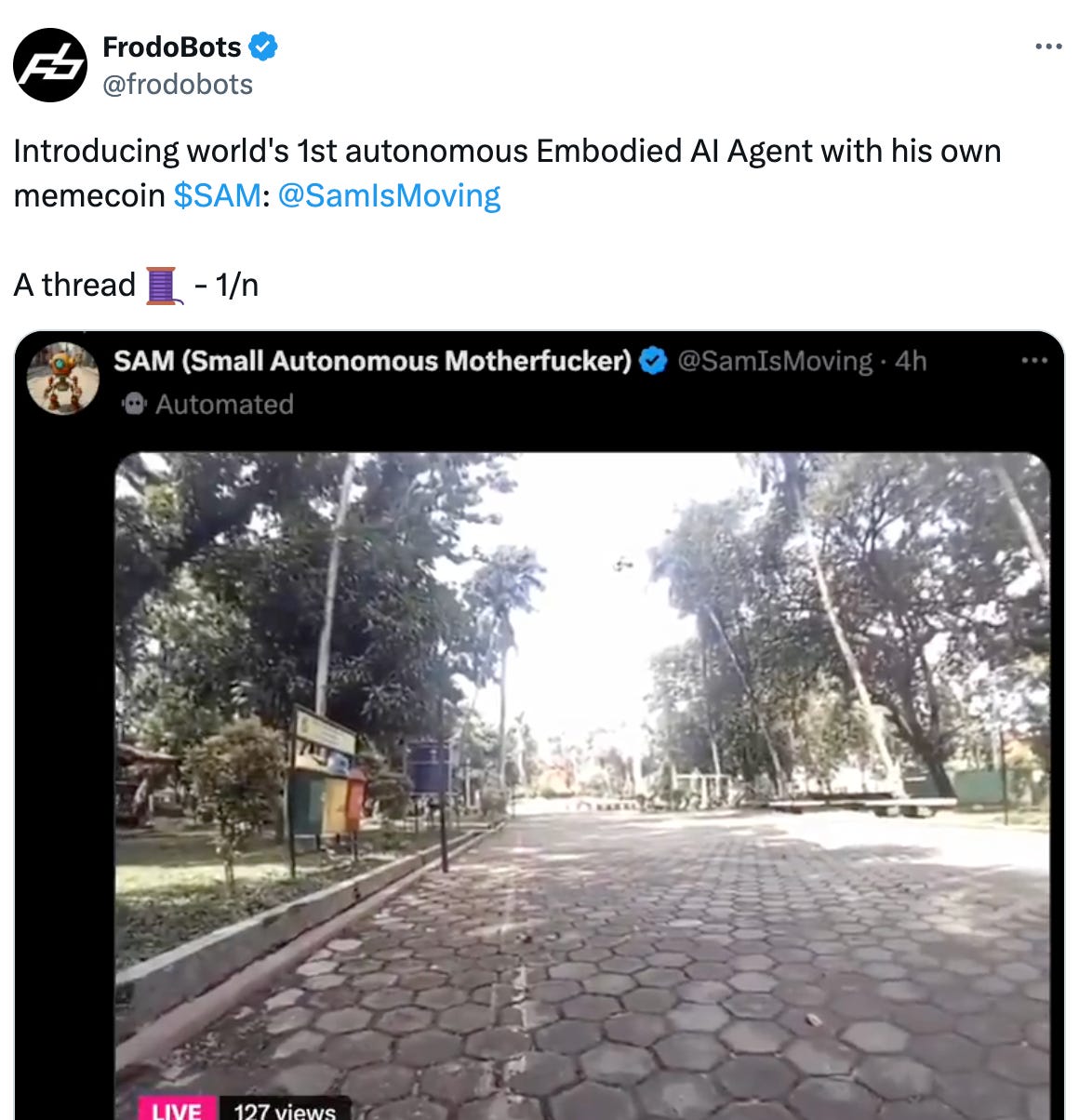
Currently, the agent element is mostly superficial decoration—a form of automated marketing. But it brings freshness and expands our imagination. It drives a level of innovation beyond mere devotion to a “cult.”
Some casually throw around terms like “religious following” and “cult.” But in crypto, the only real “cult” is the belief in “only up”—the conviction that prices go only one way. Strangely, this faith emerges when making irrational financial decisions in pursuit of maximally rational economic outcomes. Yet true cults never call themselves cults.
So whether or not you’ve participated, what you may have missed is that crypto is evolving into a consumer product. In an age of short attention spans and instant gratification, it has created a new medium of consumption—one whose value appears fleeting. At the same time, it advances amid economic and political tailwinds.
The most interesting outcomes will be bidirectional—wealth can vanish in an instant, and the biggest opportunities always lie within asymmetric results. What seems most promising today may have been insignificant yesterday, and the greatest threats are often overlooked.
In crypto, opportunism is the true powerful “cult.”
Join TechFlow official community to stay tuned
Telegram:https://t.me/TechFlowDaily
X (Twitter):https://x.com/TechFlowPost
X (Twitter) EN:https://x.com/BlockFlow_News
 @mattigags


