Shorting MicroStrategy, will Citron Capital lose again?
TechFlow Selected TechFlow Selected
Shorting MicroStrategy, will Citron Capital lose again?
As BTC surges, MicroStrategy becomes the strongest U.S. stock.
 Navigating Web3 tides with focused insights
Author: shaofaye123, Foresight News
On November 21, Citron Research announced via Twitter its short position on MicroStrategy stock. One side features a legendary Wall Street short-seller; the other, the strongest-performing U.S. stock of 2024. Is Citron about to lose again? This article explores the history behind these two iconic firms.
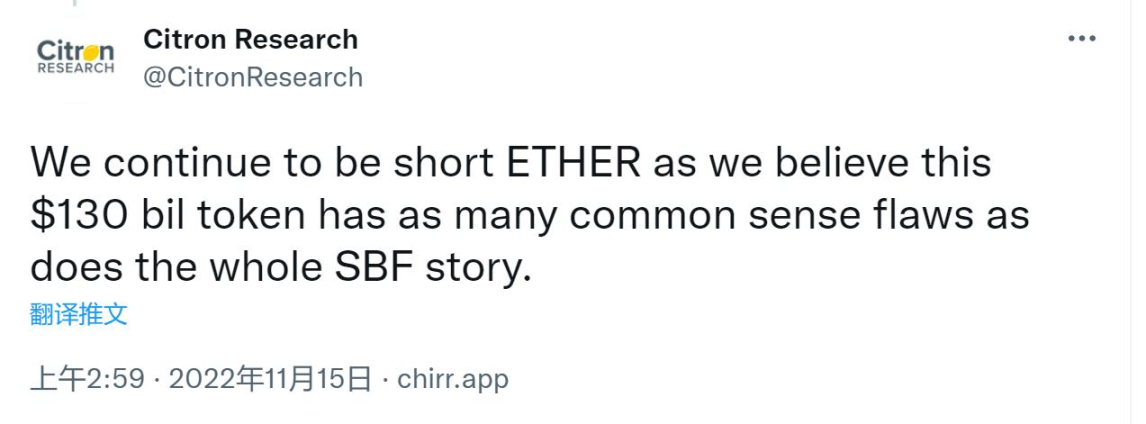
Citron Research has long been a notable presence in capital markets, appearing across multiple market cycles. In 2012 it shorted Qihoo 360, damaging its reputation. In 2021 it was forced to cover its short on GameStop (GME). Even in 2022, it attempted to short Ethereum when the latter's market cap was $13 billion.
Since Citron announced its short position yesterday, MicroStrategy’s share price dropped sharply, at one point falling 30% from its intraday high.
The Short-Selling History of Citron Research
Citron Research, one of the most influential short-selling firms in the U.S., was founded in 2001. Over six years, it targeted 20 Chinese概念股 companies, causing 15 of them to drop more than 80% in value and seven to be delisted. At the time, Citron was riding high and turned its attention to Evergrande. In its report, it stated, "Evergrande's collapse is already inevitable; the only uncertainty is timing." Eventually, Evergrande did default, confirming Citron's prediction.
Citron's reputation soared. In 2021, GameStop came into the crosshairs of major institutions. GameStop, once the world's largest video game retail chain, had seen its business model abandoned and its market share eroded. It seemed the shorts would triumph once again. But then “Roaring Kitty” emerged out of nowhere, triggering a dramatic short squeeze that stunned Wall Street. “Roaring Kitty” was later revealed to be Keith Gill, though this wasn’t known at the time. Fueled by Roaring Kitty and the Reddit forum WallStreetBets (WSB), retail investors drove the stock from $19.95 to $39.91. Citron, seeing what it believed to be grossly overvalued prices, couldn't stay silent. On January 19, it issued a bearish report on GME and insulted retail buyers as "idiots." Retail investors retaliated fiercely. With Elon Musk tweeting “Gamestonk!”, the stock surged to $483. In this battle, Citron lost 100% on its position and exited at $90, while Melvin Capital suffered losses of up to $680 million.
After this incident, Citron announced it would cease its 20-year history of short-selling research and stop publishing short reports, shifting focus toward offering long opportunities for individual investors—seemingly marking the end of the short-seller era. As major funds retreated, the narrative of retail investors defeating Wall Street appeared triumphant. However, Robinhood’s decision to restrict trading caused the stock to plummet rapidly. Ultimately, even in the GME saga, victory belonged only to a select few.
Nonetheless, Citron didn’t truly abandon shorting. In 2022, it launched a short against Ethereum, then valued at $130 billion. Today, Ethereum’s market cap has tripled since then.
MicroStrategy: The Strongest U.S. Stock of 2024
MicroStrategy is an even more legendary company than Citron—a masterclass in a transparent, open-game strategy.
Founded in 1989 by Michael Saylor, Sanju Bansal, and Thomas Spahr, MicroStrategy initially operated as a consultancy focused on multidimensional modeling and simulation. In his early years, Saylor was skeptical of Bitcoin and even mocked cryptocurrencies back in 2013. But starting in 2020, MicroStrategy began exploring alternative assets beyond cash, using its corporate treasury to purchase over 21,000 Bitcoins, gradually becoming the world’s largest publicly traded holder of Bitcoin. The company systematically invested heavily in Bitcoin, even taking on debt to increase its BTC holdings. In just two years, it has generated over $15 billion in paper profits—surpassing even Nvidia in daily trading volume at peak times.
So what exactly is MicroStrategy’s strategy? How does it generate such massive returns?
In simple terms, today’s MicroStrategy functions almost exclusively as a Bitcoin-buying vehicle. By purchasing Bitcoin, it helps drive up Bitcoin’s price, which in turn lifts its own stock price. It then borrows more to buy additional Bitcoin, pushing prices higher again, further boosting its stock, enabling more financing to buy even more Bitcoin—creating a self-reinforcing flywheel effect where share price, net asset value, and earnings all continue rising...
This flywheel model inevitably evokes memories of Luna, whose collapse remains a cautionary tale. Additionally, MicroStrategy currently trades at a 300% premium to Bitcoin’s spot price—MSTR investors are effectively paying $250,000 per Bitcoin when the market price is still under $100,000. Its shares carry a significant premium.
Shorting MSTR: Win or Lose?
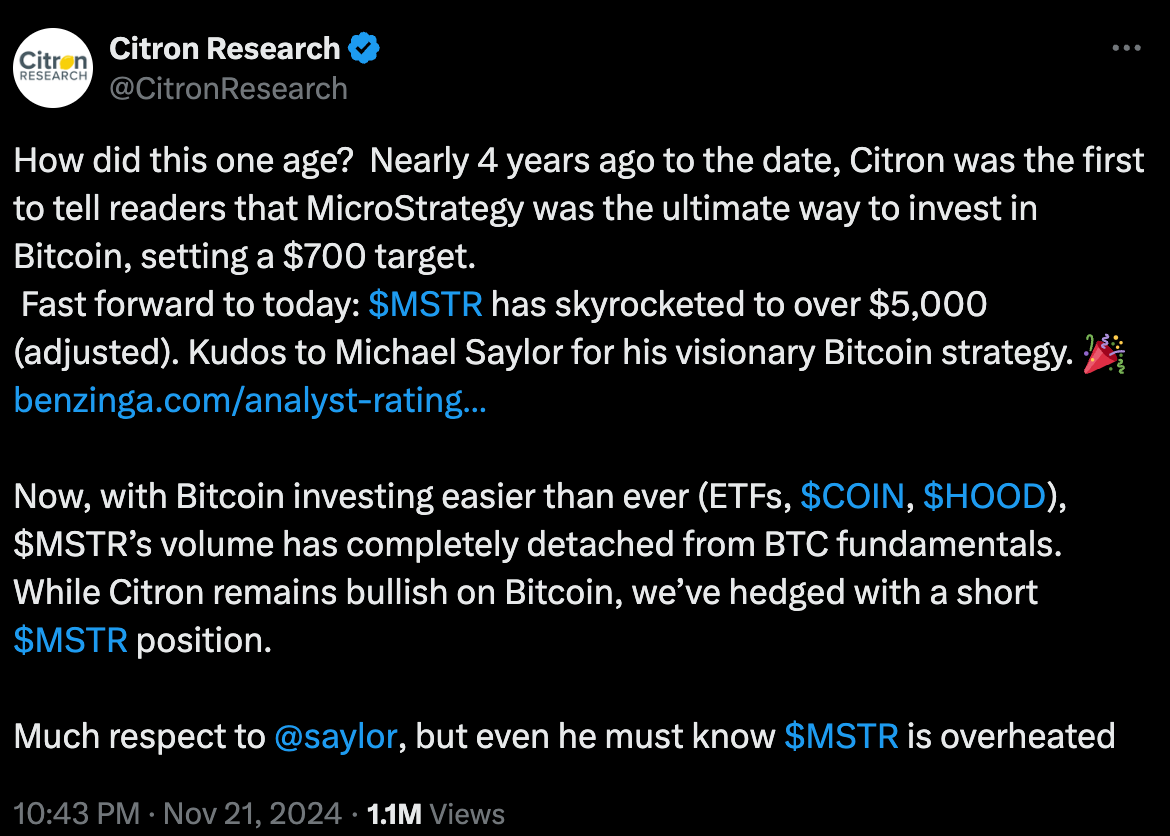
Against this backdrop, Citron has re-entered the fray. On November 21, it tweeted:
"Nearly four years ago, Citron was the first to tell readers that MicroStrategy (MSTR) was the ultimate way to invest in Bitcoin, setting a $700 target.
Fast forward to today: MSTR has surged above $5,000 (adjusted). Credit to Michael Saylor for his visionary Bitcoin strategy.
But now that investing in Bitcoin has become easier than ever, MSTR’s valuation has completely detached from Bitcoin fundamentals. While Citron remains bullish on Bitcoin, we have hedged our position by initiating a short on MSTR.
We deeply respect Saylor, but even he must know MSTR is overheated."
In fact, Citron isn’t the first to suggest shorting MSTR as a hedge against a Bitcoin long. In March this year, another prominent firm, Kerrisdale Capital Management, made a similar recommendation—going long on Bitcoin while shorting MSTR shares.
With the bears striking again, MicroStrategy’s stock reacted immediately. Will this be another Hunt Brothers-style episode, or will the rally continue? Is the market prescient, or will Citron miss the mark once more?
Data shows that MSTZ (the 2x inverse ETF on MSTR) saw a surge in trading volume on November 21, reaching nearly $1.53 billion in single-day turnover—up dramatically from its average daily volume of $84 million. Fundamentally, MicroStrategy currently trades at a 300% premium to Bitcoin. With the approval of spot Bitcoin ETFs making direct BTC investment more accessible, MSTR may be losing its "uniqueness premium" over the long term.
Still, many supporters (source: @0x_Todd) remain bullish on MSTR, arguing:
-
MicroStrategy is not Luna—it has a much thicker safety margin. According to recent data, MicroStrategy’s average Bitcoin acquisition cost is $49,874. At current prices, it enjoys nearly 100% unrealized gains—providing a very strong cushion.
-
MicroStrategy acquires Bitcoin through bond issuance and secondary stock offerings. It uses off-exchange leverage with no liquidation mechanism. Angry creditors can, at most, convert their bonds into MSTR shares at maturity and dump them on the market.
-
The next major debt maturity isn’t until 2027—over two years away. Even if MSTR stock crashed to zero, it wouldn’t be forced to sell any Bitcoin, as its earliest debt repayment obligation isn’t due until February 2027.
-
The only real vulnerability lies with Bitcoin whales—and even they likely prefer a win-win outcome.
So is MicroStrategy’s aggressive Bitcoin accumulation a virtuous cycle destined to propel its market cap toward $1 trillion, or merely a final dance before the music stops? Only time will tell.
Join TechFlow official community to stay tuned
Telegram:https://t.me/TechFlowDaily
X (Twitter):https://x.com/TechFlowPost
X (Twitter) EN:https://x.com/BlockFlow_News
 Foresight News