EU Launches Stablecoin War: 21 Issuers Compete as Circle Takes Early Lead and Tether Backs an "Agent"
TechFlow Selected TechFlow Selected
EU Launches Stablecoin War: 21 Issuers Compete as Circle Takes Early Lead and Tether Backs an "Agent"
MiCA is scheduled to be fully implemented by December 30 of this year.
 Navigating Web3 tides with focused insights
Author: Weilin, PANews
The European Union's Markets in Crypto-Assets Regulation (MiCA) rules for stablecoin issuers took effect on June 30 and are set to be fully implemented by December 30 this year. As the EU’s first comprehensive regulatory framework for the crypto industry, MiCA’s rollout not only impacts the euro-denominated stablecoin market but also serves as a reference point for global stablecoin regulation.
However, Tether, the issuer of USDT, now faces urgent challenges under this new regime. Without yet obtaining a stablecoin issuance license under MiCA, Tether is actively investing in emerging projects as part of its strategic response. On November 18, Tether announced an investment in Dutch company Quantoz, which plans to launch two MiCA-compliant stablecoins.
Circle Leads Compliance Efforts as 21 Issuers Vie for Market Share
On November 18, Dutch blockchain firm Quantoz announced the launch of two stablecoins—USDQ and EURQ—that comply with the EU's MiCA regulations, pegged to the U.S. dollar and euro respectively. These stablecoins will go live on exchanges Bitfinex and Kraken on November 21. Tether, Kraken, and Fabric Ventures have invested an undisclosed amount in Quantoz.
Quantoz’s compliance strategy signals Tether’s attempt to expand its presence in the euro stablecoin market by backing MiCA-compliant initiatives. This move could represent a key step for Tether in establishing a proxy or "agent" within the euro stablecoin space.
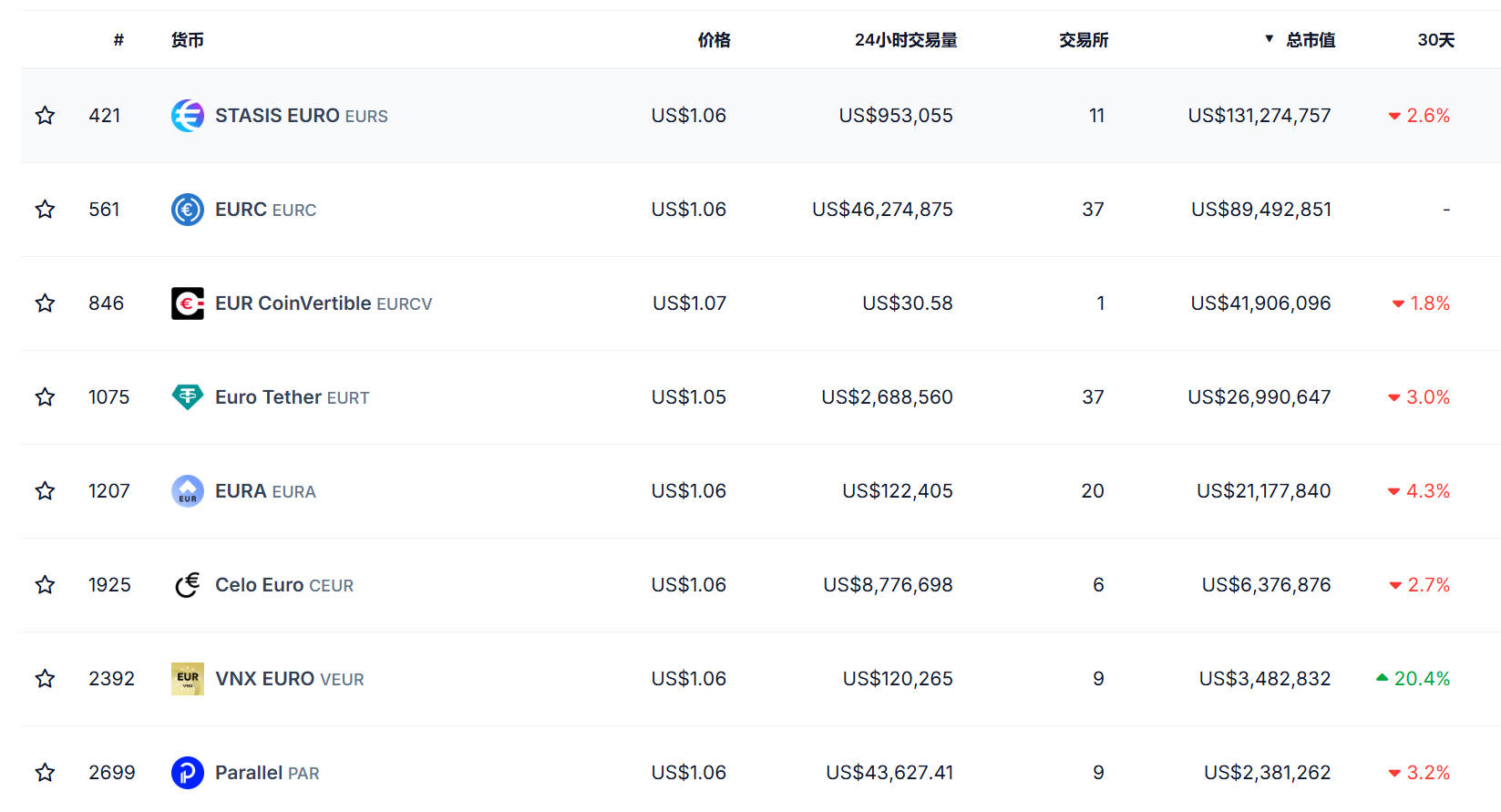
As of November 20, according to data from Coingecko, the top five players in the euro stablecoin market by market capitalization are:
-
Stasis (EURS): $131 million market cap
-
Circle (EURC): $89.49 million market cap
-
SG-Forge (EURCV), a subsidiary of French bank Société Générale: $41.91 million market cap
-
Tether (EURT): $26.99 million market cap
-
Angle (EURA): $21.18 million market cap
According to Coingecko, the total market cap of euro stablecoins stood at $326 million as of November 20. Circle’s EURC and SG-Forge’s EURCV together account for 40% of the market. This concentration presents challenges for new entrants but offers an opening for compliant players like Quantoz.
MiCA imposes strict requirements on stablecoin issuers, including several key provisions: First, licensing—issuers must obtain an Electronic Money Institution (EMI) license or register as a credit institution in at least one EU member state. Second, reserve asset requirements—issuers must hold at least 60% of their reserves in European banks. Third, transaction volume limits—if a stablecoin exceeds 1 million transactions per day or €200 million in daily transaction value, the issuer will be prohibited from issuing additional tokens.
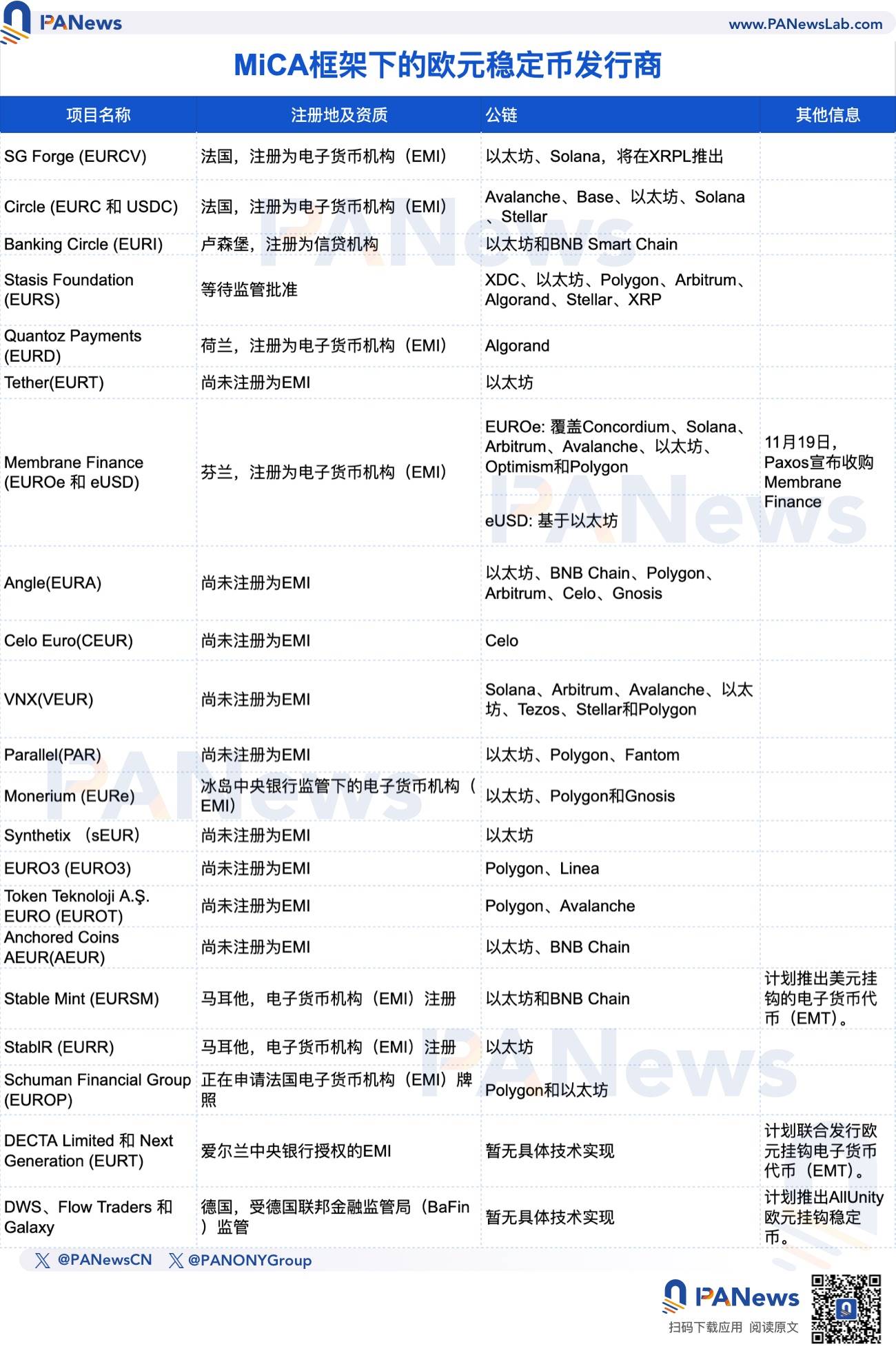
Major issuers such as Circle and SG-Forge have already met these requirements by securing EMI licenses in France. For example, SG-Forge’s EURCV operates on Ethereum and recently announced plans to launch on Ripple’s XRP Ledger (XRPL) to broaden its market reach.
With Tether’s investment in Quantoz, Tether may gain indirect access to strengthen its position in the euro stablecoin market. Meanwhile, finding new companies holding EMI licenses has emerged as a growing trend.
On November 19, blockchain and tokenization infrastructure platform Paxos announced it has agreed to acquire Membrane Finance (Membrane), a licensed Electronic Money Institution (EMI) based in Finland. The acquisition is subject to regulatory approval. Once completed, Paxos will become a fully licensed EMI in Finland and across the EU.
Tether CEO Voices Concerns Over MiCA; More Firms Seek Competitive “Agents”
For Tether, MiCA’s new requirements pose pressing challenges. According to previous public reports, Coinbase Global Inc. will delist all unauthorized stablecoins from its European crypto exchange by year-end—a move that could significantly impact Tether’s USDT and other tokens.
Currently, major cryptocurrency exchanges including Uphold, Bitstamp, Binance, Kraken, and OKX are taking steps to comply with the EU’s new crypto regulations. OKX has already delisted all trading pairs involving USDT in Europe. While Binance and Kraken have not yet delisted USDT, they are considering limiting its functionality.
Tether CEO Paolo Ardoino previously stated that the upcoming European regulatory framework would create banking-related risks for stablecoin issuers, potentially threatening broader crypto market stability. Under MiCA, stablecoin issuers must hold at least 60% of their reserves in European banks. Ardoino warned that since banks can lend out up to 90% of deposited reserves, this could expose stablecoin issuers to "systemic risk."
Major stablecoin issuers have faced banking issues in the past. For instance, in March 2023, Circle’s USD Coin (USDC) temporarily lost its dollar peg when it failed to withdraw $3.3 billion in reserves from Silicon Valley Bank, which had managed $40 billion in reserves for the issuer before collapsing.
In Ardoino’s view, MiCA’s bank reserve requirement means an increasing portion of stablecoin reserves will sit on bank balance sheets. If a bank fails, the consequences could be severe. He explained: “You deposit €1 million into a European bank account. The deposit insurance covers only up to €100,000. If the bank goes bankrupt, you get back €100,000, and the rest enters insolvency proceedings because your funds become part of the bank’s balance sheet.”
Nonetheless, Ardoino added that under MiCA, stablecoin issuers can protect themselves from potential bankruptcy risks through securities: “The safeguard is to purchase securities like treasury bills or government bonds. If the bank fails and you hold securities, those nominal assets will be returned to you—you just need to transfer them to another bank.”
Crypto Industry Calls for Extension of MiCA Transition Period
Recently, industry stakeholders sent a letter to the European Securities and Markets Authority (ESMA), pointing out that ESMA has delayed finalizing rule details, making it difficult for firms to complete certification within tight timelines and risking service suspensions.
Under current implementation plans, MiCA allows an 18-month transition period, but individual member states have adopted varying timeframes. For example, France and Greece offer 18 months, while Lithuania provides only five—potentially disrupting cross-border services, affecting users’ trading capabilities, and causing financial losses.
Additionally, crypto industry groups warn that uneven implementation threatens MiCA’s “passporting mechanism.” A core benefit of MiCA is passporting, which allows firms authorized in one member state to operate across the entire EU. However, inconsistent enforcement could undermine this advantage.
Industry representatives are urging ESMA to extend the authorization transition deadline to June 30, 2025, or require member states to harmonize their schedules, easing compliance burdens and preventing service disruptions.
Earlier estimates suggest MiCA’s implementation will drive significant growth in euro-backed stablecoins. By 2025, euro stablecoin market capitalization is projected to reach at least €15 billion, rising to €70 billion by 2026, and possibly exceeding €2 trillion by 2028.
Overall, as MiCA moves toward full implementation, traditional financial institutions like Société Générale, blockchain firms such as Circle and Stasis, and emerging issuers like Quantoz are actively positioning themselves to capture market share. Going forward, compliance and technological innovation will be decisive factors in determining market success. For stablecoin issuers, MiCA represents a pivotal moment filled with both risks and opportunities.
Join TechFlow official community to stay tuned
Telegram:https://t.me/TechFlowDaily
X (Twitter):https://x.com/TechFlowPost
X (Twitter) EN:https://x.com/BlockFlow_News
 PANews